Let's begin by just settling ourselves down.
I invite you to get yourself into a comfortable position,
Either cross-legged or on a chair.
Whatever position you adapt,
It's good to try to have a straight back if you can,
Because keeping our back straight does help our mind to be more clear and alert and concentrated.
It's also important to be as relaxed as possible.
So what that means is while keeping your back straight,
Let the other parts of your body be relaxed.
Try not to have tightness or tension anywhere in your body.
If there is any tension,
See if you can let it melt,
Flow out of you,
And sink into the earth so that your body is as light,
Relaxed,
Free of tension as possible.
We also need to have a relaxed mind.
So that means trying to keep our mind free of other thoughts.
You might have thoughts about things you're going to do later today or in the coming week,
Or you might be thinking about things that happened earlier today or yesterday or any time last week.
So our mind is often busy thinking about the past and the future.
We do sometimes need to think about these things,
But when we practice meditation,
It's best if we can put those thoughts aside and just let ourselves be in the present right here right now,
Although that's easier said than done.
And we can't expect that we can just push all those thoughts away and they're not going to come back.
They will keep coming back,
But we can just have a very firm determination that we're not going to let ourselves follow those thoughts and instead notice,
Oh,
This is a thought,
And right now I'm not going to let myself think that thought.
That I'm just going to stay focused on the present and what I'm doing right now.
Just make that determination that you're not going to let yourself follow other thoughts and instead just focus your attention on the present and what we're doing in this session.
And one thing that can help us to do that is by paying attention to our breath because our breath is happening in the present right here right now.
So if you find your mind is wandering away to another time or another place,
It can be helpful to just come back to your breathing,
Be aware of your breath flowing in and flowing out and in that way you're in the present.
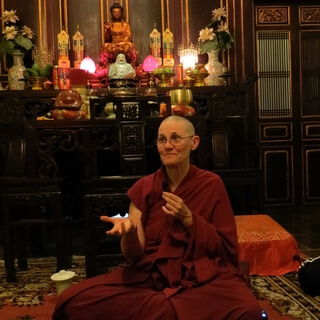
So you might find it helpful to continue imagining the Buddha either in the space in front of you or in the space above your head,
Whichever is more comfortable.
And if you like it,
If you find it helpful,
You could also imagine many Buddhas and Bodhisattvas around giving us inspiration for our meditation.
Feel their compassion,
Their kindness,
Their wish for us to be happy,
To be free of suffering,
Their wish to help us clear up our minds so that we can see things more correctly,
More realistically and in a more positive way that will bring genuine peace and happiness to ourselves,
To others and to the world.
So see if you can generate in your mind,
In your heart,
The sincere wish that this meditation that we're going to do will bring benefit to ourselves and to others and to the world.
So in his teachings,
The Buddha often spoke about the importance of contemplating impermanence,
Even saying that this is the most powerful meditation that there is.
Now some people,
For example,
Us Westerners might find it a little uncomfortable meditating on impermanence.
Sometimes people even have the idea that meditation should just make you feel good.
When you do meditation,
You should end up feeling comfortable and peaceful and happy and joyful.
And the idea of meditating on impermanence can sound like,
What?
That's not going to make me feel good.
Well,
According to Buddhism,
The purpose of meditation isn't just to feel some immediate sense of happiness and peace.
Instead,
It's to get us to look at things in a realistic way as they are rather than as we would like them to be.
We often try to run away from the reality of things,
But we've probably all experienced that that doesn't do any good.
You can't really run away,
For one thing,
And in our attempts to run away,
We sometimes just create more problems for ourselves.
So the Buddha said we need to confront reality the way things are.
And even though initially that might make us feel somewhat uncomfortable,
But that's only because we're not used to thinking about the truth of things.
And eventually,
We do get comfortable with facing the reality,
The truth of things,
And then it brings real peace and happiness.
So the meaning of impermanence is change.
Things are changing,
And this is just the reality of things,
The truth of things.
Our own bodies and our minds are very life,
And everything around us,
Other people,
Other beings like animals,
Our dear beloved pets,
All the things in nature,
And all the things we create as human beings.
So all of these things are by nature impermanent.
That's just the way they are.
We can't stop it.
We can't stop things from changing.
They are changing.
They do change.
It's much better that we come to accept this rather than deny it,
Ignore it,
Pretend it's not there,
Resist it.
So there's this one teaching about five different ways that we can understand impermanence.
So we'll spend a few minutes contemplating each one of these,
Try to bring to mind examples of these that you have experienced in your life,
Directly experienced,
Or you may have heard of,
Just to illustrate this truth of impermanence.
So the first of the five is the impermanence of destruction,
Which refers to the annihilation of something that once existed.
So it could be a person,
A human being,
Or another kind of being who once existed,
Who was once there,
But then they died,
They disappeared from this world.
Could also refer to material things,
For example,
Buildings.
The book gives the example of the Twin Towers in New York,
Which once stood very,
Very tall,
But within a matter of hours were reduced to just a pile of rubble.
So these are some examples,
And just see if you can think of other examples of how something,
A living being or an inanimate thing,
Once existed,
But then went out of existence.
The second of the five is the impermanence of cultural trends and attitudes.
So this has to do with changes that can happen in society,
For example,
Fashion,
What kind of clothing,
Shoes,
And so on are fashionable to wear.
So at one point in time,
It's fashionable to wear very tight clothes,
Another time very baggy clothes,
Different colors come into fashion and go out of fashion,
And so on.
So that's one example of this.
Then another could be attitudes and what's acceptable and not acceptable.
So this is something that changes as well.
At one point in time,
A certain attitude or a certain type of behavior would be considered totally unacceptable and inappropriate.
People just couldn't be that way,
Otherwise they'd be heavily criticized and shunned.
But later,
That kind of attitude and behavior becomes acceptable.
People can act that way very freely.
So again,
Think of some examples of this in your own life,
In your own experience,
Or in society,
In the place where you live.
And the third one is the impermanence of separation.
You might find this one rather difficult to think about because it usually goes against what we would like to happen.
It refers to relationships.
So people come together,
For example,
In families.
People meet and decide to live together and start a family or not have a family but just remain as a couple.
And also people come together in communities.
For example,
Here at the Abbey,
We have a large number of people living together,
Working together as a community.
Also in business partnerships,
People come together to start a business,
To work together.
And when these situations,
These relationships or partnerships are going well,
We want them to last forever.
However,
That is never the case.
It's never possible to remain together.
Even if the situation is very loving and harmonious,
We cannot remain together with others forever.
There's always something that will come along or will interrupt.
We could get into quarrels,
Not get along anymore,
Or there's death.
One person will usually die before the other,
Or it could happen that several people die together like in a car accident.
Even if this relationship,
This togetherness lasts for a very long time in a very beautiful way,
It cannot last forever.
There will always come a time when there needs to be separation.
So again,
Think about this in terms of your own experiences in life and what you have observed in the world around you to just understand that this is the nature of things,
The reality of things.
Never remain together with another person or with other people forever.
And the fourth of these aspects of impermanence is sudden impermanence.
And this refers to the fact that circumstances can change quickly and unexpectedly.
So a perfect example of this is just what's been happening in the world in the last couple of months with the COVID-19 virus.
So just a few months ago,
You know,
Life was going on as usual,
And then suddenly this virus appeared and has transformed situations all around the world.
Most countries have had to have lockdown,
People staying at home,
Losing jobs,
Many people getting sick,
Going to the hospital,
Sometimes dying.
A few months ago,
Nobody would have expected this situation to happen,
And yet it did.
And sometimes sudden impermanence can happen even more suddenly than that,
Like even in one day,
We might wake up in the morning feeling fine,
Feeling healthy,
But then suddenly get sick or get into our car and go for a drive and get into an accident and find ourselves in the emergency room.
So things can happen very,
Very suddenly,
Unexpectedly without warning,
And our whole life,
Our whole body and mind and situation can totally transform.
So bring to mind some examples of this from your own life,
Your own experience,
Or from the experiences of others that you've heard of.
And then the final of the five points is the nature of impermanence.
And this refers just to the fact that whatever phenomena comes into existence because of causes and conditions,
By nature it changes every moment.
This is one of the four seals of Buddhism.
All conditioned things are impermanent.
Conditioned things are things that arise from causes and conditions,
Such as a plant,
A tree that arises due to a seed,
Nutrients in the soil,
Water,
Sun,
And so on.
So all those causes and conditions have to come together for the plant or the tree to grow.
And all along,
While it's just starting to grow and then during its entire existence,
It's continuously changing every moment because the tiny particles that make it up are not static and frozen,
But they're moving and changing.
So that's the case with all matter,
Physical things,
Including our bodies,
Our clothing,
Our homes,
All the things we own and use.
All of these things are conditioned things.
They arise from causes and conditions,
And just their very nature is to change continuously.
We can't stop this.
It's impossible to stop the changing nature of things.
So it's much better to accept it,
To realize,
Well,
That's just how things are,
And flow with it,
Accept the changes as they happen without trying to resist them or be unhappy or frightened by them.
Thank you.
So,
Many of the examples of impermanence that we've been contemplating are cases of changes that we probably wish didn't happen,
Like the loss of a loved one or destruction of a house during a hurricane.
So in those cases we feel sad,
Maybe frightened,
Uneasy.
But again,
It's just a question of getting used to the fact of impermanence.
And the more we contemplate it,
The more we come to accept impermanence,
The more at ease we will feel with it.
So a nice example of this is the Thai master Achaan Chah,
Who was once asked by a disciple,
How can I accept impermanence and still enjoy life?
Achaan Chah replied,
Pointing to a glass of water that he had beside him,
He said,
You see this glass?
I see this glass is already broken.
But I can still use it,
I can still enjoy it.
So accepting impermanence doesn't mean we can't enjoy life,
We can't enjoy things.
In fact,
We'll probably be able to enjoy them even more because we realize that they're not going to be there forever.
It will help us to really cherish the people in our lives,
Our relationships,
Our friendships,
And our life itself,
Knowing that it's not going to last forever.
We really want to make the best use of it while we have it.
And also there's a positive side of impermanence.
If we were not impermanent,
If our mind was not impermanent,
Then we wouldn't be able to change,
Transform our minds,
And achieve higher states like liberation and enlightenment.
We'd be stuck the way we are forever.
Crazy,
Miserable,
Messed up mind.
So the fact that our mind,
Our life,
Our existence is impermanent means we can change for the better.
So as we end this meditation,
Let's make a mental dedication of the positive energy that we created by doing this meditation.
Remember the motivation you had to start with,
Wanting to do what is beneficial for ourselves,
For others,
For the world,
Help bring all of us to enlightenment.
So dedicate the positive energy,
The merit from doing the meditation to that same goal.
Thank you.
You