Welcome to this guided meditation for emotional insight through an inquiry into the natural breath.
Today our practice will not be about breathing in any particular way.
Rather,
The practice is to get out of our own way so that we can observe the breath as it is.
This can be much subtler and sometimes more challenging than a specific breath practice,
But it can also be quite illuminating.
When we can step back and observe ourselves breathing honestly,
We can also observe how we are feeling honestly.
Our breath frequently reflects our emotional state,
And it's surprising how often we're actually holding our breath in order to hold back our emotions.
When we allow the body and the breath to work through the emotions we're feeling,
We can return to our baseline quite quickly.
The body actually knows how to regulate itself quite effectively most of the time.
That being said,
Please note that if you're going through a traumatic period,
You may prefer to practice this with a trained professional in the room with you.
It's completely safe to practice this meditation,
But it may bring up emotions,
Images,
Or thoughts.
We'll work together to help to return to a calm,
Relaxed baseline,
But if this ever feels like too much,
Simply take a deep breath and stop.
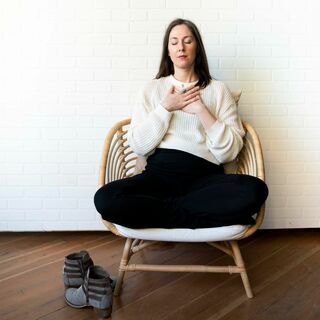
Let's start in a comfortable position.
Any seat is fine,
Including resting with your back against something or even lying down.
Take a moment to fidget and move as you need to so that your body can settle down.
You're welcome to take a few sighs just to get settled here before we begin the breath practice.
Close your eyes.
Consciously relax your shoulders,
Your face,
And your belly.
Don't worry about taking any particular shape in your body for your meditation,
And it's completely fine to move around as you need to.
Relax your body and observe your breath.
At first,
As soon as you think about your breath,
You'll probably try to change it.
That's natural,
And it takes a little practice to let your body breathe in its own way.
Gently open your mouth so that your breath is free to move in this way as well as through your nose.
Continue to simply relax your body and allow it to breathe.
Let the breath be fast,
Slow,
Jagged,
Longer inhales or exhales.
There's no wrong way to do this.
Simply notice what's happening for you.
Continue to consciously relax your body.
That might mean you need to move here and there,
Even shaking out your shoulders or hands or some other part of your body.
That's fine.
This doesn't have to look anything like traditional meditation,
And that's okay.
Keep doing your best to allow your body to breathe rather than getting involved and telling it how to breathe.
When you step back,
What do you notice about your breath?
What does it remind you of?
Perhaps you're breathing like you've just been running away from something.
That might mean you're under stress and your body is trying to release it.
Continue to allow your body to breathe that way.
Maybe your breath reminds you of crying.
You may be grieving something.
It may or may not be on your mind right now.
It doesn't matter.
Simply let your breath do what it will do.
If tears start to come,
Let them.
Perhaps you feel like you're breathing fire,
Feeling some anger.
That's okay.
Maybe there's a word or even a sound that needs to come out.
Let it.
You may also notice the breath changing here and there.
The emotions may change as the breath changes.
Don't worry too much about what you're feeling and what the feeling is about.
This is not a practice for your mind.
It's for your body and your breath.
Let the emotions come,
But also let them go.
We're just observing here.
Simply allow.
For many of us,
Simply letting your body breathe how it needs to for a little while,
Often under three minutes,
The emotion will actually slip away.
Give yourself a chance to let your body self-regulate.
If you're noticing an urge to make a sound or move in a certain way or sigh,
Simply do it.
Don't think too much about what it means.
Clench your fists or twist your body.
Shake your head or yell or cry or be still.
It's all welcome here.
Now notice how you're feeling.
Are you observing some calm or some peace after what may have felt like a storm?
If so,
That's beautiful.
You may wish to simply stay with what you're doing,
But if the storm is still raging or if you think it would simply feel good,
Please go ahead and take three deep breaths in through your nose and out through your mouth.
Let go of whatever you've been going through.
Allow your system to reset again.
Now wherever we are,
We can begin to help ourselves self-regulate,
Especially if things are still feeling a little stormy.
Next time you inhale,
Breathe in for four counts and then exhale for that same four counts.
In and out through your nose now.
These can be your own counts of four.
Please don't hold the breath.
This shouldn't be stressful in any way.
Simply do your best to even out your inhale and exhale.
Do about four of your own counts.
If this is feeling comfortable,
Add a little breath.
Breathe in for six counts and exhale for six.
If this is still feeling good,
Try for seven or even eight counts.
Maybe even a little longer than that.
Again,
Don't hold your breath.
Don't force yourself.
Just see how long your breath naturally wants to be right now.
And now a big sigh.
A deep breath in and a long exhale,
With sound if you want to.
Take as many of those as you may need.
And then return again to a natural breath.
And notice how you're feeling now.
You may have felt pretty good and calm through this whole meditation,
And that's wonderful.
You may have had some emotions coming up and moving through your body,
Which is just fine too.
You may want to take a moment before we close to consider how you're going to go ahead and take care of your heart,
Your mind,
And your body for the rest of this day.
However you're feeling now,
Thank you for sharing your practice with me,
And I hope you have a wonderful rest of your day.