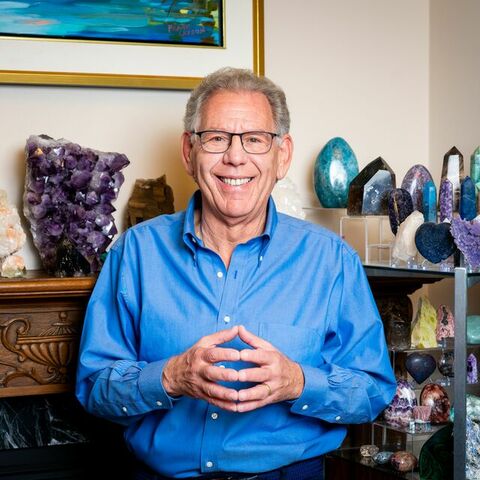
And welcome back to another episode of Dissecting the Wisdom of Shaltazar.
My name is Jeffrey Eisen,
Spiritual life coach,
Chandler of Shaltazar and an Energy Intuitive,
And I am with my good friend and collaborator,
Mark Lane.
Welcome back,
Mark.
Hi,
Jeffrey.
Thank you.
Good to be here.
It is good to be here.
It is good to be here.
And we are having so much fun.
We are doing a couple of these episodes a week once the series Unraveling Shaltazar and this one called Dissecting the Wisdom of Shaltazar.
And being a couple of old folks,
Sometimes we get mixed up as to whether we're here or there or where we are.
But we are having fun nonetheless,
Aren't we?
We are,
Yeah.
It's a good time.
Yeah,
It's interesting,
You know,
The Unraveling series is a little more focused and a little more,
Well,
I mean,
We're not very structured guys,
But it's a little more structured than this.
And this is kind of our freeform,
You know,
Whatever's on top of mind discussion.
So both fun,
Both interesting to me.
I enjoy the conversations we have and the things that come out of them,
Things I learned,
And I think you do too.
Absolutely.
Absolutely.
I think this series is more like going to the playground.
It's like,
Come on,
Mark,
Let's go to the playground.
What do we want to play on today?
Do you want to play some football?
Do you want to climb the monkey bars?
Sort of like when we were kids,
The sandbox kind of thing.
So I kind of love that because I never know what we're going to talk about and where it's going to go.
And of course,
Whatever we talk about is really the kind of stuff that we're going through and learning.
And for me anyway,
And I know I believe the same for you,
It's such a treat and a pleasure to share our experiences of learning and growth with other people because otherwise it feels kind of selfish.
It's like I learn it and I keep it to myself.
And I think this is the ultimate of generosity because whatever bumps in the road,
Whatever we learn,
We have a great desire to share it with other people.
Right,
Right.
We were actually just talking about that idea of where we are,
Where other people are,
Kind of on that spiritual evolutionary continuum.
And there's this kind of picture I have in my mind,
I guess,
Of a long line of individuals stretching from horizon to horizon.
And all of us are somewhere in that line.
And as we walk along,
We kind of rely on whoever's in front of us to kind of be our guides or to warn us of what's ahead.
And we sort of follow that path and learn from who's in front.
So if there's a hole to step over,
We see how they do it and then we learn from that.
And it seems to me that that's kind of the design of human life,
Human evolution,
Human experience,
Right?
Yeah,
You raise a good point.
And I think most of us are more willing to accept the role of student and pay attention to the person in front of us in line and the person that seems to know more.
And we read their books and we listen to their podcasts.
But the point you're raising is really interesting.
As students of life,
We are also teachers for someone else that is a little bit farther behind us in the line.
And I think sometimes people don't realize,
They think,
Oh,
Well,
I'm not good enough to be the teacher.
I'm not good enough to sort of help someone else.
I'm really the student.
And that's not true.
That's not true.
I know myself in the coaching that I do,
I learn as much from coaching someone as hopefully I do in teaching them.
And so it's really important,
I think,
For people to realize that your experience is a teacher.
And no matter what you've experienced,
Please don't be greedy and hold it to yourself.
Share it with other human beings because sometimes you can save them the trouble,
Right?
I mean,
If someone didn't tell me that when you touch the stove when the element is on,
It's hot,
I would have had to suffer a burn in order to know that.
And some people say that you won't listen to someone anyway,
But parents tend to always tell their kids that.
So please don't ignore the fact that there's people in the lineup behind you that have not learned what you've learned and try to share more.
I really encourage people to share more and more of their life experiences with other people because you can save them a lot of difficulty and trauma by sharing your experiences.
So again,
I encourage people to take on the role of teacher and student and be comfortable with both roles.
Right,
Right.
Yeah.
I've been learning as I've been growing with that idea of being the teacher and becoming more comfortable with it,
I guess,
Especially with,
You know,
I've got some younger kids.
Well,
One of them is just about to finish college and one of them is just about to go into college.
And I've learned that often the people that are closest to you are the ones who are most resistant to you teaching them anything,
I think.
And so the idea of kind of teaching by example,
I think is important to being the best you that you can be and as they say,
Shining your light is as bright as you can shine it.
And hopefully that that energy and that example that you set,
The energy that you put on the example that you set teaches them from a point of inspiration and positivity pulling them along rather than my old way of beating people over the head with my ideas and thoughts and getting frustrated with them when they didn't get it or they didn't want to do what I was saying.
And that raises a great point because a couple things come up.
My favorite quote from Gandhi,
My life is my teachings,
That following along with that are doing,
Our examples are often a greater teaching than what comes out of our mouth.
And so I find that there's a subtlety and sometimes you don't think you're teaching someone.
And that's kind of interesting because if you're going to take on the teacher role,
It doesn't mean you have to stand up at the front of the class with the pointer in your hand saying,
Listen to me.
It could be someone standing off to the side and your actions will be an inspiration to other people.
So thanks for helping me clarify that as a teacher,
You often share more teachings with your mouth closed than you do with it open.
And so I think that that's the important part.
And I guess I would add to that,
The art of good question asking is a real important one.
Because if you tell people,
They may get it,
But they really won't learn it.
One of my favorite sayings is you can give a person a fish and they can eat for a day.
You can teach a person how to fish and they can eat for a lifetime.
And so I think the object as teachers in humanity is to be the person that teaches them how to fish and don't give them the answer,
But help them find the answer.
And as I say,
The art of good question asking is really important.
I've learned that in coaching to ask those open-ended questions where you help people figure it out on their own without giving them the answer.
And I'm sure that with your daughters,
You're finding that that works a lot more effectively because there's a certain resistance when a parent tells a child what to do.
They don't really want to hear that.
Right.
And even greater resistance when a sibling tells a sibling what they should do.
That can almost result in fisticuffs.
I was just kind of having this conversation with one of my daughters the other day.
The older one is she's an old soul.
She's wise beyond her years.
And she sees solutions to things that are going on around her,
Oftentimes with her younger sister.
And she's not shy about offering her advice or opinions about what the younger one should be doing or how she should be living her life.
And I was trying to explain that it's not that your ideas and thoughts and what you're witnessing is wrong,
But those opinions and ideas are best left when—let that person come to you and ask you the question before you offer it.
Because I think when you offer it from an unsolicited place,
The resistance is far greater.
When you offer it,
When the person comes to you and asks you the question or asks you for help or wants your advice,
Even if they don't agree with you,
There's far less resistance,
I think,
In the giving of that teaching.
Yeah.
So I think it's really important to just be there for people.
And whenever I connect to someone—I love connecting on social media with people.
LinkedIn is a platform that I connect with a lot of people.
And anybody that connects with me,
I write back,
Let me know if there's anything I can do to be of service to you.
Now,
90 percent of the people don't take me up on it,
But the odd person does.
And so being available,
Not flaunting that role of teacher,
But being very subtle in sort of being there for when people need you,
I think is a great strategy.
Yeah.
Yeah.
I almost feel like we just kind of identified two modalities of teaching.
In your work that you do as a coach,
People are coming to you and they're wanting to interact with you and engage with you and perhaps find answers to questions they have or to find a way to dig within themselves to come up with understanding about things that are going on in their lives or about themselves.
So that's maybe the proactive or active modality.
And then there's this idea that we're all examples for each other and we're kind of walking on the path and being who we are.
And that maybe somehow just that act of us being authentic and true to our natures is an inspiration to people somehow and makes them want to emulate that or follow in that way.
No,
I love that.
I love that.
As a matter of fact,
That speaks very loudly to one of the principles that the Shulte Tzar has taught me,
And that's layers of learning.
And what Shulte Tzar says is that at the lower level of learning,
And hard to believe that we would call it the lower level,
Is intellectual learning because most of society thinks that those with the PhD are much smarter than those that never had any education.
But that is only one level of education.
Normally the PhD has a higher level of knowledge than someone who never got an education,
But that's only on the stratum,
Only on the level of the lower level or the lower layer of learning,
Which is intellectual learning.
What Shulte Tzar says is as you move up the layers,
You move into more of a knowingness.
You move more into,
And that's where I love helping people connect with their intuition because then you just know it.
I had a client this week and she came up with the line,
I'll know it when I know it.
That's that aha moment,
That Satori moment,
That,
Oh yeah,
I get it.
And that is not an intellectual learning.
That is not feeding the brain.
That's a full body experience.
And I think when you're talking about that example kind of thing,
Someone that watches someone else and learns from that example is learning at that higher level of understanding.
They're learning at that knowingness.
They're not just activating the brain in trying to say,
Oh,
Well,
If I do it exactly this way,
Because you're not,
They're not giving you a step by step.
That's why I sometimes get a little put off and I know the marketers will tell you that's the way you're supposed to do it.
But you're supposed to give people the five steps to do this and the 10 steps to do this and all of that.
And that feeds that intellectual learning because then it's like,
Oh no,
I'll never succeed.
I forget step number four.
But when you know it,
Then you don't,
They're not separate steps.
They're just this doing.
It's sort of like riding a bicycle.
When you start riding the bicycle,
You got to figure out the balance.
You got to figure out the pedals.
You got to figure out all of these individual pieces.
But then once you've learned,
You get on the bike and you ride.
And then of course,
You know,
Often it said you never forget how to ride a bicycle.
And so that comment,
You never forget how to ride a bicycle,
I think it's just representative of that higher level of learning,
Which is the knowing.
When you know it,
You just know it.
And that's what Shaltazar is encouraging us to do is to get to that level of knowingness.
I love the line that says,
Wisdom is knowledge experienced or knowledge applied.
And so,
Yeah,
So when you read the book,
It's one thing.
But then when all of a sudden you get an experience in life and you get to apply what you learned in the book,
Then you're into that wisdom.
Then you're into that knowingness.
And I think that's what Shaltazar is encouraging us to do.
And of course,
How they say to do so is to experience,
Experience,
Experience.
And so the bookworm that always stays home and just reads and reads and listens to podcasts,
They're not going to get it.
And so I encourage our listeners to take what you and I have talked about and apply it.
Don't just keep listening to us,
But go out and try it yourself.
And I encourage people to just become aware of the difference between the aha,
I get it moment when there's this deep knowing and where there's this intellectual learning of studying it and trying to make it happen.
To a certain degree,
It's a little bit of that control and surrender.
If you're trying to control your learning,
You won't get it.
But if you surrender to the learning,
Then all of a sudden you get an experience and you really get what someone means.
It's like,
Oh yeah,
I really get that.
I really get that.
In the oneness message from Shaltazar,
It says,
You cannot seek understanding,
For in the seeking of it,
You make it separate from you,
Which is kind of neat.
So when you really get it,
You get it.
But if you're trying to get it,
Then it's separate from you.
Right.
Yeah,
That's one of those Shaltazar paradoxes that you really do just have to sit with and let it resonate because it's a deep one.
Not only that,
I'll share my experience.
I have reread that line over and over again many times.
A lot of the times I don't get it.
A few times I got it and it's like a full body tingle.
It's like,
Oh,
I get that.
Right.
Now,
A week later,
A month later,
I read it and I don't have it anymore.
It's gone because I'm seeking it.
I'm trying to understand it.
I read it.
I remember an Oracle card,
An Osho Zen Tarot Oracle card I picked.
And I picked one a few weeks ago and I got it.
It's like,
Whoa,
I understand exactly what that means.
And then a week later I picked this other one and I don't get it.
I've gone back to reread it three times and I still don't get it.
And it's like,
I'm really trying.
What is that?
What's the message there?
What are they trying to tell me?
And of course,
I have a certain sense of tenacity.
And so I just keep trying and trying.
And the harder I try,
Again,
The seeking of understanding that card keeps me away from it.
And so I know one of these days I'm just going to be drawn to go and pull that deck out and read that explanation again.
And it's going to be,
Oh,
That's what they mean.
Right.
What do they say?
It is in the seeking that you shall never find?
The seeking of it keeps it separate from you.
Yeah,
Kind of neat.
Wow.
Very cool.
Wow,
Wee.
That was fun.
And I don't know if you noticed,
But usually you come into this series where you have a topic and I forgot to ask you for the topic.
And so we just chatted and our time is nearly up.
Isn't that kind of interesting?
Our topic is going to be on teaching and learning.
So there we go.
You didn't even have to come up with the topic,
Right?
Well,
That's the fun thing about this particular podcast is because there are no rules.
And I've been kind of evolving to that point as we've been doing them.
This is 2024,
I think we're doing now.
That the episodes seem to be invented as we proceed to start them.
So whatever we happen to be talking about tends to kind of carry over into the episode.
That's fun.
I think that's my favorite thing about this series.
Which is really kind of interesting because our message is to surrender to the learning.
And so if you would have come in with a topic,
I don't think if you would have come in with this topic,
We wouldn't have been able to handle it as well as we did because we didn't have a topic.
The topic just organically appeared.
It was not a knowledge thing where you wrote down the topic and you're going to bring it up.
We just allowed this topic to come forth.
And I think that's what we're talking about is that all of your experiences in life offer a tremendous amount of learning and growth if you're prepared to look at them through the lenses of learning and growth.
And I'm really a big fan of that.
And so without you having a topic,
We probably handled the topic that never existed in a better way than if there was a topic.
Now if everybody's head is spinning when they say that,
Then that's just perfect.
That's just perfect.
In the seeking you shall not find.
That's what we're talking about.
Then if that's what's happening to you,
Then you understand what we're talking about.
And you get to move to the head of the class.
Thank you so much,
Mark.
It's been enjoyable.
It's been fun as always.
I appreciate you doing this series with me.
And until next time,
Love and light to everyone.
Any final words?
No,
Sir.
Excellent.
Love and light.
Thank you,
Take care till next time.