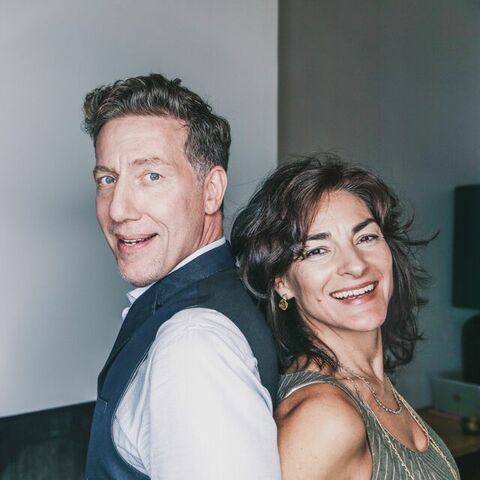
Thank you both,
First off,
For taking the time to chat to us today,
Like really value and appreciate your time.
I was interested in wanting to look at money sort of from different angles.
I haven't found a view that,
That I think,
Um,
Tries to bridge the material with the spiritual.
So I felt there was some real alignment with what you guys did.
What I think just touching on the pandemic and there's like a forced introspection.
I think that people are experiencing around,
You know,
What it is that they really want and what it is that they're really doing.
One of the reasons that I wanted to chat to you guys was because I really value the work that you do in this space.
And I feel it's quite unique and quite important.
We don't,
We don't really think about money as money.
We think of it more as energy.
It's interesting that you talk about the crisis because,
Um,
Well I'm Greek.
And so a lot of,
I study a lot of words,
What word words mean.
So the word crisis is a Greek word.
Could you see,
But the word,
Um,
We saw means gold.
So that,
That word crisis and golden Greek are so close.
You almost think that you're saying the same thing.
So what we're learning is that you find the gold in a crisis.
And I think that's what's happening for a lot of different people.
And it's not just money observing and watching that that's also a gold position where you sit and observe before you make a decision around money or relationship or career choice or wherever that may be.
So,
You know,
It's unfortunate that humans learn more so through a crisis than they do when things are good.
I know for myself,
When things are good in my life,
I kind of pay less attention.
I'm like,
Hey,
My life is great.
Let's have a good time.
It's called the law of impermanence.
Nobody's good time can last forever.
So what happens when the good time ends?
What interrupts it and how do I react and reacting consciously for us is where the gold is.
And I think you really hit the nail on the head with the pause.
It is a great resource at the moment.
And we haven't been doing enough of it in our modern society.
And in some ways I feel this like,
Oh yeah.
Even though fear was even there for me very much.
I was first locked down in an apartment in Florence and it was so restrictive for me to be in a kind of a concrete building.
I'm used to being in big nature,
But lockdown came and I was in a concrete block in a medieval city and I was missing nature.
How much I was in tuned with nature in the fact that I was like,
Wow,
This is really giving this earth a pause.
That thing,
The airplanes were grounded and travel was grounded and things just went silent.
And that was a great moment of stillness and space.
But look,
I'd like to just talk a little bit about the work that you guys do and a bit of your backgrounds.
Well,
Four Ways to Freedom is something that I contemplated for quite a few years.
After meeting Nishta,
I was like,
Oh my God,
Another person thinks and experiences reality like me.
This is unbelievable.
Essentially it came about from struggle.
So I struggled with money.
I studied money.
I struggled with being in my body because I didn't want to be in my body.
So I studied what does it mean to be embodied?
I struggled with living in the present moment.
And so I studied mindfulness and I struggled with essentially dwelling in the mystery,
The unknown,
Because we're all such controllers.
We all want to control the outcome of our life.
I decided to study what mystery is.
I won't speak for Nishta,
Although I know that she's also been on the same path for about 25,
I would say since birth,
But consciously,
It's like,
I got to study this 25 years ago.
So we went on this path to essentially be of service to people.
We've both been on a long journey of understanding what it means to live a meaningful life in terms of money,
Which means survival movement,
Which means I rented this body,
My soul rented this body.
How do I want to use this body and how does my mind work?
Not just my thinking mind,
But consciousness,
And then what is beyond consciousness.
So being able to navigate these four streams in terms of my experience has increased joy,
Has increased clarity,
And it's increased creativity and possibilities on planet Earth.
How did you choose just four and are there only four ways to freedom?
Are there a number of different ways that you can find it?
Okay,
Obviously,
There's thousands of ways.
It's like saying to somebody,
We're going to study a thousand ways to be in a healthy romantic relationship.
Well,
Nobody's going to remember.
But if you say to somebody,
We're going to study three ways of being in a healthy relationship,
It's a memory thing.
So each of those pathways encompasses a lot.
Money represents the material world.
It's the base.
It's the world of form.
So money and movement represent form and mindfulness and mystery represent the formless.
And also within movement,
You know this from doing movement workshops,
It encompasses a vast field.
Like what does it mean to live an embodied life?
That's where it's the ordinary money and movement.
And ordinary doesn't mean boring.
Ordinary means just that you can kind of poke it.
Mindfulness and mystery represent the sacred.
We wanted to keep it simple.
It was more just a curiosity around how you came to those four,
Because that would have been a bit of a whittling down process,
I guess.
And honestly,
They are the four things in which have worked and transformed our lives.
It's personal.
Yeah,
Which is always more powerful.
Nisha,
Could you take us through what it's like to be a client and to work with you guys?
Well,
We get approached through the money lens,
But we also get approached through relationships,
Business couples,
Romantic couples.
We're also working in small groups.
People,
I think,
Intuit that there's something they need assistance in seeing.
They don't have to agree with us.
They don't have to take the bait and bite it,
But they are taking the chance to hear what they haven't been told.
Gathered is that it's blind spots.
Different people are coming to you and you're helping to question them in a way to help them to reveal their unconscious blind spots.
Is that the essence?
And sometimes conscious that they're choosing to just repeat,
Right?
So because we're working with people through coaching,
Through courses,
Through workshops,
The way in which they're getting into the work through their bodies,
Through a meditation class.
So they're coming from different angles,
But they actually are tasting something unseen and said in themselves that they want more of.
They're sensing something is missing in their life.
They want to get put back on track.
They want to change.
They want to shake things up.
So they come to us to get these revelations with us.
And we give people all kinds of things.
We start with them sometimes through the money lens,
And that's the most basic,
But we're starting to really work with people through relationships and the body and meditation.
Is there a structured sort of pathway of techniques or dance or movement that you do that kind of certain things that they need to do every day?
Is it like a daily habit practice?
It's extremely individual.
Some people need to be,
Of course,
In one session in a coaching session,
We might do movement to bring home the subject of what we're working with,
Just so that it becomes embodied literally.
We might work with resources through pausing,
Through grounding,
Through centering,
So that when they're working through their daily lives,
They actually have some resources in which to navigate difficult emotions,
Difficult conversations,
Things that they're actually trying to face and work through in their personal lives.
Yeah,
It's really a process.
Yeah,
No,
That would be really super interesting.
I think particularly through the money lens,
Because I kind of came from a family where my parents argued about money a lot,
And it was such a,
It's so foregrounded kind of everything.
And I imagine that when you do couples work,
Do you find that money is one of the real kind of resistant points in relationships?
Money,
Sex,
Power and control,
Care,
Intimacy,
Recognition.
Yes,
Money is an aspect of it.
But it's a starting point.
Money is a good starting point.
It's where the sparring takes place because again,
It's tangible.
So people use couples use money as a weapon.
We see that in couples that are contemplating divorce,
But it's not about the money.
It's mostly about using money to mask feelings,
Right?
So we all we all know that money is a symbol.
And it's a symbol that represents what's going on in our inner world.
I was interested,
You were talking about evangelist,
How much you love words,
And etymology of words and things,
Maybe is there something with freedom that you have the meaning of freedom to you or the origin of freedom?
That's a really good question.
The origin of freedom for me is the origin of life.
It's like,
For me,
The origin of freedom is a circle.
In other words,
If I can be anywhere in a circle and be comfortable with that,
That's freedom,
Because there's no beginning and no end.
And I'm not just talking about the line.
I'm just talking about being in the circle,
Being outside of the circle and navigating the circle.
So for me,
Freedom is a circle.
And knowing how to dance and ride that circle brings about great fruit.
And everyone has a concept of freedom.
We hear couples talking about freedom,
But they haven't really explored it.
What does it mean to be free?
And for me,
It's like an ongoing investigation.
Does change equal freedom?
And for some it does and for some it doesn't.
Freedom,
Liberation,
Awakening,
It's not just freedom,
It's freeing the self from what is also an important aspect of that.
So in terms of defining freedom,
I don't feel there is a definition.
I feel like it's an ongoing deepening question mark.
Is this freedom?
Is this freedom?
Wait a second,
This is freedom.
I got it.
I'm going to hold on to it.
Oh,
Shit,
That's not freedom.
It's actually undefinable.
But that's a really good question.
I think it sort of makes me think of Gabrielle Roth's quote,
Which is,
Do you have the discipline to be a free spirit?
Yeah,
And I would maybe take it a step further and say freedom,
And one of my teachers expresses this,
Freedom is a great responsibility.
What do we mean by that?
Freedom isn't for some more time,
More money.
That is a level of freedom.
But if we're really talking about freedom is a great responsibility.
We're being freed from something,
But for what?
We're freeing ourselves from something,
But for what?
And that takes a lot of care and attention and responsibility to stand up and express what you want freedom for.
And what I wanted to communicate was the idea of bringing more freedom to our lives.
It was something that I read on either a blog or a podcast of Angelos when you talked about having done your dance and I walk out of workshops or I work out of conscious dance and I'm like,
I'm amazing.
I can conquer the world.
And then I look at my bank balance and I'm like,
Fuck,
I can't even pay the rent this week.
Have you guys experienced that in your own lives?
I'm reminiscent about my many years in Hawaii living a woo woo beach life.
And yes,
The hippie world is seductive and there is a sense of freedom that comes with eating off the trees and living day to day.
And we get disillusioned with that as well.
And it's about becoming disillusioned in order to free ourselves and then in order to choose.
I would love to go back to Hawaii now and live day to day and eat off the trees and sleep on the beach and see what comes.
But that would be my choice now before it was habit and being carried away by society.
I used to drive in my,
Well,
I guess it was early thirties,
Late twenties,
A camper van,
A hippie camper van,
And it had a buffalo morphing and an eagle morphing into a moon like in the psychedelic color on the outside of my camper van.
And I would drive through the mountains in Canada and people were honking me like this happened.
I remember one particular day they're honking at me and they're like,
Yeah,
Right on,
Woo hoo,
As if I represented something for people.
But in that moment I was having a fear thought.
I was nervous.
I was anxious.
I remember that realization of I bought into what freedom looks like and what I've come to realize is that freedom is being able to be,
And I had long hair by the way,
Very long hair,
But freedom is being able to be the responsible nerdy accountant,
But also be able to be the person that can be like,
Just get up and drive,
You know,
To France,
You know,
Eat oysters and have a really good time without guilt and storylines.
So freedom is only possible with awareness and awareness is only possible when you up route what's at the bottom of your mind.
When we use mind here,
We write,
We mean the conscious mind.
So what's beyond the thinking mind.
What's beyond that is unlimited potential.
In other words,
I can be the guy driving the camper van.
I can be the person driving the Ferrari.
I can be the person living in the mountains.
I can be the person living in the city.
If I'm dependent on that for my freedom,
I'm doomed.
If I'm an explorer of consciousness with those backgrounds,
Because they're just backgrounds,
Then I'm free.
I'm just having fun exploring the various manifestations of consciousness in its courses and finest forms.
So when we're coaching people,
We're like archeologists and detectives,
Where,
Where's this person getting caught?
Because if you live in their present moment,
There's nowhere to get caught because you can't hold onto the present moment.
Right?
So people are either holding to a concept from the past or a concept from the future.
And our job is to go,
Hey,
Let your fingers off the concepts and be here with us now.
So high quality money work is not possible without mindfulness work,
Because then most money coaches are telling you to be rich.
We're telling people to be affluent,
Of course,
But only so they don't have to think about money.
We also have told some people,
Yeah,
You don't need to make money.
If you want to be a monk or a nun,
Go be a monk and a nun,
But don't do it because you're afraid of the world.
Like you don't feel confident to make money,
Choose that because you want to dedicate this lifetime to exploring the mystery,
Like choose it.
Cause when you choose it from love and curiosity,
That's a healthy choice.
The same as money,
When you choose it from love and curiosity,
Like,
Oh,
What's it like to live a life where you don't worry about money and you can focus on other things,
The fruits that it produces that choice is much sweeter.
Do you think from what you've explained that that freedom and choice is a mindset that is something that doesn't depend on money?
Yes,
Because money is an illusion.
So there are,
It doesn't,
The proof that it doesn't depend on money is that rich people worry about money.
We know people that have very little money that are living a joyful life.
So joy and clarity and confidence are not dependent on money.
They're only dependent on money.
If you buy into what the world equates us as success and value.
So people attach their net worth,
Their self-worth to their net worth.
So if they lose their money,
Their self-worth goes down,
But true value is internal.
It's not dependent on duality.
Money goes up,
Money goes down.
You see this with cryptocurrencies.
It's like my cryptocurrency went up.
I'm in a good mood today on my cryptocurrency went down.
Life is so horrible.
I better take my money out.
So it's like a yo-yo.
So no,
Your state is not dependent on anything external.
If it is bottom line,
You're in deep shit.
So we coach people to be,
To rely on their inner world and presence and becoming mystery writers.
You're writing the mystery.
Is cryptocurrency going to be adopted tomorrow or in 30 years?
I don't know.
Are you,
If you're a mystery writer,
You're writing the mystery like a surfer riding the wave.
So that's what we're trying to train people to do is to ride the wave and then obviously make educated,
Practical choices to minimize,
You know,
Damage or making poor choice like investing coaching is about hiring us to help you make a better next move.
So again,
We always ask people what's your next move.
So I was curious to know what you thought about the cryptocurrency space,
Something that you've looked into.
She's laughing because I'm a little bit obsessed with cryptocurrency.
Oh,
Good.
I'm not the only one.
And that is definitely where I just hand the baton over and watch from afar,
But it's not going anywhere.
Cryptocurrency is not going anywhere.
We have top officials,
Top financial advisors in the United States who basically say it's here to stay.
Now that it might become regulated to such an extent that it won't be the wild,
Wild West that we all think it might be or have because the powers that be see its potentials.
We just don't know how it will,
It will become regulated.
That's my opinion,
But I like that he likes the wild,
Wild West.
I like watching him in the wild,
Wild West.
We don't always agree on things.
Well,
I think there's some regulation that came in actually this week from the US that's been actually,
I think that it's going to foreground a lot of what's coming from the SEC.
It's an interesting space right now,
I think.
Blockchain technology.
Well,
I've taken some courses on it and I have these moments where I'm like,
I get it.
And then I'm like,
Do I get it?
I get it.
Wait a second.
I don't get it.
And so I don't get it.
What I do understand is evolution.
And I do understand how we've gone from rocks and gems representing value to gold,
To paper money,
To credit cards,
To e-transfers.
In other words,
I'm studying evolution from the course to the formless cryptocurrency.
So for me,
It's evolution.
It only makes sense that that will happen and decentralized finance only makes sense because everybody's sick and tired of corruption,
Being conned.
I remember going to my bank and saying,
Why did you increase my fees?
Can you tell me the reason?
And they couldn't tell me the reason.
I was like,
I need to know precisely what I'm getting from the increase in bank fees.
So again,
It's in some ways we're being conned and I'm going to say this,
Human beings,
All of us egos have the ability to take an amazing thing and project our hopes,
Fears,
Greed,
Hatred,
Confusion,
Jealousy,
And pride onto it.
So yes,
It'll be marginally better.
However,
Until human beings take responsibility for their inner world,
Because everything starts with the inner world,
Humans will screw it up.
And I know that sounds very doomsday-ish,
But the self-referenced mind takes a great invention and will distort it.
So what we're interested in is what causes the distortion,
Not necessarily whether the invention is positive or negative,
But how is it that human beings are constantly dissatisfied with whatever great invention is used to improve our lives?
Yeah,
You're speaking about inner world and outer world.
And I think it would be helpful for people to have a bit of an understanding of how knowing about their relationship with me,
Knowing about their past and knowing about their programming influences them.
So I agree,
The inner world comes first and there's an argument that the outside world creates our inside feeling.
And then there's another argument that our inside creates our outside experiences.
If I have a belief that money is scarce,
I attract situations where money is scarce.
If I grow up where everything just comes to me,
Then in adult years,
Everything just comes to me.
But how do we help people know what kind of potato they are?
You have one on your website,
Which is what kind of money archetype am I?
And there's a lot of questions and I'd love for people listening to go,
Well,
How does these ideas tell me about me?
You know?
Well,
Yeah,
So the archetypes are powerful tools in which we can reveal the past and the future for ourselves,
Right?
We can see our habit bodies,
The social cultural conditioning,
The mindsets in which we were handed basically.
You know,
For instance,
For me,
It was work.
It was American immigrant life,
Work hard,
Track your money,
Save,
More is better.
Plus the American,
You know,
My father was an immigrant,
So it was really about working hard and he actually was able to fulfill the American dream in which Americans weren't even able to fulfill because he bought into the American dream.
He knew how and he worked the system.
He really did it.
So I had this belief that I had to work really hard and that that was who and what I was.
So I can see for me,
There was martyr.
There were different archetypes from my childhood that that I recognize and play out.
I don't have much of a fool because my father wasn't much of a fool with his money.
I have a little bit of tyrant because my father was a tyrant with his money.
These are powerful tools in which we can recognize and transcend our habit bodies.
And then we can actually begin again to choose which archetype is in the room and which archetype do I choose to be now.
So archetypes are like tools in which we can say which super cape superhero am I going to evolve into?
One of our clients wants me to add the prostitute.
She's like the prostitute archetype,
Which is true because again,
That's kind of like that.
I like that.
I think the prostitutes actually look really good one.
Just transactional.
Just for the audience who might not never have come across archetypes at all and don't know what they are.
Could you just give us a brief description about where they can find that and maybe a reference to Deborah Price,
Who I guess was the initiator of that?
Well,
It also goes before Deborah Price too.
I mean,
She invented that eight money archetypes,
But archetypes have been around for millennia.
Joseph Campbell,
The hero with a thousand faces also shows patterns of people's behavior in spirituality,
But also just in day to day life.
And it's been mapped out.
Deborah's an amazing creative creator artist who again used archetypes in the world of money from studying them.
You can read Money Magic.
That's a great book to read.
And Jacob Needleman on our website,
We have some resources on our resource page for ways to freedom.
I want to go back a second to what Julia was asking and then we'll just give a synopsis of the eight money archetypes is that if you think of a person like a blank canvas,
Like a painting,
You get a blank canvas.
We went to a lot of museums and saw all these paintings and I was thinking about the blank canvas.
So if you think of when from the time the fetus is first formed,
Whether the fetus knows it or not,
It's like,
How am I going to survive?
How am I going to keep going?
And so mom and dad are talking like,
How are we going to feed this baby?
The baby hears that dad might be like,
I'm going to be a millionaire.
And the baby's like,
Whoo,
Whoo.
The baby doesn't understand the baby just feels daddy's enthusiasm.
Right.
And so this blank painting is like,
You know,
Oh yeah,
This is going to be a good ride or this is going to be a scary ride or whatever it is.
And then you're born and then you're adding to the painting.
And a lot of the patterning around money and survival is taking place before the age of 12.
So it's like everything's kind of solidified and similar to you,
Gavin,
My parents used to fight a lot about money.
These actually throw money at each other coins.
You take it.
No,
You take it.
That's traumatizing.
I like,
I can laugh about it now because I'm an adult,
But everyone's walking around with this painting and,
And you know,
Some people are like,
I'm a Jackson Pollock priceless.
And other people are like,
Oh,
My painting is so ugly.
Don't look at it.
But underneath what we're interested in is the blank canvas,
Because once you become conscious,
You can scrape the paint off of a canvas as much as you want.
And there's always going to be that base.
Like I'm always going to be a little bit of a fool.
In other words,
I like nice things and spending money.
Now I do it consciously and I do it strategically.
In other words,
We're conditioned habitual habit,
Bodied beings like Nista was saying.
And again,
With awareness and with a naming system,
Like the archetypes,
I can orient myself in the world.
We went to this expensive restaurant in Denmark and I wanted to order every almost everything on the menu because it was a really nice restaurant.
I'm like,
God,
When are we going to be back in Denmark?
Look at this food.
And I've done this in the past.
I'm Greek.
So we love food.
And anyway,
I ordered all this food and she said,
What archetype is in the room right now?
And I said,
Well,
The fool.
And she's like,
Are we going to be able to eat all this food?
I mean,
Being able to name something and give it language gives you an orientation.
So when we say,
Ah,
The innocent is in the room,
What we're saying is that the powerless kind of naive doesn't want to look kid is in the room because we're all innocent with money and life.
At some point we were innocent.
Even Warren buffet at some point he was like,
What's this is this money.
And at some point we've all been victims.
We've all,
We've all been betrayed by money.
We've all been betrayed by other people because money doesn't betray you.
It's neutral people betray you.
Right.
And we're all warriors because we all have to survive in this world.
And everyone's a warrior.
Some people are like,
I'm not a warrior.
I'm like,
Yes you are.
If you weren't,
You'd be dead.
Like people say,
I'm just surviving or I'm afraid of surviving.
I'm like,
All you know is surviving.
You don't know not surviving because you'd be dead.
We all,
Everyone alive on earth right now is an amazing survivor.
In other words,
It's a warrior because they're alive and staying alive is a root desire.
It's we're built to stay alive.
And that's so how you stay alive and the extremes are that.
And again,
You have billionaires that are afraid of losing their money is no different than somebody who has no money and doesn't can't pay their rent.
And then you have the martyr,
Which is basically we all have to self sacrifice sometimes.
And quite often we might give with strings attached.
And as I mentioned before,
The fool is very impulsive.
They have a fear of living a boring life or a fear of missing out.
Then you have a creator artist,
Which is basically the blank canvas.
They're all here to create.
Everybody's creating something.
No matter,
Even if somebody's just sleeping in their bed,
They're creating something through their dream life.
There is creation happening.
And then you have the tyrant,
Which essentially is somebody that's wounded on the inside,
But they're always trying to compensate for that by acquiring more.
And also the ego's built for desire.
It's like,
Well,
This is pretty good,
But then what if we do this?
That's evolution.
So it's building.
So humans,
Whatever they build within days,
Some of the sciences,
Five days,
You're dissatisfied.
The most important archetype is the magician because the magician has made peace with their personal history and they live in the mystery.
They live with faith and trust that they're always going to be taken care of.
And the proof of that is that it took an entire universe to create everybody in this podcast.
So the universe is rooting for us.
And the magician never forgets that the magician is like,
Wait a second,
The universe created me and the universe is going to destroy you.
In other words,
Eats you to your death.
But in that period of 80 or a hundred years,
What are you going to create?
That's the gift.
That's I think one of your questions is like your true wealth.
Your true wealth is that is to acknowledge the gift of living in this physical form and being aware that an entire universe kind of like puts you together to experience a universe,
To be self-aware.
That's the magic.
That's the true wealth.
And if you can live there,
You're not so affected by the highs and lows of making money from cryptocurrency,
Losing it,
Being rich or being poor.
You're okay being poor.
You're okay being middle class.
You're okay being wealthy.
You're okay losing it all.
You're okay making lots of money.
You're okay sharing it.
That's what we mean by true wealth.
That's a really great answer.
And I found when I first came across the prices book,
Which is through your workshop,
Evangelos,
Even though I have some resistance into putting things into boxes necessarily,
I did find that naming that in terms of behaviorisms is really helpful to me.
And it also helped me to identify those archetypes in the people around me and the people I grew up with and family.
And so it became less of a blame thing,
But more of a naming thing.
I just wanted to go back to some of the movement around behaviorisms and Evangelos,
What I found really powerful when I was doing your workshop was dancing with my ancestors.
And so I just wanted you to maybe talk to that a little bit about the benefit of dancing with your ancestors in lieu of money.
Beautiful.
And as we see each level with the acceptance of your personal mandala of archetypes,
Their personal,
I mean,
We're looking at the eight,
Right?
But we're talking,
There's hundreds and hundreds of archetypes.
But if we look at the money,
We do identify who and what we have thought or people have put on us,
Who we think we are.
And as you're able to physically turn,
Lean in toward those archetypes,
Their grip is lessened.
That energy is folding in.
We're not rejecting the energy is an acceptance.
So we fold in,
We accept it,
We physically digest it,
Feeling into what's behind all the layers and layers before your parents,
Before their parents,
Within your culture,
From the beginning of time.
Yeah,
Yeah,
It was pretty amazing.
I often thought about it just in lieu of my family,
Because my dad was a bit of a gambler.
And I think mom was more of like,
If only I married a rich man,
You know,
What I discovered there was just this line that I felt was really about scarcity and really about fight and flight and find it really profound and really powerful.
Yes.
And as you said,
It's like these ideas that you shared about your parents are very fixed ideas.
They're very solid beliefs and ideas.
So we realized through the embodiment practice that we actually don't really exist in the way that we think we do.
I love that because I was at this stage where I was going on a journey from,
You know,
You go on,
I feel like you have sort of two ego deaths.
And the first ego death for me is waking up and going,
Oh,
I'm programmed,
You know,
Like you're saying between zero and 12,
I have all these programs and but then at my second awakening,
So I then I make myself a new program.
So you know,
Like my dad was a bookie,
A bookmaker at the races.
So I have a lot of interesting programs around money.
And then I was an artist.
So I had the starving artists and all of that.
And but then I'm like,
Okay,
I'm just a program,
I'm going to delete all my programming.
And I'm going to write in some new programming,
You know,
I'm going to write in like,
I can create anything and I can do whatever I want to blah,
Blah,
Blah.
But then I was realizing,
Oh,
That's just a program.
That's a nicer program that I've made.
And now I can have this freedom in that program.
But it's all a program.
And but yeah,
Everything that everyone's saying is like fireworks in my mind making me think of so many things.
But I'm just trying to stay stay in that present moment with with everything,
But I'm loving what you're sharing.
It's so beautiful.
You made a good point,
Julia,
And the difference between the programs is intention.
So do I want my mother and father's outdated programs,
And I love my mother and father,
But also some of their money programs,
Because it's not just money,
It's all the programs.
Their programs are updated.
And so once we realize what,
Wait a second,
This program,
Patterning,
Conditioning,
Whatever you want to call it,
I mean,
We're a sum product of everyone and everything that came before us.
And you're right,
You can't be in a body and not have a pro.
It's not like I'm not moving from here.
I don't want any,
I am neutral.
I am neutral.
I'm unaffected.
I'm I neither want to be rich nor want to be poor.
I mean,
That's boring.
But some people actually argue like that.
In terms of intentional programming,
What we're interested in is,
Is what is your programming based on?
And we try and encourage people to base it on generosity,
To base it on creativity,
To base it on loving kindness and compassion,
To base it on joy,
To base it on wisdom.
Right?
So when you make the programming from really wonderfully textured values,
Nuances,
And energy fields,
Then the program is like,
Wow,
It's like,
It's kind of like,
I just bought a new MacBook Pro versus my first computer that my brother-in-law made.
I couldn't imagine using that old computer now.
So again,
It's about setting intention and actually knowing what are the qualities,
Textures,
Attributes,
Values that we want to put out into the world.
And that requires study and training actually with others,
Because we're living in a world where everyone's like,
I did it myself.
And we're like,
No,
You didn't.
Humans learn,
We're pack animals.
We learn from others.
We know what we know because others,
Again,
Remember the whole universe is around us,
Are feeding us.
And then we take that information and go,
Doo doo doo doo doo doo doo doo,
And then put it back up out into the world.
And we hope that people are putting it up in the world in a more loving and conscious way.
So they're not adding to the suffering or the struggle.
Beautiful.
It's beautiful.
Yeah.
Yeah,
You guys resonate so beautifully and explain so wonderfully.
Thank you.
We're probably almost out of time.
And I feel like I could talk to you guys for ages about lots of different stuff.
But I really appreciate the insights that you've provided and given.
I think it's,
I'm hoping that it will help anyone who's kind of listening to it in terms of their own relationship to maybe name some stuff that they might be experiencing in their own lives because I do think there's a need for that,
For the sort of information right now.
Particularly,
I think,
Because there's so much anxiety around money that's kind of cropped up as a result of the crisis.
And so I do feel like it's one of those subjects that can't be taboo any longer in terms of not talking about it because it's right up in our grill right now.
So I feel like the more we can understand our relationship to it,
The more we can negotiate what is potentially tricky territory.