Good morning,
Good morning,
Good afternoon,
Good evening,
Wherever you may be joining in from.
It is a pleasure to have you here.
Welcome to this week's session of Breathe with Forbesy.
We're going to be looking at the diaphragmatic breath today and why that matters.
For a little bit of intro to anyone who hasn't joined me before,
I'm Forbesy.
I've been diving into breath work for about five years now.
When I was first introduced to transformational breath work in 2018,
It just shifted everything for me.
And I've been absolutely fascinated since to learn more about how we breathe and how that impacts our health and how we can use that as a positive force for ourselves.
We can work with the breath for our own benefit.
At any given time,
We can use the breath to help regulate our state,
To calm ourselves down,
To energize ourselves,
To find balance.
So it's like this tool that is always with us and we can always connect with.
And to me,
That's just amazing.
It's super fascinating that this is something we have.
It is this one system in our body that is automatic that we can also step in and control,
Which then we can influence other systems in our body through that process.
So it's pretty neat in my world.
So diaphragmatic breathing is what you'll notice watching babies and young children or animals breathe.
It is this very easy flow,
Low in the body.
And what happens to us just like through our lives,
Through our experiences,
Through stress,
Through whatever we've gone through,
It impacts the way we breathe.
So many of us as adults don't breathe as easily and don't breathe as fully with the diaphragm,
Which is the main muscle for our breath.
It is located like just at the top of the ribs or like not the top of the ribs,
But the top of the abdomen here,
Just under the edge of the ribs.
And it is our main,
Ideally the main muscle that's impacted,
That we use to breathe.
But as society gets its hands on us and life happens,
There's often tensions that end up being held in the body and we breathe more in the chest,
Which then uses more of the muscles between the ribs as the dominant instead of the diaphragm.
So we're going to try and do a little bit of practice here today to bring the diaphragm back into the breath process.
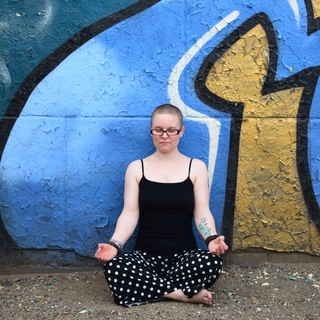
So I invite you for this just to find a comfortable seat on a chair,
On the floor,
On a cushion,
Whatever is going to best support you for this practice.
I just invite you to find a way that you can be seated comfortably with your spine long.
So I always like to imagine a string that goes through every one of my vertebrae and out through the top of my head and somebody is pulling it up to help bring everything into alignment,
Into this inner strength where everything else can then sort of soften a little.
So you want the spine long,
But your belly soft.
Finding a comfortable position that you can stay in for about 10 minutes or so.
We're going to work with a couple of different things here.
But at any time,
If you need to shift your position,
Feel free.
This is your practice.
You want to be comfortable in it,
Not creating pain in your body because that's not going to support us here.
So to begin with,
I invite you just to notice your breath.
Bring your attention to the breath.
Is it coming in and out through your nose?
Is it coming in and out through your mouth?
Some combination thereof.
Where do you feel your body expand with the inhale?
Is it expanding your chest?
Can you feel it through your ribs?
Is it expanding in your belly?
Where do you notice the expansion when you bring air into the body?
At the moment,
We're not looking to judge anything or change anything,
But just to notice where we're starting from.
Notice what's happening in this moment in your body.
Next I invite you,
If you're not already,
To shift your breath to being in and out through the nose and invite it to slow down a little bit.
As we move towards really connecting with this diaphragmatic breath,
I invite you to bring your attention to that area of your diaphragm,
The upper part of the abdomen,
The lower part of the ribs.
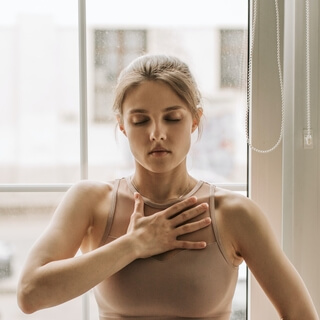
It might feel helpful to bring your hands there so you can really focus that attention.
And I want you to aim to feel expansion in that area with the inhale.
And as the diaphragm relaxes and exhale,
Things come back to a softness.
See if you can connect with that movement in your body.
If it's something you're not used to doing or have never done before,
To bring this attention like this can be really kind of strange and it can take a moment to really hone in to welcoming that movement.
We're taking some time here just to really connect with your own body and your own breath and notice what's happening.
Is it something that comes with some ease?
Is it challenging?
Maybe it's a little bit of both.
Welcoming that breath in,
Welcoming that contraction of the diaphragm that brings the air into the body as it shifts the air pressure in the lungs and the relaxation of the diaphragm that then pushes the air out again.
As you stay connected with this area,
I invite you to bring your hands to the sides of your body and feel the ribs expand to either side as you inhale and they come back in with each exhale.
When we're breathing with the diaphragm,
The expansion should be all the way around the body through the front,
Through the sides,
Through the back.
I invite you to connect in with this side movement of the ribs as the breath comes in and out.
As we get things moving together in the best way they can and the most supportive way for our bodies,
The diaphragm comes down,
The ribs come out,
You can feel them in the back body as well.
All of these muscles working together in harmony,
It becomes easier for the body to breathe fully to fully oxygenate itself.
One of the biggest benefits of the slow diaphragmatic breath is that it pulls the oxygenated air,
The fresh air,
Fully into the lungs,
All the way down into the bottom of the lungs,
Which creates greater opportunity to oxygenate the blood traveling to the rest of the body.
Where if we're just breathing really shallowly into the chest,
It's more work to get the same amount of oxygen going into the blood.
If we can slow our breath down,
Deepen it,
We increase the efficiency of our lungs and our heart and they don't have to work so hard.
In turn,
Working with these slower breaths and being able to slow our heart calms our whole system.
It brings us back into a state of balance,
A state of calm,
A state of rest.
Especially in our Western world,
That is so much go,
Go,
Go,
Go,
Go.
And I need this yesterday and all so much doing when we can gift ourselves these moments to just be and we can offer this counterbalance to the stress of daily life.
It's going to increase our general well being in so many ways.
At least create the opportunities for it.
The other benefits to working with the breath to breathe as efficiently and as effectively as we can is the breath is connected with the removal of 70% of toxins from our body.
So whether that's things that we breathe out or are excreted in different ways,
Because the breath,
The movement of breath is part of what helps move things through our limbic system.
It's like it helps keep everything flowing in the way that it was made to instead of things getting clogged up because the movement isn't there.
I'll give you a few minutes here.
I'm going to be quiet so you can just be with the breath,
Feeling the expansion through your belly,
Through your ribs and into your back.
Just be present with it for a bit.
When your mind wanders,
Gently inviting back the attention to the breath.
See if you can notice the subtleties as the ribs slowly expand.
You feel it into your back,
Into the front,
Into your sides,
That full torso expansion with the inhale,
Contraction with the exhale.
Stay with this conscious diaphragmatic breath for another minute or so here,
Staying connected with how it feels to have the air move in and out of your body,
Connected to the diaphragmatic area,
Top of the abdomen,
Through the lower ribs,
Feeling everything expand and contract with each breath.
Continuing to breathe slow and gently in and out through the nose.
This helps increase the nitric oxide in our system,
Which cleans the air as it comes in through our nose so that germs,
Bacteria,
Viruses don't actually make it into our lungs and don't make it into our system to make us sick.
It's one of our first really critical defense mechanisms.
It's just to breathe through the nose.
Beautiful.
Great job.
When you're ready,
Releasing control of the breath,
Allowing the automatic system and body to take over.
Take a moment just to offer a little gratitude to the breath,
To the lungs,
To the diaphragm,
To our nose,
All of these aspects of our breathing that give us life.
There are many modalities and cultures that the word for life is the same as breath.
Life force,
Energy,
It is all the same aspect.
We can live for periods of time without food.
We can live for periods of time without water.
We can't live without the breath.
Giving it a little gratitude,
A little bit of love,
Welcoming that sense of gratitude and love to permeate your entire being,
Your body,
Your energy,
Your mind.
Taking a few moments here just to bask in that,
Just to enjoy it because you deserve it.
Enjoy the pleasure of it.
We are all worthy of joy and pleasure.
It's beautiful when we can gift these to ourselves.
Staying in the space as long as you'd like.
If you're ready to begin to bring some movement back into the body,
Bring your focus back into your space.
Take a moment to look around and reorient yourself.
Gift your body a couple of sighs if that feels good.
Nice big stretch.
Thank you for joining me for this practice today.
It was a pleasure to guide these and share little bits about the breath.
Any comments,
Any feedback,
Any gratitude is much appreciated.
I hope you have a beautiful rest of your day.