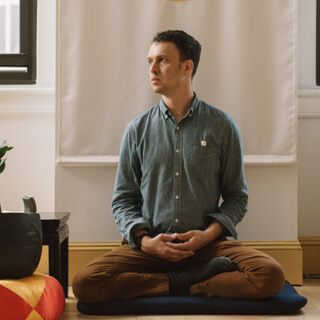
So this is a foundational practice of mindfulness awareness meditation,
Sometimes known by its Sanskrit name Shamatha,
More literally calm abiding,
A way of working with mindfulness of body and breath as an anchor to reveal our awareness of our thoughts and emotions and mental state and also to help us learn how to gather back to a soothing object of mindfulness during stressful situations.
It's a four-part technique.
The first two parts could be considered preparation or entry into the practice session and the last two parts describe the ways we're working with mindfulness and awareness of both our body and our mind.
So we'll begin with the gong.
So step one is called take your seat.
We always want to find this balance however we sit of what's sometimes said not too tight and not too loose.
My friend Maho Kowache meditation teacher uses the mantra upright but not uptight.
So we are going for this balance which we're trying to mimic in other aspects of our life of finding equality between gentleness and precision,
Relaxation and alertness and this is reflected in our sitting posture.
So sitting cross-legged if you are elevating the pelvis with enough cushions or blocks or blankets so that your knees can actually fall below the level of your hip joints as your hips rotate out and if your knees are higher you may want to elevate your pelvis further or you can sit in a chair with feet flat on the ground.
Either way let's take a moment to pay attention to our spine and really scan upward from your pelvis along the spine all the way to the atlas of the spine which is really between one's ears and let the skull relax and rest atop the spine.
Relax our shoulders feel if there's extra tension there we often carry.
Relax your jaw,
Mouth can be open or closed but you don't want your teeth to be grinding.
Tongue can rest where the back of the upper row of teeth meets the palate.
Let's just take a moment to see if there's any place in our torso or any place in our body overall where there's some held tension that might be relaxed a little bit and can we relax that without slumping.
It's fine to take a resting posture during a meditation session it's just done with mindfulness it's done to allow our back muscles to have a rest because they are training and building and sitting with an unsupported spine.
Let's see if we can find a moment of upright but not uptight and there's a kind of confidence that comes from that in taking this seat.
Having taken our seat we can check in with our state of mind just notice what's on your mind right now.
If there are particular events past or upcoming or a to-do list that's causing anxiety just see if you can note that as we check in and then also see if you can just notice the general flavor of your mind like energetically is it very speedy is it lethargic is there a dominant emotion.
I almost think of this check-in as when you go to the ice cream shop and you don't know what flavor you want and they give you those little tiny spoons to sample a flavor and it's just like taking a tiny spoonful of your own mind right now and seeing what it tastes like.
Oh this is the speedy flavor or the tired flavor.
Just take a moment to check in and this could also be a moment where you remember your intention for mindfulness awareness practice and if you don't know what your intention is that's good to know but whatever your intention is it's to work with your mind to develop your mind in a friendly way it's not to stop thinking it's not to kill your thoughts.
No Buddhist meditation teacher that I've ever heard has a method for killing thoughts that's not the way we work with them so perhaps your intention can just be to work with your mind in a friendly and supportive way.
You can decide what we want to do with our eye gaze for this session.
Your eyes can be closed if that's the way you're more comfortable to really come into the body.
In my tradition often mindfulness awareness meditation is practiced with a gentle downward gaze seeing but not seeing but not staring maybe six to eight to ten feet in front of your body so that there's a balancing of internal attention to breath and body with a sense of being in the environment.
So we're trying to find presence and return to the present moment within our environment we're not trying to escape so much but if we prefer to close our eyes that can be considered a gathering of the senses so either one is completely beautiful and so now we begin the actual technique of the practice mindfulness of our body breathing so notice your breath moving through belly diaphragm nostrils.
If you need to shift your breath a little bit in terms of take control of how you're breathing try to breathe deeply and easily without manufacturing the breath too much don't need to do much with the breath just breathe easily and place the attention which is one of the aspects of mindfulness the ability to place our attention on the sensation of breath in the body that's our home base that's what we return to and placement has this sense again of not too tight and not too loose precise but also very gentle a kind of care and intimacy not trying to fight the breath and not trying to hold on to the breath so tight that our mind becomes like a boa constrictor just place attention on the body breathing in and out so that's our physical home base for mindfulness let's just breathe together for one minute.
So as we are doing this as we're placing mind on breath which is the mindfulness element we hear our senses perhaps the subtleties of sound or if you're practicing in a big city perhaps the non subtlety of sound around you we're feeling other sensations in the body perhaps you're seeing color and texture and shape and objects if you are practicing with your eyes gently open and all of this is in the aspect of awareness the fourth part of the mindfulness awareness meditation recipe so awareness is very natural it just notices awareness is like the heart muscle in meditation mindfulness is like a voluntary muscle you choose to place your attention but awareness develops and strengthens as you're practicing but you don't tell your heart to beat and you don't tell your awareness to notice something it notices all physical perceptions and it also notices thought and emotion and the discipline of shamatha meditation is when you notice that you are not with the breath so awareness has this moment of experiencing that we are gone from the chosen object of mindfulness so rather than viewing that as a failure of mindfulness view it as a success of awareness a good reframe and awareness has a kind of attitude a kind of warmth and then there is a discipline aspect so awareness too has this balance of gentleness the warmth the care for one's experience the non-judgment and awareness has this aspect of noting when we're lost in thought and returning to the body breathing and that return is the more muscular part it's where we are actually training the mind to pay attention to come back but we are also training the mind by just allowing ourselves to notice our experience non-judgmentally if we're lost in thought that's okay and letting it be okay is training a skill if we notice an emotion that we don't like to feel that's okay and just allowing our awareness to accommodate that is training in acceptance if you want to work with this technique more precisely and feel the need to note when you've gotten lost in thought when you've forgotten the breath you can note thinking and then come back to the feeling of breath in your body in and out wherever you find that abdomen lungs nostrils mindfulness of breath awareness of our environment and our thoughts and emotions working with a friendly attitude towards ourselves and still having the discipline when we get lost and we can remember to choose to come back so we'll include about seven or eight minutes now of just silent practice and if you can just come back with a non-judgmental attitude when your mind wanders which it probably will once or twice in eight minutes that's a huge success so here we go practice comes to a close it's nice to take a moment to acknowledge the merit or benefit of practice which even if you felt like the practice didn't go as well as you wanted it to there's still great merit in making the effort setting out the time and you can acknowledge that for a moment and as the gong rings to close our mindfulness awareness shamatha meditation session if you'd like to turn that act of acknowledgement into a gesture towards yourself you can close by offering a bow if that feels organic so thank you so much for practicing shamatha meditation together