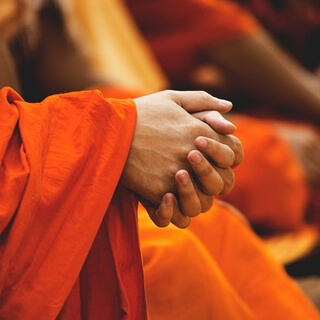
What I encourage you to do is go to your phone and find the app called Centering Prayer.
There's only one app that's called Centering Prayer.
I'm going to go to that app right now.
And I find that people who aren't accustomed to Centering Prayer,
They can usually handle about five minutes.
So let's just do it here on the front of the app.
It allows for different duration.
So I'm going to put silence duration at five minutes,
And then I'm going to apply.
And then we're going to begin.
And it always begins with the four guidelines of Centering Prayer,
Which I'll just go over briefly before we start.
And this is a tradition in contemplative Christianity,
Which has very ancient roots.
It goes back to the Desert Fathers and Mothers.
It also goes back to the Cloud of Unknowing,
Which was written in the 15th century in England.
And it's been revitalized in our time by three monks,
Basil Pennington,
William Menninger,
And Thomas Keating.
And I would say my primary teacher in contemplative Christianity has been Thomas Keating.
So the first guideline is to choose a sacred word as the symbol of your intention to consent to God's presence and action within.
So my sacred word is rest.
And I mean rest with a capital R.
It's from the scripture,
Come to me all of you who are burdened and heavy laden,
And I will give you rest.
But any one or two syllable word that works for you can work for this prayer.
So I would ask you who are listening to just choose a word.
And it should really be the second,
You know,
First or second word that comes into your mind.
It could be Mary,
It could be,
It could be Shalom,
It could be peace,
It could be Jesus,
It could be Yahweh.
There's a number of different,
It could be just spirit,
If you like.
It should have some roots in the Bible,
But any one or two syllable word will work.
As I said,
My sacred word is rest.
So the second guideline of Centering Prayer is to sit comfortably and with your eyes closed and settle briefly and then silently introduce the sacred word as the symbol of your consent to God's presence and action within.
So how this works is,
Think of it as a puppy that you're training to sit in the center of a circle.
Now if you try to sit a puppy in the center of the circle,
It is going to wander.
And so you gently bring it back to the center and then it wanders again,
Then you gently bring it back and then it wanders and then you gently bring it back.
And you do this over and over and over again and it's monotonous,
It's tedious.
But the amazing thing that happens if you do this long enough is the puppy will actually sit there for 30 seconds and that's a triumph.
Because the average human mind is like a monkey mind,
Constantly moving.
People do not have control over their minds and that's a kind of neurosis and that's what meditation especially Centering Prayer,
That's the neurosis it cures,
Is that you get control over your mind.
So there is a temptation to whack the puppy.
Never whack the puppy.
You just gently bring the puppy back to the center.
And the way you do that is with the sacred word.
Let's just say I'm sitting here and I have a thought that comes into my mind of,
I've got to get up for work tomorrow,
It's seven.
And then the thought just leaves and then I'm back to more of a kind of a quiet place.
That's fine.
Just let those thoughts go.
That's not a big deal.
But if you start thinking,
I'm really hungry for an avocado sandwich right now and I wonder if the avocados are ripe.
And do I have the kind of bread that I really like for the avocado sandwich?
And what about those tomatoes?
They seem a little bit mushy to me.
See,
Now you're on a train of thought that has derailed your meditation.
That is precisely when you introduce the sacred word.
So if I was meditating and I started having those thoughts,
I would think to myself,
Rest.
And then I would gently just bring the puppy back to the middle of the circle.
And then I'm back at a clear point,
A still point,
And I'm back at my center.
And I'm still observing my mind.
And if little thoughts come into my mind like,
Hey,
I've got to trim the tree this weekend.
That's fine.
So it came into your mind,
It left,
Let it go.
But if you start going into lots of detail about,
Oh,
I really need that tool for trimming the tree and I don't think it's sharp,
I'm going to get my sharpener,
You know,
Bloddy bloddy.
And then you're off on a train again and you've derailed and that's when you use the sacred word.
It's a technology,
It's a technique.
Use the sacred word to gently bring your mind back to its center.
Okay,
So that's number two.
So now number three,
And this is what I've been explaining here.
When engaged with your thoughts,
And thoughts includes sensations,
Imaginations,
Smells,
Doesn't matter,
Whatever it is that's going on,
Return ever so gently to the sacred word.
And Thomas Keating introduced that word ever so gently.
So you just gently bring your mind back to its center.
Then finally,
This is the fourth guideline of centering prayer.
At the end of the prayer period,
Remain in silence with your eyes closed for a couple of minutes.
So we're going to try this right now.
And whenever you have any kind of body sensations,
Thoughts,
Feelings,
Reflections,
Just gently bring the mind back to the center.
So I'm going to start this.
And the beautiful thing about this app is it has a really nice bell to start.
And then right after five minutes is done,
It'll give you another bell and you just don't have to worry about it.
And you can just sit seamlessly.
And I do this twice a day,
20 minutes each.
So this is going to be our five-minute session.
We're going to start now.
You you you you you you you you And the way that that Thomas Keating would end this prayer on retreat is he would say the our father our father who art in heaven hallowed be thy name thy kingdom come thy will be done on earth as it is in heaven give us this day our daily bread and forgive us our trespasses as we forgive those who trespass against us and lead us not into temptation but deliver us from evil for thine is the kingdom and the power and the glory forever Amen