Good morning everybody.
Thank you for being here.
Thank you for your presence and your energy today.
Today we're going to be talking about the mistakes to avoid when creating your clutter-free home.
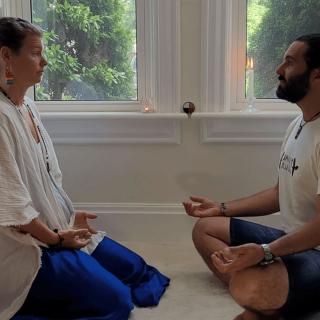
I would like to invite you to get started by doing a simple breathing exercise,
Okay?
And you will have my singing ball helping you.
So I want you to breathe in,
Hold your breath,
And then breathe out for double of the amount of time.
So for example,
If I inhale for four,
Like two,
Three,
Four,
I will hold it for maybe four,
And I will exhale for eight,
Okay?
I will count up to eight and exhale double the amount of your inhale.
Choose a number that feels comfortable to you.
You can choose two,
You can choose three,
You can choose more if you are comfortable,
Okay?
Are you guys willing to give it a try?
Okay,
So big your number,
And then inhale,
Hold it,
And then exhale slowly for double the amount,
Okay?
I,
Personally,
I'm going to choose four.
So I'm going to inhale for four,
Hold it for four,
And exhale for eight.
Okay,
Let's do it together.
One more.
Thank you so much for doing this exercise with me.
Feel free to do a few more if you feel good.
This is a good exercise to help you calm down.
This is a really good exercise to tell your brain that you are safe,
Okay?
To stop being in that state of fight or flight,
Okay?
This breathing exercise,
You will see it in many different practices,
And it's just inviting you to really bring more oxygen into your brain,
Because when you exhale for double the amount,
You are aerating your brain,
To put it in a simple way.
You are making sure that you are exhaling more,
So that when you inhale,
You are bringing more oxygen,
More like chi,
More whatever you want to call it,
Energy,
Okay?
It's very,
Very important.
It helps you feel calmer,
Absolutely.
It's a very good practice when you are doing a meditation,
If you are working in the woods by yourself,
If you are just laying in bed,
Anytime you feel yourself wanting to do something to calm yourself down,
Just give it a try to this exercise,
Okay?
So thank you so much for being here.
Today,
I want to share with you some of the mistakes to avoid when creating your clutter-free home,
Okay?
Why do I want to share this?
Because all the time,
Many of you are always bringing up that you need help decluttering.
A majority of the times,
Many of you need help decluttering physically,
Because the entry point for many people when trying to be more intentional with their lives,
It's getting started with the physical things,
Because physical things is what you can see,
Your home is where you live,
So you see those belongings all the time.
So if you have physical clutter,
If you have something out of place,
If you have a reminder of a task that you have to do,
If you are frustrated every time you use your closet,
If you cannot cook meals because your kitchen is not inviting,
So all those things are having a huge impact on you,
Emotionally,
Physically,
Socially,
With the people you live with,
It's changing your mood,
Okay?
So that's why it's so,
So important to feel well in your physical space,
And that's why that's the entry point for the majority of the people that are trying to make a change in their lives.
And the truth is,
And I'm pretty sure many of you are going to agree with this,
Anytime you don't feel very well,
If you get started and you declare an area of your home and you make it beautiful,
Organized,
And anytime you go into that space you feel well,
Something in you changes.
You feel better,
You open up space and energy for new things,
And then you just feel better.
It's just different,
It's just something that some people don't understand,
But it does happen,
It's a reality for many people,
Okay?
And I invite you to give it a try,
Okay?
But when you are doing this process,
Decluttering is not only tackling the physical things that you need to get out of the way.
That's not just a physical journey.
It's an emotional journey.
It's a mental journey.
It's a social journey if you are sharing your home with others.
So it's a way,
Way deeper journey that many people anticipate.
And that's why today I want to share some of the mistakes that I see happening over and over,
And guys,
I just want to be honest with you,
I used to make these mistakes too.
So the way that I had to recognize them and overcome them and help others overcome them is because I faced them when I got started back in 2012 helping people.
I made those mistakes,
I learned from them,
And then my wife and I would realize,
Okay,
We are not doing that again.
That was a bad idea.
It didn't work.
And then we keep repeating this over and over with different approaches until we found a recipe that works for the majority of the people.
And why does it work?
Because it's unique for each of you,
Okay?
It's very unique,
But the steps are always the same.
It doesn't matter what you are trying to do,
Okay?
And those steps are awareness.
You need to become aware and set clear intentions of what you want,
Because that's going to give you confidence,
Motivation,
Okay?
And then after you have that clear intention,
That motivation,
You know why you are doing this process,
Then you are going to take action.
You are going to actually get started physically,
Emotionally,
Mentally,
Confronting your belongings and making decisions.
You are going to find permanent homes for everything.
You are going to create systems,
And then you are going to maintain.
Then you are going to make sure that you maintain what you have created.
So in order for all those things to happen,
You need to avoid mistakes.
So mistakes that I see happening over and over,
Okay?
So are you guys ready for me to share some of the mistakes,
And then after we can have an open conversation and I can answer questions?
Are you guys okay with that plan today?
Okay,
Thank you so much for confirming.
I just want to read,
Elle says,
Interesting,
Have been working internal work so much,
So declutter become almost invisible.
Oddly supportive.
Thank you for sharing.
So these are some of the mistakes I just made,
At least prior to this session.
I just thought,
What are the things that I want to share with you guys,
And this is what I have,
Okay?
The first one that came up is not having a clear intention,
Okay?
Not having a desired outcome.
That's the mistake number one.
I can tell you one thing.
When I'm helping someone,
When my wife and I help someone,
We will not get started if we don't understand what they are trying to do.
We will not get started physically until we find what is the intention or intentions of that person.
Why have they decided to do this process right now?
What are they looking forward?
And we always try to find that thing that inspires them,
That thing that excites them,
That thing that they visualize that they are looking for,
That thing that they visualize themselves doing in the future.
Once we connect with that together,
That's when we will get started,
Okay?
So mistake number one,
Not having a clear or clear intentions and a desired outcome.
Because if you don't have that,
You are going to lack confidence,
You are going to lack motivation,
And you are going to procrastinate,
Okay?
So that's the mistake number one.
Mistake number two,
Only tackling the physical work.
Only focusing on the physical belongings and not allowing space and time to process all the emotions that are going to arise when you are confronting your physical belongings,
Okay?
This is very clear for some of you when you are facing a big life event like a divorce,
A family member passed away,
A big change that is traumatic,
Especially when it's a traumatic event,
And then you are left with belongings that you are still grieving that life event,
And those belongings are going to trigger emotions on you.
So you have to allow space and time for you to process those emotions.
So please don't make that mistake.
When you are decluttering,
You need to allow time and space for the emotional and the mental aspect too,
Not just the physical,
Okay?
Mistake number three,
Not allowing time to process those feelings and emotions.
What I said,
When something is emotional for you,
When a space is charged emotionally,
You need to understand that you are going to need time and space,
And sometimes,
Sometimes that work is going to take longer than the actual physical work,
Okay?
So moving things around,
Deciding what stays and what goes,
And getting that done,
That's just a matter of time.
The items that you have are finite.
You can count them.
Even if you have a thousand,
It doesn't matter.
You can count them and you can go through them.
The emotional charge that you may have with those items,
It's very difficult to estimate.
It's very difficult to understand how long is this going to take me?
How can I process this?
And it's going to look very different for each of you.
So just be aware that that's a mistake,
And don't make that mistake.
Try to always be aware of,
I understand that when I am going to do the decluttering,
These things can show up,
And I have to be okay with that.
I have to be ready,
And I have to just allow myself the time and space to process those things.
And if you need help,
Make sure that you have the right help,
Okay?
Mistake number four,
Lack of communication with others.
Okay?
Lack of communication with others.
What does that mean?
That means that if you are sharing the space with someone,
Family member,
Flatmate,
Your son,
Your wife,
Your husband,
Your parents,
Whoever you are sharing the space with,
It's important to give them an opportunity to have an input.
It's important to understand each other's needs and wants.
It's helpful to set healthy boundaries that everybody understands.
Maybe one room is yours,
One room is for the other person.
Maybe the kitchen,
You decide on how the kitchen needs to look like after you use it.
Maybe you decide who is in charge of cleaning,
And how do we rotate responsibilities.
Whatever you decide,
You decide who is in charge of the kitchen.
Whatever it is,
Communication needs to happen.
Okay?
And many times I see people taking charge or undoing the decluttering process for their families,
But they haven't talked with them at all.
And yes,
I know what some people are going to say.
They don't want to have anything to do with it.
Okay,
If that's the case,
Then you have to make sure that you get approval from them to give them the opportunity to name what do you need to happen here?
What would you enjoy in this space?
What are the frustrations that you have?
What are the things that I need to keep because you love them the way they are?
So if you give them that opportunity and they don't care,
And they give you permission to do whatever you want and they are okay with it,
That's fine.
But at least give them the opportunity to speak up.
And I think I see is very powerful when families get together and they together create a vision,
A family vision on how they see themselves using the house,
Especially the common spaces.
And then it's nice for each individual,
Each family member,
Or each person who lives in that house to then have an independent space too,
If possible.
Maybe this is your room,
Maybe this is my room.
If having a room is not an option because you don't have the space,
Then maybe you can say this is your bookshelf and this is my bookshelf.
And then you can do whatever you want in there and I can do whatever I want in here,
But the common spaces need to look this way.
And that's how we all agreed on.
Okay,
So that's that communication needs to happen.
And sometimes having a mediator is helpful.
Having someone from the outside facilitating those conversations is an option that you have.
Okay,
So mistake number one,
Two,
Three,
Four,
Five,
Mistake number five.
Not finding the time to do it.
One of the sentences that I hear all the time is I don't have the time.
Okay,
And it is true life is busy and we don't have the time,
Especially when we are facing a huge amount of clutter.
But I don't want you to think with that mindset.
I want you to flip the coin and then think about how much time am I wasting by not doing this.
Okay,
So what is the cost that all this physical clutter is having in my life now?
Once you connect with that,
And this is not to make you feel bad,
This is just to make you feel aware and to find motivation to change.
Okay,
Once you connect with that,
You can then say,
Wow,
If I spend one or two full days or one weekend or two hours a week for two weeks and I can get this done,
My life is going to look like this.
I'm going to be able to do this.
I'm going to feel this way.
That's what I want you to think about.
What are the benefits down the road of doing this process?
Okay,
And then you are going to have an easier time to actually make this a priority.
Okay,
Many times I talk with people,
Especially when I do support calls and I can ask face-to-face questions.
Many times people bring up that they don't have time and they cannot find the time in their calendar to do this.
And then when we start diving deeper into this,
It is not a when problem.
The problem is not when am I going to do it.
The problem is how am I going to do it.
And because they don't know how,
They procrastinate and they don't want to find the when.
Because deep inside they know that they are going to find the when,
They are going to put it in the calendar,
And then they are going to get to that time and they will not know how to get started.
And then that will feel really bad.
That will feel really like I don't know how to do this.
So I rather procrastinate.
So just be aware that sometimes it's not a time excuse.
It is a how excuse.
It's not an excuse.
It's just a challenge that you are facing.
And it's okay not to know how to do it.
That's why you are here.
That's why there are resources.
That's why I do have a course that you can take,
A 30-day course here on Inside Timer,
An audio course.
I have an upcoming workshop that you can explore that starts next week.
There are books you can read.
There are resources to help you learn how to do this.
So just be aware that sometimes that mistake is not finding the time,
Okay,
And not knowing how to do it.
That can lead to procrastination.
Okay.
The registration for that workshop is not closed.
That closes I think five days prior to,
And it starts on Tuesday.
So I think I told Inside Timer that people can sign up up to two days prior to.
So if we have enough people before Tuesday,
Then we're gonna make it happen,
Okay.
It's only 10 spots.
So make sure that you check that in my profile if you are interested.
Another mistake is not choosing a specific space to start and finish.
This is really,
Really,
Really,
Really,
Really important,
Okay.
Choosing the right space to get started.
Why is this something very,
Very,
Very important?
Because decluttering is already difficult on its own,
And if you cannot prove yourself that you can do it,
If you cannot get a quick win,
Then it's gonna be very difficult for you to keep going.
You are going to feel bad.
You're going to feel that you don't know how to do this,
And then you are going to procrastinate.
But if you can start and finish something and create a visual impact,
That's going to make you gain momentum.
That's going to,
You're going to prove yourself that you can actually do this,
That there is hope,
Okay.
And then you will get started flexing the muscles of decision making,
Making sure that you find permanent homes for everything.
But it's important that you choose the right space,
Okay.
How can you choose the specific and the right space?
One of the conditions that I always recommend is don't choose a space that feels charged,
Emotionally speaking,
Okay.
Try to choose a space that you feel comfortable tackling,
That you don't foresee a lot of emotional baggage coming up when you are dealing with it.
That's gonna be different for each of you.
When I go to help people,
I always start asking them questions,
And I am watching their reaction.
I talk about what I see in the space.
I try to think of categories,
Right.
Maybe I see furniture,
Maybe I see books,
Maybe I see paperwork,
Maybe I see clothes,
Maybe I see office supplies,
Maybe I see food.
So I start asking questions about the different categories,
And I can tell you that I can sense how they feel.
Some categories they say,
Yeah,
I don't care about that paper,
Whatever I can do.
And somebody's like,
And then they put their hand here,
Or they kind of back up a little bit,
Or their face expression changes,
Then I can sense that there is a charge there.
I can sense that there is an emotional charge.
Somehow that category is triggering emotions on them.
So I will not recommend getting started there,
And I will focus on the ones that are easy for that person first.
Why?
Because when they get started doing what's easy for them,
They are going to start flexing the decision-making muscle.
They are going to start facing the objects and starting making confident decisions,
And they are going to create a change,
Hopefully a visual change that they can see.
And once they see the visual change that they have created,
They are going to be proud of themselves.
They are going to feel like I can actually do this.
And then that momentum,
That motivation,
That confidence that they are gaining is going to allow them to then tackle the next phase with a little bit less charge,
Okay?
A little bit less of a charge.
And again,
You have to understand how,
What is your emotional charge,
And you are the only one who knows that.
You need to face the different belongings that you are trying to make decisions about,
Always keeping in mind the vision that you set for yourself,
The motivation,
And then deciding about is this the right space to start with?
Is this the right category to start with?
How am I feeling about this?
And if you feel uncomfortable,
But it's doable,
That's fine.
If you feel overwhelmed and paralyzed,
Please don't start there.
Start somewhere else and start making changes there,
And then come back here after.
And I promise you that majority of the times,
Guys,
When I am helping people,
Even during the same session,
One hour or two hours after we got started,
I just sense a difference.
And I always ask the people,
How are you feeling on a scale zero to 10?
Anxiety-wise,
Overwhelmed-wise,
How are you feeling?
And sometimes they say a seven,
Eight,
Six.
One hour or two hours later,
I will ask them,
How are you feeling right now?
A majority of the times,
It's like a four.
So always feel,
Always make sure that you ask yourself those questions.
How am I feeling?
And if you notice that you are racing and racing and racing,
Up and up and up,
Maybe you should stop that category and get started somewhere else.
OK?
Some other questions that you can ask yourself to make sure that you find the right space is,
What is the space that is frustrating you the most?
OK?
That could be one question.
Another question,
What is the space that you can benefit the most from?
OK?
Think about those questions,
Because you want to transform a space that you are going to benefit from the most.
So for some people,
That's the kitchen.
For some people,
That's the bedroom.
For some people,
That's the living room.
It doesn't matter which space it is.
It's going to look different for each of you.
But once you connect with the intention,
With the vision that you want for yourself,
And once you assess how much emotional charge do I have in this space,
Is it too much for me to tackle right now?
Or is it good enough for me to start making progress here?
That's when you can decide with confidence,
OK,
I'm going to get started here.
OK?
So remember those questions.
What space can I benefit the most from?
What space is frustrating me the most?
And then what space is the less emotional for me to tackle?
What space is the one that I don't have to involve anyone else?
That is just me making decisions so that I can get started.
So just think about how can you make,
What is the space that is the right fit for you right now?
OK?
Another mistake that I see a lot,
Not allowing enough time to clean up.
OK,
This is a very,
Very important one.
Because things get messier before they get better,
When you are decluttering,
You need to pull things out and you need to spread things around so that you can see them,
So that you can decide.
And then you're going to start making piles.
This is a donation pile.
This is a gift to my friend pile.
This is a sell pile.
This is a shredding pile.
This is a belongs in the garage pile.
This is a belongs in the garage pile.
Whatever that is,
You are going to start creating piles.
OK?
That's a necessary process.
OK?
It needs to happen.
The bigger the project you are attempting,
The bigger the mess you are going to create.
OK?
And then you need to allow more time to clean it up.
So if you don't allow enough time for cleanup,
What happens is that you get started with motivation.
You start pulling things out and then you run out of time.
And then you have to put things back maybe because you want to keep living in the house.
And then you feel like a failure because you didn't make progress.
It seems that you went backwards and you didn't allow the process to unfold completely.
OK?
So not allowing enough time to clean up is very important.
So how can you avoid that mistake?
By getting help and doing faster,
By breaking the project in smaller categories.
So for example,
If I were to come to your house with my wife and we are going to do the bedroom,
Maybe we can do the bedroom in one session.
OK?
Because there are three of us.
If you are trying to do that by yourself,
Maybe doing the whole bedroom all at once is too much because it's going to take you probably days or hours.
If you can close the door of that bedroom and you have a different place to sleep temporarily,
Then do it.
Just start the process.
When you are done,
When time runs out,
You shut the door and then you keep doing the same thing after.
OK?
But if you need to sleep there,
If you need to still use the space,
Then you have to break the project in smaller chunks.
So maybe you look at your bedroom and instead of saying,
I am decluttering my bedroom,
You will say,
I am just doing the clothes today.
And then after,
I am just doing my bedding today.
And then after,
I am just doing the paperwork today.
And then after,
I am just doing the ornaments today.
So look around you and then see what are the categories that are in here that I need to organize and declutter and then break them down in categories.
That way you can start and finish in the amount of time that you have.
OK?
So when says my art therapist friend said that the cleanup after making art is a vital part of the healing process.
Yeah.
It is a necessary part.
It's also healing.
And it's also like,
So when you guys are decluttering,
There is a process that needs to unfold.
OK?
And this is the next mistake.
Skipping the decluttering process and going straight into the organizing.
OK?
Another mistake,
Skipping the decluttering process altogether and going straight into the organizing.
Huge mistake that I see happening all the time.
Many people feel that they don't have enough space.
Many people are willing to do a renovation,
To build an addition to their homes,
To pay for outside storage.
They believe that they don't have enough space and they need more.
After working with them,
I can tell you that 90% of the time,
Maybe 95% of the time,
When we are done doing the whatever space they chose,
They are left with empty shelves,
Empty drawers,
Empty cupboards,
And open space everywhere.
OK?
Unless it's an extreme situation where they have a lot of volume and they are not willing to let go of anything.
If they have a vision,
If they have a specific motivation,
If they have connected with that and they know why they are doing this process,
Then they will have the confidence to do the decluttering.
And it's going to,
They're going to open up a lot of space,
Way more than they think.
So this is a big mistake.
Don't skip the decluttering process because it doesn't make sense to organize things that you don't need,
Things that you don't want,
Things that are not going to help you create the lifestyle that you want to become the person that you want to become.
OK?
That's why it's so important to have that vision first,
To connect with the reasons why you are doing this process.
Because you are going to encounter a lot of items that are going to be good.
They are still good,
They are still usable,
But not to you because you don't want to use that item.
It doesn't fit in your life,
In the life that you want to have.
But maybe because of guilt,
Because of you spend a lot of money,
Because someone gave it to you,
Because it belonged to your parents,
Because many emotional reasons are making you keep that object or have a difficulty to let it go.
But if it doesn't fit what you want to create and you don't have the space to store it,
Then you have to be ruthless and you have to be true to yourself and say,
Do I really need and want this?
And it's nice to honor the items that you no longer need by giving them a new life,
By giving them to someone that can love them again.
Okay?
So skipping the decluttering process is it's a big mistake that I see happening all the time.
Many times people just go straight to the store,
They buy organizing solutions to get organized,
But they didn't take the time to actually create the vision,
Think about what they want,
Declutter the space with that vision in mind,
And then making confident decisions.
So please don't do that mistake because you will not move forward because you will have a lot of physical credit and you won't know what to do with it.
So the first step is always becoming aware of what you want and connected with that new reality that you want to create.
Okay?
And becoming aware of the challenges that you are facing,
All the emotions associated with it.
Second step is the decluttering.
Eliminate everything that doesn't belong in your life,
That you no longer need.
Then after that,
You are going to organize.
Organizing means finding permanent homes for everything that you are keeping so that everything has a home.
And that's going to allow you to maintain the space,
To create a system that when you are done with this,
It belongs here.
When you are done with that,
It belongs there.
Everything has a home and there is no physical credit around you because everything is intentional because you created that for yourself.
Okay?
So don't skip the decluttering process.
And many people skip it because it is hard,
Because it is emotional,
Because you are going to be confronting all the emotions that we were talking about.
That's why it's a process that is difficult for some people because we are not just talking about physical things.
We are talking about all the emotions that those physical things are going to evoke in you.
Okay?
So another mistake that I talk a little bit,
Not creating systems and a maintenance plan.
Okay?
So you need to create systems.
In order for you to maintain your home and to avoid credit to come back,
You have to have clear systems that you and everybody else living in your home,
Everybody using that space understands.
Okay?
So that can be like kitchen,
Opening a cover and saying,
This is where the coffee mugs go.
This is where the plates go.
This is where my glasses go.
This is where my calorie goes.
This is where my pots go.
And everything has a home.
Everything fits in there.
And by the end of the process,
Nothing is outside.
Everything is where it belongs.
If you have too many pots,
For example,
Then you have to be intentional.
Which one am I letting go of?
Or where am I creating more space to store my pots?
And you have to find that balance between space and things that you are keeping.
Okay?
Once you find that,
Fine tune that,
That's when you can maintain that system because everything becomes a habit.
The more you use those cupboards,
The more everybody will understand,
Oh yeah,
Calorie goes here,
Plates go here,
Mugs go here.
The same approach in your garage,
The same approach in your bedroom,
The same approach in your pantry,
Same approach in your living room.
Everything that you are keeping has a home and you put it back there when you are done using it.
Okay?
And it's okay to drop the ball during the week if it's a busy week,
But you know that Friday night during the weekend,
You will put everything back in no time because everything has a home.
So you can catch up very quickly and your home will go back to normal,
Back to being decluttered.
Okay?
So that's very important.
Some people don't think about that.
They don't create a system and they don't maintain.
And that's when declutter comes back very,
Very quickly.
Okay?
Another mistake,
Not having a plan for all the unwanted items that you are going to find.
Okay?
If you are foreseeing a lot of things that you no longer need,
You need to have a plan on what am I going to be doing with all those things?
And guys,
There are a lot of different options that you can explore.
I share them in the course.
In the course,
I have a full session.
A full day is just about what to do with belongings that you don't need anymore.
How can you give them a new life?
How can you love them by passing them along to someone who can use them?
Okay?
And you can explore.
There are different ways that we do it,
Like auctions,
Private selling,
Donation,
Family members.
There are so many options and I share all of them in the course if you are interested.
Okay?
But it's important to have a plan.
What am I going to be doing with all the things and how am I going to be moving them out?
When we do a session with people,
We take everything out for them.
And that's a huge role in our service.
Sometimes we come with a big track because we know that if we don't do it,
They will get stuck with having that clutter in their homes and they won't see a change.
So we bring a truck,
A trailer,
Or a car and anything that is donation,
It just leaves the house right away.
We just put it outside.
And then that person is starting to see the change.
Okay?
If they are planning on,
If they have a lot of stuff,
We will recommend an auction or we may invite them to private sell them,
But it takes time to private sell things.
Okay?
And then another one,
Another mistake,
The butterfly effect.
Okay?
What is the butterfly effect?
The butterfly effect is something that we see people doing when they are overwhelmed,
When they have clutter in different areas of their homes and we decide to focus on one area,
We see them maybe taking one thing,
Putting it in the room next to where we are working.
And then they see something there and then they grab that thing and then they go to the garage and then they see a thing in the garage that belongs in the kitchen.
And then they go to the kitchen and then they start doing that.
And it's like,
No,
No,
No,
That's the butterfly effect.
And you will never end if you do that.
Okay?
So that's why it's important to remind yourself of what you are focusing on.
What is the space that I am focusing on now?
Let's finish that space.
If I find something that belongs in a different space,
We create a pile outside of the space that says garage,
Pantry,
Kitchen,
Whatever.
And you deal with that pile in the during the cleanup.
Okay?
But you finish that space first.
That's really,
Really important.
Okay?
The butterfly effect is real guys.
And we have to remind people to say,
Stop,
Stop right now.
Take a couple of deep breaths with me.
Okay.
Now you're going to stay here.
You're not going to go to the room again because you are getting distracted and you are getting overwhelmed because you are seeing the mess in every room.
Okay?
So try to avoid the butterfly effect.
Try to gently invite yourself to go back.
Okay?
So guys,
These are some of the mistakes that I have.
I want to leave a little bit of time.
We have seven minutes left,
Maybe 10.
Uh,
I would like to leave some space for questions.
Is there any other mistake that you can think of that you have done?
Uh,
Is there anything else that you want me to cover?
So today kids don't want your stuff anymore.
Minimalism is the thing.
Stuff not important to them.
Yeah.
And on beautifully said,
Parents have very unclear expectations sometimes on the real value of things because they have a lot of huge emotional value to them.
They think that that relates to a huge financial value.
And that's not true.
Unfortunately,
That's not true.
The style has changed.
The need that people have has changed.
Many people want way less things.
And then parents are getting a little bit offended when kids don't want their stuff.
But that's a,
That's an emotional thing that they need to overcome.
Because if you ask to your family members and no one wants anything,
I mean,
It's going to be,
It's going to offend you if you are placing a lot of value on that.
But if you understand that they have a different lifestyle,
That they are happy,
That they are making intentional decisions and you respect that,
Then you are going to be ready to give those things a new life to someone else outside of the family.
So just be open to that because that's a reality for many,
Okay?
Staying stuck in the emotions,
Depressed and negative self-talk.
So Sharon,
I talk a lot about that in the course,
In the 30-day course that I have.
It's called Creating Your Sacred and Peaceful Clarity-Free Home.
So that course goes very,
Very deep into what you are mentioning,
Like all the emotions,
Feeling depressed.
I will invite you to really take that course if you have the time because it's,
This is a very,
Very emotional process and you are going to face all those emotions,
Most likely.
So there are ways to overcome them.
There are practices to keep you on track and there are practices to just allow yourself time and space to deal with them.
Okay,
So I hope that you can check in and please use the course classroom.
Ask anything that you need while you do the course so that I can support you along the way,
Okay?
Thank you for this info,
Emilio.
You are welcome,
Kelly.
Why is this so scary?
It seems to me that people are happier in countries where there is less staff.
When physical clutter is something that started happening since not long ago.
It wasn't really a reality,
Maybe 30 or 40 years ago,
Right?
I think the access to cheap things,
There are many factors that are contributing to people having a lot of clutter,
Physical clutter.
But yeah,
It's scary,
It becomes scary when the task is overwhelming for people.
And when it's affecting your mental health,
When it's affecting your emotional health.
Some other people also didn't have the opportunity to see someone helping them create the skills that they need to maintain a home.
And this may sound very,
This may sound very simple to some of you,
But some people don't know how to put the garbage out.
They don't know how to maintain a home.
They don't know how to place things in their homes.
They didn't learn any of that.
And it's not that they are not capable,
It's that they just didn't have the opportunity to learn the skills.
And there is a lot of shame around that.
When people don't know how to do this,
They believe they should know.
It's something that everybody knows.
So I should be also able to be doing these things.
So I don't want anyone to know that I am not able to do these things.
And then when that happens,
That's a cycle where you don't want help,
You are feeling ashamed,
You don't have the skills to change the situation,
And then you just get in this spiral until one day you had enough and then you are open and say,
I don't care,
I want to try something different.
And that's when you may call people like me,
Or you may take a course,
Or you may read a book,
Whatever you need to start making change.
But sometimes,
Guys,
You didn't have the opportunity to learn this,
And that's not your fault.
And it's never too late to learn,
Okay?
It's never too late to learn.
So once decluttered,
Don't go and shop to fill the emotional gap in you.
So,
Aaron,
Thank you for saying that.
Sometimes this is part of the maintenance,
Right?
When you have worked really hard to create a declutter space,
Then the old habits are going to kick in,
And some people go out and they shop because they feel good,
Because they see deals,
And then they bring them home.
But then you have to be intentional enough to know and ask yourself these questions.
Can I afford this item?
Okay?
Can I afford it in the way?
Do I have the space for this item?
What am I willing to let go for this item to be inside my house?
Do I have the finances to pay for this?
Do I have the energy to maintain this item?
So there are so many different things that you have to ask.
It's not just money.
It's space.
It's the emotional attachment to it.
It's the maintenance.
It's all these things.
So be intentional and ask yourself,
Do I really need this?
Okay?
Before bringing things home.
Sista says,
It's too easy to accumulate stuff because everything is so cheap and easily accessible.
Yeah,
Sista,
I agree with you.
Things are very accessible these days.
That's why we have to be even more intentional.
We have to really spend time in that vision,
In that intention,
In that what is my desired outcome?
What is the desired lifestyle that I want to live?
What are the activities that I want to be doing?
And then when you are intentional about that,
That intention is going to trump the easy access to things because those things won't matter to you as much.
And you will be intentional about,
No,
I don't want to have more of this because I already have enough because that's not an activity that I want to do.
Or if you decide to start doing it,
Then you create a home,
You create a station for that activity so that everything is accessible.
You have space to store the things that you need.
And then that's a new habit in your life.
But if you don't do that with every activity that you have,
You are going to end up having piles of things that most likely you won't use.
Okay?
So Nina says,
I was talking to one of my clients who has over 20 boxes of paper,
Which she has opened in 12 years.
Shocked to see her mental health issues when she describes how uncomfortable she is about it.
So Nina,
That's paperwork is a huge one.
Why?
Because paper takes a long,
Long time.
And I will not recommend going through paper first.
And this is something that I share in my course.
This is something that I will talk about during my upcoming workshop.
We made that mistake.
Okay?
We went to a session back in 2012 and then we got started doing paper.
And I remember we were helping this woman and then her husband left the house like at 10 a.
M.
In the morning.
And then we were doing the filing cabinet and then her husband came back at like one,
I think it was like three hours later.
And then his words were,
What have you guys been doing?
That those were his literal words.
What have you guys been doing for the last three hours?
Because I don't see any change.
You haven't done anything.
And I was almost biting my tongue saying,
But we have done like this much of the filing cabinet and it took forever because paper was very emotional.
That's when I learned the lesson.
Like I will never,
Ever get started doing paper again.
Never.
Why?
Because it takes forever because it can be emotional because you don't see a transformation visually.
So you end the session and it feels like you have done nothing.
And then there is no momentum.
There is nothing.
So that's why it's so important to first declare and organize your physical space so that you can feel great in there.
You can see a change and then you bring those papers out and then you get started doing just paper.
And that's what we do.
We only do paper sessions or space sessions.
We don't mix them up.
Okay.
Unless we have days to work with that project.
So that's another mistake.
Do not get started with paper.
Okay.
Yeah.
So what else do you guys have here?
Let me see.
Amazing answer.
Thank you so much.
Yeah.
Nina.
And again,
Like paper takes forever.
I will say,
How can you create a system to get started from now so that the her paper world looks organized and then she feels in control right now and towards the future and then decide what to do with the backlog.
The reality is that here in Canada,
We only have to keep seven years of worth of papers.
Okay.
So knowing that,
You know that only seven years are something that you have to keep.
The rest,
You don't have to keep it.
Only if you have important papers that are not tax related.
So knowing that,
Sometimes it's easy to put a date on the boxes and store them if you have the space.
And then when the seven years expire,
You just shred the box and forget about it.
If you have to go through those papers for a reason,
Sometimes people have a case.
Sometimes people have to do back taxes.
Sometimes people have important things that they need to.
Then you need to allocate for time to do that backlog.
But I will focus on first creating a system moving forward.
And then all the backlog is a plus that you will do slowly.
Okay.
Is it helpful to write a plan Roxanne?
Yes.
It's very helpful,
Very helpful to write a plan because it's going to be a reminder for you.
It's going to be something that you can follow.
Okay.
Amy says,
Breaking up paperwork into categories for me,
Medical,
Creative,
Personal,
Birthday.
Yeah,
That's really important.
Create categories that make sense to you.
When I do paper,
Again,
I cover paper in depth in my course.
There is a one day just about paper,
But I normally start creating piles on the floor,
On the table with the categories that make sense for you.
I don't create them.
I ask,
What is this?
What name comes up when you are thinking of this category?
And some people will say,
Oh,
This is car.
This is home.
This is medical.
This is electricity.
This is hydro.
This is utilities.
It doesn't matter how you do it as long as you remember.
And then when you go back to finding a paper,
You will remember the categories that you have in your head,
Not the ones that I impose on you.
Okay.
So I don't say,
I have four files for my papers.
File it away immediately.
It's so simple to find everything I need,
No stress.
I know,
Celebrating your,
Your amazing paper system.
That's great.
That's what everybody wants to get to,
Into having a system that is easy to use,
Fast,
Convenient.
But to get there sometimes it's a little bit tricky.
So that's why,
Uh,
It's important to create a system.
Okay.
So Amy says there is an app called Tiny Scanner.
Yeah.
I use that app,
Amy.
Thank you.
What is your course,
Please?
Nina,
My course is on Inside Timer.
So my,
I have three courses here on Inside Timer that you can access.
One is called,
Uh,
One is about self-care.
The other one is about minimalism.
And the other one is about creating your clutter-free home.
You can access those three courses from me.
That's how I can support you.
I also have an upcoming workshop next week,
Starting next week.
It's a two-day workshop to help you declutter your home.
It's just for that.
Only 10 people,
Only 10 spots.
So if you are interested,
We will,
You will have time during the workshop to share your specific space that you are working on.
And you will have time one-on-one with me to actually,
Uh,
Answer any questions and give you motivation and whatever you need.
Okay.
How to handle digital clutter.
That's Maya.
That's another one.
Uh,
I'm not going to get into that today,
But I have recorded sessions about that topic.
Okay.
Okay,
Guys.
Uh,
I think,
Uh,
I'm going to cut it here.
It's five minutes over the 45 minute mark.
I want to let you guys go with your day two.
So thank you so much for being here.
Here,
Uh,
Let's transition out of the session,
Uh,
With the same exercise.
Okay.
So I will invite you to get comfortable.
Okay.
Close your eyes if you can,
And then take a couple of deep breaths with me.
And if you want to do the four in,
Hold it and eight out,
Feel free to do that.
Okay.
One more.
Okay guys.
Thank you so much for being here.
I hope you have an amazing rest of your day.
I hope to see some of you inside any of my courses.
If you join any,
Please use the course classroom,
Share your progress,
Celebrations,
Questions.
That's a safe space for you and you have lifetime access to that space.
So even after doing the course,
You can come back anytime you want.
And if you feel brave and you are ready to declutter with me and with nine other people,
Then join my workshop that starts next week.
You can find everything on my insight time profile.
Okay.
I have a workshop tab and I have a courses tab and also a one-on-one.
If you want to call with me one-on-one and if you are listening to the recording,
I will put a link below.
Okay.
Have an amazing rest of your day guys.
Adios.