Hello everybody,
Welcome back to another session with me.
My name is Emilio Jose Garcia and today's topic is the key dimensions of self-care.
So thank you so much for joining today.
Thank you for being here.
Or thank you for listening to the recording if that's what you are doing after.
I just want to make sure that you guys are seeing me.
Can you guys hear me and see me well?
Just put something in the comments so that I make sure that everything is alright.
Today I am doing this session from a different location.
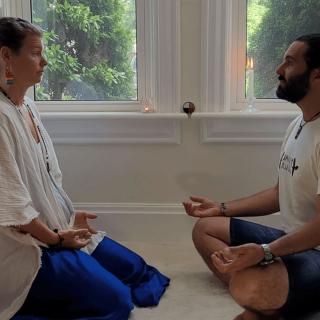
I am at my wife's new studio.
She calls it the studio,
A healing place.
It's a little studio that she rented at the beginning of the year and it's just up the street from our house.
So today I came here to do the session.
Before getting started,
As always,
I would like to do a little intro exercise.
I want you to allow yourself a little bit of quiet time and I have an instrument today.
It's called a cactus rain stick.
Cactus rain stick and it simulates the sound of the rain.
Okay,
So I want you to close your eyes if you can.
Just breathe in and out gently and deeply and just listen to the noise for a few seconds.
Okay.
Don't forget to breathe!
Thank you so much guys for doing this little exercise with me.
It really helps to ground yourself.
It really helps having something to guide you back to the present moment is really important and you can find many activities,
Many things that may help you do that.
I always try to bring something new,
A sound,
A noise,
Maybe some silence,
Maybe a breathing exercise,
Something that will help you come back to the present moment.
And that's why I am trying my best to find different things to help you guys started at the beginning of every session.
So welcome to all the new people that are coming.
I saw some comments saying,
Hi,
I'm new here.
Welcome.
So these sessions,
My name is Emilio José Garcia and I call these sessions your thriving lifestyle.
That's the theme.
I always talk about intentional living and today I'm talking about the key dimensions of self care.
This is a lesson in one of my audio courses here on Inside Timer that you can take.
It's called improving your mental health with self care.
In that course,
In the introduction,
I talk about what self care is and I talk about these key dimension areas that we all can benefit from being aware.
And if you are familiar with self care,
This is a nice reminder of areas that maybe you want to do more of,
More self care in.
Maybe it's a reminder for you to say,
Wow,
Like that area feels good to me now to focus on what can I do to make that area better?
OK,
For all of you that maybe are new to self care or don't even know what self care means,
It's going to give you a very nice overview of what self care is and how you can use it to improve your life.
You don't have to do everything all at once.
I just want you to be aware of them.
OK,
This is like seeds that I am going to plant in your head.
OK,
Seeds that are going to start growing.
And when the seeds grow,
You're going to start taking action.
You're going to start becoming aware.
You're going to start integrating new things in your life.
And that's what I would like you to get out of this session.
OK,
So if it's good with you,
I will start by naming the key dimensions that I have,
The ones that I included in that lesson.
I have nine of them.
But again,
You can find many,
Many older ones and you can find very specific ones or you can find very generic ones.
What I'm sharing here is something that I believe will apply to the majority of you.
And if they don't apply,
I will invite you to see how you react to them,
To see what you feel,
To see what evokes on you.
Because sometimes I will say the name of one dimension and you may say,
Oh,
Yeah,
I have that under control.
Everything is good there.
OK,
Maybe maybe something comes up like,
Wow,
Like I didn't even think about that dimension for a really long time.
Maybe it's time for me to revisit it.
Or maybe you say,
Oh,
There is something here that doesn't feel right.
Maybe that's an invitation for you to explore.
Why are you feeling so much resistance to that dimension?
And again,
This is all to be gentle with yourself,
To just be aware and always be aware of what's coming up for you as I mention them,
As I talk about them.
OK,
Are you guys ready to dive into the nine dimensions with me and then we can have a conversation after?
Just give me a thumbs up so that I know that you guys are ready.
Amazing.
Amy says,
What we resist,
Persists.
So true.
That's so true.
Normally,
If you if you find a strong reaction to any of them,
I will invite you to write that down or keep it in mind so that you can explore that more.
You can say,
Why am I feeling so much resistance here?
Why is this strong emotion showing up for me?
OK,
So let's go.
The first they are not in any specific order.
OK,
These dimensions are going to apply differently to all of you.
And yes.
Just listen to them and see what comes up for you.
OK,
So the first dimension I have is spiritual.
OK,
Spirituality.
That is what you believe in.
That is the relationship that you have with the world,
With the universe.
OK,
There are many different kinds of beliefs,
Many different kinds of spirituality paths that you can take.
And this is one area that is very important for a lot of people.
Spirituality,
Whatever that means to you.
I'm not talking about a specific religion or practice,
Whatever.
You can explore thousands of modalities.
And at the end of the day,
You will have your own beliefs.
You will have what feels good to you.
And this is an area that clearly you can expand on as much as you want.
Inside Timer does a really good job of bringing a lot of awareness,
A lot of practices in many,
Many different spirituality modalities.
OK,
So that's one spirituality.
Second,
The second dimension I have is the mental dimension.
OK,
This is what you think about.
We all think about things all the time.
Sometimes we think we think about good things.
Sometimes we think about things that happened to us,
Experiences that we felt.
And we are constantly thinking.
So self-care in this area can be bringing some mindfulness into your day to day life.
When you find that your mind doesn't stop thinking,
I find myself in that state a lot.
It's OK to let yourself go in the business of life and doing stuff and getting things done.
But it's nice every now and then to come back to yourself and just allow yourself even 10,
15,
30 seconds of just silence,
Just presence,
Just presence.
And that's why listening to the rain stick instrument,
Singing ball,
Just some music,
Your breathing in and out,
That's something that can help you come back to the present moment and bring some presence and stop thinking.
So the mental dimension is a huge one for many of us.
We all have to tame our minds in a way that we are not constantly thinking and over analyzing things.
And we leave some room for emotions,
For feelings,
For just the present moment to be there.
Another key dimension,
The third one that I have is the emotional one.
OK,
The emotional one is how do you feel?
OK,
So we talk about spirituality,
What you believe in,
Your relationship with the universe,
With the world,
With the stuff that surrounds you.
We talk about the mental,
That is we use our minds to think,
To analyze,
To make decisions,
Executive functioning skills.
Mind is used in many,
Many different ways.
The mental capacity that we have,
The emotions are what we feel.
How do we feel?
And sometimes our minds are telling us to do something from a logical angle perspective,
But our feelings are telling us something different.
So it's important to be able to pay attention to those areas.
OK,
Pay attention about your beliefs,
Your spirituality,
Pay attention about your mental,
The thoughts that you have,
And then pay attention about your body and the feelings that you experience because they're going to tell you a lot of information that most likely your mind is not catching.
OK,
So emotional key dimension.
You can nurture that dimension by practicing mindfulness,
By allowing yourself time and space to let feelings come up,
To observe them,
To allow them to be there.
Sometimes our feelings of gratitude,
Sometimes our feelings of anxiety,
Overwhelm,
Sometimes it's upset.
You are upset.
Sometimes it's there are so many different kinds of feelings that may show up.
And it's important sometimes to allow them to just be for a little bit so that you can understand why are they there and what triggered them and how can you start understanding yourself more,
Start coping with those feelings better and stop reacting to them and instead allowing them to be,
Understand them.
And then from that place of awareness,
Then you can decide what to do with them.
But sometimes you don't have to do anything with them.
You just have to let them be there for a little bit.
So for you to be aware of them.
So that's the emotional dimension.
OK,
The fourth key dimension that I have is the physical one.
That physical one is your body,
Your physical body.
How do you feel?
And this we can talk about self-care practices to make sure that you are taking care of your body,
Are eating well,
Sleeping well,
Exercising,
Moving your body,
Stretching.
Like movement is very,
Very important,
Right?
Like some people move by going for walks.
Some people do exercise.
I do play squash.
I juggle my balls.
I bike.
I rollerblade.
I do yoga.
I like dancing.
So you will find whatever feels good to you,
But movement is a very healing practice,
Especially when you sweat,
When you get your body used to exercise.
And then it gets strong.
It gets healthy.
It gets flexible.
So your physical body is a very key dimension.
And these dimensions that I'm talking about,
They are probably one of the most important ones.
Because if you don't feel well physically,
If you don't have energy,
If you don't understand how your body works,
Your energy levels throughout the day,
Your sarcasm rhythm that they call it,
If you don't understand those things and you are trying to do a task,
But you don't have energy,
It's very difficult to get started doing things.
And the same thing with your mind and emotions.
If you don't have a clear mind,
If you cannot control your emotions or at least like understand them a little bit,
You're going to be in a state of overwhelm,
In a state of feeling anxious,
Upset,
Worried.
If you are constantly in that state and you don't allow yourself a little bit of presence and you don't have energy with your physical body,
Then trying to tackle the rest is going to be very difficult,
Very,
Very challenging.
So that's why it's important to just tune in with yourself.
How do I feel physically?
How do I feel mentally?
How do I feel emotionally?
And just accept where you are right now and start practicing self-care by allowing yourself a little bit of time every day to just tune in with yourself,
Checking how am I feeling?
Wow,
I do have a lot of tension in my neck.
Wow,
Like I did an exercise in a while and my body feels a little bit kind of like I need to move a bit more.
I feel that I need that.
Maybe I should go out in nature today and go for a walk or maybe a bike ride or maybe I should do some push ups.
Just start tuning in with yourself and just testing new things to see what starts working for you,
What makes you feel better.
Trying to work with your circadian rhythm is really important.
Violette,
Thank you.
Yeah.
What is that?
That means that you are starting to pay attention to that cycle that repeat every 24 hours.
OK?
Every 24 hours,
Your body has a rhythm.
So you need to sleep,
You are awake.
There are times of the day that you are going to feel the most energized.
There are times of the day that you are going to feel the most drained and tired.
There are times of the day that you are going to feel the most creative and the most focused.
And there are times of the day that you don't want to do a task that is very demanding because you don't have the capacity,
The mental capacity to do it.
OK?
So it's very important for you to start paying attention to your cycle.
How is your day flowing for you?
Are you a morning person?
Are you a night person?
Are you a middle of the day person?
And start watching yourself,
Observing how you feel,
Your emotions,
Your feelings,
Your physical energy.
And then you can then start making more informed decisions about when am I going to be doing exercise,
When am I going to be doing a task that is going to be very demanding.
And this can be applied to your work,
This can be applied to your leisure,
This can be applied to your exercise,
This can be applied to anything,
To your creativity if you are trying to create something,
If you are trying to paint,
If you are an artist,
If you create content.
It's important for you to start understanding your cycle.
When is the best time for me to do those things?
And this is a mixture of all those key dimensions that I have already explained.
The spiritual,
The mental,
The emotional and the physical.
Those are very key ones that you have to start paying attention to.
Everything is good so far,
Guys.
Are you guys following me so far before I keep going?
Yes,
Yes,
Yes.
OK.
So with spiritual,
Mental,
Emotional,
Physical.
OK,
Let's do the next one.
The next one I have is professional.
Again,
I don't have them in a very specific order.
OK,
The professional one is what do you do for work?
OK,
How do you make a living?
And the professional one is it's very important because for some of us,
It takes a long time.
So we spend some people spend an average of eight hours a day just working.
So it's a huge chunk of time of your life,
Of your day,
Of your week,
Of your month.
And that's why self-care is so important in that.
And inside the professional one,
Something that you can explore about self-care is how do you feel in your work?
Is your work challenging you in a nice way,
In an intellectual way,
In a physical way?
It keeps you engaged.
Are you happy?
Do you have a nice and healthy environment?
And then you can always improve that.
And improving your professional dimension doesn't mean that you have to quit your job and do something else.
Sometimes the same job that you have,
You can change how you approach it.
Sometimes you can change the dynamics.
You can change the location.
You can change the routines.
And again,
The more you become aware of your cycle energy wise,
Mental wise,
Creativity wise,
You will start taking this into that area too,
The professional area.
Okay.
And when you start tackling that area,
You are going to make improvements in your current situation right now.
Sometimes the more you change,
The more you may need to change jobs.
That's true.
But sometimes you just improve your current one.
So there is not a right or wrong approach here.
You have to take in with yourself and then really assess how am I feeling in my professional dimension?
Is there anything that I can do right now to try and improve it?
Okay.
So a different name for professional work.
Yeah.
So Amy,
Professional,
If that sounds too corporate to you,
Again,
These dimensions are just generic ones,
Feel free to change the name to words that make sense to you and words that make you feel well.
For some people,
Professional sounds too corporate and they don't like that word.
So maybe you can use a different one.
In my case,
My work is also my passion.
So for me,
When people ask me,
What do you do or what do you do for work?
I consider my work to be,
It's my passion business.
It's what I love doing.
And I was able to convert it into a paying career for me.
Okay,
So I call it passion business.
That's something that relates.
I relate to that every day.
I show up with passion,
With enthusiasm,
And that's how I make my living too.
Okay.
For some of you,
Maybe you have hobbies,
You have creativity that don't fit right now in your work,
In how you make a living.
But maybe you are working towards creating that.
Maybe that's something important to you.
And that's how you can apply self-care to that area.
If that's your goal,
It's like,
Wow,
Like I would really love to start doing something that I love and get paid for it.
Some other people,
They have a really good job,
Meaning they get paid really well.
They have good hours and they show up and they leave and they love the separation of this is my professional work time,
Whatever you want to call it.
And this is my personal time.
Some people love that,
That separation,
Physical,
Mental and emotional.
For those people,
They are going to pursue their passions and their creativity outside of their job,
Day to day job.
Again,
There is not a right or wrong way to do this.
Some people may feel like I want to include my work and my creativity and combine everything together.
And some people will say,
I don't want to do that.
I just want to keep them separated.
Again,
If you find yourself having strong feelings about a specific thing,
Invite yourself to reflect about it.
Why am I feeling this resistance,
This trigger,
This.
.
.
Because most likely there is something in there that you can learn from.
There is something that you can probably get better at.
OK?
So,
Yeah,
And Amy says my contribution to the highest good of myself and others,
For example,
A stay at home pattern,
Etc.
For some people,
That's the reality.
They don't have a job that pays them,
But they are doing a huge amount of work,
Raising kids,
Taking care of a household.
So again,
You define that however you like.
And maybe that's a specific dimension that you have to create for yourself.
So don't be shy about creating a dimension with a name that fits your current lifestyle.
OK?
I invite you to do that.
So let's move into the next one.
The next one that I have is the intellectual.
OK?
I will consider this the intellectual dimension is what you learn.
How do you challenge yourself intellectually every day?
OK?
And I will include in this in this area for me,
I will include what do I read?
What kind of ideas do I expose myself into on a daily,
Weekly,
Monthly basis?
What kind of courses do I listen to?
What kind of content do I create?
What kind of videos do I watch?
So this is all about what are you willing to learn?
How much do you need to learn to feel well?
OK?
And this is something that checking with yourself.
So one example,
When I spend time with my daughter,
Eva,
I look at these dimensions and I see how can I make my time with her better?
This morning,
She was having a bath,
An hour and a half bath.
As you can understand,
I can play with her for a little bit,
But she only needs me there just for safety all the time.
She doesn't really need to play with me all the time.
So I am there sitting down beside the top and I am sometimes bored out of my mind.
I don't know what to do.
So this is a great opportunity for me to think about what can I do to make this situation fun for me,
Too.
So I'm here,
I'm watching her.
So something that I did today,
I just had a Sudoku,
Sudoku book.
Sudoku is that that number game that you have to find all the numbers from one to nine.
And there are like 12,
3,
No,
9 squares.
And each square has 9 squares inside.
And you have to find all the numbers inside.
So I started doing that.
And let me tell you,
45 minutes flew by and then I was playing my Sudoku and then I was just playing with my daughter every now and then.
I was feeling better because I was being challenged.
And then my daughter was seeing me and then sometimes she was speaking,
What are you doing,
Papi?
And then she was playing with her choice.
So that's something I read intellectually.
And I thought,
Why don't I try to do something like that?
Sometimes I juggle my balls.
Sometimes I do something so that I can be entertained,
Too,
Because this is not only about my daughter.
It's also about myself.
So those are situations where you can take in with yourself when you are not feeling well,
When you are not feeling interesting,
Excited,
Motivated and you need to create energy.
How can I,
What can you do to make the situation better?
OK,
Can someone tell me what this dimension was called?
So this dimension was called intellectual.
Again,
That's a name that I just put in there.
It's the intellectual dimension.
You can say the learning dimension.
You can say the creativity dimension.
It's basically how much do you challenge yourself?
Some people need to be challenged intellectually all the time to feel well.
Some people don't need it almost ever.
They are happy doing what they do and they don't need to learn new things all the time.
So you need to find your gauge.
What is your edge?
What is something that makes you feel well,
That gives you energy,
Entertains you at the same time that you are not overdoing it?
OK,
Personal growth.
Beth,
Amazing.
That's another dimension that you can include that I don't have it here.
Beautiful.
Personal growth.
That can mean a combination of things,
Right?
Personal growth for some people may talk about mindset.
I want to change my mindset.
I want to change my thoughts and be more optimistic.
I want to be more intellectually advanced.
I want to learn more things,
More strategies.
I want to be more connected with myself.
I want to spend more time doing spiritual things.
So personal growth can mean something very different for each of you.
And it can mean a combination of these things.
But it's a beautiful name and a beautiful dimension that you can include.
OK,
Another dimension that I have is environmental.
This can be environmental.
This can be is basically where you live.
OK,
Where you live.
This can be your house.
This can be your physical environment.
The space that you surround yourself with,
The physical belongings that you own and are facilitating your lifestyle.
And you can find a different name if you want for it.
I just call it environmental.
And for me,
That's the environment that surrounds you.
So you have the ability to create and change the environment where you live in.
You can declutter your home.
You can make your home more inviting.
You can display things that you enjoy.
So you can do you can have an impact in your physical environment.
And the same thing for some people,
The physical environment,
The home where they live is really important and it has a huge impact in how they feel.
For some of the other people,
They don't care.
They live in mess,
But they function well and they don't care.
They don't really care.
And it doesn't bother them.
So again,
This is very personal.
You need to define what kind of environment do I need to thrive?
What kind of environment do I need for me to feel well?
And you get to define that.
You get to set the standards that you want.
You get to talk with your family if you live with other family members and together create something that feels good to you.
OK.
And then Angie says,
Me big time,
Always being so affected by my environment.
So for you,
Angie,
Because you are so affected by it,
Maybe this is an area that is very important for you to tackle,
Very important for you to nurture on a daily basis.
And how does that look like?
That can look like maybe you do a cleansing ritual in your home once a week where you burn some Palo Santo or maybe you put some essential oils in the air with a spray bottle and water.
Maybe you bring fresh flowers every now and then.
Maybe you change the things that you display so that the energy keeps recycling itself in your space.
Maybe you change the layout of your furniture every now and then to change the energy of the space.
There are so many strategies that you can do to change your physical environment and how you feel.
OK.
But again,
This is very personal.
All of these dimensions,
Guys,
Are very personal.
There is not a right or wrong way.
And there is not that you have to do this or you don't have to do that.
You get to decide what's important to you.
You get to decide how much do you need of each.
OK.
And then you can start integrating them in your life.
So this is just a guideline for you to become aware of them.
Think about how do I feel about my spiritual,
My mental,
My emotional,
My physical,
My professional,
My creativity,
My learning,
My intellectual,
My environmental.
OK.
And then start assessing how you feel and start assessing what do I want to spend time changing,
Nurturing,
Tweaking,
Testing.
OK.
And it says a nature around very important as well as silence.
So grateful.
Yeah.
I don't.
This is a huge one,
Too.
When you are practicing self-care,
Sometimes just putting yourself in a different environment can help you feel better.
OK.
So if you are feeling stress,
If you are feeling anxiety,
If you are feeling tired physically or drained or stuffed,
Stagnant,
Your creativity is not flowing.
Maybe your focus is not there or maybe you are having a social interaction with someone and it's too heavy.
Sometimes by placing yourself somewhere else,
Just going for a walk and then being in silence,
Smelling the trees,
Feeling the breeze in your face.
Maybe it's wintertime and it's cold and you feel that cold.
Maybe it's summertime and you feel the sunshine in your face and then you notice that when you go in a shadow,
Out of the shadow,
The sunshine.
So you start being more present and then the energy is going to change and you are going to change how you feel.
You start breathing in and out.
Maybe you start paying attention to the noises around you.
So changing your physical environment can have a huge change in how you feel.
And this is really,
Really important.
OK.
Another dimension that I have,
I have two more and then we can start talking about them.
The financial dimension.
Very important for all of us because like it or not,
We all have to deal with money.
We all have to deal with finances.
We all have to be able to sustain ourselves so much.
Sometimes maybe we have a partner that does all the finances for us,
But if he's feeling stressed,
If he's feeling something related to finances,
You are going to notice that and you are going to be affected by that,
Too.
So finances can be a very big dimension for some people,
Especially when you are not making ends meet,
Especially if you want to start a new business using your creativity.
But you have no idea how to make that happen financially.
And then that's stressful.
That was stressful for us,
For me,
More for me than for my wife.
And this is another example of how different people deal differently with different pressures.
For me,
Not having consistent income has a huge impact in me because I am afraid.
I worry.
I am like,
What's going to happen if I if I don't make enough money this month?
For my wife,
She's more of a everything is going to be all right.
We will figure it out.
And she's not as affected by it.
So these are two different people with two different sets of beliefs and two different reactions to the same trigger.
OK,
So this is really important financial awareness.
What helps me be supported,
Stable,
Secure and self-sufficient.
Thank you,
Amy,
For those words.
Yeah,
So that's a big one.
And then always checking with yourself.
How do you feel on that area?
The finances.
Is there anything that you can do to make them better?
Are they affecting you positively or negatively?
Is your partner or someone else doing them for you,
But you feel that they are feeling pressure?
So again.
Just think about it.
So I don't say I pay bills first,
Save some,
And then the rest is play money.
And I live on a small income,
But I make it work.
Yeah.
Thank you for sharing.
Finances is something that we can talk about in a different session if you guys want to dive deeper.
I don't think I have done a financial session here,
But that's something that we can talk about if you guys want.
OK.
And then the last one that I have is social dimension.
OK.
The social dimension is how do you connect with others?
OK.
How do you connect with others?
And then we go again to the same thing.
Some people are introverted.
Some people are extroverted.
What does that mean?
Some people thrive in social environments and they feel drained by being alone too much.
Some other people,
They thrive being in solitude and they feel drained in social settings.
So it's very important to take in with yourself and then to understand how much do I need of social engagement.
OK.
See,
Roxanne says the social dimension is a lifesaver for me.
It's been hard during the pandemic.
So Roxanne clearly,
She's an extrovert.
She enjoys social interactions.
She needs them to feel well.
So there are different things that I want you guys to explore here.
First,
To make sure that what you are craving is healthy.
OK.
Sometimes,
I feel myself.
Some people feel that I am an extrovert.
And some people think that I am a very introverted person.
And for me,
I think I'm leaning more into the introvert than the extrovert.
So I enjoy social settings,
But I also need my solitude time.
So that's sometimes I don't go to a social event because I know it's going to be hard for me and it's going to demand a lot of energy.
But then I have to check in with myself about,
Am I avoiding this or I am choosing healthily not to go to it.
And sometimes,
I notice that I am choosing not to go because I'm afraid or because I'm worried or because whatever.
And then I have to push myself to actually do it because I know it's going to be good for me.
Sometimes I feel like,
No,
That's not for me.
And I feel complete here.
And then I don't have to do it.
So check in with yourself about that.
How much do you need?
Are you trying to avoid something?
Sometimes people are very extroverted.
They need social interactions because they can't be with themselves.
And I had a friend that he was 100% that.
One day we were driving back home from an activity that we did together and I was noticing him feeling anxiety.
And I was asking,
Hey,
What's going on with you?
What's happening?
And then he told me,
I don't know,
Man,
I'm not feeling well.
I don't have anything planned after this for today.
And I am not feeling well.
And I asked him,
Like,
So what are you feeling?
I'm feeling anxiety and I'm feeling like,
Why do you think is that?
And then he was saying,
I just don't want to be with myself because when I'm with myself,
Like,
I can't stop thinking and I have a hard time.
And then I get in a very dark place.
So he uses social settings to avoid confronting that.
OK.
So again,
You have to connect with yourself and understand what you need and understand if you are doing this from a healthy place or from an avoidant place.
OK.
But yeah,
It's nice to be both.
It's nice to be introverted and extroverted.
There is a place and a time for each of those settings.
And I believe everybody needs some social and everybody needs some solitude and just finding that mix that makes you feel well.
That's the secret of the self-care.
OK.
So guys,
Those are the ones that I have.
As I was saying,
You can come up with as many other dimensions as you wish.
You can change the names.
You can find names that make you feel excited.
So can you think of other key areas that I haven't covered here?
Just share in the chat.
And then we can talk about it and diet.
I don't know,
Amazing,
Diet,
Sexual,
Beautiful.
So we have diet,
The diet dimension.
This is,
Again,
Very important for some people and maybe not as important for other people.
For me,
Diet is included in the physical body because that's why I eat and I don't need a specific one,
But some people,
They are paying a lot of attention to what they eat,
Losing weight or gaining weight.
So that's very important.
The sexual,
Huge one.
Huge taboo for so many people.
It brings a lot of emotions,
Sometimes not very nice emotions,
A lot of guilt.
And sometimes we don't explore sexuality more because we are afraid of it.
So the sexual dimension can be a beautiful one to explore.
And body connection in terms of health,
Amazing.
Roxanne says you have done most areas.
Amy says healthy relationships that are healthy,
Not codependent,
Good communication,
Intimate family,
Friends.
Is that social?
Amy,
That can be social.
But again,
Sometimes,
Guys,
When something feels heavy in your life,
When something feels like I need to tackle that specific thing,
Sometimes a very specific thing can be a huge project for you.
And in that case,
It deserves its own label.
It deserves its own your full attention.
OK,
So some people say healthy nutrition,
Diet.
For some people,
That's a huge and very important area that they are focusing on that right now.
So guys,
These areas can change as your life evolves.
I will invite you to write the ones that are important and a priority for you right now.
And always keep the guidelines in front of you when you are doing this exercise.
Always look at the guidelines,
Check in with yourself about how am I feeling here?
How am I feeling here?
How am I feeling here?
And then you will notice like,
Oh,
This one needs attention.
So that's a priority for you.
Maybe that's dieting.
Maybe that's sexuality.
Guys,
Sexuality.
My partner and I,
We did a six month program,
Couples program,
And it was all about polarity,
Sexuality,
Clear communication,
Dialogue,
Stuff like that was very important for us because our relationship was going through bumps and we needed to pay attention to that.
We needed to do those exercises.
We needed to reconnect in that area.
So we made it a priority and that was a huge category for us for the past six months.
So this is just an example of how sometimes you have to make something a priority and that's your priority for the next few months.
And then once you get there and you feel complete or you feel like you are making progress and you have changed your habits,
That's when you can revisit the list and then think about what's next for me now.
What do I want to focus on now?
What's your thesis?
Mental health,
Like cyclical depression?
Yeah,
Rocio.
Beautiful.
So I do have a sister with schizophrenia and I do have a dad that has bipolar disease.
So I witnessed those ups and downs,
Especially on my dad.
My sister was more balanced because she was medicated from way before and she's kind of like still has ups and downs,
But they are not as visually defined.
But my dad,
He had like by the end of the last one that he had a few years ago,
I could tell,
I told my mom,
Mom,
That's going to be on this aggressive like high for the next couple of weeks.
And then he's going to,
He's going to tank and then he's going to go to the depressive side and that's what happened.
And then he has this huge euphoria that normally lasts somewhere between a few weeks and a couple of months.
And then he had this huge depression and then he stays there for a while.
And then when he was on the high,
We couldn't control him.
So we had to take him to the hospital.
They had to constrain him.
They had to give him medication.
It was horrible to watch,
But he lost control completely.
He was in his own fantasy or maybe he was seeing things that we don't see.
I sometimes believe that,
Too.
He was able to see things that we cannot see.
And I can tell you that many of the most creative and successful people in the world that they have created amazing things,
They created them when they were in that euphoria state.
So that tells me that when you get to that euphoria state,
You are connecting with something there that regular people cannot.
And of course,
It's too much and you cannot control it.
And that's what happens to my dad.
I think then he sinks.
But yeah,
Understanding your cycles is very important.
And if you find yourself that you feel depressed and then you feel euphoria and then you feel depressed,
Tracking those emotions are important in your journal,
In your phone,
Using an app.
It's important for you to be aware of those cycles.
If those happen to you often.
OK.
Yeah,
Mental health.
So Amy says,
That's why I prefer the term mental health instead of mental illness.
Yeah,
I want you guys to just call it mental health,
Mental wellness,
Whatever you want.
But mental illness is just lack of health.
It's just you just have to pay more attention to that area to make it better.
So if you think about the word DISEASE,
DISEASE means that things flow easily.
OK,
Everything flows easily to you.
So when you have a DISEASE,
That means that you are somehow you are blocking the easiness in you.
I like that analogy because that means that you have access to that flow easily.
The only thing that you have to do is get out of the way,
Do something different to allow that easiness to flow through you again.
I like that a lot because that's more uplifting to me than if someone labels me with a DISEASE and then I have to live with that label.
That label takes the control away from me.
It means that,
Oh,
I am DISE,
So I cannot do anything to change.
I don't like that.
I like more,
Oh,
You are facing DISE temporarily state,
But you can change that.
OK,
So I like that DISEASE versus sickness or whatever you want to call it.
Yeah,
It's hard for highly sensitive people to deal with bipolar people.
Yeah,
Absolutely.
It's really hard.
Especially if you don't know what's going on.
They will take over your time.
They will take over your energy.
They will take over your finances.
They will take over everything.
They will carry chaos everywhere.
They will start a thousand things and not finish anything.
You will not be able to catch up with them.
They are always on the go,
Go,
Go,
Go.
They never sleep.
I can tell you,
Like,
It was horrible.
It was really horrible.
But you have to learn from that.
You have to learn.
And that's the only way for you to get better.
Right.
So guys,
That was the session for today.
If I want you to take something out of this session today is to always keep this list,
These guidelines of these key dimensions that they have shared with you,
Plus the ones that you have heard from other people,
Plus the ones that came up for you that feel good to you,
Create that list,
Put it in your calendar and set a reminder every every month,
Every two months,
Every three months,
Every week,
However frequency you feel is good for you right now,
Set a reminder that will show up on your phone and then you will be reminded of,
Oh,
I'm going to do an inventory.
How do I feel about my life right now?
What areas am I working on?
What areas do I feel good working on?
And then just do a check in with yourself.
And this is what we do.
We do what we call creations.
And then it's nothing else that looking at this and then setting intentions for the areas of our lives that we feel it's important to focus on.
Sometimes you will do this exercise very often because you are changing really fast and a lot of times and a lot of things all at once.
And sometimes life is slower.
Sometimes six months go by and you are feeling good.
You are making progress in the areas that you want to.
Everything is kind of flowing nicely and easily.
And that's a nice flow to be in.
Right.
So that's that's nice.
Sometimes it's lower and sometimes it's faster.
And it's OK either way,
As long as you feel well,
As long as you are connected with yourself and as long as you are being challenged enough to don't stay stagnant,
But not too challenged that is overwhelming and you are frozen.
That's the edge.
You always find that edge that you are a little bit uncomfortable,
But not too much.
That creates anxiety.
And then you just stop.
OK,
So Charlotte,
Where can I find the recording of the session?
YouTube,
I missed the session,
But got the last seven minutes.
So Charlotte,
All my sessions,
You can find them.
I upload them to Inside Timer,
But it will take a few days to get approved.
I upload them to my podcast,
Your Thriving Lifestyle,
That you can find everywhere podcast wise and you can find them on our YouTube channel,
Too.
OK,
So any of those places.
But it will be available on Inside Timer,
Hopefully in the next two or three days.
OK.
OK,
Guys,
Thank you.
I see some donations.
Thank you so much for your support.
Again,
This session today,
It's a lesson of one of my courses,
Improving Your Mental Health with Self-Care.
Guys,
If you want to dive deeper into the self-care,
Learn how to create your self-care list and learn how to create healthy boundaries and learn about six self-care practices that are very simple and will help you improve your mental health.
Just take the course.
It's a very short course.
It's like a 10 day course.
And then you will learn about all those topics.
And it's here on Inside Timer.
OK.
And if you are listening to the recording,
You will find a link below that for the course on Inside Timer that you can take.
OK.
CJ suggested that course.
Thank you.
Yeah,
And please use the course classroom.
Every course that here on Inside Timer,
It has a course classroom that you can share your main takeaways.
You can share the challenges.
You can ask questions.
And I will always reply with an audio reply.
I will always support you with whatever is coming up for me at that moment.
And what I feel you need to know or you can benefit from.
And if you have a specific question,
That's always the best.
OK.
Just share a specific question or sometimes you just want to share,
Wow,
This session brought this and this out of me.
And then it will help you also come back and read this later.
It will serve you as a reflection piece because you can filter by your own interactions and then you can see your progress.
You can you can read what you what came up for you.
And it can be your own journal here on Inside Timer.
OK.
OK,
Guys,
Session is over.
50 minutes,
Five minutes over.
Sorry.
I hope to see you in the next one.
Talking about self-care.
Next week,
I will be talking about how to create your advanced self-care list.
That's also another lesson from this course.
And this is an example of my self-care list,
The advanced one.
And this is a self-care list that you can do by person,
By event,
By activity type,
By location.
It's very beautiful.
It's very,
Very powerful.
And it's going to take your self-care to the next level.
So that session will be next week.
And it's already scheduled here on Inside Timer.
OK.
And I hope to see you on Thursday.
I will have another session then.
OK,
Guys.
I hope you have an amazing rest of your day.
Let's end the session with the rain stick,
OK?
The cactus rain stick.
So please sit comfortably.
Or if you are walking,
Just relax yourself deeply.
Inhale and exhale.
Close your eyes if you can.
And then just enjoy the sound of this rain stick,
OK?
Chinese Wind Blowing last one Okay guys,
Thank you so much for being here.
Thank you so much for your presence and your energy today.
You guys are awesome and I always love sharing with you.
I hope to see you in the next session and if you're listening to the recording,
Thank you so much for being here and feel free to join live if you can every Tuesday and Thursday at 10 a.
M.
Eastern Standard Time.
Okay adios guys.