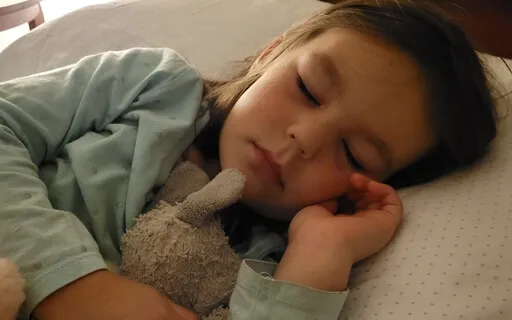
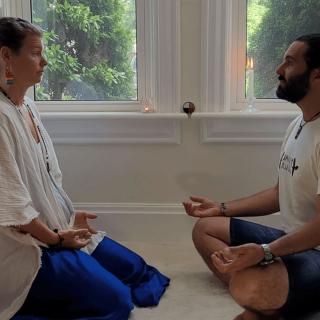
So welcome back to another session guys.
My name is Emilio Jose Garcia.
And today I want to talk about sleep training for babies.
And why am I choosing to talk about this topic today?
Because it's a topic that I wanted to share about for quite a while.
And it's something that we have done as parents is something that it has helped us a lot.
And I see a lot of a lot of frustrations around these for new parents.
I see lots of struggles.
I see lots of emotions showing up.
It's a very,
Very triggering topic for many.
It was a triggering topic for me when I became a father.
I felt I should know how to do all this stuff and I didn't.
And the motivation for me to talk about this,
So that you understand,
Is before we had Eva,
Our daughter Eva,
We have a good friend,
And she has three boys.
So we went to her house.
And I remember seeing them going to bed.
And it was 730pm or something like that.
And then going to bed,
It was easy.
It was fun.
They didn't know.
They didn't cry.
And they sleep the whole night for 12 hours.
And then we went another time for nap time.
And then one of them came.
And at that point,
I think they were probably one and a half or two years old.
And one of them came to her and say,
Mommy,
I'm tired.
And then she said,
It's okay,
Just go to bed.
And then I will come and pull you up with a blankie and give you a kiss,
But just get ready.
And I just see him.
He grabbed his teddy.
He grabbed his music box,
Something similar to this.
And then he went to bed by himself.
And then she just went after 30 seconds or a minute,
She went inside,
She gave him a kiss.
And then she came out.
And my wife and I were looking at each other.
And we both agree like,
We want this.
And guys,
This is something that I always invite you to do in every area of your life.
When you are watching something,
Doesn't matter what topic,
Doesn't matter what area,
Doesn't matter who is doing it.
When you see something that you like,
I want you to mentally say,
I want that.
I choose that in my life.
And when you see something that you don't like,
Mentally,
Without judgment,
You just say,
I don't choose this in my life.
I don't want this in my life.
So I do that all the time.
Every time I see a behavior that I don't like from someone,
A behavior that I don't like from myself,
I mentally will make a check mark.
I don't want that in my life.
I don't choose that in my life.
And then I will think,
What do I want instead?
So at that time,
My wife and I,
We said,
We want this in our lives.
We want our daughter,
When she's born,
We want her to sleep like that.
We want bedtime to be easy,
To be fun.
We want her to love sleeping.
And we're going to do whatever it takes to make that happen.
We're going to try our best.
Okay.
So at that point,
We asked her,
Like,
What are you doing?
Or what have you done?
How did you achieve this?
We want to know.
And then she shared with us,
Well,
This is a book that I followed.
I normally don't share about this because I have shared before with other parents and I have noticed a lot of resistance.
I have noticed lots of judgments.
I have noticed that other parents don't have such an easy bedtime with their kids.
And I feel guilty when I say that my kids sleep super well.
I have no problems with them.
And they sleep 12 hours a night and they have a two hour nap and I don't have to fight with them to go to sleep.
She said that she stopped sharing that because many parents were frustrated and upset when she was talking about that.
Because sleep training,
Sleep for babies is a very,
Very big deal for parents.
It is a huge deal.
Right now,
I have many new parents around my life and I always ask them and I don't share anything if they don't ask,
But I always ask them,
How's it going?
And sometimes they share how struggling it is,
The sleeping portion of it.
It's like,
I just don't know.
They don't sleep.
I don't know what to do.
They are eight months old.
And then I was just wondering,
Like,
Wow,
Like,
I wish I could just take everything I have in my head and put it in your head so that you can create something different.
And I know every baby is different,
But today I want to share what we did.
And I want to give it my own spin from my own organizational and executive functioning skill.
And from my own experience,
I want to share this method with you so that you understand the steps.
And that you can give it a try if you are a new father,
A new mother,
A new parent,
Or if you have anyone in your life that is becoming a parent,
And maybe they are open to exploring.
Okay.
So,
Good morning,
Amy.
Good morning,
Heidi.
So Heidi says,
Hi Emilio,
I have a hard time turning off before sleep,
So I feel like I need this session for myself.
I'm sending my love to everyone for something main and in wagon.
Yeah,
Thank you so much.
Amy says,
Yes,
Curious,
Have you looked into Gabe or Mate yet?
Amy,
Yes,
I have watched quite a few videos from him.
I also listened to an interview from Tim Ferriss and him.
And I love his work.
It's amazing.
Thank you so much for sharing that.
And I also someone shared Karen,
Karen something.
I don't have my journal with me here,
But someone shared another name of another coach for parenting that again,
I watched a couple videos and it's amazing.
I have it on my to do to keep watching.
So yeah,
It's very,
Very inspiring that you guys are sharing resources.
I love listening to all of those.
So let's dive into today's topic.
Okay,
So the book that I am sharing the book that I am talking about,
It's called 12 hours sleep by 12 weeks old.
That is the name of the book.
Okay.
12 hours sleep by 12 weeks old.
And the name of the author is Susie Giordano.
Okay,
Susie Giordano.
If you go online guys,
So don't worry about taking too many notes if you don't want to if you go online,
There are lots of blogs of people that are dissecting the method and they share the steps.
But basically,
I'm gonna share the main steps.
And then I am going to give you my point of view on these things.
Okay.
So the first thing is the two,
The eight weeks when babies are born,
And that was our experience,
The first eight weeks,
The first two months.
Don't worry about routines,
Forget about it.
It's gonna be chaos,
It's gonna be all over the place.
It's not a place for you to establish anything.
It's a place for you to be a parent.
It's a place for you to do skin to skin as much as you can.
So basically naked baby on naked you with a blanket and just sleep with him as much as you can or with her and give that baby as much love as you can as much time and presence as you can.
Because when babies come out of the wound,
Just imagine you are nine months in a beautiful cozy place surrounded by liquid that is warm.
And then you are listening the heartbeat,
Pum pum,
Pum pum,
Pum pum,
You are listening the breathing.
You are moving around,
You're being rocked all day long.
And then you can hear voices from your mama all the time and sometimes your puppy and I'm poking into in the belly.
So just imagine being there for nine months.
And then all of a sudden you come out into this world,
You feel cold.
It's noisy.
It's different.
You are separated from your mom.
And all of a sudden you are in this world that you have no idea where you are at.
It's so traumatic,
Right?
It can be so traumatic.
That's why the first two months,
Baby don't have the right way to do this training.
And it's the job is for parents to be as present as they can.
Okay,
And that's what we did with our daughter.
We tried to be there.
We tried to help her.
We tried to do skin to skin.
And my wife and I,
We were giving each other a little bit of space and time in the sense of I will go out with her for a couple hours so that she could get some sleep.
And then I will do the opposite.
And then I remember that my wife had a hard time doing the late evening shift.
So I will stay up until 11pm.
And then she will come out.
And I was on the couch with Eve on top of me.
And then she will come out at 11pm.
And then she will give me 11pm to 6am.
And then I will get up at 6am and I will take over.
So that's how we were doing it.
But the first two months,
There is no routine,
There is nothing to be done.
Okay.
When they are eight weeks old,
Two months,
That's when you start the training.
That's when you start doing the steps that I'm about to share now.
And then the goal is that by 12 weeks old,
So by three months old,
They sleep 12 hours a night.
And they have two naps a day,
One hour in the morning and two hours in the in the midday.
Okay,
So for us,
The end result was,
Eva was going to bed at 8pm.
She was getting up at 8am.
And then she was having a nap from 9am to 10am.
And she was having a nap from 1pm to 3pm.
Okay,
So 1pm to 3pm and up.
So in total,
She was sleeping 12,
13,
14,
15 hours a day.
Okay,
That was the end result of this method.
Okay,
And I will read the charts after.
Let me just share the steps so that I don't interrupt too much here.
So the method is starting at eight weeks old,
When they are two months old,
You have a few jobs to do here.
First,
I will recommend that you start tracking from day one,
You start tracking when your baby goes,
When your baby's feeding,
How much the baby's feeding,
Each time,
The times that they are feeding.
And then you track when they go pee,
When they go poo,
And all that stuff.
And there is a graph.
So I was using this spreadsheet that they gave us,
Or you can create your own.
But basically you are monitoring.
Oh,
My baby is breastfeeding at this time for this much time from right boob,
Left boob,
Or I'm giving it formula if you don't have like in our case,
We were hoping to breastfeed all the time.
But the reality was that Samantha wasn't producing enough milk.
And Eva was hungry and she was crying.
So the doctor told us,
You have to give her formula,
You have to supplement because she's not getting enough.
So that was our reality.
The reality can be different for each mom,
For each family,
Okay.
And this is another thing.
It's very frustrating to have expectations about something.
And then the reality checks,
Hits,
And it's completely different than what you were expecting.
Samantha tried pumping,
She tried breastfeeding,
She tried all the techniques that everybody recommended us,
And it just didn't work for her.
So some other moms,
They can breastfeed for a year or even two sometimes.
So every reality is going to be different.
But when you start monitoring how much they eat,
When they eat,
You start noticing the rhythm of your baby.
Okay.
And then once you have some data,
At week eight,
The first step is to start spreading the feedings.
Okay.
So that the end result of this process is that by the end of that,
Of these four weeks of training,
Your baby is going to eat every four hours.
So Eva was eating at 8am,
12pm,
4pm,
And 8pm.
And she was able to go from 8pm to 8am without feeding.
Okay.
So how do you accomplish that?
Well,
We knew that Eva needed 24 ounces of formula a day.
If you breastfeed,
There is a specific time,
You will know how much time you need the baby to feed for,
And the book talks about all the details.
But the goal here is to,
Instead of letting the baby eat sporadically with no agenda,
With no intention,
You start setting the intention that every four hours,
You are going to start spreading out.
But you are not going to start four hours right away.
Those four weeks,
You are going to start spreading the feedings,
Five minutes,
10 minutes,
Every day,
Five minutes or three minutes or 10 minutes.
And then how are you going to do that?
Distraction,
Distraction,
Distraction.
Okay.
So when Eva was crying because she wanted to eat,
We will distract her with something,
With a toy,
With a color,
With a sound,
Going for a walk,
With whatever.
And then she will get distracted for an extra five or 10 minutes,
And then we will feed her.
And then every day,
That was spreading more and more and more until we got to the four hours window.
Okay.
So that was a process that happened day by day.
It's not something that you just do right away.
Okay.
So that's the first thing.
The second thing is you establish what schedule do you want to create?
And this is the fun part that I feel is very,
Very important.
Some people work at night,
Some people work during the day,
Some people have different agendas,
Different schedules.
So this method works,
Doesn't matter what you decide.
But the goal is they sleep 12 hours,
One chunk of time,
And then they have one hour nap and two hour nap.
How you spread that throughout the day,
It is your choice.
In our case,
We decided to go 8 p.
M.
To 8 a.
M.
That's the two hour chunk at nighttime because that was for us.
And then we decided to do 9 to 10 one hour nap and then 1 to 3 p.
M.
To our nap in the middle of the day.
When Eva was one and a half or two,
She dropped the morning nap and she still did the two hour nap until pretty much when she was three.
When she was three,
It was an on and off.
Okay.
Sometimes she will nap,
Sometimes she won't.
But we always offer her quiet time.
Okay.
So the combination of spreading the feelings and the combination of creating that structure,
It's going to help to go to the next step.
That the next step is teaching your baby how to sleep.
And this is not a cry out method in the sense that you are not letting your baby cry for half an hour.
Like I have seen other methods do.
That's for me,
That's very traumatic.
And for me,
That feels like you are abandoning your baby there.
So this is my take on this.
The method says you put your baby in the crib.
Okay.
And then you put a timer for two minutes and then you leave the room or you leave the space and you let your baby try to go to sleep by himself or by herself.
And then when the baby starts crying,
You put the timer on and then maximum two minutes.
You can do one minute if you want.
You can choose the time.
But the method recommends two minutes.
You wait for two minutes.
And if the baby doesn't stop crying,
You go inside and then you won't pick the baby up.
You will just like do whatever you want to do to like calm him or her down.
I will go into the room.
I will play the music again.
I will touch her head.
I will sing her a song.
I will do whatever I could to soothe her.
I will give her the the soccer game.
What is it?
I have it somewhere here.
I will give her the little like soccer that she had or I will give her her teddy.
So the idea here,
Guys,
Is that you are teaching your child,
Your baby how to sleep and what's happening here.
Why two minutes?
Because babies don't know how to sleep.
It's something completely new that you are introducing.
So,
Of course,
When you leave,
They are going to feel abandoned.
They are going to have separation anxiety.
They are not going to understand what's happening and they are going to feel like threatened.
So they're going to cry,
Cry,
Cry because they don't understand what's happening.
But when you show up really shortly,
You are giving them the option to experience that uncertainty that is new to them.
But you are limiting how much they experience so that it doesn't become traumatic to them.
But you I feel in my heart that the goal here is to teach them how to sleep by themselves so that they don't need you to go to bed.
That's the goal here.
I want my daughter to be independent when it comes to sleeping.
I want her to love sleeping.
That was our main intention here.
So we started to do that method.
And after repeating that two minute a few times,
She started to go to sleep by herself.
And then we were amazed when the whole night went by and she didn't wake up and she slept the whole night for 12 hours.
And we were like,
Wow,
This is great.
This is amazing.
So another part of this method is to create a routine.
OK,
A bedtime routine.
The routine that we created was.
She got on her jammies and then we gave her the little like soothing sucker that she had and then she had her music box.
We will put this music on.
OK,
Now it almost doesn't work anymore because it's been really used.
But it's a little music box that we will wind and then that music signals her that this bedtime we will give her her teddy.
That is like a little blankie with a lamb head that she has at school.
I don't have it here because that's her best friend.
And then we will try to make the room dark as dark as possible because that really helped her go to sleep.
And sometimes we play music like if this stops,
We will play another kind of music.
But what happens with the routine,
Guys,
When you repeat this.
OK,
What do you think is happening here?
Eva started to connect the dots.
She started to think,
Hey,
I'm getting in my jammies.
Hey,
They're giving me my sucker.
Hey,
They're giving me my teddy.
Hey,
I recognize that music.
Hey,
The room is getting dark.
Oh,
Oh,
Papi is saying good night.
He's giving me a kiss in the cheek and then he's disappearing.
But when that happens a few times,
Then she connects the dots and she understands,
Hey,
It's safe.
It's time to sleep.
I love sleeping.
Bye bye.
And then she will go to bed and she will just sleep.
But of course,
It takes a little bit of time for babies to learn that because they have never done it before.
So that's why I find that this method,
It's really gentle,
Is really helping the baby explore and get get in touch with that anxiety,
That separation anxiety that it is necessary to overcome.
Babies need to overcome that.
But if you don't give them the chance to experience it and you don't prove to them that you are there,
That you are that they are safe,
That you are going to show up,
That they don't have to be picked up,
That they don't need that to in order to go to sleep,
They will develop that habit.
And the beauty of this structure is that babies thrive on routine because they understand what's going on.
And Eva understood when she was being fed,
She knew when she was going to bed.
And you could say sometimes that she was kind of smiling and she was getting close in her blanket because she was tired and she understood what was happening.
She understood.
Yeah,
I really want to go to bed.
And then she would do this with her teddy and then she would just just stay there.
So sometimes we had a webcam on to see what she was doing.
And then sometimes she would be awake with her teddy like this and then she would be looking at the ceiling.
And it was beautiful to see her having a quiet time by herself without crying and really enjoying that time.
You could see that she was enjoying that time.
OK,
So this is basically the method.
OK,
So you create you start spreading the feedings at week eight,
You start this training.
So you don't start before that.
And babies need to have a specific weight,
Too.
OK,
So your doctor needs to be OK.
They need to have a specific weight.
If they don't have a specific weight,
You have to wait because they are not going to be ready for you to spread the feedings.
OK,
So once you have that at week eight,
You will start spreading the feedings until you feed them every four hours.
And then in our case,
We will do four feedings a day and every feeding will be six ounces.
Six ounces times four.
That's 24 ounces.
That's what she needed to consume on a daily basis.
So that's the beauty of this method.
And then you will have a routine that repeats every day.
And when they start noticing the routine,
When they get used to the routine and when they start crying and you show up right away after two minutes,
Every single time and you are calm and you are not like expressing negative emotions and you are there with love,
With your open heart,
Touching them,
Singing to them,
But not picking them up.
They will understand that is safe,
That they are just there,
That puppy and mummy will come up if they need them.
They are not abandoned.
And then they will start trusting the process and they will start enjoying the process.
Okay.
The best thing about this routine is that many times we will not say no to friends going to their house or going traveling or going somewhere else because we have to be home to do the sleeping routine.
No,
We can take that routine somewhere else.
And this was the wonderful piece that we took out of this,
That we had a crib,
We had the music box,
We had every component that we needed from that routine.
And we will take those with us.
And if we go to a friend's home for a dinner,
We will take Eva with us.
And then at eight o'clock,
What,
7.
30,
7.
40,
We will start the routine and she will go to bed anywhere.
Can you imagine your baby going to bed anywhere?
At grandparents house,
At our friend's home,
We went camping,
We went to so many different places and she will just sleep.
Sometimes in the stroller.
We will do the routine in the stroller and then she will fall asleep in the stroller and then we will just be walking.
I use that for nap times so many times.
I went running,
I went rollerblading,
I went biking and she was in the bicycle trailer just having a beautiful nap like this for like two hours or one hour.
So that was the beauty of this process that once we did it,
Once it became consistent,
All of a sudden,
Now we could plan.
We know that between one and three p.
M.
We have free time to do stuff.
We know between nine and ten we have free time to do stuff.
We know between eight p.
M.
And eight a.
M.
We have free time to do stuff.
And that was beautiful.
Of course sometimes she will wake up,
Of course sometimes she had tooth pain,
Of course sometimes she was sick.
Absolutely.
But that wasn't the norm.
That wasn't the reality of it.
The majority of the times she will go to sleep with no problems.
And if she didn't,
We will just repeat the process a couple of times.
And just the last thing I'm saying and then I'm going to read the chat and answer questions.
One time I remember that Samantha's parents,
They took Eva and we gave them the routine.
And we told them like,
Hey guys,
We are doing this sleep training and because she's still like,
I think she was three or four months old at that time.
She's still very susceptible to changing the routine.
She's still not old enough to take care of her routine.
And the method I think says if you get out of the routine for one or two nights in a row,
I think she reversed.
She will revert back to be wanting to be held.
So what happened?
I think she went to their house.
I don't think they followed the process.
I think they picked her up right away when she cried.
They didn't let her like be for a little bit.
So she came home and she just wasn't going to sleep.
We had one night.
It was horrible.
We couldn't,
We couldn't calm her down.
She didn't want to go to sleep.
We thought she was sick.
We gave her medicine.
We were holding her up.
We don't know what's going on.
She was like losing it.
Right.
And then after two or three nights of this chaos and she wasn't sleeping well,
We were not sleeping well.
We talked with our friend,
The one that has done this with three kids,
And then she told us,
It sounds to me that you have to retrain her.
It sounds to me that she has been out of routine for like too long and now she,
She forgot.
So you guys have to retrain her.
So when she told that us,
It's like,
Yeah,
OK,
Let's do that.
And then I remember my wife saying,
OK,
Emilio,
How can we make this fun?
How can we make this in a way that we are not going to be just waiting for her to cry and looking at the timer and we are going to get stressed and emotionally charged?
And then she said,
I am going we are going to make tiramisu.
She said,
I'm going to have everything ready to make tiramisu.
And when she goes to bed at 8 p.
M.
,
We are going to do the retraining process and we're going to be making tiramisu at the same time.
So that way,
When we put the timer for two minutes,
We are not hearing her cry and losing our shit because she's crying.
So we will be making tiramisu,
Having fun.
And when the timer goes off,
We will go and then go inside and console her.
Guys,
We did that three times.
We put the timer one time for two minutes.
We went inside.
We calmed her down.
She stopped crying,
Got out.
And then Samantha went a second time and then came out and then she lasted a few more minutes.
And then I went the third time and then she fell asleep.
Twelve hours until 8 a.
M.
The following night,
Guess what happened?
She was on routine again.
She didn't fight.
She didn't cry because she understood.
I remember now.
So this is something very interesting that happened.
And now that she's older,
We can take her out of routine and it doesn't affect her as much.
Sometimes we go out and she wants to stay up and sometimes she stays up until 11 p.
M.
It's like,
Wow,
It's late.
But sometimes it's good to break routines,
Too.
It's good for her flexibility to to be exposed to something different for a short amount of time.
So I also thrive on seeing her thriving with no routine sometimes so that she can be flexible and every kid is going to be different.
So you have to make sure that you are being flexible,
You are reading what they need,
But you are not caving into their crying because they want to be held.
And that's not really helping them at the end.
So this is my description of the method.
And this is what I wanted to share with you guys.
Again,
Don't take this like this is the only method to do this.
This is the one that worked for us.
I really wanted to share it with you so that you know it.
If you don't like it,
Don't do it.
I'm not saying this is the method that you have to follow.
This is what we did.
There are many ways of doing sleep training.
There are many culturally ways of teaching kids how to sleep.
There are many ways of sleeping physically,
Because sleeping is the reality for many people.
Sometimes you don't have an extra bedroom.
Sometimes people have their babies all night long.
Do whatever works for you.
At the end of the day,
I feel that you have to do whatever makes you feel well,
Whatever makes you feel sleep well,
And whatever helps your baby sleep well.
If those components are in place,
How you get there,
It doesn't matter.
In our case,
This is how we got there.
So now I'm going to read the chats and I'm going to answer questions if you guys have some.
Alina says,
Wondering if you ever co-slept with your child as part of your process.
I have done it from day one and actually love it.
It was also done with me as a child and I have found memories of it.
Now she's two and a half and I still love co-sleeping,
But I realize I should slowly transition.
Or at least start researching how to transition.
Not because I'm tired of co-sleeping,
I still love it,
But just because she will get older.
Okay,
So Alina,
Same thing.
If that works for you,
If you got a good night's sleep,
If your child got a good night's sleep,
If that's what works for you,
Just do it.
Like in my case,
I move a lot,
Co-sleeping wasn't safe for me to do because I really move a lot when I'm sleeping and I was afraid of like pressing her or being on top of her and me not realizing that.
There has been some deaths with co-sleeping with babies.
That's real.
And it's something that we didn't enjoy that process.
We tried it and it wasn't working.
And then she was depending on us to go to sleep.
We couldn't put her down at 8 p.
M.
And us keep doing stuff until 10.
We had to be there with her.
If not,
She wouldn't calm down.
So we didn't enjoy the process and it didn't work for us.
But that doesn't mean that it wouldn't work for you.
So how to transition out of that?
The older babies children get,
The more difficult it is to transition into a different reality,
Into a different process.
It is doable,
But I have heard friends that they have waited until children were eight months old,
One year old,
Sometimes older.
And some of them,
They even hired a sleep trainer and they are letting the child cry for like over half an hour.
And to me,
That feels,
That doesn't feel right.
I don't know why.
That feels like I am just abandoning my child for half an hour crying.
That sounds too traumatic for me and I didn't want that in my life.
So that's why I decided to do the two minute interval sooner.
And I wanted her to be an independent sleeper so that she loves sleeping by herself and she doesn't need us to do it.
Of course,
Co-sleeping is another option.
Again,
This is a personal choice and there are many ways of doing this.
Okay.
Mary says,
Become the observer of your baby.
That was one of the points in the book too.
Yeah.
And that was Mary.
That was,
That's why like keeping track of when they are feeding,
When they are going to the bathroom and all that stuff,
You are starting to notice how they flow.
You are starting to notice their circadian rhythm,
Right?
When they are sleeping naturally,
When they are eating,
How much they are eating and then working from there,
You start doing the spreading technique.
And then you get to decide what kind of schedule you want to create.
Amy says,
Can someone tell me the title of the book again?
12 hours sleep by 12 weeks old.
Okay.
So let me read.
Hey Emilio,
This is from Caroline.
Hey Emilio,
I am wondering if you can share tips on how to get me to bed on time.
Often I'm staying up too late working.
This is because I'm trying to improve with getting work completed in a more timely manner.
It's not good because I wake up around 5 a.
M.
Thanks.
Caroline,
I would recommend to really start noticing what your circadian rhythm is.
Naturally,
If you didn't have things to do,
If you didn't have to set an alarm,
What is your sleeping preferred time?
In my case,
11 p.
M.
Is when I start to notice like I really need to lay down and 6,
7 a.
M.
Is when I wake up.
Okay.
So that's my natural flow.
It has always been like that.
11 p.
M.
To 7 a.
M.
Is my sweet spot of sleep.
That's what I do naturally.
I don't set alarms and I normally wake up before 7,
But I like to stay in bed.
So start noticing and start practicing a different routine.
If you want to create a different routine,
You start to start practicing that.
And how can you start creating a routine that works for you?
The same way that babies,
I was having the music,
I was having the teddy,
I was putting the yamis on.
So what kind of routine can you create for yourself that your brain starts entering that phase?
Some of that routine is lowering the lights so that you don't keep producing melatonin and serotonin.
So you change that chemical so that you start going to bed.
So lowering lights,
Lowering distractions,
Maybe not being on screens,
Maybe listening to something soothing,
Maybe having a bath.
Start exploring different ideas.
Okay.
Start exploring auditory ideas,
Visual ideas,
Movement ideas.
Taking a bath,
That's a sensory idea that you can try,
Right?
Maybe a cold bath or maybe a warm bath or maybe start trying different things until you find some people have a rocking chair.
And that kind of static movement combined with maybe lowering the lights and combined with maybe listening to something soothing like running water or a meditation or something.
You do that for five minutes and then you will notice like,
Wow,
I am passing out now.
I notice that I sit on the couch and if I lay down and we lower the lights and we are watching something,
If I lay down or I get comfortable,
I can tell you that I know.
Fact,
15 to 20 minutes into that and my eyes are like,
I have a hard time staying awake.
So that's a really good way for me to slow down.
Right?
So again,
Start trying different techniques and notice what works for you.
And be intentional about your choice.
Maybe your choice is that you are a night owl and you choose to work at nighttime because that's your peak time and you choose to sleep more during the day.
If that's an option for you,
Start honoring your energy cycles in whatever way works for you.
Mary says children thrive off of routine it is needed so they know what is going on.
Like you said.
Yeah,
Mary,
I totally agree.
They thrive when they understand what's happening,
When they know what's coming next.
They feel safe.
They feel supported.
They remove anxiety and they can expect.
They transition better from task to task because it is familiar and then they have the capacity to have fun and enjoy.
When they don't know what's happening.
And I honestly I notice this in many kids around me.
They don't have routines.
They don't follow a specific thing.
And you just see them that they are frustrated.
They are tired.
They want to sleep,
But they don't know when they are sleeping.
Maybe they are hungry,
But they don't have a specific time where they eat.
So I feel that they are frustrated because they don't know what to expect.
They don't know where things are happening.
And then they need their mom or their dad to go to bed so they cannot sleep alone.
And then all of a sudden,
Mom has to always be there.
And I don't know.
I don't like that personally.
I don't have.
I don't like being dependent on someone else to sleep.
And I don't want my child to be that way.
But that's my own choice.
And again,
It's not right or wrong.
This is my own choice.
And you get to choose what you want.
OK.
Erin says our routine changed when we converted to a toddler bed and my son realized he could get out of bed.
Now he's in a twin bed at five years old and won't fall asleep unless I am with him.
If I leave his room when he's still awake,
He gets up to play.
Once asleep,
He sleeps through the night.
Yeah.
Erin,
That was interesting.
And it was interesting to see the transition for Eva to go from a crib to an open bed.
And I remember that I was very afraid of her doing that,
Getting out of bed,
Coming to get us,
Getting distracted.
And I was so surprised when we transition heading to the bed and then we say,
Eva,
This is your bed now.
And then we put some pillows on the side and then it was amazing to see that she didn't get off.
She didn't get down to bed many times.
And then when she started to do that,
She will come to the door and then she will open the door and then look at us like this.
And then we will say,
Eva,
Are you OK?
Do you need anything?
And then she will just smile and say no.
And then she will just go to bed by herself.
Sometimes she is playing.
And then sometimes we let her play a little bit and then do her own thing.
And then she normally goes to bed by herself.
But sometimes if we notice that she's getting too excited,
We will go inside and then we will say,
Eva,
It's time for bed.
It's time to have quiet time.
It's time to go to bed.
Grab your teddy and then it's time to go to bed.
OK.
It's not time to play right now.
And then she will understand that.
So I think that for us,
It was a priority for her to be able to sleep by herself.
In her room,
Because we wanted that in our life.
We wanted her to love sleeping.
We wanted her not to depend on us and we wanted her to become independent.
Now she goes by to sleep by herself.
Sometimes we shut the door and then we say,
Eva,
You can choose whatever you want to do.
She has access to a light that she can turn on and off.
She has access to all the toys.
And then we just tell her like Eva,
If you go to bed now,
It's fine.
And if you don't,
It's your choice.
But just be quiet.
Please don't make a lot of noise.
And when you are ready,
Just go to bed and go to sleep.
And then she just does that.
And the majority of the time she will choose to go to bed and go to sleep.
And sometimes she gets off.
She plays a little bit.
She colors or she does whatever.
And then she will go up and go to bed by herself.
So I love seeing that.
I love seeing that independence.
And I love that she will come and get us in the morning and jump in bed.
And sometimes I go to sleep with her if we are at someone else's home.
And it's no problem because I put her in the bed first and then she falls asleep.
And then I come to bed whenever I'm ready and then she doesn't get bothered.
We can transfer her if we want to to a different bed.
No problem.
We transfer her to the car from the car to the bed.
And she doesn't cry.
She doesn't get upset.
And she understands what's happening because we tell her before.
It's like,
Eva,
You're going to go to bed at this bed and then Papi and Mami are going to transfer you to the car and then we're going to go home and then you're going to go to your bed.
OK,
Is that OK?
And then she will say yes.
And then when it's time to go,
I will go there and I will say,
Eva,
It's Papi,
We're going to go to the car now.
Just relax.
And then she will be OK with it.
So be gentle with transitioning routines and always like emotionally self-regulate how you feel.
Parents need to model that.
Don't get upset.
Don't get frustrated.
Try to stay calm and try to state what's happening.
Try to stay what's happening very clearly with a nice tone of voice,
But following through.
OK,
So Eva,
You are going to bed now.
Eva,
There is no more play now.
Eva,
It's one and a half hours past your bedtime.
You already had enough playtime.
I want you to go to bed now.
And if she doesn't do that,
Then I say,
OK,
Eva,
If you don't go to bed now,
Teddy,
Your best friend,
Teddy,
Is going to sleep with Papi.
So you want that to happen or you want to go to bed.
So we try to create some sort of consequences.
And she always chooses to go to bed.
So we never have to get there and grab Teddy away from her.
Sometimes it's normal to lose patience.
Sometimes it's normal to don't be calm.
But our job is to try and become as much as possible,
Especially when you are transitioning.
So remind yourself why you are doing this.
Remind yourself of the benefits of what you are doing,
The intention behind it and verbalize that to them.
Eva,
I want you to go to bed because I know when you sleep a lot,
You will have energy.
And tomorrow we're going to be able to play more.
We're going to be able to have more fun.
Do you want to have more fun or do you want to feel tired and cranky?
What do you want?
And then she will say,
I want to feel well.
So what do you think?
Do you think if you go to bed now and you get a good night's sleep,
Do you think we're going to be able to have more fun or less fun?
And then she say,
More fun.
So what do you want to do?
I want to go to bed.
Papi,
OK,
Let's go to bed.
So start talking to them as much as you can and you will start noticing that they understand what you are doing.
Amy says,
My mother let us scream for three,
Four hours until we were so exhausted we fell asleep.
I know I remember this,
Even though people say I couldn't remember things that young,
But it is excruciating to hear babies cry and attended to.
It is abandonment and traumatizing to me.
Amy,
I totally understand what you are saying.
And I totally understand that it feels that way because you have a trauma around that.
Three to four hours of being abandoned is a humongous amount of time for a child.
That's that's that's not acceptable.
And my criteria,
That's not acceptable.
Something is happening there and they are not getting the support that they need.
Two minutes of crying.
One minute and a half of crying.
And then you showing up with your open heart,
With love,
With support and you doing this not because you are being selfish,
But because you really want your baby to thrive sleeping,
You connect with the final goal of teaching them how to sleep by themselves.
It is a necessary process when you are creating a new habit in your life.
How do you feel?
Do you feel excited or do you feel fear?
Do you feel afraid of the uncertainty of this new thing that you don't know how it's going to unfold?
Do you need to be exposed to that uncertainty and get messy until you figure out what's going to work for you?
That's a necessary process.
If you avoid that process,
You will never get to the point of doing something new because you will never allow yourself to mess up,
To make mistakes,
To learn so that you can create a new habit and you can start doing something different.
How are supposed,
How are kids supposed to learn how to face that anxiety,
How to be by themselves if they never get the opportunity to experience that?
Just think about that.
And I'm not saying abandon your child for three hours.
That's,
I will never do that to my child.
Never,
Ever.
I have never done that.
Two minutes has been the max.
No more than that.
And sometimes 90 seconds.
And that's enough.
And we didn't have to do that for more than four or five times at a time.
Four or five times.
That's it.
And then after that,
The Reaper FX were amazing.
So I think it's worth it.
I think it might,
From my personal point of view,
I think that's a necessary step that they need to,
They need to be exposed to that so that they can start developing the skills to cope with that.
If they never experience that separation anxiety,
If you are always there for them and they are never alone,
How can you teach them how to be alone?
How are they supposed to feel well in their own presence if they are never,
If they never had the opportunity to do that?
That's why in our case,
We also decided from a very early age,
She started doing home daycare when she was three or four months old.
Two days a week.
And then we started three days a week.
And then we started four days a week.
And now she's on four days a week.
But she was going to daycare.
She was staying over with Samantha's parents.
We were going to the gym and she was staying at the gym daycare for two hours.
We had a babysitter that would come home and we had friends that we would partner to help each other out.
So she was exposed to different environments,
To different people,
To different energies,
And that helped her become independent,
Become comfortable,
Understand that things are not always the same.
And now she thrives.
She can go with anyone anywhere.
And she has fun.
She's comfortable.
And she doesn't miss us.
She misses us,
But not to the point that she's traumatized or that she will cry forever.
She's able to do her own thing.
She's able to have fun.
She's able to adapt to the routine of the place and the people that is taking care of her.
I think that's priceless.
I think that teaching is priceless.
So let me see if I such a lucky little person to have you.
Thank you,
Caroline.
Wow.
Even as an older parent,
I have learned more from you than any parenting book I have ever read.
Thank you.
So many parents need to hear this to be the best parent they can be.
Thank you so much,
Beth.
And again,
When I remember when I was becoming a father,
Guys,
And everybody was telling me resources,
Books,
Podcasts to listen to.
And I was so overwhelmed.
I was overwhelmed.
I just couldn't read anymore.
I was feeling like I don't have the capacity to to to absorb anything else.
I don't want more advice.
I just want to see what I like.
And that's when I started to pay attention to other parents,
Other families.
And I started to recognize I like that.
I don't like that.
I want that in my life.
I don't want that in my life.
And that's how the sleeping technique came,
Because my wife and I,
We said we want that.
And we made the commitment like,
Doesn't matter how tired we are,
Doesn't matter how difficult it is.
We know that this is for a higher cause.
We know that what we want is more important than how we feel in the present moment.
And we are going.
We made a commitment with each other to support each other when we were feeling down to support each other when she was crying.
And we just quit our whole hour shit because we were like desperate.
We wanted to go inside and having a partner to do this with was really amazing and very necessary.
I don't know if I was if I would have been able to do this alone.
Yes,
Myself.
I honestly don't know.
Don't think so.
Mary says,
Yes,
Talk to the baby and let them know everything they understand,
Everything you tell them.
Babies are extremely smart sponges.
Yeah,
Absolutely.
Mary,
I totally agree with you.
They understand way,
Way more than you think.
And they understand way more from what you do,
How you feel and how you behave.
That what you actually say.
But having conversations is really important.
Including them in what you are doing is really important.
Telling them what you are doing and why and being excited and sharing that excitement with them.
It's very important.
They really absorb everything from you and they really absorb your emotional state.
That's why when you are doing this process,
One of the most important things that you can do when you are doing the two minutes waiting for them to go inside the room and help them.
You need to get in a state of calmness,
Love,
Compassion,
Really grounded.
And you just go inside with such a presence and then you just touch them.
And you say,
You are OK.
I love you.
You are safe.
You are going to love sleeping.
It's a wonderful thing.
And I am here and I will come back any time you need me.
I don't need to pick you up.
You are safe and I will come back any time you need me.
So don't worry.
You are not alone in this.
I am here for you.
Papi is just outside.
And then just repeat that over and over.
Sing a song.
Stay there for as long as you want.
You can stay there for as long as you want.
You can stay there for an hour.
You can sing a song.
You can touch her head.
You can do whatever you want.
But just don't pick them up,
Because when you pick them up,
You are breaking that routine and they are learning,
Oh,
When I cry,
He's picking me up.
And then I want to cry more because I want to be picked up,
Because that's what safety means to me.
So you are teaching them how to learn a different kind of safety,
A different kind of structure.
And that's why the cry out method of a two minute is it's I feel it's necessary.
Hey,
This is please put this information into a track on Inside Timer that we can share with our family and friends.
Absolutely.
Hey,
I will totally do that.
I will place this recording inside Inside Timer.
Erin says our teenage boys with cell phones and video games are another story,
Too.
They want to stay up all night.
No one ever regulated their caffeine intake until recently when they came to live with us full time.
We are currently in an adjustment period.
All advice is helpful.
Yeah.
Erin,
I hear you and I'm not at that stage yet.
I don't really know how to deal with that.
But that's why it's I feel it's so important to establish these routines from really early on,
Because I feel that when they have these kids from early on,
They are more resilient.
They understand how to do it and they will make different choices.
I don't know how my daughter is going to be when she's 10,
12,
15.
I don't know if she's going to start video games and it will be uncontrollable.
I hear this story from many parents and I always tell in my head,
I don't choose that in my life.
I don't know how I will make that happen.
I don't know if I will be able to make it happen,
Because at the end of the day,
Babies,
Children,
Toddlers,
Adolescents,
They are independent people.
They have the ability to make their own choices.
And we parents can try our best to micromanage and to provide safety.
But there is an limitation of how much we can do there.
And our only job is to try and be a role model,
Try to offer a supportive,
Compassionate,
Loving environment for them.
Teach them how to be independent,
Teach them how to make good choices,
Teach them how to find themselves,
Teach them how to be themselves,
Creating space for them to choose how they want to be and accept whatever comes out of that.
And sometimes that can be really hard.
But I feel that I am trying to do that with my daughter because I don't want this to get to a situation where it becomes uncontrollable and I have no idea what to do.
At least I'm trying my best and that's the best I can do.
And I feel that every parent is trying their best with the knowledge they have to create the best environment they know how to do at that time.
And Erin,
In your case,
You are transitioning.
You have kids that maybe are coming to your life with different,
Different,
A different sense of reality,
Different routines,
Different norms,
Different rules.
And now you are trying to change that.
You are trying to question that.
And if that's if that has been the reality for a long time,
Just be aware that it's going to take a little bit of time.
It's going to take resilience.
It's going to take ways,
Finding the best ways to connect with them,
Finding the best ways to make them feel loved and supported.
Yeah,
It's a really tough situation to be in.
And I don't even know.
I have the answers for you,
To be honest.
I don't know.
I know that love,
Opening your heart and being compassionate and at the same time being gently strict,
Gently speak your truth and keep in mind what you are trying to create for them.
That deep inside is going to be something better.
And you know that it's going to be for their better selves to just keep in mind that when you are doing things and act from that place of support,
Love,
Compassion,
And you will start finding ways on how to change those things,
Hopefully how to create different routines.
Yeah.
OK,
So what else?
Mary says exactly if a baby falls and cries,
I say,
It's OK,
You are OK.
I don't pick them up.
And they stop crying right away.
Yeah,
Mary,
Kids will use cry because they cannot talk.
So when they don't feel safe,
They will cry.
And if they don't understand what's happening,
Of course,
They're going to cry.
And when they feel picked up,
That's what they have received all the time.
So that's what makes them feel well.
But if you are trying to transition into a different strategy,
If you want to teach them that sleeping is safe,
That they can do it themselves,
That you are going to always be there for them,
But they don't need you to be beside them or pick them up to sleep.
You are teaching them how to sleep alone.
And that's why it is necessary for them to cry a little bit so that they can be exposed to that new thing and they can discover that it's not bad.
They can discover that nothing happened.
They can discover that they didn't die.
They can discover that,
Oh,
Every time I cry,
Papi comes,
I'm safe.
He doesn't pick me up,
But that's OK.
And then when you repeat that a few times,
They will connect sleeping in my crib and not being picked up is safe.
It's OK.
And then they will relax into it.
But they need to be exposed first to that a little bit.
Not too much to make it traumatizing,
But just a little bit so that they can understand and they can overcome it.
So I hope that this is helpful,
Guys.
Yeah,
You are teaching them to deal with their frustration even.
Yeah,
So that's everything I have for today.
Really,
Really understanding that the necessity of helping your children be exposed to that uncertainty for a little bit so that they can learn from it and they can develop the skills to overcome it by themselves.
So that's what I see this method is all about,
Allowing them to cry for just two minutes.
Just make it short and sweet,
But long enough for them to really experience that new thing that they need to understand and overcome.
Yeah.
So,
Guys,
Thank you so much for being here today.
I hope that this session inspires some new realities in you.
Hopefully some new parents can get value out of this.
For Samantha,
Myself,
I can tell you that this method transformed the way we lived.
It transformed the way we interact with our daughter.
It gave her the skills to sleep wonderfully since she was two months or three months old.
So 12 weeks old.
We are always amazed at it.
And we sometimes choose not to talk about it with people because the truth is that many parents are stuck in the problems that they are having,
But they don't ask for anything.
They don't really ask.
They are not open to and they just want to talk about their frustrations.
They just want to talk about what's not working.
And I say I don't choose that in my life.
So if they ask,
I always share this method.
I always share the book.
But many times I feel sadness in my heart because I see what it could be.
But I also know that I'm not the one to fix everything in life and I am not responsible for it if I'm not being asked.
So if you guys feel inspired to share this episode with other parents,
Please do.
But always accept that maybe they don't want to listen to it.
And that's fine.
Not everybody is open to ideas.
Not everybody wants to try something new.
And so many times we are just,
As parents,
We are overwhelmed and we are doing the best we can and we don't have the capacity to do one more thing.
But the truth is that investing in this one thing can open up so,
So,
So,
So much.
Sleeping is really important for me and having a consistent routine that I understand and that my daughter understands has created a wonderful life for us.
That I see my daughter thriving.
I see her loving sleep.
I see her not having many tantrums,
Not being frustrated too much and really dealing with emotions in a very,
Very healthy way.
And I know that all of that is in part because she got good sleep.
Sleeping is so important for kids.
During sleeping is when they are like developing many,
Many things in their bodies,
In their brains.
Sleeping is such an important thing for their development.
And if they don't get enough sleep,
Like 15 hours a day is the recommended,
16,
14,
Somewhere around that.
If they don't get as much sleep,
They are going to suffer.
They will suffer.
And it is our responsibility as parents to do our best to provide that safe environment for them to sleep well.
So I hope that these ideas,
I hope that this method or parts of this method can help you create a better sleeping environment for your children or for the children that are coming into your life.
Maybe you are grandparents.
Maybe you are uncles,
Aunts.
Maybe you are good friends.
Maybe you are a neighbor.
Now you have steps,
You have resources,
You have something tangible that you understand and that you can put into practice.
Okay,
So thank you guys so much for being here.
I am reading the last comments.
Sleep is also good for adults too.
Absolutely Heidi.
I love sleeping and I don't function well when I don't get enough sleep.
I'm not a good person.
Elena says hold on to your kids by Dr.
Gordon Neufeld and Gaber Maid.
Yeah,
That's another resource.
Thank you Elena for that.
Part of bedtime routine is we each say three gratefuls.
Beautiful,
El.
So guys,
Thank you so much for your presence,
For being here and yeah,
And I will see you.
I'm gonna be taking a break next week.
I'm not going to schedule lives next week.
I need a break.
I want to create content.
I want to work on my new course and I want to have a little bit of time with Samantha in the mornings too on Thursday.
So I'm gonna take a break from lives for the next week and then I will see the topics that come up for the following weeks.
As always,
Join my circle if you haven't and share any topics that you want me to cover because it's always nice to cover things that you guys are interested in.
Okay,
And yes Amy,
There is a Zoom session today.
I will be doing that.
You can find more information about that on my About link on Inside Timer.
Okay,
I will be talking about decluttering tips today and that will be a Zoom live.
That will be a live video conference.
Okay guys,
Have a wonderful day and I will see you in the next live.