20 will be the first power?
4 is the power of love.
Hi guys,
Welcome back to another session.
Today's topic is embracing your digital life in your home.
Good morning CJ,
Good morning Kevin from UK.
Thank you guys so much for connecting today.
Very happy to have you here as always.
I would like to get started with a little practice with my singing bowl.
Let's just together close our eyes and just allow ourselves just a few seconds of silence and relaxation.
Okay?
Good night.
Just remind yourself,
Why did you choose to be here today?
Why is this topic important to you?
What would you like to get out of this session today?
Thank you guys for doing this practice with me.
I will invite you to share in the chat what would you like to get out of this session today.
I'm just curious to know before I get started.
Is there anything specific that you would like to get out of today's session?
Is there any frustration that you are experiencing with your digital life in your home?
Maybe your habit around technology?
Maybe how much time you are spending on devices?
Maybe healthy boundaries and separation between work time,
Family time,
Personal time?
Just share in the chat,
Speak up.
What is coming up for you around this topic?
What is something that you would like me to cover or to discuss about?
I would like peace and more joy.
Thank you,
Julia.
What does that mean exactly?
What does peace and more joy mean to you?
It's important to define that because peace and more joy is very broad.
So I don't really know how to take action on that.
Less stress.
Beautiful.
Are you happy to go deeper in here with me,
Julia?
What's causing you stress right now?
What are the causes of your stress right now?
Are you aware of them?
Amy,
Yes,
This is recorded today.
It will be available on my podcast or here on Inside Timer too.
I spend most of my time on Inside Timer,
But I am here to learn in general.
Amazing.
Thank you,
Monica,
For sharing.
Too many requirements from my work.
Okay,
So that's what's causing stress from you.
Amazing.
Yeah,
So when it comes to digital life and your home,
This is a topic that I extracted from my course Creating Your Peaceful and Clutter-Free Home.
This is a course that I have that is available.
If you want to dive deeper into that,
I will invite you to enroll in that course.
But this is an important topic because when we are designing our physical spaces,
Technology and the digital life is so prevalent these days,
Right?
Majority of us have computers,
Phones,
Tablets,
TVs.
We have a digital life to maintain.
We have a digital life that we are interacting with.
And that digital life enters our homes in very different ways.
And depending on how you manage and how you embrace that digital life in your home,
That's going to affect and dictate your routines,
Your habits around that technology,
Around how much time you spend with devices,
How you use your devices,
Where you use your devices.
And if you are noticing frustrations,
Okay,
This is the entry point for you to get started finding answers.
Okay,
As Sanja says,
How to use the resources in Saitame without becoming overwhelmed by all of the content and all of the options.
Yeah,
Beautiful.
That's such a nice,
That's such a nice awareness.
And this is something that we all feel that way with digital life.
It's infinite.
You go to YouTube,
It's infinite.
You are here on Inside Timer,
It's infinite.
There are millions of people here,
Thousands and thousands and thousands of tracks that you will never be able to keep up with.
Okay,
But that's why it's important to really be intentional.
And this is the key word here.
And it's always the same key word,
Being intentional about what do you want from your digital life.
Because at the end of the day,
Your devices,
Technology,
All the digital life that you have access to,
It should be serving you,
Not overwhelming you.
And you have tools and strategies that I'm going to share some of them here to help you just do that.
To help you leverage the power of that technology,
Reap the benefits of it,
But try to be intentional around the negative side of it.
That is like the destruction,
The maybe the addiction to it,
Maybe the fear of missing out,
Et cetera,
Et cetera,
Et cetera.
Okay,
So that's why we have these two things here.
On one hand,
Technology is really convenient.
It's very useful.
It's very practical.
And it makes our lives easier in so many ways.
And it gives us access to content,
Access to experiences,
Access to meditations,
Access to life sessions like this one.
So it's beautiful.
It's such a great learning opportunity.
But on the other side,
If we don't manage that with intention,
If we let that technology and that digital life control us,
Then our mental health is going to be affected.
We are not going to be doing what we want to be doing.
It's going to enter our personal life,
Family life,
Social life.
And then we're going to be in a state of chaos,
Stress,
Anxiety,
Disease,
Like just not feeling comfortable and always feeling that you are not in the right place at the right time.
That's why it's very important to really set the intention about what do I want from my digital life.
And the way you set up your digital life and your devices in your home can have a huge impact in how you interact with that technology.
Let me share some simple examples of,
For example,
Things that we do in our home and why we started doing them.
So one of the things that we started doing a few years ago,
We covered our TV with a beautiful canvas painting.
OK,
Why did we do that?
Because we started to change the layout of the living room and then we realized that we were trying to create a living room around the TV.
And we realized like,
Wow,
Like is that our intention about the living room?
What does the living room represent to us?
What kind of experiences do we want to get out of our living room?
And then we started brainstorming,
My wife and I,
OK,
The living room should be a place where we can socialize with friends and family,
Should be a place to eat meals with our daughter and enjoy mealtime.
It's a place where my wife plays the piano and I play the guitar.
It's a place to read.
It's a place to have beautiful plans.
It's a place to relax in the couch and play with my daughter.
So a lot of intention started coming up.
And yes,
Watching TV was it's another activity that we enjoy,
But that's not the center.
So that's why we decided to we put the TV in a place that made sense to us.
It's not in the center of the room.
And then we covered it with a beautiful canvas painting,
Like looks like similar to the one I have behind me.
And then that serves in many different ways.
That serves in a way that we don't just lay down on the couch,
Grab the remote and tune on the TV.
It's not as convenient.
There is a next step added.
So we have to intentionally say,
OK,
We are going to watch a movie or we are going to watch a video from YouTube or we are going to do this specific activity.
So we set the intention and then we go to the TV,
We remove the painting,
We put it down and then we grab the remote that is in the cabinet underneath behind doors.
So everything is covered.
So we have to open the doors,
Grab the remote,
Remove the painting,
Sit on the couch and then we watch TV.
That for us has been a huge difference on how much or how little TV we watch and how intentional we are with the TV.
That's just one example.
Another example that I'm happy to share is a phone usage in the bedroom.
My wife and I started noticing that the last thing we look at is our phone.
And the first thing we look at in the morning was our phone.
Our phone became our alarms.
And then we were getting into this habit of just scrolling,
Looking,
Sometimes unintentionally.
And then we once realized like,
Wow,
We need to change this.
So what did we do?
Below the TV in the living room,
In that closed cabinet,
We have a charging station.
So our phone charges are there.
So when we are going to bed,
Before going to bed,
We put the phone in there.
We put it in silence and we put it in there and we charge it there.
And we don't bring them into our bedroom.
So phones out of the bedroom.
That's something that became a norm for us a few years ago.
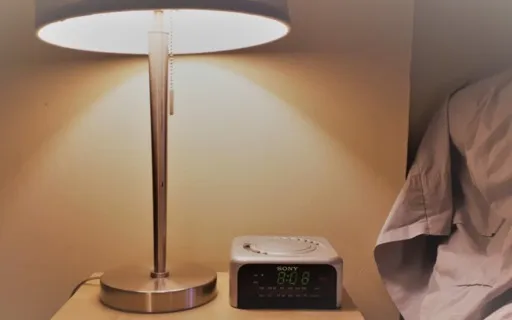
And then we got this old fashioned alarm clock.
So if we need to set an alarm,
We will use those.
We know what time it is,
But we don't need to have a phone beside us.
OK,
Every situation is different.
OK,
So some people will say,
Oh,
But I am on call.
You know your own needs.
I am always talking here from frustrations that you may have.
I don't want you to change something that is working for you.
I want you to become aware of how can I make this relationship healthier.
Specifically,
How can I change any frustrations that I may have right now?
OK,
So that was another example.
Sometimes people say,
Yeah,
But I enjoy doing meditations and I need my phone to do that.
And again,
If you do that and that's not causing you stress,
Frustration,
Anything,
Just do it.
In my case,
I have two devices.
I have one device that I use for insight timer and mindfulness,
And then I have my phone.
So basically,
If I am just doing self care and I don't want to be distracted,
I don't use my phone for that.
I use this specific device that doesn't have any apps.
So I won't get distracted.
Some people have a computer.
Some people have a tablet.
Some people,
So if you do have access to different devices,
You can set intentions for every device.
Maybe you work from home and you need to separate work from personal.
Maybe you have a laptop that is from work and maybe you need to create a healthy physical boundary of this is where I work and this is where I live.
So when you are on working mode,
You will get to that corner or that desk or that room or whatever you do it,
And then you will be on working mode and that's your working time.
When you are done,
You will leave the device there and then you will leave and then you will do something different.
And that's a physical and mental separation that may help you transition.
OK,
Transitioning is an executive functioning skill that allows you to transition from task to task,
From mode to mode,
From working mode to pattern mode,
From pattern mode to friend mode,
From friend mode to like exercise mode.
So you are changing from activity to activity throughout the day.
And sometimes technology can affect how that transition happens.
OK,
So those are some strategies that you can start using.
And then when you are setting your home,
You can start taking these digital life,
These devices in account.
And then you can design spaces that will facilitate habits and routines that are going to be healthier for you.
So for us,
The habit of covering the TV is one.
Putting the phones in that charging station created a whole new habit of what we do in the bedroom and what we do in the morning and what we do before going to bed,
Stuff like that.
So those are things using separate devices for different intentions.
Having some sort of separation from devices throughout the day,
Throughout the week is important too.
Maybe you say,
I'm going to go for a walk,
For a one-hour walk,
And I don't want to have my device.
And maybe that's your time to just feel,
Just be disconnected from everything,
Right?
Another thing that you can do is tweak your notifications,
Tweak the way you receive that information from your phone.
You don't need to be distracted and interrupted every few seconds,
Every time you get a WhatsApp,
An email,
A social media update.
You can silence all those things and then only receive the things that are important and meaningful to you.
So if you work and you receive work emails,
Maybe you have those alerts.
They ring because you have to pay attention.
But maybe that email is only used for work,
And there is nothing else in that email.
And then you have a separate email account for a separate purpose.
So that's another way that you can integrate that intention into that habit of,
I am only going to get interrupted with emails that are truly important and work-related if you are on call.
Again,
Every situation is going to be unique,
And then you guys know what you need.
You guys know what your frustrations are.
I am inviting you to step back and think about new possibilities.
Think about new strategies that you can test to create something different in your life,
To change what's frustrating you right now,
To improve what you think is not working quite well,
Or to just explore different ways and see how you feel.
So far,
Guys,
Are you following me with these?
Are these techniques that you are using currently?
Are you doing something else that I didn't mention that is working for you?
I would really love to see what you guys are doing,
If there is anything that you do that helps you be more proactive,
More efficient,
Less distracted,
And more intentional.
If there is anything,
Please share it in the chat,
Because I always love learning from you guys.
Monica suggests,
I like the TV idea.
Beautiful.
Give it a try.
Try to cover the TV with something.
It doesn't have to be a canvas paint.
It can be a blanket,
Can be a nice painting if you have one,
Can be anything.
We shut off Wi-Fi and devices at night.
Amazing,
Denise.
That's something that I have seen some families do that.
They shut the Wi-Fi at a specific time,
And then no one is able to connect to the internet anymore.
That's helpful for teenagers and kids when they have a hard time disconnecting.
That's another idea that you can explore.
I love the TV idea also,
Kevin.
Amazing.
Another thing that I also recommend is using timers,
Timers that are not tied to your device.
Basically,
I have this timer here on my watch.
It's like a wristwatch that is not a smartwatch or anything,
Just a regular watch,
But I have a timer here.
I use this timer for meditation.
I use this timer if I need to tell Eva,
My daughter,
Oh,
We have 10 minutes left and then we have to go to school.
I will use this timer.
If we are in the house,
I have a time timer that is basically a little timer that has like a red pie.
Then I set 15 minutes,
30 minutes,
Or 45 minutes,
Or one hour,
And then it becomes everything red.
Then as the time goes by,
The red pie becomes smaller,
Smaller,
Smaller,
So that she can see the passing of time.
She becomes aware of what half an hour is,
15 minutes,
And et cetera.
Then when it beeps,
She knows that it's time to transition.
So that's a beautiful way that we have discovered to help her understand what's happening.
We use a time timer,
It's called.
You can use a kitchen timer too.
We use a kitchen timer to do the laundry,
To cook,
To remind us of things,
To do the Pomodoro technique that I have shared with you guys.
The Pomodoro technique is a time management technique that you can integrate in your home and in your day-to-day routine.
Basically,
You are going to use a timer to focus on a specific task for 15 to 20 minutes.
Then when the timer goes off,
You are going to have five-minute break.
Then you are going to do another Pomodoro,
That is another 15 to 20 minutes of intentional and focused time.
When you repeat that three times,
That sequence three times,
15 to 20 minutes of work,
Focused task,
Five-minute break.
Twenty minutes work,
Five-minute break,
20 minutes work,
And then you take a longer break.
You can tweak this recipe to fit your specific needs.
Some people can do a longer period of time,
Some people can do less.
It doesn't matter the quantity,
What matters is that you have a strategy and you are testing and tweaking.
That timer is something that will allow you to be intentional,
To remind yourself,
And to really become aware of the passing of the time.
I would recommend that you use an analog timer.
Don't use your phone because if you use your phone,
You are going to get distracted.
If you are doing this,
Most likely,
It is because you are trying to distance yourself from your phone.
You are trying to distance yourself from notifications,
From distractions,
From interruptions,
And you are trying to bring more intention.
So you having the control over when you look at your phone and when you don't look at your phone,
That's the ultimate goal.
You decide that,
Not the phone.
And that's why all these strategies can help you start becoming more aware of how you use that.
Kevin says,
I waste so much time.
Kevin,
Is that frustrating you?
Wasting time,
Is that a frustration of yours?
Because sometimes people think I'm wasting time,
But I don't care.
So I'm just curious,
Do you want to change that?
Do you feel the need of doing something different?
So what do you feel you can try?
You say,
Yes,
This is something that I would like to work on.
I would like to change.
So what will your idea outcome be?
And this is how this starts working out,
Okay?
So you identify a frustration.
You identify a routine,
A habit,
Something that is distracting you or is not allowing you to get what you need.
And then you think about what will my idea outcome be,
Okay?
So if I could snap my fingers and I have the perfect solution and the perfect situation happening here,
What is it?
How does it look like?
Maybe it's like,
I don't get distracted by my phone and I can work on a task for 20 minutes at a time.
Or maybe it's like,
I have a digital detox once a week for a full day.
I don't know,
Whatever that is for you,
Once you have that outcome in your mind,
Then you think about how can I make this happen,
Okay?
So Kevin says,
Your course.
So my course is helping you with ideas and strategies.
So I hope that you find something,
Kevin,
That you can test,
Tweak,
And integrate in your life.
And this is what happens.
There are thousands of strategies that you can try.
But the most important piece is that once you identify that frustration,
Once you connect and visualize the idea outcome,
Or at least where you want to move towards,
That's when you have to think about what is my next step now,
Okay?
What is my next step now?
For some of you,
It's like,
I need to gather more information or I need to get more ideas.
So maybe you're enrolling the course.
Beautiful.
You're enrolling the course,
But then after,
You get ideas,
And then what are you going to start implementing?
And once you decide that,
You have to actually give that strategy an honest try,
Okay?
So if you decide,
Like,
I'm going to cover my TV,
So I want you to actually cover your TV and then give it a try,
And then notice,
Being aware,
Notice how you feel when you are using that new strategy.
Is it frustrating you?
Is it helping you avoid watching TV unintentionally?
Like,
Start noticing what's going on,
And then you will start deciding if that's a good strategy for you or not.
Okay,
So Denise says,
Ideal outcome.
Giving so much to do,
Productive use of time without having undone tasks hanging over my head,
Distracting me from the present moment.
Beautiful,
Denise.
That's a very nice ideal outcome.
So I will invite you to be more specific now.
Because you say,
Without having undone tasks,
Well,
How many tasks do you have?
How much time do they require from you?
When are you planning on doing them?
Are those tasks really relevant and important to you?
Do you really need to do them?
So start questioning all those things,
And then you will start bringing more intention,
And then you will start noticing what's getting on the way for me to doing these tasks.
And in today's topic,
I am inviting you to look at the digital world and the technology and the habits and routines that you have around that.
So maybe you start noticing,
Wow,
Every time I try to do this task in the kitchen,
I get started and then my phone rings.
I get started again and then my phone rings again.
And maybe what you need is to give yourself a little bit of time without distractions.
So maybe for you doing the Pomodoro technique of silencing your phone for 20 minutes and give yourself a chance to actually do the task with focus and intention for 20 minutes,
Or 15 minutes,
Or 10 minutes,
But your full attention is on that task,
And then you go back to the phone and you check,
Is there anything new?
Is there anything I need to reply to?
And then once you are done,
You set the timer again,
And then you go back to doing another task for 10 minutes or 15 or 20 minutes.
And then you start giving your undivided attention to every specific task that you are about to do.
And every time you are transitioning from task to task,
You remind yourself of,
Okay,
Now I am going to be doing this task.
I'm going to set the timer and I don't need to be distracted.
So you remind yourself of that,
Okay?
And then you dive into that task.
You allow yourself full presence.
You do that task and when the timer goes off,
You can decide.
Stop the timer and sometimes you will decide,
I'm going to do another 10 minutes because I am in the zone now.
So you click that timer and then you do 10 more minutes.
Maybe the timer goes off and say,
Oh,
I need a break now.
I think it feels good to have a break.
I'm going to check my phone now.
I am choosing to do that.
It's not the phone telling me,
Check me.
No,
I want to check the phone right now or I want to go and go for a walk.
You see,
You start taking control rather than your phone telling you,
Check me,
Check me,
Check me.
Okay?
So these are some things that,
Again,
The way you set up the space is going to really help you with these strategies.
So if you have a work environment in your home,
You have a home office,
For example,
You have a desk,
If you are doing work and your phone is sitting beside you,
Facing up,
Every time your phone vibrates,
The light blinks or it makes a noise or whatever,
You are going to stop what you're doing and you're going to peak to your phone.
So you are going to be interrupted.
And guys,
When you are trying to focus your attention and you get interrupted,
It takes you time to go back where you were at.
Okay?
So this is an executive functioning skill,
Is attention and focus.
And then that distraction is going to force you to transition from whatever you are doing,
You have to transition your attention.
You have to shift your attention to then the phone.
Then think about that.
If you open the phone and you start reading an email or a text or social media or whatever,
Your mind is going to go there and then you're going to stop doing that.
You're going to shift your attention back to what you were doing.
And then you are going to need time.
The more demanding that task is,
The more time you are going to need to go back where you were at.
Okay?
That's what happens with multitasking.
It's the same idea.
You are doing several things at once,
But you are not focusing on a specific task.
You can multitask efficiently with tasks that don't require too much of your attention,
That you have done them so many times that they just happen automatically.
But the ones that you are doing that are not automatic,
The ones that you have haven't repeated too much,
Or the ones that are new and you have to pay attention to them,
Those are the ones that you are going to have a hard time transitioning from.
If you start multitasking and your attention is here,
There,
Here,
There,
You're going to have a hard time finishing that task.
And you're going to start feeling overwhelmed,
Stressed and frustrated.
So that's why maybe allowing more time of focus and intention for that task can help you be more efficient,
More intentional,
Finish that task or a section of that task and then move on with the next one.
But you get to choose that.
Okay,
You get to choose that.
So if you put your phone in a different room when you are doing your focus time and your phone is in silence,
Or only the truly important notifications are on,
For example,
In my case,
If I were to put my phone on,
On do not disturb,
Daycare and my wife will go through.
So if they call me,
That will ring my phone.
So if I hear my phone,
I know that this is an emergency.
I have to pick it up.
It's either the daycare that I have to go and pick my daughter up from the daycare,
Or it's my wife that she needs something.
Because we have communicated and she will send me a WhatsApp if it's not important.
Text message is,
It's pretty important and phone call,
It's an emergency.
I need you now.
So that was our rule.
So you can start educating people that way.
So if you work,
Create a channel that is the only channel that people know how to get you.
And then when you are on the zone,
If they need to get you and it's an emergency,
They know.
Okay,
Kevin.
I know that Kevin goes on the zone.
And I know that if I send Kevin an email,
He's going to take one hour or sometimes two hours to respond.
And I am okay with that.
Okay,
If I need Kevin right now,
I know that if I call him and he sees my number,
He's going to pick up because I am on his priority list.
So that's another example of how you can mainstream,
How you can create a flow that is intentional.
Everything else will get,
We can wait,
Everything else can wait.
So you don't have to worry about that.
Okay,
So that's another strategy,
Really thinking about how can I send my notifications?
How can I create my priority list so that when I put my phone on do not disturb,
The important people that I need to talk to,
They go through.
Okay.
But other than that,
Everything else guys can wait.
Emails can wait.
Social media can wait.
Notifications can wait.
They don't have to be immediately looked at.
Okay.
So,
So far,
How are you guys feeling with all these strategies?
Which one are you feeling inspired to give it a try?
Positive.
Amazing.
The timer.
Yeah,
Guys,
The timer is a lifesaver for us.
Love listening to you as it reaffirms what I am.
Love listening to you as it reaffirms what I already do.
Amazing,
Christine.
Is there anything else,
Christine,
That you do that I didn't mention here that is working for you well?
Because guys,
There are hundreds of strategies that you can implement.
So I'm just sharing the main ones that I have seen working and the ones that I use.
But there are so many other ones that you can test.
And at the end of the day,
It's all about testing them and then seeing which one resonates with you.
Which one sits well with your style.
And also you have to give them an honest try.
Okay.
Yeah,
Savannah says,
Good.
I slept with the phone out of the room the last night and it was more peaceful.
Amazing.
So Christine says,
Apple Neo update puts silence on all devices.
IPhone,
IPad,
IWatch,
IMac.
Amazing.
Good to know.
So now you can set the silence and then all the devices will become silence automatically.
That's great.
If you have several ones.
Like this is what I see like more and more these days.
Like now that people have these watches that are smart,
They have the force,
They have the computers.
Guys,
Sometimes I am doing stuff,
Playing squash,
Doing something that before that didn't exist.
And now I'm playing squash or playing tennis or whatever.
And I see people like they're playing and then they are looking at the phone while they are almost playing in it.
And it's like,
Wow,
Like there is really no disconnection these days.
Like I don't know if it's necessary to be so,
So,
So connected,
But that's your choice.
Again,
That is your choice.
I am always giving more importance to people in my life and always get disappointed when they will change what I can do to change my priorities.
Thank you Deepali for sharing that.
Yeah,
Guys,
So these are some of the strategies that I had today for you.
It's very important to first step is always becoming aware.
Right?
Becoming aware,
Coming to the present moment,
And then start noticing what's happening.
You start noticing what's happening and always being gentle with yourself,
Always being patient with yourself.
You start noticing your behavior.
You start noticing your pattern.
You start noticing your habit and then you start questioning.
Wow,
Like every time I do this,
This happens.
Every time I try to work and I am getting on the zone,
Then I get interrupted.
Then start questioning.
Do I need to get interrupted?
Is there a different way I can take this?
Can I do the Pomodoro technique?
Can I put my phone in a different room?
If I were to put my phone on silence,
Is there anything that I need to take in account to don't neglect responsibilities?
Okay,
For example,
In my case,
I cannot put my phone in silence and ignore it.
Because if my daughter calls me from daycare and I have to go and get her,
I have to go and get her.
So that's an advantage.
Right?
So I have to be aware of that.
Okay,
That's one thing that I have to make sure that goes through.
Or maybe if I go away,
I will tell my wife because they have both of our numbers and I always make sure that she's available or she makes sure that I am available.
And that's another way.
Like if I want to go away for a full day and I want to leave my phone behind or I don't want to worry about my phone at all,
Then I can tell my wife,
Hey,
Sam,
I am going for a full day.
Can you make sure that you are available?
And then if she says yes,
Then I have permission to just be completely disconnected.
Okay,
So again,
Different strategies for different people.
And I invite you to try and test.
So Jackson says my husband is on the phone nonstop.
Often work,
But also social media news.
I don't know how to support him to disconnect.
So Jackson,
As I was saying,
This is something that needs to come from him.
He's the one who needs to have that necessity.
He's the one who needs to feel inspired to change,
To try something different.
He's the one who needs to feel frustrated about it.
Many people,
They have that habit and they don't want to change it.
So if they don't see a problem,
It's very difficult for you to help them.
But you can create boundaries and you can communicate clearly how you feel.
And you can request what you need.
So maybe you say,
Honey,
I don't care what you do on your phone,
But if we go on a date once a week and we are going to be on a date for two hours,
I don't want to see that phone in there.
I want to make sure that you are with me for these two hours.
That's what I'm asking for.
Can be a different request,
But you can voice and name what you need.
Maybe you say when we are home and we are having dinner time,
I don't want to see the phone on the table,
Please.
Or we start creating and communicating with him so that he starts understanding what you need and how you feel.
In our household,
We try to do that when we are with our daughter.
If we are having dinner,
We try not to be on the phone.
If we are having a bath or doing something family wise,
We try not to be on the phone so that we can be present.
Right.
And then if we need to be on the phone,
We just go away.
We are on the phone or we have dedicated time or it's intentional.
We try to be as intentional as possible.
Sometimes it doesn't happen,
But majority of the times it does happen.
So we are mindful about that.
So start thinking about what do you need from him?
How do you feel?
Is there anything that you can communicate so that he can understand what's going on and your needs so that maybe he can question himself and say,
Oh,
Wow,
I had no idea that you felt that way.
Oh,
Yeah,
I can put my phone away when we are having dinner.
Oh,
Yeah,
I am happy to take you out on a date and I will not look at my phone.
I promise.
You know what I mean?
Or maybe he says,
I am expecting a very important call and I have to be accessible.
So maybe that's a rule,
Right?
Again,
Like you get to chat and communicate.
So Erin says my voicemail is on the phone.
So Erin says my voicemail is full so I can receive new messages.
I am having a hard time deleting them because some are from my mom who passed away four years ago.
Any recommendations for how to move forward with time away from the responsibility of answering?
Yeah,
Erin,
Sorry about that.
And then I will say you can probably record those messages.
You can probably record.
So play those messages from your mailbox and you can record them so that you can have the files and you can store them in a safe place and then you can delete those messages so that you have an empty mailbox if that's what you want to do.
In my case,
When I get voicemails,
I just delete them right away when I take action.
Of course,
In your case,
I understand why you want to keep them,
But you can keep them in a different format.
It doesn't have to be as a voicemail.
So maybe you can explore that idea.
I don't know if that sounds good to you,
But that's an idea.
Yeah,
So Caroline says,
Jackson,
Here is an idea about your husband being on the phone all the time.
Ask if he wants to disconnect sometimes.
If yes,
Ask if he wants to start with five or 10 minutes or 30 minutes or an hour.
Then can build from there.
Just an idea.
Yeah,
Caroline,
I love that idea.
And this is what's called a digital detox.
Okay.
And there is a really good book called Digital Minimalism by Karl Newport.
I think it's his name.
He has this book and then he invites you to do a digital detox.
Sometimes he takes it to 30 days.
Okay.
And that's very extreme for some people.
But what she's saying,
What Caroline is saying is good.
Start small.
Start in a way that doesn't feel overwhelming and it's doable and start building.
Start building from there.
Okay.
That's one strategy.
When you are disconnected,
It's also very,
Very important to find something to distract yourself with.
So you cannot say if you are,
For example,
Spending five hours a day on social media and then you remove those five hours,
You don't check social media.
You need to understand that what are you going to do with that time?
That's a lot of time that before you were doing a task and now it's empty.
So that's why it's very important to be intentional about what am I going to do instead?
What is something that excites me?
Is there a hobby I wanted to start?
Can I go to the gym?
Can I meet with friends?
Can I cook a meal with my mom?
Can I start thinking about activities that are going to replace your old habits?
This is really,
Really important because if you don't,
You're going to get bored.
You're going to be confused.
You are not going to be intentional and you're going to most likely go back to doing what you used to do because there is nothing else to do.
So keep in mind that finding something that in your case,
Jackson with your husband,
Try to find an activity that may inspire him.
Something that maybe he always wanted to do and he never could.
Or maybe it's going to try a new restaurant or maybe it's going and having a picnic in the park with a blanket and a nice snack.
Or maybe it's just having a nap in the sunshine if it's warm.
Can be very,
Very small,
But something very different out of the ordinary.
Still very simple,
But something that you normally don't get to do.
So maybe he's watching a movie in the middle of the day and then a blanket.
I don't know.
You will find something,
But hopefully you can find a replacement for that time.
So hi Emilio,
Can you please say again what you have in front of the TV?
Thanks.
So Caroline,
I have a canvas paint that looks like this one behind me.
It's basically like a it's like a wooden frame with a canvas on top.
So it's very light and I use an L bracket.
With some soft material and then that rests on top of the TV.
So I put that on top of the TV,
That bracket rests on the top of the TV and then the painting hangs in there.
OK,
That's how that's how we do it.
But you can use a nice piece of material.
You can use a painting and just that sits on top of it like it doesn't have to sit on top of the TV.
You can just rest it.
You can just rest it if you have the TV on a mental or a cabinet,
You just get a painting big enough to cover the TV and just leave it against the TV and make sure that there is something soft so that nothing is touching the screen so that you can scratch it.
But other than that,
It's just as easy as sit that in front of it.
And when you want to watch,
You take it out and then you put it back in.
Many times people come to our home and they start looking around and they say,
Guys,
You don't you don't have a TV here.
And I say,
Oh,
Yeah,
We do.
Where is it?
And then we take the painting and say,
Oh,
That's so cool.
They they had no idea that is there.
They don't know because there is nothing exposed.
So that's why they don't know that is there.
And it made our living room be something more neutral.
It's not all focused about the TV.
It's as I say,
Our intention wasn't our living room to be just for the TV is to do way more things.
The TV is just one more thing.
It's not their thing.
So that that's why for us it was so important to cover it.
Yeah,
And again,
It it makes watching TV more inconvenient.
OK,
So that means that now when we want to watch TV,
We have to remove the painting.
We have to open the doors from the cabinet underneath.
We have to grab the remote and then we have to tune on the TV.
So it's not just I'm tired.
I don't know what to do.
I lay on the couch and I just do something just because of no now it's intentional.
OK,
What are we going to watch today?
OK,
I have a movie that I I have or there is something on Netflix that someone told me.
So it's more intentional.
OK.
Yeah,
Guys,
So this is what I have for you today.
I hope that you enjoy this session.
I hope that you can think of what is the next step for you.
To start bringing more intention into your your digital life and wait for you to integrate and embrace that digital life in your home,
Physically speaking.
And then that in the form of where am I touching my my mobile device?
Where do I have my TV?
Where do I have my laptop?
What what is the usage of its device?
Is there an intention behind them?
How long do I spend in them?
Is there any frustration that that I am noticing that I would like to change?
So start questioning all these things,
Becoming aware and gentle with patience,
With compassion.
You start making changes.
I don't like what I'm doing here.
I don't like my phone interrupting me all the time.
This computer,
I work here,
But I don't have I don't have a disconnection from work.
I feel I need to set a more structured way to transition from work to home.
Guys,
Some people during COVID and this is something true,
OK?
Some people work from work from home and they live at home so they don't have a physical separation.
Some people when work is over,
They leave the house,
They go for a one or two minute walk around the block and then they enter the house in the new mode.
So,
For example,
If I get up in the morning and I want to work.
I say,
OK,
Honey,
I'm going to work,
Emilio,
Let's go to work.
I will open the door,
I will get out of the house,
I will do a loop around the house outside and I will enter the house with a working mode.
OK,
I will go to the house,
I will go to my desk and I will work.
When I am done working.
I can do the same.
I can go out,
Do a loop and then enter the house,
Transition into personal mode,
Into family mode,
Into whatever I want to be doing.
Some people do that.
They physically change.
They physically get out and do that so that it helps them transition from working to being at home or from being at home to working.
And this is a great and beautiful way of doing it.
If you don't have a physical separation.
OK,
So again,
Another idea that I just thought of and it's something that I read in books and I have seen people doing it and I do it sometimes.
OK,
So,
Yeah,
Very,
Very important.
I'm very,
Very interesting.
OK,
Guys,
Let's leave the session.
I'm going to play the singing ball a little bit and I would like you to just take a couple of deep breaths,
OK?
Get comfortable and close your eyes if you can.
Just listen to the sound of the singing ball.
And I invite you to think about what's next for you.
What steps are you going to try?
Did you notice any frustration showing up during this session?
Anything you would like to change?
You would like to change to improve?
If an action comes to mind,
A clear next action comes to mind,
I will invite you to write it down.
Write it down in your journal,
Write it down in your to do list,
Do whatever you need to do to make sure that you actually do it.
And if you want to learn more,
Make sure that you enroll in my course,
Creating Your Peaceful and Clutter-Free Home.
This is one session that is included in that course,
And that course is going to guide you through the process of becoming aware,
Setting your intentions,
Confronting emotional items,
And then decluttering and organizing every space of your home.
OK,
It's a very beautiful course that I am so proud of.
It's the longest course I have created,
The more in-depth,
And you have access to the course classroom where you can have access to me to ask questions,
And then you can have any questions you may have.
OK,
I will be there to support you.
And it is on my to do list every day to check the course classroom and make sure that I am there for you.
So as always,
Remember that the most important part here is action.
OK,
Whatever that looks to you,
Just take the next step,
Take the next action.
And from there,
You will see what the next one is.
OK,
You don't need to know all the steps.
You just have to take the next one.
Thank you guys so much for being here.
And I hope to see you on Thursday.
OK,
Have a wonderful rest of your day.
Adios.