Welcome back,
Guys,
To another session.
Today,
We're going to be talking about energizing and activating your home.
Thank you so much for tuning in.
Kathleen,
Good morning.
Emilio,
8 a.
M.
Here in New Jersey.
Good way to start my morning.
Amazing.
Yeah,
It's 2 p.
M.
Here in Barcelona,
And I'm starting these sessions one hour earlier,
And I'm testing this new time.
I know for some of you,
It may work better.
For some of you,
It may not work.
This is the problem of being worldwide,
Right?
Reaching everybody everywhere.
There is not a perfect time for everybody at the same time.
But don't worry.
That's why I record every session,
And you can access every session that I do in my recordings,
Okay?
You can find them on my Insight Timer profile link.
If you click in there,
You will find a section that says Insight Timer Live Session Recordings,
And that's where you will find this session at the end of the day,
Okay?
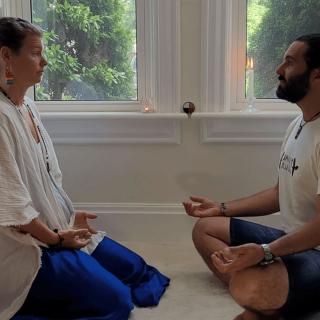
So let's start the session with my singing bowl.
Let's come back to the present moment.
Let's transition into this session together.
Let's create this container of energy and presence.
Get yourself comfortable.
Feel free to close your eyes.
Take a few deep breaths,
And enjoy the sound of the singing bowl.
Amazing.
Thank you guys for allowing for this sound and for your presence,
For coming into this session.
So today I want to talk about something that I'm inspired by.
Why am I inspired by right now?
Because I'm working one-on-one with a client,
Okay?
And she's been doing a lot of amazing decluttering work in her home,
And the other day she sent me a WhatsApp message.
I support her through WhatsApp one-on-one,
And then we also do video calls sometimes.
But she told me,
Emilio,
I am amazed.
Before,
I used to go to that room,
I used to open the door,
And I used to feel overwhelmed.
I used to feel paralyzed,
And I would shut the door and run away because I had no idea what to do.
And those are the feelings that she had.
Now,
After doing this process for a few months,
And she has successfully done some areas of the home,
She told me,
Emilio,
I opened that door,
And I see possibilities,
And I feel excitement.
So I was like,
So you have gone from feeling overwhelmed and paralyzed to feeling excitement.
How amazing that transformation is.
And that's why I felt inspired to do this session today,
To really help you energize and activate your home,
The place where you hang out,
The place where you consider your shelter,
Because that is a basic human need.
And I want you to become aware of the huge connection that your home,
The physical spaces where you live and you hang out with,
How those spaces connect with your mental and emotional health.
And I also want to take it a little bit further,
And really make sure that you understand that it's all energy.
Okay?
Do you guys understand that even though we are talking about physical things,
Do you understand that everything's energy?
Any of you don't understand that it's energy?
I just want to make sure that everybody understands that we are talking in the essences of energy,
And we are moving energy.
We are transforming energy.
We are processing energy.
The way we feel is energy.
Okay?
Please explain that more.
Yeah.
So today I want to talk about stagnant energy.
Okay?
Everything that you have around you,
Somehow it is energetically connected to you.
Everything is a decision you made.
Everything is a behavior that you follow,
A routine that you have.
And sometimes you have spaces that you don't put a lot of energy into.
That's why they are cluttered.
That's why there is accumulation.
That's why they are stagnant.
Because maybe you don't have the time.
Maybe you didn't have the energy.
Maybe you had an accident and mobility was reduced.
And there are some areas of the home,
And I can name you the ones that are normally the most stagnant ones.
Attics,
Basements,
Garages,
Extra closets that are not on a daily use.
All those spaces are the spaces that we tend to spend the least amount of time and energy in them.
That's why sometimes they become stagnant,
Because we have not been there.
We have not checked what's in there.
We have not put our presence,
Our energy into those spaces.
And that's why they become stagnant.
That's why you don't remember what was in there,
Because you have not used them in a really long time.
So that's stagnant energy.
What happens when you start moving,
You start decluttering,
And you start opening up boxes,
And then you start seeing objects?
Many people,
They will feel something,
An emotion,
A memory.
Maybe they will feel sadness.
Maybe they will feel guilt.
They will feel guilty because they bought something that they never used,
And they spent the money.
Maybe a memory from a loved one that is no longer here may show up.
All those things are energy,
And they form their emotional energy,
And you are feeling those emotional triggers from those physical items.
Sometimes you go into a restaurant,
Into a coffee place,
And sometimes you feel a specific way.
Sometimes you go into a room and you feel a specific way.
Sometimes you don't feel well.
Sometimes you don't like it.
Sometimes you feel peace.
You feel like,
Wow,
I feel really well in here.
I can hang out here for three hours,
No problem.
How many of you have noticed that?
I do notice that with coffee places.
Sometimes I just look from the outside,
And I know if I want to go inside or not.
That is energy.
Why do I know?
Why do I feel if I want to go inside or not?
What's inside that is triggering me,
If I like it or I don't like it?
And this is something that you guys have to start becoming aware of,
Especially in your home,
Especially in the spaces that you normally use and hang out with.
Monica says,
Yes,
I'm learning to wrap my head around that more and more.
So today is all about how can we activate and energize the spaces that we use so that we can feel well,
So that they serve us in the way that we need,
So that we overcome whatever is present in that space.
We can process it.
We can transform it.
And what's present there that sometimes is the resistance that people feel,
That's also energy.
That's also something energetic that doesn't let you move forward.
Because if you look at things,
Things are just physical things.
They are just objects.
So why can't you just move them around?
Why can't you just organize them?
Why do you sometimes feel a huge emotional attachment to something?
And why the same object means the world to one person and means nothing to another person?
So that's why I want you to understand that this is such a subjective journey.
This is such an emotional and mental journey that is going to look very,
Very different from person to person.
And this is why you are the only one who knows how you can go through that journey,
What you truly need.
No one else but you knows that.
And it boils down to how you feel.
It boils down about what the physical objects that surround you represent to you,
How they make you feel.
And how can you energize them,
Activate them?
How can you move them?
How can you declutter?
At the end we're talking about the decluttering journey.
That word may not like,
Some people may not like hearing that word because decluttering can mean another task to do,
Another chore I have to do.
Decluttering may mean feeling uncomfortable.
Decluttering can mean confronting what you don't like,
What you don't understand,
What you don't know what to do with,
What you don't know how to communicate with other people,
Etc.
And at the end of the day all of those things are physical,
Mental and emotional energy combined that you have to transform,
Process,
Move,
Activate.
And that's why today I really want to talk about these things because this is so important.
Kenya says,
But never paid much attention to it.
Yeah,
It's normal because sometimes we forget that that's how it works.
But this is why I'm here.
This is why I have a course that is called Creating Your Peaceful and Gladly Free Home.
And that's why in that 30-day course,
That is the longest course that I have ever created,
That's why I think eight sessions,
They are all about awareness,
All about intention,
All about helping you process whatever shows up for you physically,
Emotionally and mentally,
Especially emotionally and mentally.
But emotionally,
That's the main resistance that many people face when they are trying to declare their home.
They are facing something emotional.
And at the end of the day,
That's energy.
Emotion is energy in motion.
That's how it is,
Right?
So I want you to start becoming aware of that.
I want you to start becoming aware more and more of how you feel.
How do you feel in your home?
How do you feel in your living room,
In your kitchen,
In your bedroom?
How do you feel outside of your home?
How do you feel in a coffee place when you enter?
Which one is your favorite coffee place?
For example,
Why?
Which one is a coffee place that you don't like?
And why don't you like it?
And it's fascinating to hear what people tell me when I ask them those questions.
Because sometimes some people love knickknacks everywhere.
And sometimes people hate having so many things in front of them.
Sometimes people love the minimalism of a place.
And some people say,
I don't like being here because it looks stale.
There is nothing to look at.
It's so boring.
And because it's so personal.
And it's beautiful to have diversity.
And you have to understand how you feel.
You need to understand what you like.
What makes you feel well.
What do you want to surround yourself with?
And why?
And then you can start using that in your home in a way that makes you feel well.
Okay?
So let me ask you a question.
And please use the chat.
How can we activate and energize our home?
What are ideas that come to mind?
What can we do,
Practically speaking,
To activate,
To energize our home?
I would like you to share in the chat what comes to mind,
Please,
Before I start sharing what I have witnessed in the last 10 years.
How can we energize our home?
How can we transform stagnant energy into something that is better,
That makes us feel better?
So she says,
Open the blinds,
Letting sunlight.
Beautiful.
That's a great idea.
Open the windows.
Let fresh air go through.
That's amazing.
Remove clutter.
Promote art.
Be still and focus on the room.
Meditate.
Meditate presence.
Donate things that we are no longer using.
Beautiful.
Move things around occasionally.
Amazing.
Fresh flowers,
Candles.
Amazing,
Kim.
Deep cleaning.
Deep cleaning.
Absolutely.
Purge,
Clutter,
Burn incense,
And play music.
I love lots of houseplants.
Amazing.
Houseplants.
Bringing nature into your home.
Have the dishes washed and put away.
Clutter makes my mind clutter.
Of course it does.
Remove excess items.
Plants.
Open your blinds because a lot of people just keep all the blinds and curtains totally shut.
Yeah,
Let the light in.
Let your home be bright.
Be aware of every item in the room and be sure each one has value in your happiness.
Absolutely.
Question everything that you have,
Right?
Clear surfaces.
Fix or remove anything broken.
Get rid of clutter and keep meaningful items.
For example,
I keep the beds of my pets who passed away.
I get to think of them whenever I see them.
Amazing,
Kathleen.
So you'll enjoy seeing that.
For some people,
Maybe that's not the case,
But for you,
You enjoy that and you are aware of it.
Gopi says,
This may be a bit extreme,
But I got rid of the TV in my house.
I think TV is no longer a necessity in today's age.
It is an addiction.
The invisible drug.
Gopi,
I have no TV.
I didn't have TV in a while and I don't miss it.
I have my computer when I want to watch something.
So it's not crazy.
Nothing is crazy here,
Guys.
This is your home.
You get to set the rules.
You get to decide.
There is no crazy ideas here.
This is your home.
Pictures of people you love.
Keep floors clean.
Sweep vacuum.
Amazing.
So guys,
You have shared a lot of things and now I would like to give it a little bit of structure because everything that you said is beautiful and perfect and everything fits.
Everything works and everything fits in the structure that I have created from my own experience of helping a lot of people in the last 10 years.
And I'm happy to share with you what those steps are.
Yeah.
Toys for kids or dogs or cats aren't using anymore.
So declare the toys.
Actually,
Just donate the toys like I am going to do.
Smiley face.
Yeah.
So guys,
When I started doing this work,
I didn't really understand what I was doing,
But my intuition was guiding me to doing something.
And then I remember that I started doing this work way before I started the company because when I was traveling the world,
I found myself doing this work of the catering,
Organizing,
Emotional processing,
All this stuff with people I was staying with.
And now I look back and it's like,
Wow,
It's amazing to see that I was already doing this.
And I didn't even know that this was a thing.
I didn't know that this was an industry.
In 2012,
When I started doing this with my wife and we started going to people's homes and starting to help them,
We had no idea what we were doing at that time.
We didn't know if this was doable,
How to follow the order,
What to do,
How to make things like function for people.
Right.
But after doing these several times with different people,
We started to develop a system.
And then now we have a system that we use with any person and we use the same system.
Sometimes the steps take longer.
Sometimes they take shorter.
But the order we have found by trial and error,
What works and what doesn't work and what doesn't work,
We found it because we made mistakes and it didn't work out.
And then after that,
We realized very quickly what is the order of this process?
How can we energize,
Activate your home quickly?
How can we do it efficiently?
How can we do it respectfully?
How can we do it so that you feel that you are a part of the process?
It's not someone coming and changing everything.
You are doing it.
You are deciding,
But you have guidance.
And the steps that we created are the ones that I follow in my course.
In case you are curious,
You can enroll in the course and then you can do the 30 days.
But basically,
I'm happy to share the main steps in here if you guys want to listen to them.
I'm glad I'm not alone as I am the only one in my family without a TV.
Thank you for sharing.
Yeah,
There are lots of people that don't have TV,
So it's not something crazy.
Step number one.
The step number one is always awareness.
We have to be aware.
We need to be aware of what we want.
We need to be aware of how we feel.
We need to be aware of our current situation and that awareness inside the awareness step.
So let me share the main steps and then I'm going to dive into each of them to go deeper.
First step is awareness.
The second step is decluttering.
The third step is organizing.
The fourth step is beautifying.
And the fifth step is maintaining.
So those are the five steps that I'm going to cover here,
The general ones.
So becoming aware,
Decluttering,
Organizing,
Beautifying,
And then maintaining.
So those are the five main steps that we always follow in that specific order.
It doesn't work if we do it in a different order.
We have found that when we don't follow this order,
We don't create the massive results that we normally do with people.
People are amazed at the transformation that we provide them.
They can't believe it.
And this is not because we are magicians.
This is because we have done this for 10 years with so many different people.
So we know what works and what doesn't.
And we know why.
Because we have done it.
It's the experience,
Right?
You become good at what you repeat.
So first step is awareness.
What does awareness mean?
Awareness means you have to know how you feel.
You need to understand where you are at.
You need to accept it.
Part of the awareness is to accept that you have clutter,
If that's your case.
To accept that you are not feeling well.
To accept that you have tried your best and you don't know how to do this.
To accept that whatever is present for you,
Whatever is happening for you right now,
Whatever life event happened to you,
You need to accept what is.
So that is the first step,
Awareness.
Then you have to forgive yourself.
You have to really be very gentle,
Very compassionate with yourself and with everything that you have done until now.
And it doesn't matter how long you have done it for.
Every present moment is an opportunity for you to set a new intention,
To change,
To start doing something different.
That is another huge piece of the awareness.
Once you become aware,
Once you accept,
Once you forgive,
Once you are ready and willing to try something different,
Then you are going to set intentions.
An intention is basically you are going to decide to do something different.
You are going to start trying something different.
You are going to check in with yourself about what do I want to do?
What activities I want to do at home?
How do I want to feel at home?
And then you will discover that you don't need to have the answers yet.
That is a part of the awareness.
Sometimes you don't have the answers.
You have to try and test different ideas and see,
Discover what works for you,
How you feel.
All of that is the awareness.
If I don't know what you need and want,
If I ask you to visualize what you would like to see and you cannot describe that to me,
I will not be able to guide you through the process.
So even if you say,
I don't know what I need,
But this is not it.
So I need change.
I need space.
I need to move what's around me because what's around me is no longer serving me.
And this is not what I want.
That's enough.
Because the decluttering process,
When we start the decluttering,
The magic starts happening.
Because when we declutter,
That is the second step.
When we start the decluttering process,
You are going to start questioning.
You are going to start confronting the reality of things.
Why did I buy this?
Does this belong in my life?
Why do I have emotional attachment to this thing?
How is this thing going to help me do x,
Y,
And z that I said I wanted to,
Et cetera,
Et cetera.
And then you are going to start going through that journey of discovery,
Through that journey of questioning,
Through that journey of processing,
Emotional processing.
And the decluttering means normally we pick one space in the house.
We try to give you a before and after.
We try to give you a quick win.
So we will decide together with you,
What is the space that you can benefit the most from?
What is the space that you feel that is the priority right now?
And we will get started there.
And we will start in one corner of the room and we will touch everything in that room.
And I know what you're thinking.
Some people will say,
But that's going to take forever.
There is no way we're going to be able to get through that.
Trust me,
You get through that.
And that is the magic of this process.
Of course,
We are doing it together.
You are not doing it alone.
So it goes faster.
But you start in one corner of the room and you question everything that's in there.
What's this?
Why do you have it?
Do you need it moving forward?
If you need it,
Where does it belong?
How is this going to help you paint?
Because you told me that you wanted to paint,
You wanted to read and you wanted to have space to practice yoga.
How is this object going to help you do that?
And then you have to really start questioning and start being intentional.
And then when you do that decluttering process,
Majority of the times people are amazed at how much more clarity they have.
They are amazed at how many things they have that they didn't know.
Oh,
Maybe I didn't know I had 10 pairs of hammers or 10 pairs of scissors or I didn't know I had these many pencils or I didn't know I had 25 screwdrivers.
So when you start decluttering and you group things together and you assess everything that you have and you finish touching everything in that space,
The clarity that you have is amazing.
The confidence that you build is incredible.
Your capacity to make decisions increases 300% because all of a sudden you understand what's happening.
You know what's in there and now you have intentions that you are following and now you can make very,
Very intentional decisions.
So that is the decluttering process.
So once you have finished the decluttering,
Because we don't organize before we declutter,
It doesn't work.
Guys,
Do not organize before decluttering.
It doesn't work.
Let me repeat again.
Do not organize before decluttering.
It does not work.
And I have tried many times and it doesn't work.
Why doesn't it work?
Because if you don't finish the decluttering process in that space and you start organizing,
You don't know what you are organizing.
You don't know how much you have of each category.
If you have not finished touching everything in the space,
You are going to start organizing and then you are going to find something else that needs a home.
Because organizing,
Let me define what organizing means.
Organizing means finding,
Creating permanent homes for everything that you are keeping.
So every object that you are keeping needs to live somewhere.
So when you are done with that object,
You need to put it back somewhere.
So you are creating what's called a permanent home.
So books go on my bookshelf.
Our supplies go on the third drawer of my dresser.
My coats go on the entry closet.
My water bottle goes on the kitchen counter on the right hand side beside the coffee,
Whatever.
You start deciding permanent homes for everything that you keep and you start creating systems.
You start creating something that is functional.
Systems that you can easily maintain,
Easily use.
And if you want to do yoga,
For example,
You will create a home for your yoga mat,
For your yoga blocks,
For your yoga strap,
For whatever you need to practice yoga.
And you will decide where are these things going to live?
How can I put them in a place that is convenient,
That I am more likely to practice yoga because it's easy to access?
And you are going to do that with every activity that you want to be doing.
So that is the organization process.
If you don't know what you have,
What you own,
Or how many of each thing you have,
How can you organize them?
How can you know how much space you need and where are you going to place them?
And that's why so many people are so confused because they didn't finish the decluttering process and they are trying to organize without having all the information.
And that's why the organizing is so difficult and that's why it never gets done in some places because the process is awareness,
Intentions,
Clarity,
And then you declutter and the decluttering is going to give you more clarity,
More confidence,
And then you are going to organize.
When you organize,
You need to find the happy balance between how much space you have and how many things you are keeping.
For example,
If you have a bookshelf like it's this wide and you have books to fill 10 bookcases like that,
Then you have two choices.
Either you increase how many bookshelves you have or you have to reduce the amount of books.
If you don't do one of those,
You will have clutter.
You will have books that will not have a permanent home.
So it's either you create more homes for those books so that they are not laying on the ground or you accept that there are going to be piles of books on the ground and you have to be okay with it,
That's another option,
But that's a compromise that you are making intentionally.
When you declutter,
You start facing how much volume you have of each category and you start making intentional decisions.
I always recommend that you keep decluttering the things that you are the most confident with and leave the ones that are most difficult towards the end because when you start the decluttering process,
This is like a muscle that you start flexing.
You start making decisions.
You start thinking.
It's a lot of mental work.
The more you do it,
The more confidence you build.
We have seen this hundreds of times where people have an object that they are hesitant.
I say,
Maybe pile.
Let's keep moving with what you know.
We'll come back here later.
And one hour later,
They go to the maybe pile and they say,
Yes,
No,
Yes,
No,
Yes,
No,
Boom,
Done.
And the person is like,
Wow,
That was fast.
How can I have so much clarity now?
Well,
Because you have spent one hour making decisions and now you feel more confident and you are seeing that energy in that space moving,
Flowing,
And you start seeing open space that you didn't have before.
And you are proving yourself that you can do this.
So there are many things that are happening that will allow you to be there with more confidence,
More present.
And that's the organizing step.
You are creating homes.
You are creating systems.
And it's okay if they are not perfect from day one.
You can test and tweak them.
And that is the next step.
So maintaining,
You are going to maintain those steps.
You are going to maintain those systems.
You are going to tweak them.
They don't have to be perfect from day one.
There is nothing that is perfect.
You are going to use them.
And then when you sense frustration,
You allow yourself to tweak.
You allow yourself to change.
You allow yourself to develop a better system until it becomes something that you enjoy.
The beautifying is something that happens after organizing.
So you declutter,
You organize and create those systems.
You make your home functional.
And then you beautify your home.
How do you beautify your home?
You can paint it with a different color.
You can add plants.
You can display art.
You can display things that make you feel well.
You can change the layout of the room.
You can do many,
Many things that physically make the space more appealing to you.
But the functionality is not the beautifying.
So many times people want to organize their homes and what they are thinking is what color I'm going to paint the rooms for,
What plants I'm going to put.
But they don't think about the functionality and the systems.
And that's a mistake.
Because you won't be able to organize that space if you don't create a system,
If you don't create homes for everything.
You are going to try to beautify,
But you are going to still have clutter.
That's why you have to declutter.
You have to organize and create those systems and those homes.
And then you are going to beautify and make it beautiful.
And then you are going to maintain.
And anytime you notice that you can't maintain,
That's a sign that there is something that is not working.
And then you can reassess how can I make this different?
How can I make this better?
Do I need to change this to a different place?
And that is how you can activate and re-energize your home.
That is how you can move stagnant energy into something that is going to give you new possibilities,
New activities,
A different way of feeling in that home,
In that space.
Okay?
And now,
Do you guys have any questions?
I know that I shared a lot.
But this is something that is so exciting,
Guys,
Because I have seen so many transformations from people.
And I want you to have that too.
That's why I created the course.
That's why I show up here every week.
And that's why I understand the huge transformation that this can provide you.
And this is not only physical.
This is not only physical,
Guys.
This is way more than that.
When you do this physically speaking,
Everything changes.
When you do the decluttering process,
Everything changes inside of you.
And that's going to have a ripple effect in your relationships,
In your self-care,
In your work,
In any area of your life,
Because you're going to feel more confident.
You're going to feel more intentional.
You're going to feel more fulfilled.
And you're going to open up more time and energy to do the things that you love.
And when you can do that,
You're going to be a different person.
So,
What is the course?
So,
See,
The course is called Creating Your Peaceful and Character-Free Home.
I do have five courses available on Insight Timer,
And I have more on my website.
But that specific course that I'm talking about is an audio course.
It's a 30-day course where the first sessions are going to help you become aware,
Process emotions,
Set intentions,
Visualize.
Every session has a specific practice that you can follow.
And then after that,
We are going to go through all of these steps,
The awareness,
The decluttering,
The organizing,
And the maintaining.
And I share how to clean,
How to do rituals to make your home more peaceful and more special to you.
And then I share different methods of organization,
The Marie Kondo method,
The Julie Morgenstern method.
I talk about different ways and how they relate with each other.
And then I have one session for every area of your home.
I have one session for the bathroom,
One session for the bedroom,
One session for the living room,
One session for communication with others,
One session for the garage,
One session for pictures and mementos and emotional items.
So it's a very in-depth course that you can take at your own pace,
And it's going to help you go deeper into everything that I'm sharing today.
Please repeat the name of the course.
It's called Creating Your Peaceful and Clutter-Free Home.
If you go to my Insight Timer profile link to my name,
You will see a tab that is called Courses,
And you will see all my courses in there.
What is the best way to get rid of emotional,
Like inherited family items of value,
Like china,
Glass,
Figurines,
Stuff not needed but expensive?
So Rose,
You have to be intentional about these things,
And you have to understand that there is an emotional connection to those things because they belong to a family member that you love.
So,
First of all,
My question to you is,
Do they belong in your life?
Yes or no?
Can you display them in your life?
Can you use them in your life?
Do you want them in your life?
Yes or no?
And be honest.
Yes or no?
Don't feel guilty.
Just be honest with yourself.
Do I like these items to have them in my life right now?
Yes or no?
If the answer is yes,
How can you integrate them in your life?
How can you store them?
How can you use them?
And how can you honor them in a way that makes you feel well?
If you cannot do that because you don't have space,
Because you already have china that you love,
And you are not willing to replace it,
Then the answer is,
It doesn't belong in my life,
And they don't live here.
So then what can you do with them?
Well,
You can talk with family members and ask everybody,
Does anyone need and want this?
And set a deadline for them to pick them up.
If no one shows interest,
That sadly that's what happens majority of the times,
No one needs anything,
Then you have different avenues.
You can donate them,
You can sell them,
You can auction them,
You can consign them,
And that's going to depend on where you live and the options that are available to you.
In the course,
I have a full session about how to let go of items that you don't no longer need,
Unwanted items.
What are all the options that are available to you so that you can explore them in your specific area?
But I go through all the options that we use when we help people,
All the options that we have tried and used,
And I cover pretty much all of them.
So those are the ones that I can think of.
If you want to donate them,
Thrift stores,
Giving them to family members,
To friends,
Posting them for free,
Facebook marketplace.
If you want to sell them,
Then you can private sell them,
Or you can sell them through a consignment store,
Or you can auction them through an auction company.
The truth is that majority of the times,
You think that things are valuable,
But the reality is that they are not,
Because the market is very depressed.
So you have to assess how much is this really worth,
Not how much you paid for it.
How much is this worth now if I were to sell it?
You can use Google Lens.
It's an application that you can download.
You can snap a picture of something,
And you can see the value.
You can see what people are selling things from.
You can go to specific websites if you want to see if you can find someone selling something similar,
And you can see the price,
The price tag.
That's what I will do.
Let me see.
Yeah,
Linda,
You said,
I found an auction place that can sell off items.
Problem was only accepted value-based items.
Yeah,
So many times they are very restrictive about what they accept,
And many times it's very difficult to find a good home,
Someone that will sell them for the price that you want.
So that's part of the awareness process.
It's like getting all the information that you need so that you can make an intentional decision.
But having the information,
How much is this really worth?
How much can I sell this for?
And how much time am I willing to to invest in doing this?
Because sometimes it takes time to research,
To post things,
To reply to the people who is asking.
It just takes a lot of time.
So Christine says,
How do you ease the concern people may have that things are going to get worse before they get better?
Especially if the space requires multiple sessions spread over a few days or weeks.
I have found that the messiness of the cutting can be more stressful than the mess that existed before.
Christine,
That's a great question,
And it is true.
Things get messier before before they get better,
But this is a transition.
This shouldn't be the state of your life.
Sometimes people say,
Yeah,
I declutter five minutes every day and I will do that for the rest of my life.
And I say,
No,
Decluttering should be a one-time event.
A one-time event doesn't mean that needs to happen all in one go,
But you are decluttering and you are in the process of decluttering and then you will be done.
And then you will be keep moving forward with life and you don't have to be decluttering forever.
That's why I always recommend to start small,
Start with a place that you can transform and do a before and after.
And then this is like a ripple effect.
You will keep going through room after room after room,
But you need time.
And I don't know how much volume you may have,
But the more volume you have,
The more decisions you have to make and the more things you have to spread around.
And it depends on the specific situation.
I will have a different approach,
But the process will always be the same.
I will first declutter.
Majority of the times people let go of a lot of things.
And when they let them go,
Like majority of times they donate them.
They say,
I don't want anything to do with these things anymore.
I don't need any money.
I don't want to spend the time selling them.
I don't,
I just want them out of my life.
I want the space back.
When we do that,
We always bring a trailer or a truck.
We load everything in that truck,
In that trailer,
And we take it away.
And the person is left with this space.
And when the person experiences that,
They don't choose clutter again.
They don't want,
They are very intentional about what is coming back to their lives.
So my answer would be,
You need to accept that this is a process,
A process that needs to unfold and needs to happen that way.
If you are decluttering,
You have to put things away.
You have to spread them out.
You have to look at them.
You have to make decisions,
And then you have to place them back and create a system.
That takes a little bit of time and energy.
But if you do it once,
I promise you that it's going to be better than if you don't do it,
And you are struggling every day with physical clutter,
If that bothers you.
So that would be my recommendation.
If the clutter is bothering you,
If you want to do something about it,
If it is your intentional choice to declutter,
Because that's what you are choosing,
Then do a one-time event.
Maybe it takes you three days,
Maybe three weeks,
Maybe it takes you whatever.
But it's a one-time event that you will start and finish.
It's not an ongoing thing that will happen forever.
That's my recommendation.
How do you recommend organizing things by categories?
So Kenya,
Very simple.
I always,
One of the exercises in the course that I invite you to do is pick a space in your home and then visualize the activities that you would like to do.
And then when you visualize the activities that you would like to do,
Then you can write them down.
For example,
If I look at in this space in my living room right now,
I say,
Okay,
This is a space.
What do I want to do here?
I want to work and do my sessions here.
I want to play my guitar here.
I want to hang out with friends,
And I want this to be a social space when people come over.
I want Eva to play and she has a little table there.
So I think of all the activities that I want to use this space for,
And then I start thinking about what are the physical things,
What are the categories that I need here?
So for my music,
I need a guitar.
I need somewhere to hang it.
I need a place for my music book,
And I need a place to sit and to be able to play.
So I create a home.
I have my music book on the cabinet there,
And I have this chair that normally lives beside the guitar,
And that is my music station.
That's how I use it.
And then books,
There is a book section,
So I think about that.
And then if there is anything else that doesn't belong in any of those categories,
Then that is clutter.
It doesn't belong in this room.
So then I will look at that thing,
And I will say,
Where does this belong?
Is this something I need and want,
Or can I let it go?
Can I donate it or sell it?
And that would be my processing.
So the categories will vary depending on the space that you are organizing,
Okay?
Yeah,
Beautiful.
Dani,
I love what you say.
Yes,
Decluttering is one time,
Like when you are going to paint your room.
It's messy,
But when it's done,
It's beautiful and feels great.
That is an amazing example.
Yeah,
When you paint,
It gets messier before it gets better,
But you don't stop painting because everything is messy and you are freaking out.
You accept the process.
You accept the messiness,
The temporal messiness.
You accept it because you know the benefits of that after.
It's the same when you are moving homes.
Many times people call me,
I need your help.
I have clutter everywhere.
I am overwhelmed.
And then they tell me the situation,
And they are moving houses.
And it's like,
Excuse me,
You are moving.
You need to relax.
You need to accept that you are moving.
Things are going to be messy.
You have to pack things in boxes.
Boxes are going to be everywhere.
And then you're going to go to your new place.
And that's going to be the reality for a couple of days,
Three days,
However long it takes you to unpack.
But you cannot avoid that process.
And you need to relax,
And you need to accept,
And you need to be excited about why you are moving there.
And remind yourself of why did you choose to do this?
What are the benefits of moving to that new home?
What are you excited about that new place?
And that's what's going to help you move through that discomfort of mess,
Boxes,
Etc.
So it's,
Yeah,
Kenya says,
I try to visualize the end result.
Remind yourself it's only temporary.
Absolutely.
I always invite you to visualize like what is the end result that you are seeking?
Why did you choose to do this transformation?
What were the frustrations that you were experiencing that were big enough to make you change?
Remind yourself of them.
And then you will feel more confident to keep moving forward because you will understand the reasons why you are doing this.
Because you are doing this because you want to energize your home.
You want to like move a stagnant energy.
You want to become someone different.
You want to create a different environment for yourself.
And that's why you are doing this process.
Okay.
Yeah,
Amelia,
Thank you for giving me hope and direction.
You're welcome,
Kathleen.
So the last question I can take,
Gopi says,
How do you do this when you are in charge of belongings of a deceased family member?
The belongings are not yours.
Do you have any guidance?
Yeah,
Gopi,
Happy to reply to that question and then we can wrap up.
So this is something that I also cover in my course because it's a very common situation.
You have a person passes away and they leave a lot of things behind and then someone is responsible and that person doesn't know because that person is in the process of grieving.
That person is overwhelmed.
That person is sad.
That person is in a roller coaster of emotions.
And on top of that,
They have to deal with things that majority of the time they have enough in their homes.
Everybody has enough in their homes and no one wants anything.
So my guidance will be to first,
If you can photograph or make an inventory of what you have,
And then I will send an email to every person that is involved in the family and friends and say,
Guys,
I don't need any of these things.
They are here.
Who wants them?
Claim them and come and get them if you want them.
OK,
And then let them show your interest and then set a deadline.
If things are not gone,
If no one claims these things,
I will make any decisions by myself and then you will not get them back.
OK,
So if I choose to donate them,
To sell them,
To do whatever,
It will be my responsibility.
So if you any one of you is interested or has expectations about anything,
Speak up now and then you let them show interest or maybe not.
If no one shows interest,
Then at least you have the peace of mind to say,
OK,
This is now my responsibility.
No one else wants to do anything and whatever I do is going to be OK.
So now it's just you.
If people show interest,
They can come and they can get them and process them in whatever way they want.
OK,
And then after that,
What can you do?
You can donate.
You can sell.
You can auction.
You can consign.
You can do a garage sale.
You can give them to a family that may need them.
You can post them for free on Facebook marketplace.
So there are many,
Many different avenues that you can like diverge those things into.
But many times the problem is the emotional connection to those things and the communication between you and all the family members.
It's unclear.
That's why I my recommendation is make it clear,
Make it convenient for people to show up interest if they are interested and put a deadline and say,
Guys,
This is my responsibility.
The things are in my home.
They will be gone by this day if no one shows interest.
And I will decide what to do with them unless anyone has expectations.
And then that will be a good approach that hopefully will make you feel more in control,
Will make you feel more intentional,
Will make you feel that you are honoring those things because you are giving everybody the opportunity to speak up and take them and love them if they want to.
But you are not forcing anyone to do that.
But if nothing of that happens,
Then you have the liberty.
You have the freedom of deciding after what you are doing without having to consult to anyone.
And no one is to come and tell you that you did something wrong because they didn't speak up.
And you are going to be very clear about that.
Like I don't want anyone coming after telling me that I should have sold that or I should have that X,
Y and Z because now is your opportunity to speak up.
And if you don't,
I will not accept anything after.
And you have to be very clear about that.
That's my recommendation.
And time is up,
Guys.
I went a little bit over time.
Thank you so much,
Guys,
For being here.
I hope that this session was helpful.
I hope that you guys can enroll in my course if you're feeling interested and you can dive deeper and I can support you through each day.
If you enjoyed this session,
As always,
I appreciate donations.
You can support me and my work with a donation.
A great donation is also going to the course and enrolling,
Engaging in the course classroom and sharing your experience.
That's amazing and I love doing that and reading from you.
Yeah,
And I hope to see you on Thursday that I will do another session.
And I have a few Q&A sessions from different topics from the different courses that I have that I hope that you can join.
And yeah,
I hope that you guys have an amazing rest of your day.
Jane Enson,
I love your work that you do for us.
Emilio,
Wonderful book,
The Gentle Art of Swedish Death Cleaning.
To live so that we only have left behind useful and important things that we need.
Yeah,
I love that book.
I actually did a TV segment on that topic,
Swedish Death Cleaning,
Here in our community and I talk about that book.
And I really like that in Sweden,
This is a part of life and the Swedish death cleaning.
I also did a live session on that,
That you can find in my recordings.
But the Swedish life session,
The Swedish death cleaning philosophy applies not only for when you are going to die,
But it applies when you are evolving in your life,
When you are having a family,
When you become an empty nester and your kids go away and they no longer come to live with you when you retire.
So every stage of life,
They do like a Swedish death cleaning because they are kind of getting ready for what's to come.
So it's not only about when you die,
It only applies for every transition,
Important transition in your life.
So I really love that philosophy and that they are taking a very proactive approach to it.
Okay,
Guys,
Thank you so much for being here.
I hope to see you next Thursday.
And until then,
Yeah,
Have fun and keep the catering,
Keep moving that stamina and energy and create something that you enjoy more.
Okay.
Adios,
Guys.