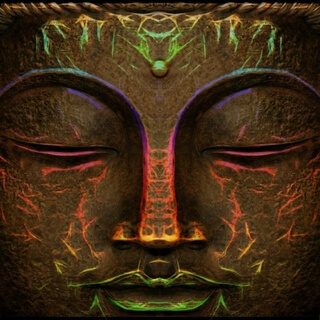
Let's do a self-exploration on I Am That,
Chapter 20.
Where does the compulsion to satisfy a desire lie?
Let's sit comfortably.
Let's close our eyes.
Let's take the attention beyond the person.
And let the I collapse into the quietness,
Into the brilliant stillness.
Ask yourself,
Is there a realization that the light of the supreme called Pragya reflects in the mind or Antakarna?
That reflection of light in the mind is called Chetana or consciousness.
Is there a recognition of Chetana?
Chetana in turn reflects in the body or Deha as Prana.
The consciousness reflects in the body as Prana.
Ask yourself,
Do I have the recognition of Prana?
Is there a recognition that the reflection of the supreme is the sense of I?
Is there a recognition that the sense of I reflects as a thought?
Is there a recognition that thought reflects as a feeling or sensation?
Is there a recognition that feeling or sensation in turn reflects as perception?
Is there a recognition that it is all like a hall of mirrors in which one mirror is reflecting in another mirror,
Is reflecting in another mirror,
Is reflecting in another mirror and so on,
Creating an infinity of images.
Ask yourself,
Do you recognize this infinity of images appearing and disappearing before you?
Do you recognize that they are all known by you?
Do you recognize that whatever appears before you cannot be yourself?
Once you realize that whatever appears before you cannot be yourself,
You are free of it.
The infinity of persons appear and disappear before you.
Once you realize that whatever appears before you cannot be yourself,
You are free of all,
Free of all the persons,
Free of all the Jeevatmas comprising of Antahkaranas and Dehas.
Let's bring up a desire.
Any desire.
A desire for some favorite object or for spending time with a favorite person or for experiencing a favorite situation.
Any desire is fine.
Intentionally bring up a desire and look at it,
Observe it from a distance.
What is a desire?
A desire is simply a thought.
That which is being known right now is simply a subtle thought.
A subtle thought is nothing but the reflection of the Chetana or Consciousness.
In the infinite reflections of Consciousness,
This particular desire is also simply a reflection.
Whenever there is an identification with a desire that counts as a step away from the Supreme,
The reflected has gotten entangled in its reflection.
The Consciousness has gotten entangled in its reflected thought and stepped further away from its truth.
It has become the person.
That is the meaning of the reflected has gotten entangled in its reflection.
Whenever there is identification with the desire.
Desires that arise out of passion or apathy are painful for this reason.
Because of the stepping away from the Supreme.
Because the reflected gets entangled in its reflection.
As such desires are not credible and not cogent.
They are not fulfilled.
They always bring pain.
When there is the dropping of identification with a desire,
That counts as a step towards the Supreme.
The reflected becomes unentangled or disentangled from its reflection.
Desires that arise out of compassion are never painful because of the step towards the Supreme.
Because the Consciousness does not get entangled in its reflection.
Because the Consciousness in fact disentangles from its reflection.
Such desires are always credible and cogent.
Thus they are always fulfilled and never bring pain.
Then what is a desire that is not cogent and not credible?
A desire that destroys other reflections is not cogent,
Not credible.
It appears and disappears almost instantly and remains unfulfilled.
For example,
A desire born of passion takes one away from the reflected and entangles one in the reflection.
This desire of passion aims to destroy the subject as there is stepping away from the Supreme involved here and getting entangled in the reflection of the Supreme is the product of this desire.
Such a desire is not cogent,
Not credible.
Thus it remains unfulfilled.
Another example is a desire born of apathy.
Such a desire takes one away from the reflected and entangles one in the reflection.
This desire aims to destroy the object.
It is not a credible or cogent desire.
Thus it remains unfulfilled.
All such desires that aim to destroy the subject or the object remain unfulfilled.
Those that arise in memory portraying to be fulfilled desires are simply random events and not the product of craving.
There is no cause and effect.
Cause and effect is simply another story of the mind.
Desires are not fulfilled because you craved for them.
Fulfillment of desires only follows one law.
The law of remembrance of the Self and stepping towards the Supreme fulfills the desire.
They are part of the script,
Not cause and effect,
Even if they may appear to be so.
Ask yourself.
So many desires have been fulfilled by this law,
But some of them do not subside on satisfaction.
Do you notice these desires?
Those desires that do not subside on satisfaction are self-contradictory.
Self-contradictory desires always remain unfulfilled.
Ask yourself.
Do you recognize those desires that are fulfilled and not self-contradictory?
An example is a desire born of compassion.
A desire that is born of compassion does not have the opposites of passion or apathy.
It has a neutral mood.
The entire universe of reflections strives to fulfill a desire born of compassion.
Why?
Simply because it aims at uplifting both the subject and the object.
It aims at uplifting both the reflected and the reflection.
And above all,
It is not self-contradictory.
That is why a desire born of compassion is never painful.
Ask yourself.
Why is a desire born at all?
Is there a clear recognition that the reflected must be faced with its own reflections in order to know itself?
Do you realize that your desires are your own reflections?
Do you realize that desires lead to experience?
Do you realize that experience leads to discrimination,
Viveka?
Do you realize that Viveka or discrimination leads to Vairagya,
Dispassion or detachment?
Do you realize that dispassion leads to self-knowledge?
Do you realize that self-knowledge itself is liberation from the belief of being the reflection?
When there is liberation from the reflections,
The compulsion to satisfy a desire dies away.
When there is liberation from the reflections,
The compulsion to satisfy a desire dies away.
Ask yourself this question.
Have you reached the stage where there is no urge to satisfy?
No action to be taken?
Nothing to do?
Nothing to do?
Nothing to do?
Nothing at all?