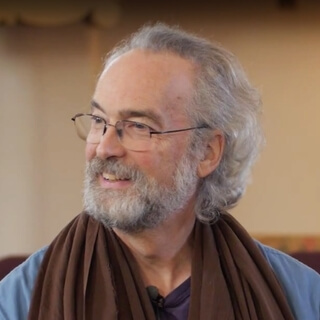
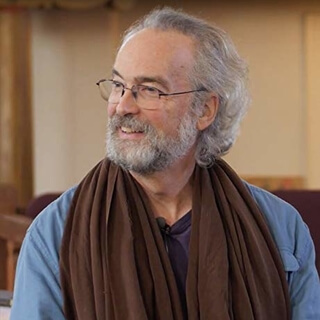
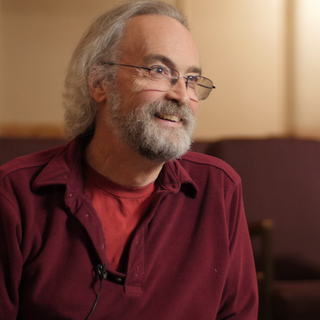
This is Amanda Kimball reading from Resting in the Waves by Doug Kraft.
Chapter five,
Steadiness of practice.
In my early ventures into meditation,
I wanted to know which flavor of Buddhism was best.
Buddhism has three main branches from which I could select,
Theravada,
Mahayana,
And Tibetan.
Theravada,
Which is Pali for school of the elders,
Is the oldest and most conservative branch.
Geographically,
It's associated with Central and South Asia.
It includes insight meditation,
Vipassana,
And awareness of breathing,
Anapanasati,
Among other practices.
It looks to the extant records of the Buddha's talks,
The suttas,
As a primary source of inspiration and authenticity.
And it offers commentary on these texts.
The Mahayana,
Which is Pali for great vehicle,
Grew out of Theravada as it migrated to East and Southern Asia.
It includes Zen and Pure Land Buddhism,
Among other schools.
It promotes the bodhisattva ideal of reaching beyond monastic communities to the laity.
It emphasizes that liberation can be achieved by anyone in this lifetime.
Tibetan Buddhism,
Or Vajrayana,
Sanskrit for diamond vehicle or thunderbolt vehicle,
Grew out of Mahayana Buddhism over a thousand years after the Buddha died.
It blended with some elements of the native Tibetan Bon religion with its special powers,
Rites,
And rituals.
Today,
Tibetan Buddhism retains a wide and rich array of practices.
In my early years of practice,
I did some training in all three.
Each branch has its characteristic flavor.
I found I was more drawn to Theravada.
In time,
I realized that this was not because it was necessarily best for everyone,
It's just that it just suited me.
All three branches have produced many wise and clear beings.
The Buddha taught different practices to different people.
Looking through the ancient records,
It's clear he was talented in assessing individuals' gifts and vulnerabilities and suggesting a well-matched path.
There is no need to find a winning team in the Buddhist Super Bowl.
We only have to find a good enough path for ourselves and those who seek our guidance.
The path will be a little different for each of us.
Having said that,
There are common themes in all three branches and in all the Buddha's practices.
This chapter explores some of those common elements and the steadiness of the practice.
In the next chapter,
We'll look at its fluidity.
Taking Time Taking Time.
The first prerequisite for any spiritual practice is time.
With the pace of modern life,
This can seem difficult,
But the heart of spiritual practice is helping the mind heart rediscover its nature.
As the musician David Darling put it,
Nothing is difficult.
Some things take time.
Spiritual practice takes time and patience.
A Vedic text says,
Truth waits for eyes unclouded by longing.
Wisdom arises naturally when awareness is patient,
Relaxed,
Clear,
Open,
Receptive,
And not fogged by emotion.
Usually it's not.
As I write these words,
The sky outside my window is overcast.
There's a clear sky above the clouds,
But not down here where I am.
We can't create a clear mind any more than we can create a clear sky.
It's already there,
But we can clear some of the cloud cover of reactivity.
As we saw earlier,
Evolution gave us neural systems that grab our attention by creating clouds.
Of emotions.
Fear,
Anger,
Delight,
Longing,
Etc.
We can't turn the signal system off,
But we can set aside times when there are fewer triggers.
In daily meditation or on retreats,
We can do what's reasonable to reduce disturbances and distractions.
We can simplify the environment for an hour of meditation or several weeks of retreat.
Taking time on a regular basis is a vital part of any spiritual practice and deep living.
This helps us find moments of eyes unclouded by longing.
They remind us of what's possible as they expose the clear awareness beyond the overcast sky.
It can be such a relief that we just want more,
But the clouds return again and again.
With time and practice,
We become less interested in getting rid of the clouds and more interested in what keeps bringing them back.
If we can deal with the causes,
There will be fewer clouds.
Suggested Exercise.
How much time do you give to meditation?
When you practice,
What do you long for?
How much of your practice is motivated by longing?
How much by pushing?
How much by being?
Attuning,
Not attaining.
As our meditation practice deepens and steadies,
We see that spiritual awakening is not about attaining.
It is about attuning.
Attuning requires time,
Patience,
And seeing clearly.
The Buddha taught the primacy of awareness.
Spiritual deepening is not the result of behavior,
Rites,
Rituals,
Social status,
Beliefs,
Or philosophical conclusions.
It is the result of seeing clearly and directly how life actually works.
It is the result of awareness.
One Pali word for this is Vipassana.
The term is usually translated as insight,
But literally means clear seeing or clear knowing.
Just as 20th century Western psychologists came to understand,
The Buddha recognized that knowing begins with contact between the organism and the environment.
It begins with the phenomenon of awareness.
In a sense,
They were all phenomenologists.
If awareness is the byproduct of our physiology and neural networks,
Then to have greater awareness,
Train ourselves and our brains to manufacture deeper and clearer states.
But if awareness is a primary property of the universe,
Then we can't train it.
However,
We can attune to what's already here.
Meditation is not about creating something new.
It's about revealing something that's hidden.
It's not about doing.
It's about being.
It's not about giving birth to something novel,
But about recognizing something that's been here all along.
We want to listen more than create,
Surrender more than control,
Receive more than act,
And attune more than attain.
The amount of attuning that the mind needs depends on the clarity it already has.
Awakened awareness is clear,
Open,
Present,
Softly luminous,
Peaceful,
And responsive to the world without being reactive.
Truly awakened people don't need formal meditation because their normal state is the same as deep meditative awareness.
On the other hand,
Overcast awareness is opaque,
Dense,
Lost in the past or future,
Unresponsive,
And reactive.
Such people are lost.
Meditation might be helpful,
But they're unlikely to engage spiritual practice because they're too absent to know there's a problem.
Most of us are somewhere between these extremes.
We have moments of clear,
Unfettered awareness and moments of opacity and irritability,
But we recognize there's a problem and that meditation training might be beneficial.
Some of us know our minds go out of balance and that the essence of the problem is tension.
Others know there's a problem but don't know its source.
They know they are discontented,
But don't really understand how to work with it.
This can be painful and discouraging.
It happens often with new meditators who have not yet learned how to work effectively with the tension and tightness in the mind or even that that is the root of their difficulty.
Suggested exercise.
When distracting the mind,
What are some of the typical ways that you respond?
How much do you see it as a helpful reminder to relax?
How much do you feel like you're not there?
How much do you get caught in the content?
Home base.
To work with our difficulty and attune,
The mind needs a job.
If we leave it unchaperoned without anything to do,
It wanders off into the wilderness or gets caught in a briar patch.
It picks through old conversations,
Makes shopping lists,
Drifts into fantasies,
Explains worries,
Fogs up,
And more.
Most styles of meditation start by choosing a home base and giving the mind the job of returning to it when it rambles off.
The home base could be the breath,
A mantra,
Kindness,
A koan,
Or almost anything.
The main difference between different styles of meditation is what home base they recommend.
Awareness of the breath is a popular home base because it's easy to use in the beginning and directly addresses the concern of most beginning meditators.
What do I do with the herd of buffalo stampeding through my mind?
Focusing on the sensations of the breath draws attention out of the mental dust.
Thoughts can be about the past or future,
But body sensations are in the present and are easy to find.
The limitation of using the breath as a home base,
As it is commonly used,
Is that it focuses on the coarse end of the spectrum of awareness.
Meditation is ultimately about the qualities of awareness,
Not the content of awareness.
Putting too much attention on physical sensations can bog us down in content.
I used the breath for 25 years.
I made good progress in the beginning,
But ultimately my practice plateaued.
Meta meditation begins with uplifted qualities.
When I shifted to that home base,
My practice accelerated and went to places I had not imagined possible.
In the beginning,
Meta can be difficult because mental qualities are subtle and can be hard to see.
However,
We all know what kindness,
Compassion,
Joy,
And equanimity feel like,
Even if we aren't feeling them in a given moment.
If we lightly send out meta or well-wishing,
Uplifted qualities generally take hold.
Suggested Exercise.
What's your home base?
How fresh is it?
How stale?
How alive?
Steadiness.
In many meditation styles,
As the practice deepens,
The home base shifts from coarser to subtler qualities.
The home base can be fluid.
So we'll come back to this in the next chapter when we talk about the fluidity of practice.
But having a home base of some kind is part of the steadiness of practice.
It doesn't help to jump quickly from one home base to another.
It's better to find a good one and let it settle in for a while.
The middle way is neither jumping around too much nor doggedly staying in one place.
Whatever we use for a home base,
It's helpful that it be farther up the spectrum of awareness than where our mind normally rests.
Otherwise,
It doesn't serve as well as it could.
No matter what home base we use,
The mind still sneaks out the back door and wanders off over and over again.
Having a base doesn't really solve our problem.
It just makes it more obvious.
We become painfully aware of how out of control the mind is.
It can be frustrating and discouraging.
This may have been the Buddha's point.
He said often that he was concerned with only one thing,
Suffering and the relief from suffering.
It sounds like two things.
I think what he meant was that his main concern was relieving suffering.
But we have to be careful.
But we can't find a cure if we don't know there is a disease.
So the home base often flushes hidden discomfort to the surface.
Three essential practices.
Most students and scholars agree that the root of the Buddha's teachings is the so-called Four Noble Truths.
Chaturi Arya and Pali.
They are the bedrock of all Buddhist practices in all three branches,
Theravada,
Mahayana,
And Vajrayana.
I say so-called because they aren't philosophical or metaphysical truths.
They are pedestrian observations about life.
Noble doesn't refer to the observations.
The Pali term is idiomatic.
Noble refers to the mind that sees clearly.
The Buddhist scholar Stephen Batchelor refers to them as the Four Ennobling Truths.
They ennoble us when we work with them wisely.
Each observation has a verb,
A practice,
To help us attune more deeply.
They are meditation instructions.
There are only three practices.
The supposed fourth is the Eightfold Path,
A kind of eightfold checklist.
If the first three practices are not working well,
The eight are areas we can check to better attune our meditation.
Turning toward.
The first essential practice is turning toward whatever experience arises.
The first ennobling truth is called Dukkha,
A Pali term for suffering or dissatisfaction.
The Buddha doesn't say that life is suffering,
Only that it has discomfort.
The practice of returning our awareness to a home base helps us see how difficult such a simple task can be.
In pointing this out,
The Buddha is saying to us,
It's not your fault.
You aren't to blame.
Don't take the discomfort personally or think that you're doing something wrong.
It's just what happens in this world.
Rather than blame ourselves for hurting,
The Buddha says suffering is to be understood.
Understanding is a practice we can engage.
This does not mean analyzing.
When a friend understands us,
She knows how we think,
How we feel,
What lifts us up,
What gets us down,
What makes us tick.
The Buddha says we need to understand intimately how suffering and dissatisfaction work.
We can't do this if we're busy pushing away the angst,
Trying to rise above it or straining to control it.
Instead,
We simply turn toward whatever we experience.
We don't try to push it away or fix it.
Just see it as it is.
Suggested exercise.
How welcoming are you in turning toward your inner experience?
How often do you turn away?
Relaxing into.
The second essential practice is relaxing into.
When we understand dukkha,
We see that it's rooted in tension.
In the Pali,
Tanha.
The practice associated with Tanha sounds dramatic.
Tanha is to be abandoned.
To abandon tension,
We relax.
Rather from it or just grinning and bearing it,
We relax into it.
Anytime the mind is distracted in meditation or elsewhere,
Tension is a contributing cause.
The tension may be thick and obvious or subtle and hard to see.
Tension also contributes to a sense of solidity in the mind and to a sense of self.
Tightness disrupts the natural flux and flow of experience.
There's an evolutionary survival advantage to being sensitive to threats.
Tension stimulates thinking.
So when the mind wanders a lot,
It's helpful to notice if something truly does need attention.
We left the water running.
Someone is knocking at the door.
A wasp landed on our hand.
If so,
It may be best to attend to it.
But if it's a false alarm,
We relax.
It's important to give the reassurance and relax the tension rather than power through it or ignore it.
Suggested exercise.
How easily do you relax into tension?
How often do you push it away or hold on to it?
Deepening or savoring.
The third essential practice takes this a step further.
It says it is not enough to see superficially what's going on.
It helps to see into the core of it.
We need to see deeply what's going on underneath our experience.
So for example,
If we turn toward and relax into our fear,
Hurt,
Or heartache,
We see tenderness underneath.
If we weren't tender,
If we were an emotional brick,
We wouldn't suffer.
Anytime there is discomfort,
There has to be some tenderness beneath it.
If we relax into this tenderness,
We may notice openness or spaciousness.
Without these,
There would be no tenderness.
If we relax into the openness,
We may experience freedom.
We want that sense of freedom,
Inner peace,
Spiritual aliveness,
Openness of being.
Too often,
We may be able to look for it by turning away from difficulty,
Hardening against hurt,
Or distracting ourselves.
But the only path that works in the long run goes through the suffering and tenderness,
Rather than around them.
Of course,
When we turn toward and relax into our experience,
There's not always pain and suffering.
Sometimes there's even a little bit of pain and suffering.
Not always pain and suffering.
Sometimes there's peacefulness,
Ease,
Or wellbeing.
Deepening into these feels like savoring.
The third essential practice implicitly recognizes that we are more sensitive to negative experiences than to positive ones.
Neuroscientists say we are four times more likely to notice pain than pleasure.
So when an uplifted feeling arises,
The Buddha said it should be realized,
As in making it real.
We not only welcome it,
We let it soak in.
We savor it.
This allows it to deepen.
The three essential practices could be summarized as welcoming.
We turn toward whatever arises,
Relax into it,
And deepen or savor it.
Suggested exercise.
Can you deepen turning away?
Can you savor the good stuff without getting lost in it?
Wise effort.
Turning toward,
Relaxing into,
And deepening are an overview of Buddhist meditation practice.
However,
The most difficult part of meditation is dealing wisely with hindrances.
Hindrances are distractions that grab our attention.
They are unwelcome intruders.
It may take effort to get the practice back on track.
So it's easy to use too much effort.
Strain to get rid of strain.
Get up tight over tightness or confused about what to do with confusion.
If we just push awareness back to the home base,
The pushing adds tension to tension.
The tension makes the mind restless.
It wanders off again and again.
We're at risk of sliding into a discouraging downward spiral.
Wise effort,
In contrast,
Means effort without strain.
This is so important that one of my teachers,
Bhante Wimalaramsi and his students,
Put together a simple,
Paint-by-numbers implementation of what the Buddha meant by wise effort.
It's called the six R's.
Recognize,
Release,
Relax,
Re-smile,
Return,
And repeat.
The R's are both tangible enough to use anywhere along the path and flexible enough to work in most situations.
And they are self-correcting.
They can be used across a wide variety of home bases and depths of practice because they are primarily concerned with skillfully releasing tension.
Tension will change and get subtler as meditation deepens.
But tension will be there in some form.
The six R's are used when the mind wanders off while meditating.
At first,
There is nothing we can do about it.
We're lost in thought and don't even notice.
We're no longer attending.
But at some point,
Wisdom brings us back to the present,
Often accompanied by an observation such as,
Oh,
I'm supposed to be meditating.
How did we get back to the meditation practice at this point?
The answer is six R.
Recognize,
Release,
Relax,
Re-smile,
Return,
Repeat.
Recognize.
The first R,
Recognize,
Is part of turning toward.
We recognize where the mind is at that moment.
Thought content is not helpful.
It is more useful to notice the processes in the mind.
Thinking,
Worrying,
Planning,
And so on.
If the qualities of awareness are easily seen,
We can recognize them as well.
Release.
The second R,
Release,
Is also part of turning toward.
To help us recognize clearly,
We release what we see by just letting things be as they are without holding on to them or pushing them away.
We mentally step back to get a wider view.
Relax.
The third step is to relax or relax into.
It's the second essential practice and the most important of the Rs.
Tension,
Tanha,
Is a common element in all distractions.
Sometimes the tension is thick and obvious.
Sometimes it is subtle and hard to see.
But any time the mind wanders,
There will be some level of tension.
Otherwise,
The mind heart would be serene and steady.
Tension is also the glue that holds the sense of self together and the clouds that obscure natural unborn awareness.
So relaxing helps loosen up the density of selfhood and lightens awareness at the same time.
We can't force relaxation.
Trying to do so is counterproductive.
We just invite the body,
Emotions,
And mind to soften or relax.
When asked how to become enlightened,
The Buddhist teacher Adiyashanti said,
Relax.
Resmile.
The fourth step is to smile.
We call it resmile because we need an R word and because we'll be doing this a lot.
When the tension drains,
It leaves an open space in the mind heart.
Old habits can rush in and fill the void.
So we deliberately invite uplifted qualities like kindness,
Compassion,
Or peacefulness to pervade that spaciousness.
But we don't force anything.
If no uplifted qualities arise easily,
We lift the corners of the mouth in a quiet smile.
Because of brain wiring,
Mechanically smiling can trigger a gentle feeling of uplift without pushing.
Resmiling is part of the third essential practice,
Deepening or savoring.
Return.
The fifth R is to return to our regular meditation practice,
Which might be sending out metta,
Observing the breath,
Or another kind of meditation practice.
We return to our home base.
If our home base is sending out uplifted qualities,
This R becomes part of the essential practice of deepening.
Repeat.
The final R is repeat.
Anytime the mind gets lost,
We repeat the R.
The repeat step is a reminder that we will be doing the six R's a lot,
And that patience is helpful in any spiritual discipline.
With patience,
Practice is so much easier and more enjoyable.
Rolling the R's.
As we practice the six R's,
They tend to flow together.
This can be helpful.
We call it rolling the R's.
We could also call it welcoming because that's how the R's feel as they merge into a single motion.
As they blend together,
Sometimes one of the R's fades without us noticing,
So it's helpful to take them in for a tune-up from time to time.
Intentionally slow them down into the six separate movements.
That way we'll see quickly if all six are still there or not.
If one has faded,
We bring it back.
Once they are all going,
We let them roll back into a single flow of welcoming.
Having a steady home base to return to and cultivating an ease in using the six R's helps the mind stabilize.
They keep the mind from running all over the place,
And when it does,
They give it away for settling down into a steady practice that opens the mind heart.
And this in turn builds wisdom by helping us see how the mind heart works.
However,
It's not helpful for the mind to get too stiff and thick.
The awakened mind heart has a natural ease and flow,
Which is the topic of the next chapter.