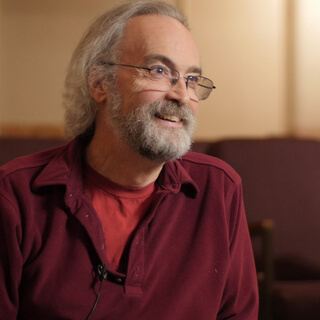
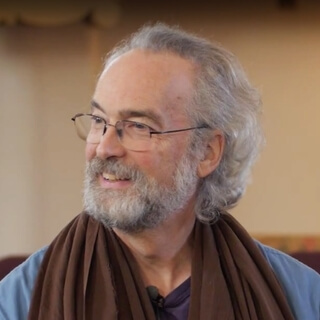
This is Amanda Kimball reading from Resting in the Waves by Doug Kraft.
Chapter 6 Fluidity of Practice Taming the mind is like taming a wild elephant,
The teacher explained.
I sat toward the back of the meditation hall at the Insight Meditation Society in Barr,
Massachusetts.
This is June 1974,
And I was starting my first extended meditation retreat.
She continued,
In ancient India,
An elephant trainer secured one end of a chain to the leg of the beast and the other end to a post pounded deep into the ground.
At first the elephant was mellow,
But when it realized it was tethered,
It rebelled,
Tugged and flailed.
But it couldn't break free,
Fighting was futile.
Eventually,
The elephant wore out,
Accepted the situation,
And settled down.
The teacher paused to let the image sink in.
Then she said,
Chain your awareness to the breath.
Your mind will run off in stories,
Thoughts,
Images,
And ideas,
And back to the breath over and over.
It will gradually accept that breathing is here to stay and settle into it.
At the time,
I found the metaphor persuasive and did my best to practice as she suggested.
Sometimes the cycle of rebellion and calm was not pretty.
However,
The quiet moments gradually lengthened.
This strategy worked.
While I was grateful,
I was not totally satisfied.
Treating the mind like a rogue elephant was not the best.
I came back for more retreats with similar instructions,
But I was curious to know more about what was really going on in the rogue mind.
So when attention wandered,
I didn't always rein it in.
Sometimes I took it to heart,
The way I might embrace a rambunctious child.
When I did this,
The mind seemed to have more energy than it knew what to do with.
It was trying to burn off excess vim.
Going from object to object,
Story to story,
And topic to topic dispersed superfluous energy.
This was not particularly skillful or effective,
But I saw that the mind wasn't being naughty.
It was doing the best it could with what it already knew.
Suggested Exercise How do you feel toward the mind when it wanders off without asking permission?
If you can't control it,
Whose mind is it anyway?
As I became more adept,
I noticed times when the mind was not chaotic.
This quiet had always been there,
Obscured by the noise.
Now I was becoming more aware of it.
At these times,
Foremost in awareness was not a series of objects,
But a series of processes.
Sometimes the mind just muttered,
Sometimes it explained,
Sometimes it argued,
Whined,
Dreamed,
Planned,
Or plotted.
These activities had content,
But I could see the processes apart from their content.
I noticed explaining apart from the explanations,
Worrying apart from what I worried about,
Excitement apart from what was exciting.
I was beginning to understand that the types of things the mind could notice vary over a wide spectrum.
Sometimes the best I could do was to see the chaos in the mind.
Sometimes I could see individual objects within the cacophony.
Sometimes I could see subtler processes behind the various objects.
Sometimes I could see the qualities of awareness that gave birth to those processes.
Sometimes I could see awareness itself,
Without which I wouldn't have known any of this.
I was beginning to suspect that the practices that deepen awareness necessarily vary.
When the mind is chaotic,
It is difficult and discouraging to try to see the mental processes themselves.
On the other hand,
When awareness is subtle,
Bringing attention back to a single,
Coarse object such as the breath can actually prevent awareness from becoming serene.
Fluidity helps the practice adapt wisely.
Know best home base.
Years ago,
I could not have imagined writing that last sentence.
I knew there were different styles of meditation,
Different strokes for different folks,
But I assumed one home base was better than others.
I was searching for the most effective technique so I could master it.
But a single optimal technique doesn't exist.
The best practice is contextual.
The most effective ways to meditate are as fluid as the mind.
If this leaves us feeling like Wile E.
Coyote suspended in mid-air,
Then it helps to welcome that feeling as well.
We have to relax into its fluidity.
The moment itself becomes our teacher.
Just because there are times when our practice is subtle and refined enough to be aware of awareness doesn't mean that that will be our optimal home base from now on.
The next time we meditate,
The mind may be a wild elephant.
Just because the elephant flailed the last time doesn't preclude the possibility that our next meditation may drop into deep stillness.
As noted before,
The mind has a mind of its own.
We are navigators,
Not pilots.
It is best to welcome surprise.
The more we welcome the mind's fluidity,
No matter what's going on,
The more receptive we are to the deep stillness and contentment that float behind all awareness.
Corruption vs.
Ignorance My early forays into Buddhist practice touched on basic questions about human nature,
Though I didn't appreciate it at the time.
The orthodox Christian view is that humans are fundamentally corrupt.
Original sin.
We are not capable of the deepest happiness without the intervention of outside forces such as God.
A modern agnostic view leaves divinity out of the equation but assumes our core nature is more like a feral elephant than a serene Buddha.
It replaces our external God with internal willpower.
We need some force,
Such as meditative discipline,
To shape us up.
It may not be easy,
No pain,
No gain,
But we need to save ourselves from our wayward tendencies.
This attitude suggests forceful and disciplined spiritual practices.
Awareness not will The Buddha's view of human nature was different.
He suggested we are fundamentally noble.
Original goodness.
We already have what we need for the deepest contentment and well-being.
Our problem is not corruption,
It is ignorance.
We don't fully recognize our Buddha nature.
So spiritual practice is less about fixing us and more about seeing clearly what we truly are already.
It's not about beliefs,
Rituals,
Concepts,
Philosophies,
Or metaphysics.
It's about penetrating mindfulness.
When awareness is deep enough,
We know effortlessly what to do and what not to do.
Meditation is less about willpower and more about sensitive wakefulness.
Open,
Clear awareness is alive and fluid.
If we pay attention,
No two sittings are exactly the same.
Similarly optimal meditation techniques are fluid and able to adapt to what we see and learn.
The Buddha taught different people in different ways.
He recognized that different people had different gifts and blind spots and he offered techniques best suited to them.
He also expected that the techniques a person used would have to adapt and change as the person progressed.
He didn't teach one size fits all or even that one technique fits a given person all the time.
Fluidity of the Jhanas The most striking illustration of the Buddha's fluidity of practice is the jhanas.
The jhanas describe eight stages of practice,
Each with characteristic qualities.
The insights gained in each jhana suggest how a meditator can shift their practice.
It's a bootstrapping in which insights from one phase make deeper,
Subtler techniques available for the next phase.
The jhanas proceed through joy,
Happiness,
Peacefulness,
Spaciousness,
Stillness,
Fading of distinct objects into a sense of flow,
And the fading of perception itself.
The Buddha's map does not use a never-changing home base.
To be sure,
The base doesn't jump around chaotically,
But neither is awareness chained to a single object.
Instead,
It slowly and gracefully shifts to a subtler and subtler object as our practice deepens.
Suggested Exercise How do you decide when to let the mind-heart find its own way and when to assert meditative discipline?
When is the use of willpower helpful?
When is awareness alone enough?
Breath,
A shifting home base,
Was not how I was taught when I began Buddhist practice.
My earlier teachers relied heavily on one home base,
The breath.
It is ubiquitous in many American insight practices as well as in stress reduction programs in the larger community.
But when Bhante Vimalaramsi encouraged me to read what the Buddha said about meditation,
I realized there were only a few texts that referred to breath-based awareness,
Whereas about a third of the texts mentioned jhanas.
And even breath-based awareness does not stay exclusively on the breath.
The Anapanasati Sudha,
Discourse on Mindfulness of Breathing,
Has the most detail about the breath as meditation home base.
It starts with knowing the sensations of the breath,
Long or short,
Coarse or subtle,
And so on.
As we settle into those sensations,
Attention shifts from single breaths to awareness to breathing throughout the whole body.
Then it shifts from the body to joy.
From there it progresses up through the jhanas.
The breath sensations are only used as an entry point into deeper jhana practice.
Four Ingredients The jhanas parallel the spectrum of awareness described in Chapter 4.
The difference is that jhana practice lumps together the whole lower end of the spectrum.
Everything before uplifted qualities is treated as a distraction to be six-ard.
On the other hand,
The jhanas start with uplifted qualities at the upper end of the spectrum – joy,
Happiness,
And peace – and go up from there.
Since all of us have some familiarity with these refined places,
We are able to use them.
However,
For those who are new to meditation or do not meditate regularly,
The first step from everyday awareness to uplifted qualities can be daunting.
In these cases,
I've found the framework of the four ingredients of the mind can be a helpful bridge.
To review,
The ingredients are 1.
The world around us 2.
Wired in proclivities 3.
Personal history 4.
Willpower Here's an example of what this can look like in everyday life.
One summer,
A construction project began next to the home of a friend of mine in Sacramento.
The project went on for months.
Because of the summer heat in central California,
The workers started at dawn when it was relatively cool so they could get in a full day's work before the temperature climbed through the 90s.
My friend liked to meditate in the early morning.
The workers used large machines equipped with alarms that beeped a tone and timbre that drew attention.
It was unpleasant.
At first,
He six-arred these alarm sounds.
But as the days and weeks rolled by,
He found he was bracing himself for the beeps before they started.
He spoke with the workers.
They were sympathetic.
They noted that they did not use jackhammers or other loud equipment before normal work hours.
But to get anything done,
They needed to move their equipment.
If they disabled those backup alarms,
They'd get cited for a safety violation.
His meditation and quality of life degenerated.
He used the six-rs,
But they were not enough.
So I encouraged him to stay longer with the first of the six-rs.
Recognize.
Together we identified the various ingredients of his experience.
The world around us.
The most obvious was the environment.
The beeping.
He did what he could externally to stop it,
But it continued.
Unconsciously,
He tried to shut it out of his mind.
But the body is designed to notice threat signals.
Trying to use willpower to blank out an alarm was futile and exhausting.
Two.
Wired in proclivities.
The biological ingredient was less obvious,
Because under stress the mind looks out there rather than in here.
However,
With a few prompts,
He recognized the sound itself apart from his feelings about it and that in itself it was neutral.
Nevertheless,
He noticed the mind found the sound uncomfortable.
It tightened up and labeled the whole thing an awful problem.
He couldn't prevent these reactions.
They were wired in.
Three.
Personal history.
The personal history ingredient of the mind had developed as the days and weeks rolled by and he began to anticipate the disturbance,
At which point he tried to solve the awful problem.
When he couldn't,
The mind slumped into discouragement.
Four.
Willpower.
The willpower ingredient resided in his attempt to make the problem go away.
However,
Willpower is not very strong when compared with the forces of the world around us,
Wired in proclivities and personal history.
Not knowing what else to do,
He tried to just will it all away.
The task was too much.
The Buddha's awakening and the core of his teaching was based on an analysis of phenomena such as these,
Which he called the links of dependent origination.
The primary sound that so disturbed my friend would be identified by the Buddha as simply a body-based sensation.
Fassa.
The discomfort would be a feeling tone,
Vedana.
The tension was Tanha,
Which we've spoken of earlier in the book.
The label,
Awful problem,
Was clinging,
Upadana.
The attempt to figure out a solution was a habitual tendency,
Bawa.
The attempt to implement the solution was an action,
Jati,
And the discouragement was suffering,
Jaramarana.
I thought that trying to teach him these finer points of the links of dependent origination while in the midst of a crisis would not be kind or effective,
But the four ingredients could provide a simpler strategy to him to untangle his situation.
The most important elements were the beeping sound,
Which was impersonal and out of his control.
The inner tightening,
Which was an impersonal reflex and out of his control.
And the discouragement,
Which was a natural response to a seemingly intransigent situation.
Using this simplified model,
He could redirect his precious resources of effort and will from the large and nearly impossible job of shutting down the whole chain of events.
Instead,
We focused his effort on one Aikido-like move,
Relaxing the tension.
We can't always do this completely.
Sometimes the tension is a physiological response,
But we can invite relaxation.
That was enough to get him onto a reasonable and doable path.
He wasn't wasting willpower on things over which he had little or no control.
Conserving effort wisely.
The story illustrates an important aspect of the Buddhist practice,
Conserving effort for when we need it most.
Awareness is more important than willpower.
When we see what's going on clearly enough,
We naturally know what to do and what not to do.
We shouldn't waste our precious will on trying to control the world around us or within us.
It's better to use gentle intention to cultivate open,
Clear,
Agenda-less awareness.
Relaxing tension is key to clear awareness and fluid meditation practice as well as to expansive and joyful living.
Compared with ancient India,
Modern Western culture puts more emphasis on controlling than on relaxing,
On being the master of our fate than on being curious about what life is offering,
And on being on top of our game rather than surrendering to the moment.
Without our science,
Technology,
And gadgetry,
Ancient yogis were less likely to think they should be the captains of their ships.
The Buddha was speaking to his contemporaries.
He had no understanding of our modern cultural biases.
So we have to look a little deeper into his teachings to realize things that were obvious to his people,
But not to us.
Agenda-less awareness of awareness.
When we look deeper into the Buddha's teachings,
We see how his practice conserves effort by emphasizing awareness.
Agenda-less awareness is inherently calming.
This peacefulness deepens our motivation.
Meditation master Sayadaw U Tejaniya puts it this way,
If awareness never comes off the object of awareness and onto awareness itself,
Your practice will not go very far.
Awareness of awareness is subtle.
However,
Cultivating a kind openness toward awareness requires less willpower than manipulating its content.
So in the long run,
It's more effective.
For example,
I look out the window in the morning and see it's cold and rainy.
Before I go out,
I slip on a jacket and pick up an umbrella.
When I see the weather,
I know what to do and what not to do.
I don't need a set of rules that say,
Wear a jacket when it's cold,
Don't wear a jacket when it's warm,
Take an umbrella if it's raining or looks like it could rain,
Leave the umbrella at home if the sky is clear.
If I had to go through that checklist every day,
It would take longer to get going and life would feel stiff and regimented.
The Buddha,
In contrast,
Put more faith in awareness than in willpower.
It made life simpler and more joyful.
To be sure,
The monks had lots of rules,
But precepts were not intended to bludgeon someone into lying.
They were tools of awareness.
For example,
A monk takes a precept to refrain from lying and harming.
If he's tempted to lie or hurt someone,
The precept reminds him to slow down and pay more attention to what's going on inside.
The monks had the faith that when they truly saw what's going on,
They'd know instinctively what to do and what not to do.
Awareness can be bad news too.
Even when awareness is strong,
We still need some willpower because awareness is often bad news.
Sometimes it takes a little effort to stay with experience and six-R it rather than reflexively push unpleasantness aside.
Ram Dass tells a tale about how this works.
The rabbi knelt down at the altar and began to beat his chest and intone,
I'm nobody,
I'm nobody,
I'm nobody.
The cantor bent his knees next to the rabbi,
Beat his chest and lamented,
I'm nobody,
I'm nobody,
I'm nobody.
The janitor knelt next to the cantor,
Beat his chest and moaned,
I'm nobody,
I'm nobody,
I'm nobody.
The cantor turned to the rabbi and said,
Look who thinks he's nobody.
We can imagine the cantor's many thoughts and feelings,
Pride in his humility,
Caring for the suffering of some people,
Disdain for the janitor,
Protectiveness of sacred rituals,
Self-doubt,
High-mindedness,
Low-mindedness,
Longing to be appreciated and more.
He probably wasn't conscious of all of these,
But like the moon below the horizon pulling the tides,
Unseen thoughts and feelings would have had a gravitational effect on the cantor's mood,
Speech and actions.
Like the cantor,
We all have a lot going on inside,
We're conscious of some things and oblivious of others.
With billions of neurons in the brain,
Multiple circuits are usually active at the same time.
If we were fully aware of all of them,
We'd be overwhelmed.
So the mind filters awareness,
Some things surface while others hover below the horizon.
One mental filter is self-image,
Things that support our self-concept are easier to notice than things that conflict with it.
The cantor found it easier to see his humility than his pride,
His caring than his disdain,
His confidence than his self-doubt.
The same is true for us.
It's easier to notice what harmonizes with our self-sense than the things that are discordant with it.
In the short run,
Self-awareness is often bad news.
Things that emerge from the depths are often the things we once pushed down because they were disturbing,
Harmful or didn't support our self-image.
But there is no freedom outside of truth.
Repressed feelings affect us.
So seeing them all is helpful even if they are uncomfortable for a while.
Learning to tolerate uncomfortable feelings is a boon in the long run.
It's said that pain is inevitable,
Suffering is optional.
Dependent Origination Another example of conserving willpower wisely can be found in the links of Dependent Origination or Dependent Co-Arising,
Paticca Samupada,
Which we explored earlier in this chapter.
It shows how willpower can be conserved by one's cultivating subtler and subtler awareness.
Dependent Origination says that everything arises out of causes and conditions and those causes and conditions arise out of subtler antecedents in a chain of causality.
It's like a line of dominoes.
As each one falls forward,
It knocks down the one in front of it.
However,
In the links of Dependent Origination,
Each domino is slightly larger than the one behind that knocked it over.
So the force and momentum increase the further we go down the line.
It takes more and more effort and willpower to stop the larger dominoes from tipping over.
For example,
The smell of fresh bread is just an aroma,
But it can trigger a bigger domino.
Pleasantness Pleasantness can trigger attraction.
Attraction has more momentum and tension than the aroma alone.
It can trigger craving,
Which can trigger the thought,
I want a bite of that,
Which can trigger thoughts about how to get that bread,
Which can trigger the action of getting the bread,
And so forth.
As we go down the causal chain,
The dominoes get bigger,
Have more momentum and tension,
And are harder to stop.
However,
As awareness gets subtler,
We can see and intervene earlier in the chain.
With careful observation,
We can use this causal chain to our advantage.
Rather than wrestling with the gross effects at the end of the chain,
We look for and relax the subtler causes within causes.
This requires some effort and patience,
But it's easier because the smaller dominoes require less effort.
As we see smaller antecedents,
Awareness itself becomes enough to stop the chain reaction.
Noticing the Mind's Tone of Voice A simple practice that is an offshoot of dependent origination is noticing the tone of voice that is speaking in the mind.
This can be very helpful with a busy mind.
Rather than attending to what the mind is saying,
We attend to the quality and volume of the voice that is speaking.
For example,
Ask yourself whether the voice sounds loud,
Grumpy,
Edgy,
Curious,
Or submissive.
This is a way to step out of the topic in the mind without pushing it away.
We may think the content of the mind determines the tone of the mind,
But the opposite is usually true.
The subtle tone generates the coarser content.
For example,
If the mind is arguing as we try to meditate,
It's easier to get involved in the content,
Who's right and who's wrong and why.
It seems like the content is important and stirring up trouble.
However,
If we resolve the argument,
The mind often picks up another fight.
In other words,
The arguing comes first,
The content second.
What is most helpful is seeing the arguing as a process unto itself and six-arring and relaxing the tension in the process.
With this,
The content tends to evaporate as irrelevant.
Habit Another way to rely less on willpower is to cultivate wholesome habits.
It's said that habit is stronger than will.
A modest amount of effort is needed to develop a habit,
But as the habit grows,
Less willpower is required to maintain it.
It's as if we're trying to traverse a meadow of waist-high grass.
The first time through requires a lot of effort.
The tenth time takes less exertion because we've started to wear down a path.
The hundredth time is easy because the well-worn track offers little resistance.
It still takes some intention to follow the path,
However,
We can glide down it with relative ease.
Similarly,
To develop a meditation practice,
It helps to practice every day.
This way,
We rely more on the momentum of habit and less on brute will.
I recommend yogis sitting 30 to 45 minutes minimum in the beginning.
However,
If you can't find the time on any given day,
It helps to sit as much as you can,
Even if it's only five minutes.
This builds a daily habit.
Another habit is to sit regularly with a group of meditators.
It's easier to sit in a group than alone because the group support means we utilize less force of will.
And at the same time,
We're deepening the habit of sitting regularly.
Ancillary Practices Even when our overall meditation strategy is fluid and we are conserving willpower effectively,
There are times when the mind-heart gets stuck or stale anyway.
We may not need to overhaul our practice,
But some short-term intervention,
There are some interventions where ancillary practices can be employed for a while,
Then allowed to fade unless or until they are needed again.
The following are a sampling of practices we might consider fluidly as needed.
Forgiveness Empirical Trials Asking What Else Non-dual Awareness Moving Toward the Present Being in Multiple Places Forgiveness When meditation practice gets stuck,
One way to loosen it up is to switch to forgiveness meditation.
Forgiveness is particularly helpful when we identify with negative feelings or experiences.
Forgiveness heals by welcoming whatever is going on without trying to control anything.
It uses phrases similar to the beginning metapractice,
But the phrases can center on forgiving.
We can make up our own or use the following traditional four.
At first,
We focus on ourselves.
I forgive myself for not understanding.
I forgive myself for making mistakes.
I forgive myself for harming myself or someone else.
I forgive myself for not following my own sense of what's right.
We repeat a phrase or two slowly until we feel it.
We radiate that feeling of welcoming acceptance to ourselves.
If the mind resists,
We gently sixar the resistance and come back to forgiving ourselves.
The mind may naturally go to a person who left us or hurt us in some way,
If so,
We direct forgiveness to that person.
I forgive you for not understanding.
I forgive you for making mistakes.
I forgive you for harming yourself or someone else.
I forgive you for not following my sense of what's right.
We don't get involved in the storyline,
That doesn't help.
Until we feel them.
When the mind becomes distracted,
We gently sixar and start again.
The mind may naturally go to someone we hurt or abandoned.
If we feel remorse,
Guilt,
Or regret,
We shift the practice again.
We imagine them looking at us and hear them saying,
I forgive you for.
.
.
I truly do forgive you.
We allow that feeling to soak in.
If we get stuck and are unable to forgive or feel forgiven,
That may mean that we have a subtle attachment or aversion to anger,
Guilt,
Or allowing ourselves to be forgiven.
This holding on or pushing away can be forgiven and released as well.
We can take this practice into the rest of our life by forgiving everything.
We forgive ourselves for knocking something over,
Spilling something,
Bumping into someone,
Forgetting to do an errand.
We can forgive ourselves for distracting thoughts and forgive the thoughts for distracting us.
When our inner critic starts to speak,
We forgive ourselves and forgive the critic for being so enthusiastic.
We forgive ourselves for everything from how we squeeze the toothpaste tube to how our voice quivered in that meeting.
Most of us have an inner critic that is so familiar,
We don't even recognize it.
Continuous forgiveness helps bring that overlooked tension to the surface and allows it to relax in a welcoming embrace.
After a few days or a few months,
Those subtle tight places inside relax.
Forgiveness starts to feel like simple kindness and compassion.
We are ready to return to our regular practice.
Empirical Trials As meditation practice deepens,
What remains to be cleaned up is less generally applicable to everyone but to our own particular temperament and proclivities.
It's natural to wonder about the nature of our experiences,
Have questions,
And want guidance and confirmation.
But sometimes there is no one around who can help us.
The deeper our practice goes,
The fewer the number of people can give us useful guidance.
Gandhi subtitled his autobiography,
The Story of My Experiments with Truth.
I like to think of meditation as experiments with the truth of awareness.
So if we have questions and no one to guide us,
We can conduct empirical trials.
Imagine what the guidance from a wise person might be,
Then try it out,
Take your best shot at it,
See what the results are,
Try it another way,
See what the results are,
And so forth.
If we do this lightly,
Openly,
Patiently,
And with a sense of humor,
The chances are we'll find a good direction.
Asking What Else?
When our practice gets stuck or grows stale,
It's often because our mind passed over something.
As we six are the stuckness,
The first are recognize,
May need a little more time and attention to allow awareness to deepen.
A simple way to do this is to ask,
What else is going on?
For example,
You might notice that the conversation is repeating in a thought loop despite six arring it over and over.
This usually means we're not seeing with enough breadth and depth.
So we ask,
What else is going on?
We're not trying to push thoughts and feelings aside.
Rather,
We let them be as they are and ask,
What else?
This generous receptivity makes it easier to see multiple processes and qualities at once.
Explaining,
Worrying,
Figuring,
Fighting,
Anger,
Fear,
Hurt,
Worry,
Guilt,
Righteousness,
And so on.
Even if they contradict one another,
We don't anticipate or try to figure out what they might be.
We just see what shows itself.
Then after pausing for a moment to allow the emergent thought,
Feeling or quality to sink in,
We gently six are we don't six are to get rid of it,
But to make space for it and to allow its tension to dissipate naturally.
It's hard to fully notice tension without our grip on it starting to ease up.
Or we can gently invite the tightness to soften.
Trying to force relaxation can lead to more force than we soften into the tension to make sure we're not pushing it away.
With patience,
Eventually the inner space becomes peaceful.
We let awareness rest into the peacefulness.
At this point,
Our practice is no longer stuck or stale.
Sometimes a smile may arise spontaneously.
When this happens to me,
I often don't notice the smile for a few moments because it's so easy going and I wasn't expecting it.
It's not part of my self image.
It just arises on its own.
If this happens to you,
Don't use it to push other harsher qualities aside.
Just let them all be there.
The peacefulness of the smile may gradually absorb those harsher feelings into a tender aliveness that has fewer and fewer boundaries.
This is a hint of enlightenment.
Nothing is excluded.
Everything is a part of everything.
As we rest in immediate waves,
We're also resting in a larger ocean.
As the poet Babcock put it,
We rest in the immediate as if it were in the deep.
Non-dual awareness.
Non-dual practice can be cultivated in other ways.
For example,
When the mind is relatively quiet,
We may look at awareness and sense someone,
Us,
Seeing something.
There's a seer and there's what's from that quiet.
We relax deeply and allow the space between the seer and the seen to diminish.
They start to move closer.
If we keep relaxing,
The seer and the seen may become one and the same.
At this point,
There is no separation.
There is just awareness without a separate person who is aware.
This is non-dual awareness.
In the suttas,
It's described as non-self,
Anatta,
A negation,
But in experience,
It is more of a oneness.
This is one-dual awareness.
Moving toward the present.
Another similar practice is bringing awareness as close to the present as possible.
In reality,
Because of the massive number of neurons in the cerebral cortex that process perception,
By the time we become aware of something,
It is at least a fraction of a second into the past.
When the mind is relatively quiet,
We notice how far into the past the content of the mind is.
If I am reminiscing about an event earlier in the day,
The mind may be several hours in the past.
If I am delighted about how great my meditation is going today,
Or upset about how terrible it is,
Awareness is still focused at least a moment back.
To bring awareness closer to the present,
We have to let go of thinking itself.
Trying to push thoughts away just creates more tension and a longer time gap.
Rather,
We just let the mind relax into a simple,
Effortless flow of phenomena.
As this happens,
The sense of the seer and the seen may start to merge.
This is non-dual awareness,
Or oneness.
In the present,
There is just a single flow of phenomena.
Jhana practice is another way to describe moving toward the present.
In the seventh jhana,
Awareness relaxes so deeply that it doesn't coalesce into separate objects.
There is just a flow of phenomena,
Rather than a string of separate things.
The seventh jhana is called the realm of nothingness,
But a better translation might be no-thing-ness,
Because there is just a flow,
Rather than separate things.
There is so much ease and contentment that the mind doesn't divide experience into conventional categories.
In the eighth jhana,
The mind doesn't even feel compelled to assemble perceptions and memories.
This is called neither perception nor non-perception.
Perception doesn't stop cold,
But neither does it continue on its old way.
The fluidity of the seventh jhana becomes a radical relaxing that is not exactly the end of perception,
But not exactly a continuation of it either.
Awareness is more attuned to the elements of perception than to putting them together into the familiar categories or concepts.
When awareness moves fully into the present,
Categories of past and future,
Self and other fade.
Eventually,
Awareness itself fades.
This later stage is called nirodha,
Or perception,
Feeling,
And consciousness.
Invoking oneness Even when we experience non-dual awareness,
This side of enlightenment,
We will slide out of it,
Sometimes a little,
Sometimes a lot.
Nevertheless,
Non-dual practices can still be helpful.
They leave an embodied memory trace of what oneness feels like.
Bringing the memory of that feeling forward can invoke the sense of being a part of everything.
It's said that no two snowflakes are alike.
Each is unique.
However,
When the temperature of snowflakes rises above freezing,
They all melt into similar drops of water that are indistinguishable from one another.
In one context,
They are different.
In another,
They are the same.
In a similar manner,
We can feel our individuality and our deep interconnection at the same time.
We can be aware of our relative duality and our absolute non-duality all at once.
This helps us relax into a sense of freedom.
It can also help us not to get stuck on a self.
This is the core of the Buddha's teaching.
We have a conventional dualistic self that navigates the world,
But it is nothing more than a sometimes helpful illusion.
As awareness relaxes and opens,
The various selves fade into oneness.
Consider all phenomena to be dreams.
Be grateful to everyone.
Don't be swayed by outer circumstances.
Don't brood over the faults of others.
Explore the nature of unborn awareness.
At all times,
Simply rely on a joyful mind.
Don't expect a standing ovation.
Ati sa.
Seven Point Mind Training.