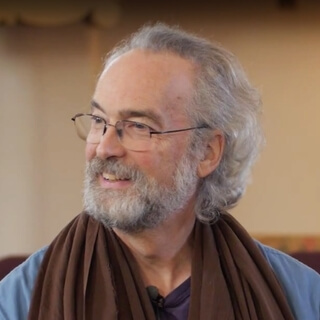
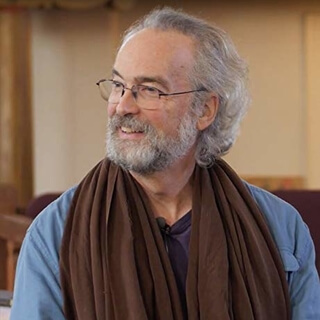
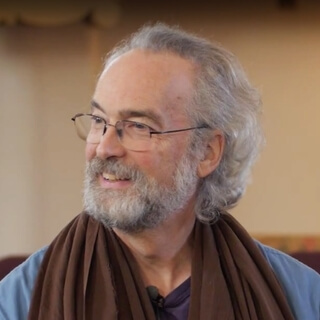
This is Amanda Kimball reading from Resting in the Waves by Doug Kraft.
Chapter 8,
Fluidity of Fluidity.
We humans are complex creatures who exist fluidly in many dimensions at once.
We live in physical,
Emotional,
Mental,
Social,
Cultural,
Political,
And spiritual realms.
We also live in the worlds of intentions,
Aspirations,
Stories,
And much more.
These realms interact and influence one another in ways that are lawful,
Complex,
And nuanced.
We cannot be reduced to any one realm or dimension.
Our physical nature may seem the most substantive,
But if we were to be placed naked into interstellar space in a matter of minutes,
We'd be reduced to a lifeless collection of frozen crystals.
We are embedded in an ecosphere of air,
Water,
Minerals,
And billions of other creatures.
Without this vast interdependent ecology,
We cease to exist as a living organism.
In other words,
We are swirls within swirls embedded in larger swirls of interdependence.
We have no independent self apart from the web of life.
There is no solid rock we can stand upon and declare,
This is the real me.
For example,
Our bodies grow out of a unique set of 20 to 25,
000 genes,
But how and when genes are activated can be influenced by food,
Rest,
Pathogens,
Stress,
And a multitude of other internal and external factors.
In addition to our physical bodies,
We are relational creatures affected by those around us.
When someone enters the room,
If we're quiet and attentive,
We can notice how we shift inside.
Our responses to others are also influenced by our social,
Cultural,
Political,
And economic circumstances.
Our memories shift depending on our mood,
Social setting,
And so on.
If we look within to find our true self,
We find an endless labyrinth with no final endpoint.
Two truths.
The Buddha alluded to all this when he described two truths,
The relative and the absolute.
The relative truth refers to how we think about life in everyday situations.
We are distinct individuals.
We are responsible for our actions.
Practices can help bring out our potentials and so forth.
The absolute truth refers to the web of life as a whole.
It is the deeper reality.
We may have relative differences,
But in absolute terms,
We are movements within this field of life.
These two truths should not be confused with Plato's two realms.
In Western philosophy,
Plato contrasts the realm of ideal forms with the ordinary world of degenerate shadows of those ideals.
Ideal forms are extraordinary.
The Buddha didn't say the absolute was better or more real than the relative.
Both are real.
They just have different frames of reference and behave differently.
To be fully alive and awake is to live with both truths as the mind-heart moves fluidly between them.
Perhaps only a Buddha can remain fully conscious of both truths at the same time.
However,
We can learn to travel between them.
As we become facile in moving back and forth,
We are less likely to confuse one with the other.
The phenomena we refer to as mind and self are nothing more than a stream of phenomena that have no discernible beginning or end.
No matter what our thoughts and feelings are about the origin of mind and self,
There are experiences that precede it.
And no matter where we end up,
There is something else that follows.
The awakened mind rests comfortably in the ever-shifting flux of experience.
When we see all this clearly enough,
We are content to let things be as they are.
With this,
Suffering abates.
Then we continue on.
There is no final destination called my enlightened self.
Suggested exercise.
If you have a hint of absolute truth,
Don't hold tightly to it.
If you see a relative truth,
Hold it lightly.
Practice moving back and forth between them.
All goes onward and outward.
Nothing collapses and to die is different from what anyone supposed and luckier.
From Leaves of Grass by Walt Whitman.
Emptiness.
Another way to express the two truths is with the Pali term sunyata or sunyata in Sanskrit.
It is usually translated as emptiness.
However,
The root of the word comes from the verb si,
Meaning to swell.
Relative reality is sunyata,
Like a bubble.
A bubble is real.
We can see it,
But inside it is vacuous.
There's nothing below the surface.
To say our lives are relatively real doesn't mean they're completely an illusion.
Our lives are real.
The self is real,
But it's real only in the way a bubble is real.
It has a surface with nothing substantive within.
If we don't see the emptiness and instead base our lives on imagined solidity,
Then when the true nature of things is revealed,
We will suffer.
However,
If we see that the world and the self are empty,
We can live with them just fine.
It requires a mind that is clear,
A heart that is kind,
And an awareness that is fluid.
Suggested exercise.
What if the surface of life is real and the interior is open space?
Can you look fiercely,
Gently,
And openly into the emptiness?
Rose Apple Tree.
With this understanding of the two truths and emptiness,
Let's go back to the experience of fundamental fluidity and how it's cultivated.
The Buddha's life gives us a clue.
When Siddhartha became a Buddha,
He remembered a moment from his childhood.
His family had left him under a rose apple tree while they joined the spring ritual of the first plowing of the fields.
Sitting in the shade of the tree,
He felt how life was swirls within swirls of interdependence with nothing fundamentally separate from anything else.
He effortlessly went into a deep and pervading calm.
He understood the world,
So it faded from his conscious memory,
Though it remained hidden inside.
It was part of what encouraged him to embark on his spiritual quest as a young man.
Years later,
When he sat under the Bodhi Tree and woke up,
It didn't feel like a new revelation or new quality of mind.
It felt like something he already knew deep down but had forgotten.
I suspect there are many among us who have had Rose Apple Tree moments,
Moments when we tasted interrelatedness and deep calm but don't consciously remember them.
But it affects us.
It may have been part of what drew us to meditation.
When meditators share with me glimpses of oneness,
I often ask,
Does this insight feel like a new revelation or does it feel like remembering something you once knew but somehow forgot?
Typically they pause for a moment to reflect and then they say,
It does feel more like a forgotten memory.
If you'd asked me about it yesterday,
The insight would have seemed esoteric,
But now it seems simple and obvious.
No big deal.
The Buddhist texts do not describe enlightenment as a place we get to but as the unraveling of the notion of a self that is separate from everything else.
Enlightenment is not a place at which we arrive.
It's the recognition that there is no self to be enlightened.
In the Udona 8.
1,
The Buddha described it this way,
There is bhikkhus,
That base where there is no earth,
No water,
No fire,
No air,
No base consisting of the infinity of space,
No base consisting of the infinity of consciousness,
No base consisting of nothingness,
No base consisting of neither perception nor non-perception,
Neither this world nor another world nor both,
Neither Sun nor Moon.
Here bhikkhus,
I say there is no coming,
No going,
No staying,
No deceasing,
No uprising,
Not fixed,
Not movable,
It has no support.
Just this is the end of suffering.
At any given moment,
We may be moving in an enlightening or unenlightening direction,
But there's no destination.
There's no awakened rock for us to perch upon,
Just swirls within swirls.
Enlightenment is not a destination,
But the recognition that there ultimately is not self to be enlightened.
When we meditate,
Rather than seek new understandings,
It may be more helpful to relax and rest in open awareness without an agenda.
Don't try to guide awareness,
Let it settle deeply into intuitive receptivity,
Then see what emerges.
Suggested exercise.
Don't search for insights,
Let them find you.
Ask,
What did I know but forgot?
Then leave the door open.
Emptiness of fluidity.
Here's an example of emptiness and fluidity.
I woke up a little after 3 o'clock a.
M.
As I rolled over to drift back to sleep,
My mind clamped down on a phrase from an email.
A friend had referred to me as a tightly wound guy.
I didn't like the phrase,
It wasn't complimentary,
But I knew there was truth in it.
The fact that I was lying in bed obsessing about it illustrated the point.
I 6R fairly automatically,
But I knew getting up to meditate would help the 6Rs be more effective and besides,
I was too awake to go back to sleep.
I sat up in a chair.
Leela Arkat curled up in my lap.
I recited the refuges,
Precepts,
And aspirations.
The aspirations reminded me of the general direction of practice.
I seek to observe the mind heart without preference.
I seek clarity and acceptance.
I seek to relax any tension in the self.
I rest in oneness.
The mind opened,
Softened,
And settled into stillness.
Then,
Like a dog chewing on a bone,
It chomped down on the phrase,
Tightly wound.
I 6R'd again and again.
After a few minutes,
Obsessiveness replaced tightly wound as the bone of choice.
Then the dog spit out that bone and grabbed another,
Then another.
It was clear that the phrases didn't cause the mind to tighten.
Rather,
The mind tightened and then looked for an excuse to chew on.
I became more interested in the chewing than in the bone itself.
The various phrases,
Images,
And stories faded into the background as I watched the mind chomp and release,
Tighten and loosen,
Get noisy and quiet,
Contract and expand,
Stiffen up and let down.
The periods of quiet lengthened until I could feel the slight thickening in the mind,
Release it,
Relax,
Smile at the humor of it all,
And return to radiating well-being before any content arose.
Was my mind wound or loose?
Was it tight or fluid?
The obvious answer was yes,
It was both.
The mind is in flux as it drifts from topic to topic,
From one static state to another,
From loosening up to tightening down.
Being fluid and being fixated are not mutually exclusive.
In short spans of time,
Continuity is easy to imagine.
In longer spans of time,
Fluidity is obvious.
It's just a matter of time.
Constancy,
Fluidity,
And mystery coexist.
All can be welcomed.
Even fluidity comes and goes.
Yes,
Even fluidity is fluid.
Like a tiny drop of dew or a bubble floating in a stream,
Like a flash of lightning in a summer cloud or a flickering lamp,
An illusion,
A phantom,
Or a dream,
So is all conditioned existence to be seen.
The Buddha,
Diamond Sutra 32