Somebody says,
Well how's your retreat going?
Use your social intelligence?
And I mean you can just say simply,
You know,
We're in silence,
You know,
Things are going well,
You know,
Thanks.
What you don't want to do,
Because you'll feel the blow back from that,
It's something that sounds righteous or better than or any of that sort of stuff.
So there's no reason to expect them to know and understand all that we're in,
So it's really upon,
It's an accord to be mindful and heartful and,
Anyway,
I'm in silence.
It's really not needed.
Yeah.
So part of it is remembering what the actually spirit of this is.
It's actually trying to create an environment that has some more stillness and quiet to allow those,
That quiet part of us to open up and that doesn't always mean not talking because there's sometimes when not talking creates more disturbance than talking.
It usually goes the other way,
But it's not that there is a fundamentalist way to do this right and if you just stick with that you'll be fine.
If you just stick with it no matter what then you'll just be rigid and a little righteous and that doesn't get you so much.
Does whispering mean you're talking to us?
Nope.
Reminds you to have this experience with little kids,
You know,
You say you don't talk to me while I'm on the phone and so you're talking to someone and they come up and whisper to you.
Kids are allowed magical thinking,
We aren't.
So tonight I would like to.
We spoke with Serene today.
Oh that's right,
Yes.
She's in a really good place,
She's very happy,
Energetic,
She's feeling great,
She hasn't gotten her reports back from her doctor and she's hoping she can come back and resume the retreat.
And she was really happy that we would call and check in on her.
So it was a bit of a class reunion.
And Jordan was very appropriate and just wanting to support her whether she came back or not and I just told her if she didn't come back I'd give her a really hard time.
I know Serene well.
I can take some liberties.
And I sent off a note to Kim to see if we can get a reading on where she is.
And then there's the rest of us.
Oh and Erica is gone as well if you're looking for numbers.
She was from the beginning was only staying through yesterday.
She gets to go back to work today.
So this evening I'd like to tell you a very sweet little bedtime story,
Not,
About a character in the Suttas called Angulimala.
And I'll just tell you the story and then we'll take it from here.
So Ahimzakha was the son of the chaplain in King Pasenadi's court.
King Pasenadi was one of the lay very strong supporters,
Followers,
Disciples of Buddha.
Astrologers noted that Ahimzakha was born under what they call the robber star.
Today we call it Sirius.
But the astrologers were very confident that Ahimzakha,
Because he was born under the robber star,
Was very vulnerable to becoming a robber or a criminal.
So his parents gave him the name Ahimzakha,
Which means harmless,
In hopes that that would inspire these ideals in him.
And his parents raised him with a lot of kindness and a lot of care and a lot of love.
And he grew up strong,
Intelligent,
Very well behaved,
And quite diligent in his studies.
In fact,
He was so diligent that when he got to the appropriate age,
The parents sent him off to the university at Taxakila,
Where he was accepted by a very renowned teacher there.
He settled into the university life,
He was very diligent in his studies,
Very devoted to his teacher.
In fact,
Pretty soon he became the teacher's favorite.
And the teacher's family would actually send him meals.
I assume they did not have any cafeteria,
Dormitory food plan back then.
And so he was settling in and doing quite well.
But as you can imagine,
Some of the other students were a little envious of the tightness of his relationship with the teacher.
And so they began to scheme to try to figure out some way to drive a wedge between the two of them.
And their plan was to start,
Today we call it a whispering campaign.
So they just began to drop hints,
Not make a big deal of it.
You know,
Ihemsuka really is not that loyal to the teacher.
You know,
Ihemsuka,
I sort of wonder if he's trying to plot a way to push the teacher out.
So they just began his little rumors floating around.
And at first the teacher just ignored him.
He's like,
No,
That's not Ihemsuka.
But after a while the poison in him began to soak in.
And the teacher began to worry about it and started to scheme himself to figure out what to do about all this.
Well,
At this point Ihemsuka was nearing the end of his studies.
And so the teacher called Ihemsuka in and said that the final thing he had to do to complete his studies was to give the teacher a gift.
This is part of the tradition.
And Ihemsuka said,
Oh,
That's wonderful.
I would love to do that.
What kind of gift would be appropriate?
And the teacher said,
You must give me a hundred fingers off the right hand.
And Ihemsuka said,
What?
You know,
I can't possibly do that.
My family abhors violence again.
The teacher was quite insistent and quite firm.
He said,
You know,
If you don't give your teaching the proper homage,
They're not going to bear any fruit.
I think probably secretly he was hoping that Ihemsuka would get caught or killed in this project.
So the teacher was quite firm about this and pretty soon Ihemsuka was persuaded of what he had to do.
So he gathered together some weapons and retreated off into the wild Jelini Forest which was in his home province of Kosala.
And he took up residence in some caves that were up high on a cliff,
The side of this hill,
These cliffs up high.
And there was a main road that went right through the forest past those cliffs.
So from his caves up there he could look down and he could see quite a long ways up and down this road and could see when travelers were coming,
In which case he would grab his weapons and run down and kill them and then cut off a finger and then take it back up to his cave where he would hang it on a tree outside the cave.
So the birds would come along and eat the flesh off it.
And then when the bones were picked clean,
Rather than leave them there to make them drop to the ground,
He strung them on the string and put them around his neck as a necklace.
So the news of these gory crimes began to spread and nobody knew the identity of this criminal so they took to call on him N'guli Mala.
N'guli means finger and Mala means garland.
So they began to call him finger garland.
The people stopped traveling through that part of the forest so much anymore.
So N'guli Mala had to travel a little further to the little villages around the outer edges of the forest to find his victims.
And pretty soon the villagers began to flee their villages.
It's like villagers fleeing a war zone and going into the cities where there was more protection.
And so because of the villagers going in there,
King Pasenade learned of this one man reign of terror and he gathered a regiment of soldiers to go out and see if they could track him down and put an end to all this.
And at the same time the Buddha heard about all this and in his deeper intuitive sensing he recognized that there was actually some good in this character.
So the Buddha decided he would go and visit him as well.
So we'll pick up the narrative here from the N'guli Mala Sutta which is number 86 in the Majjhima Nagaya.
And N'guli Mala saw the Blessed One coming from afar and thought,
Isn't it amazing?
Isn't it astounding?
Groups of ten,
Twenty,
Thirty and forty men have gone along this road and have fallen into my hands.
Yet now this contemplative comes attacking as it were alone and without a companion.
I think I'll kill him.
So N'guli Mala took up his sword and shield and buckled on his bow and quiver and ran with all his might to catch the Buddha who walked along at a normal pace.
Yet he could not catch him.
So there's something paranormal going on here.
N'guli Mala is running as fast as he can and the Buddha is just walking along slowly but N'guli Mala can't catch him.
And N'guli Mala thought,
Isn't it amazing?
Isn't it astounding?
I could catch a swift elephant,
A swift horse,
A swift chariot,
A swift deer and seize them.
But I can't catch this recluse walking at a normal pace.
So he stopped and he called out,
Stop recluse,
Stop.
The Buddha said,
I have stopped N'guli Mala.
You stopped too.
N'guli Mala asked,
What does this mean?
How have you stopped?
How have I not stopped?
The Buddha said,
N'guli Mala,
Once and for all I have cast off violence towards all living beings.
That's how I have stopped.
You are unrestrained towards beings.
That is how you have not stopped.
N'guli Mala thought,
At long last a revered great seer has come to the forest for my sake.
Can you hear that?
It touches me.
At long last a revered great seer has come to the forest for my sake.
I will renounce evil forever.
He hurled his swords and weapons into the gaping chasm.
He paid homage to the sublime one's feet.
And right then and there he requested the going forth.
It is a request to be accepted as a disciple of the Buddha.
The Buddha said,
Come monk.
With those simple words N'guli Mala became a monk because the Buddha addressed him as a monk.
It was a matter to an ordination.
I suspect that the conversation between N'guli Mala and the Buddha was quite a lot more detailed than what has survived in the records.
But you can get the course of events.
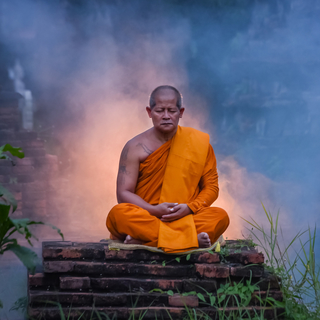
So N'guli Mala walked back to Shavasti with the Buddha and took up a monk's life,
Began his training there,
Which included meditation training and also doing alms rounds.
So he would go around on his alms rounds to people to get food and some of them would recognize him.
And so they wouldn't give him any food and some would throw clods of dirt and sticks and stuff at him.
Often times he came back to the monastery bruised and bleeding.
But he continued these daily rounds anyway because that was what was expected.
He had that devoted side to him.
One day when he was out on alms rounds he heard of a woman who was in great pain,
Great difficulty in labor.
And he was very touched by this and very concerned and he went back and told the Buddha about this.
And the Buddha said,
I don't know how to address him,
Ahimzika,
He said,
You should go and help her.
So he sent word back to this woman's family that he was going to come.
And so the family put a sheet or a piece of cloth or like a curtain and hung it up in the room where the woman was staying.
So she was in the bed and there was this curtain hanging there and they put a chair on the other side so he could come and sit without actually seeing her because for a monk to see a woman in bed would be considered really unseemly.
So he came and he spoke with her.
And there was something about his presence that was so soothing that she just calmed down and her difficulty subsided.
And she was actually completely healed.
And then pretty soon this child who was not given much chance of living,
This child was delivered successfully into the world.
So the news,
The word about this miracle spread very rapidly so other women who were in labor began to seek his help.
And as more and more were healed,
Their attitudes,
People's attitudes towards him began to change.
So he began to get some food on alms rounds,
Although some people continued to throw stones and stuff at him.
But he bore all these injuries with a great deal of serenity.
In time he became a fully enlightened arahant.
An arahant is the final stage of enlightenment.
He just went all the way.
And then he retreated back into the forest to live out the rest of his life in serenity.
And there's not much known about what happened to the latter part of his life,
But there are these verses that are around that he spoke and that were recorded.
For example,
Who once did live in negligence and then is negligent no more,
Illuminates this world like the moon freed from a cloud.
I love that image.
Who checks the evil deeds he did by doing wholesome deeds instead,
He illuminates this world like the moon freed from the cloud.
Today in Buddhist countries all children know the story of Angulima.
So you can imagine the 10,
11,
12 year olds would just love to hear these kind of stories.
And among pregnant women he's looked at like a patron saint whose blessings can ensure really safe and healthy delivery.
When Angulimala began training with the Buddha,
He probably had moments of great joy and peace and serenity and ease,
But I really doubt that it was all just sweetness and light.
He had the momentum of his past deeds.
He had renounced violence,
But there's something about the momentum of all that he had done.
And I can just imagine him meditating and having these horrific images come up with him over and over again.
He must have had moments of great discouragement and working through all those.
As we sit down to meditate we have moments of joy and equanimity and peace and delight.
Insights and old habits can bring a great deal of relief and we get little tastes sometimes of freedom,
Little glimpses.
And then the meditation falls apart.
You know,
Like,
You know,
Mind sometimes will just fly around the room like a party balloon that's been blown up but it slips out of your hand before you get the knot tied,
Goes around and smashes into the wall and falls down into the ground.
We all know that place,
Right?
Mind just zips around.
We have moments of graceful serenity followed by moments when the mind is as graceful as a dwarf trying to do ballet and work boots or something.
While I was training in Thailand,
I remember one point I took out my journal.
It was after this tremendous experience I had that was really quite wonderful and then a little bit later I remember I took out my journal and I wrote in it,
My mind has checked out every other book out of the Library of Congress and is reading them all at once.
So this practice can be discouraging.
There are times when it can be quite difficult.
You think,
You know,
This is beyond me.
I have my moments but I'm no great yogi.
I just,
I don't have the talent for this.
So it's actually in this context that I like to bring in the story of Angulimala for three reasons.
The first is that in a span of a few years he went from killing 999 people to becoming a fully enlightened arahant.
So unless you have killed more than 999 people in the last few years there is hope for you.
There is really nothing essential.
There is nothing essential within us that will prevent us from going as far as we would like to.
These states are not as esoteric as people make them out to be.
They are actually quite,
Quite accessible.
And this sutta,
As I read it says,
You know,
Look how far you can go astray.
Look how difficult it can be and you can still find full,
Peaceful awakening that's right there.
The story of doing this is also just very reassuring that distractions are normal without being fatal.
There are many,
Many stresses in our lives and quite frankly all of us have done bad things.
We know this.
Some of them intentional and some of them unintentional.
We all stumble over and over and over.
So it is not surprising,
It's not surprising that disturbing states,
You know,
Come up.
There is a residual effects of these come up inside us as we sit and meditate.
This practice is about seeing the truth of how things are.
It's not about shielding us from it.
Did I quote Vivekananda on this the other night?
Where he said spiritual growth is one insult after another.
You know,
So we are trying to expand our consciousness.
What's been pushed out?
The lovely stuff,
Probably not.
So as consciousness expands,
As awareness expands,
You know,
All these little stuff get exposed.
So what the story suggests to me is that we can manage this.
Probably none of us have gone over to the dark side as far as Guli Mahal went.
And he awoke nonetheless.
So we can too.
The problem,
The problem is never who we are.
The problem may be who we think we are.
The problem could be who we fear we are.
The problem may be who we hope we are not.
But the problem is not who we are.
We don't take refuge in who we think we are.
My condolences.
We can talk about that later.
We take refuge in who we truly are,
Whether we understand what that is or not.
So that's one reason I like to share this story.
The second reason,
And really the main reason when I read this story,
There's a subtlety that you look at it,
It becomes more and more apparent.
The story suggests that there is a relationship between our greatest gifts,
Our natural greatest gifts,
And our greatest vulnerabilities.
Ahimsa's greatest gift was a healer.
He was a healer.
He could do these miraculous things.
He could,
His sense of serenity,
Of presence,
I don't know how you explain it,
But there was something about him who could heal people and actually bring children joyfully into the world who might otherwise die.
And his greatest vulnerability was killing innocent people,
Taking people violently and perhaps prematurely out of the world.
So this suggests to me that our greatest gifts and our greatest vulnerabilities may be fraternal twins.
Any religion,
Any spirituality,
Any philosophy of life that has any depth to it at all acknowledges that we have a tremendous capacity,
All of us have a tremendous capacity for kindness,
Compassion,
And courage.
And on the other hand,
We also have the potential to do great damage to ourselves and others.
We all have both of these.
Within each of us is an Ahimsa and a Guli mala,
An Anakin Skywalker and a Darth Vader,
A Mara nature and a Buddha nature,
Part of all of us.
So we could call our greatest gifts and our greatest weaknesses our Dhamma gifts,
Dhamma vulnerabilities.
So these gifts and vulnerabilities go beyond ordinary gifts and vulnerabilities.
So ordinary gifts and vulnerabilities,
Gifts might be for things like what?
Music,
Poetry,
Engineering,
Chiropractic,
Lots of things we do well.
And our ordinary vulnerabilities are things like,
I don't know,
Stuff of ordinary psychology,
Short-tempered,
Complex,
Avoidant,
Easily confused,
Melancholic,
And rascible.
The Dhamma gifts go a lot deeper than this.
They're a whole different caliber.
I think of our Dhamma gifts as ways that we all can connect most deeply with the core of life itself.
These are ways that,
And they're slightly different for each of us,
The ways that we naturally have of just touching the source of well-being,
A source of well-being that is undisturbed by everything else in our life,
Particularly the surface of life.
Ways of tapping into the place where we are already fully enlightened.
And I think all of us have one or two of these Dhamma gifts.
They may be so close to us that we don't see them.
They may have been so ignored in childhood that we have difficulty acknowledging them.
They may be so denied that we become a little cynical about them or the possibilities,
But I think they're there.
For example,
Some of you have what I would call the gift of oneness.
It's actually the ability to just see and sense how deeply everything is all connected together.
And the people I see with this gift,
One of the places where it shows up most readily is out in the wilderness or out in the wild.
You know,
Get out in the woods or the forest and it's like there's something that just melts.
It's the armor that you use to hold yourself together,
It just fades away and there's a kind of peace or serenity or sort of sense of rightness with things as they are that just happens there.
And it can feel so organic that you don't see anything special of it,
But it's really quite remarkable.
Like Ahimsika,
Some people have the gift of compassion.
And a part of what compassion is,
Is the capacity to look straight at deep,
Deep suffering and not be thrown by it.
And it's an enormous gift to actually sit with somebody,
Because what happens to a lot of people is that when somebody is in great pain,
We end up being very disturbed by it and it sets up this resonance.
But there are some people who have this gift of compassion that can sit with people who are in great stress and inside they're not thrown by it.
They have the capacity to kind of see through the stress into some place that's okay in them,
Even if they don't see it or know it.
But you can just see it and feel it and so you can remain with it.
Some people have the gift of serenity,
Some have the gift of lawfulness,
Some have the gift of faith,
Some have the gift of generosity,
Some have the gift of,
I would call it innocence.
It's really,
It's kind of an openness.
One of my sisters-in-law,
My father was a really scary man.
And so when my youngest brother was getting married,
His bride-to-be had not ever met my father.
All she knew was the stories about him that came through my brother,
Roger.
And so she was actually quite frightened of meeting him.
And I remember,
We were,
You know,
I had flown in from out of town to do the service and stuff when we were at the house and my father drove up and parked there outside and he came walking in.
And she opened the door and walked right up to it and said,
Mr.
Kraft,
I've been so scared to meet you.
And there was a kind of just openness and innocence about it all that just completely charmed him.
And it was just organic,
It was just who she was.
So there are probably ten or fifteen of these gifts and they're all related to one another so we all know them a little bit.
But I think all of us have one or two in really great abundance while the others,
They may sit inside but they're a little dimmer in the background.
If this was all there was to the story,
We would be living in a heavenly realm,
Right?
But of course,
Life is a little more interesting than that.
We all have this dark side.
There is a dark side to each of these gifts.
And Ahimzakas was both gifted and confused.
So we have these flaws,
These blind spots,
These weaknesses.
Consider.
So this is one of the ways of finding where your gifts are.
There are lots of obstacles in life.
You know,
There are obstructions,
Down trees,
Lost out bridges,
People who step on their toes that get in the way,
Blocked opportunities,
Disappointments.
And when we run into obstacles,
Each of us may have our own different way of responding to that.
So one of the ways of recognizing your Dharma vulnerabilities are just recognizing how you respond to obstacles.
So for example,
Social rejection.
For some people it's just water off a duck's back.
It doesn't faze them.
For other people they just get soaked until it feels like they're drowning.
Under pressure,
Some people get frantic,
Others get sort of invigorated,
Some people become lethargic,
Some people worry about safety.
When you run into a block,
Some people feel oppressed,
Some people feel resentful,
Some feel invigorated,
Some feel abandoned.
Some people are more prone to melancholy,
Some more to anxiety,
The other end of the spectrum.
Some people jump the gun again and again.
There are others who have trouble getting off the dime.
So if you want to recognize where your vulnerabilities are,
If you've ever been in a difficulty and you've wondered to yourself,
How did I get caught in this place again?
I know this pothole so well,
How is it that I fell into this place again?
It's probably related to one of your deepest vulnerabilities.
So Dharma vulnerabilities are ways that we get caught and thrown off balance over and over and over again.
If there's only one thing that you take out of this talk tonight,
I hope it's the willingness to consider the possibility that maybe your vulnerabilities are related intimately to your greatest gifts.
For example,
If you have the gift of oneness,
Sensing this deep inner connection,
Then you're a lot more vulnerable than other people.
When you feel a little bit cut off,
You're a lot more vulnerable because of your sensitivity to feel cut off from life itself,
Feeling deeply isolated,
Abandoned,
Alone,
Separated from the goodness of life.
Because your sensitivity to connect also makes you very sensitive to any little separation.
If you have the gift of serenity,
A tremendous amount of stability in the face of all kinds of things,
When you get thrown,
You're much more likely to get really moody and jumpy in the mind that races all over the place.
To get thrown off balance,
Sort of inside you just feel off.
Somebody who,
For example,
Doesn't have the gift of serenity,
If their equilibrium inside gets a little disturbed,
It's like,
Okay.
They're actually a little more at peace with it.
But if you have a great sensitivity to that,
Then it's like,
Wow.
If you have the gift of compassion,
I mean it's this little letter trick,
But 70% of the word compassion is passion.
So when your passion gets thwarted,
It can really flare outwardly in anger or it can flare inwardly as a sort of seething grumbling.
To see your dharma gifts and vulnerabilities,
Let's do a little exercise.
Sorry,
You guys don't get enough chance to talk.
So what I'm going to do is I'm going to suggest two little contemplations that we'll do just for a couple minutes and then what I want you to do is to find a partner and to share a little bit about that.
Okay.
Maybe it would help.
Why don't you just get in pairs right now and then I'll guide you through this.
Okay.
So we're going to have one threesome.
So we're looking for somebody who has the gift of oneness so they can actually just sit there and feel abandoned.
Okay.
So what I'd like you to do first is just close your eyes for a minute and just respond inwardly.
Just let these questions float inwardly.
What is the beauty in you?
What are the gifts in you?
How do you most easily connect with the highest in life,
The deepest in life?
And don't try to think and analyze this.
Just take this question,
What's the beauty in me?
What are my gifts?
And just relax,
Release,
You know,
Any tension and let those questions flow there and just see what comes to you.
It may come quickly or it may take a few minutes.
You can ask yourself,
What's my inner beauty?
What are my gifts?
How do I connect most easily with the depth of life,
With the fullness of life?
And then let those questions just sort of drift off and consider,
You can ask yourself,
How do I hide my beauty?
How do I hide my gifts?
What are my dharma vulnerabilities?
What quirks and weaknesses blind me?
How do I hide my gifts and beauty?
Alright A be equal sample sample sample no participant And so I'd like you to spend just a few moments sharing with your partner.
What are your gifts?
What is your beauty?
And how do you hide your gifts?
How do you hide your beauty?
And how do you hide your beauty?
And how do you hide your beauty?
And how do you hide your beauty?
And how do you hide your beauty?
And how do you hide your beauty?
About halfway through the time.
And how do you hide your beauty?
And how do you hide your beauty?
And how do you hide your beauty?
And how do you hide your beauty?
And how do you hide your beauty?
And how do you hide your beauty?
And how do you hide your beauty?
And how do you hide your beauty?
And how do you hide your beauty?
And how do you hide your beauty?
And how do you hide your beauty?
And how do you hide your beauty?
Some people have the overdose of the gift of humility.
And also sometimes the Calvinist overlay in this culture,
I mean there's all kinds of reasons.
So,
Were you able to get to both strengths and weaknesses in that?
Yeah.
Proof is in the pudding.
You get there,
It's fine.
What did you notice?
What happened?
I noticed first in myself how making those statements created a physical reaction.
And I started resisting it because I was sort of showing my hand.
And so the vulnerability issue came way right up to the top.
So all of a sudden I'm showing my vulnerability.
And also it felt that the positive things might have been self-serving.
Like,
Yeah,
I'm really determined.
So I felt uncomfortable in doing that too.
So vulnerability,
Uncomfortability.
And then when it was my partner's term,
I watched the same kind of responses,
The physical responses to statements that were both positive and negative.
And so I noticed both of us,
When we were positive,
Our eyes would come up and our head,
Our chin would come up a little bit.
But when we started to talk about how we suppressed our rhythm,
Our chin came down to a posture slightly slum.
And it was like,
What a tell that is.
I mean,
It was like watching myself in the mirror,
Jack.
Because I would have seen the same thing in myself.
I mean,
I think it's just human nature.
Yeah.
No,
It's not your fault.
It's not yours.
But you have to hook.
Other people feel visceral responses.
So part of it is too,
Sitting in meditation makes us much more sensitive,
Particularly when you're in stillness and then you start speaking and you can feel this stuff more intensely.
The transitive is run both directions.
Yes.
So where it becomes a shadow aspect is that I like people a lot.
I really like people and especially I've been so much nicer towards everybody,
I think,
Since coming in cahoots with Buddhism has made a big difference.
And at the same time,
Because of my astrological thing,
I've got a scorpion moon,
I can be very secretive.
And so I can appear to be really open but actually be very undisclosed by choosing to be.
That was the paradox.
When I was in theological school,
I could encounter groups and just kind of,
And so I was doing this training course in it.
And at the end of one of these things,
This guy looked at me and he said,
Doug,
You're clinically open.
And he was right.
That capacity to appear open without being there.
Yeah,
Yeah,
Yeah.
That I was more secretive and I could put on a good act.
Yeah,
I could put on a good act.
And that's interesting because Jay and I came up with different qualities and different shadows but our shadows both looked the same.
Like both of us,
For our shadows,
When we're in our shadow,
We both tend to isolate and kind of do it for different reasons.
But yours and yours sound like that too.
I mean,
So there's this shadow thing and maybe it's just because of the shadow it makes us isolate from other people because we don't want them to see it.
Right.
I don't know.
Right.
But I just thought that was fascinating.
Well,
It's really helpful to see that because there's a tendency when you see somebody isolating,
For example,
You don't know what's going on,
Is you just assume that they're doing it for the reasons you do.
Yeah.
And that might not be the case at all.
We tend to think,
When we don't understand,
We tend to think people are acting away for the reasons that we would but oftentimes it's not true.
Right.
Yeah,
Well,
I was kind of desperate for connection.
My experience growing up was really more one of abandonment but it was also very touchy.
So I was,
You know,
All these ways to look like I was opening up but I didn't want to really expose it.
Yeah.
Other comments,
Other things you noticed?
I'm also interested,
You know,
Being in a silent retreat,
Just the invitation to talk to somebody.
I won't take a poll but it's to notice whether you thought,
Oh,
Well,
Good,
We can talk or you're thinking,
Oh,
No,
You know,
What a drag.
Right.
I feel more love for everybody.
Yeah.
Because we need to notice that.
Yeah.
It's just like,
Yeah.
Yes,
I like that too.
I found the sort of rule of not talking in some ways frustrating in every workshop I've been to because I'm really used to quickly getting to know people and for it to be easy and flow and have it sort of artificially stopped off until the final wonderful day.
It's difficult for me.
Yeah.
And it used to be much more difficult.
Now I've got used to it and realize it's not personal.
Right.
But the first time that happened it was really difficult because it's very easy to translate that personally even though it's absolutely not personal.
Yeah.
Well,
And as I was talking about the first night,
If there was a way to move us all into mindful speech we would have no silence.
I really like that it's directed and it's real intentional.
I mean,
It's like chit-chat.
Right.
Talk about this.
Right.
This long.
Right.
And change.
Right.
And listen.
Yeah.
And you're done.
Yeah.
Okay.
I realize that how words create gaps between people.
Mm-hmm.
We don't speak.
We feel everybody is wonderful.
I don't like this person.
Isn't that true?
That's why I'm here.
No,
That's you.
There's a question.
Thank you.
I'm sorry.
I have to ask you this.
I have a question.
I'm just wondering.
I have a question for you.
I wanted to ask you this.
I'm not sure if you can answer this because I'm not quite sure.
You're not quite sure.
Yeah.
I'm just wondering.
Yeah.
So,
You're saying that you're not interested in speaking,
Because you're not interested in speaking.
I'm not interested in speaking.
I'm just wondering.
I'm not interested in speaking.
I'm not interested in speaking.
That's you.
There are some people,
But it can really go both ways.
It can really go both ways.
I think that one precept is so important,
You know,
Careful with what you say.
Or be mindful.
Be mindful.
Yeah.
Yeah.
I like mindful better than careful because careful can have a shielding thing,
But if you say something off the wall,
You know,
Just really be mindful of where that came from.
There is this thing they used to talk about a lot.
They called them vipassana romances.
What's the.
.
.
Yeah.
Yeah.
And vipassana vendetta.
So,
You're in a silent retreat.
Like,
I was in this retreat once and there was this woman there that I,
You know,
I fell in love with.
And I just thought it was really,
You know,
It was all in fantasies and I went and talked to her at the end of the retreat and I just hated her.
It was like,
Was it at all what I thought she was?
So well,
It's a little exatruous,
But it's.
.
.
I was very disappointed.
So it's not only a function of the people,
But it's a function of you and what you tend to see when you have limited information.
What's the vendetta?
Oh,
It's,
You know,
That person is so annoying and why do they keep doing that and they must be a real jerk and all that stuff.
And then at the end of the retreat you talk to them and you find,
You know,
They're really very sweet.
They're D2 loud.
That's right.
They leave their shoes in the door every single time.
Right.
Yeah.
Okay,
Any other comments or questions?
I have a vipassana romance story very quickly.
So there was this young woman,
Well,
I was young at the time too,
So she was just a woman.
She was in the head of me and I had just a vipassana romance with her.
So on like the fifth or sixth day or something,
I put a flower on her cushion.
I didn't think much of it.
And when the silence broke,
She was like,
She was very busy talking around our circle and she came to me and she said,
Do you know who put that flower on my cushion?
I said,
Yeah,
I did.
She said,
Oh no!
And I was crucible all the time.
And she was disappointed.
Oh,
She was tragically disappointed.
I thought she was going to cry.
So it really told me not to interfere.
I learned it was a great lesson.
Don't interfere with somebody else's experience in these retreats because we are really on our own.
And we all interfere with other people's experience whether we want to or not.
But you are talking about intentionally trying to.
.
.
I didn't mind myself,
But I saw the pain in her disappointment.
She was like having something with somebody else.
She was two-timing me.
No,
It was one-timing.
It just didn't include you.
Okay,
Yeah.
You said very lenient.
I was wondering if you could expand our consciousness.
Well,
Yeah,
Consciousness is a really tricky word.
That's a long discussion.
But what I should have said was actually expand our awareness.
Because part of this is actually quieting.
You know the six R's are all about releasing tension.
And the byproduct of that is that as the tension disappears,
The mind gets clearer and the heart gets more open.
So we become more perceptive.
Because this is an insight practice.
It's designed to create the conditions in which insight is more likely to arise.
And we do it not by focusing on what your insight ought to be.
It's just a catechism.
But we have practices that kind of help us,
Help open up our sensitivity so we can see more deeply what's going on.
So it's expanding awareness.
And so the question is what is it that is likely to crop up in awareness as it gets more sensitive and open.
Well,
The first things that crop up are not necessarily all the wonderful things we like about ourselves.
They're more likely the stuff that we don't like to see.
Those are the ones that get shoved under.
And so as our awareness gets less defended,
It's one insult after another.
Yeah,
Well,
Yeah,
Yeah,
One would think,
You know,
Unless,
I think some people are not happy unless they're miserable.
But yes,
And so where it eventually goes is where you just,
You take all that stuff less personally.
You know,
That things arise because of causes and conditions.
And that's where I'm going to end tonight.
So let me see if I can get us there.
Are there comments before?
I'm sorry,
I abruptly cut that one off.
Which is?
Make it quick.
I will be.
Part of what you're doing is actually exploring that in order to actually convey that through the assembled multitudes here.
Yes.
Yes.
Yes.
So all of you are multitudes.
Question.
This idea of dhamma gifts and dhamma vulnerabilities,
It's something I would like to explore.
Some of the things you mentioned are probably very forgotten.
Is there any place to find,
Have you written any of this down there?
Yeah,
It's not out there,
But I can send you what I did.
I did a whole version of this many years ago around Hercules.
I was talking to Western audiences who was,
Somebody was actually the gift of compassion.
And then he was,
It's a long story,
But Hera,
The wife of Zeus,
Was jealous because Hercules was born of Zeus and another woman.
And so she cursed him to make him blind to his strength,
To his gifts.
And in that blindness he killed his family.
And then she lifted the curse so he could see and feel what he'd done and he went crazy.
And then,
You know,
So the story unfolds from there,
But you know,
In that Greek stuff it's really stark.
But I,
You know,
So I come across in Gulimala,
Who was a healer,
And oh my goodness,
There it is again.
But I don't know of other people who have talked about it so much.
I really,
I tied into the hindrances and where they come from.
Because the other place where these things show up is,
You know,
In meditation.
We have lovely moments,
We have difficult moments,
We have moments of just crystal clarity and moments of mud.
And we tend to grasp for one and push away the others,
But they're deeply connected together.
And if you can see that,
It'll help get away from,
It just helps loosen things up a lot.
I would say that our recurring hindrances,
You know,
The ones that come back a lot,
They're probably related to some gift in there.
I don't think they arise without each other.
It talks about how this practice affects the hindrances in a way that they either weaken or subside or begin to subside or have some degree of lessening.
Because you talked the other night about kotancha and how we continually almost reinforce our ideas,
Our beliefs,
Our fears,
So that it is apparently what you were saying,
That that's kind of an unending cycle.
It can be,
Yeah.
So the practice then is what to curtail this or lessen them or whatever?
The practice is one of awareness.
If you can step back,
You know,
You can only hit yourself with a hammer.
The only way you can actually hit yourself with a hammer is if you don't know you're going to do it.
But if you see,
You know,
Actually swinging this way smashes my thumb,
It just becomes very,
Very difficult to continue that.
And so part of it,
And this is where the gifts and vulnerability,
I mean it's a different twist on it,
But if you can actually see and feel the direct connection between what you're doing and the pain it causes you,
It just becomes difficult.
It's called wisdom.
In the arms race it's called blowback.
Right?
You know,
You can send out arms and somebody picks them and shoots them back at you.
So it's the stuff we do that comes back on us.
And one of the difficulties with it and why it's a little tricky to talk about gifts and vulnerabilities is because we can get our sense of self really wrapped up in it.
As you were saying,
I'm so great for doing this,
This is who I am,
And I'm just such an idiot for falling into this thing over and over again.
And we get our sense of self wound up around that.
And so,
I'm so clever,
This is a segue to the third reason that I brought this up because this tendency to personalize things is really the core difficulty where suffering is.
Samadhi,
You know,
In wise view,
Samadhi is about seeing the impersonal nature of things.
And this story has this lovely,
Lovely example of seeing things impersonally.
As in Ghulimala,
It goes back out on his arms rounds and people start throwing rocks and stones at him.
And he comes back and he's actually completely unperturbed by it.
And the reason he's unperturbed by it is because he sees clearly what's going on.
It's like,
Duh,
You know,
Of course I've done all these terrible things,
People see me,
It's very natural for them to be angry at me.
And so he's able to just bear all that with very deep serenity.
And a little point I'd love to add is that,
To your point,
Which is that yes,
In one's normal day to day practice,
One certainly learns that.
But what's great about doing a retreat like this is that you go through these crazy lurchings from state to state,
Expectation to expectation,
Which is really in your face.
And then there's a certain person called D.
K.
,
Who you have to meet with sometime the next day,
Where Doug mirrors back or comments on other aspects of the shadow side that's out of control.
And I do that with you,
And nobody else needs that.
But the beauty is that you should avoid it if you're on your own,
Whereas with having somebody else comment in a loving and supportive way makes it much better of a learning opportunity.
And that's the key to learning how to actually utilize that power of meditation,
Whereas if you just exclusively did it by yourself.
Well,
And it's one of the reasons,
Too,
I was thinking of adding some of these exercises,
Because there's something about even just sharing it with another person.
Speaking it out loud sort of transmutes whatever you're seeing inside into a different modality,
Which actually can help clarify.
It can muddy it,
Too,
But it just helps you look at it more deeply.
Sure.
That's right.
That's right.
Yeah.
Right.
Yeah,
And people vary a lot on this.
I want to share another story with you that gets at how to work with this personalizing aspect of it.
This is a very personal story.
It's about another murderer.
Yeah,
Me.
About me as a murderer.
I was on the fifth day of a meditation at Insight Meditation Society back in Barre,
Massachusetts.
And it was quiet and serene and peaceful,
And I was sitting there,
And this image just arose in my mind of this long,
Jagged dagger that I was pushing into Erika,
My wife's back.
And,
I will tell you,
I did not greet that image with dispassionate interest or wise view.
I just freaked out.
And I thought,
Oh my,
Is there some homicidal tendency in me that I just never,
Am I and Gulimala out there masquerading as a hymnsica?
And so what I did is I just forced my attention back to the breath,
Just,
You know,
Forced it back,
Just the breath,
Held it there with kind of white-knuckled intensity until they rang the gong at the end of the meditation period.
And then when I came back to the next sitting,
As I sat down,
I coached myself.
I said,
Don't let an image of me killing Erika arise in your mind.
It didn't work.
My strategy didn't work very well.
And so gradually I got it.
We can't hide from our mind.
There's no way we can hide from our mind.
You know,
We run around and it just kind of tags right along behind.
And so I thought,
Well,
I can't get away from this,
So maybe what I ought to do is just get to know it.
You know,
If there's this homotidal tendency,
You know,
I had better really understand it,
Otherwise it's going to leap out at a weak moment.
And so I just sat down and as I was talking about the other day,
Just actually turned towards it,
Just softened and opened up and said,
Okay,
I really want to understand what this was all about.
And so I stopped fighting the image completely.
And you know what happened?
It just evaporated.
It was just completely gone.
And it was replaced by,
Well,
Some of you experienced this sort of uncontrollable smile and this really sense of expansiveness.
And in that spaciousness,
I began to see what was going on.
That deep down I had this deep conditioned tendency to try to think of myself as a good boy.
You know,
It was part of how I saw my childhood.
I'm going to be a good boy,
I'm a good boy.
And this image was so unacceptable to the good boy that it just freaked out.
And the fear just started to cycle on itself and it just created this whole big lump.
Not when I,
Actually it was sort of letting go of this image of being a good boy.
I didn't know the six R's,
It wasn't like six R's,
But I just said,
Okay,
Maybe that's not true and kind of let go of that.
And as soon as that subsided,
Its evil twin evaporated.
And I think about that now as I was putting this talk together.
I was thinking about this story and I was thinking,
You know,
That was probably over 40 years ago.
And just imagine what my life would have been like if I had spent all this time and investment about keeping that thing at a distance.
It would have become this big lump that was held at arm's length that could have really warped my life,
You know,
Hugely.
So let's see if I can pull this together.
It's really easy to think about the good boy and the killer as different entities,
You know,
Serially inhabiting one body.
It's easy to talk about in Gulimala and Himzica as if they were separate people that inhabited one body.
But the Buddha didn't see this way.
They are obviously one person.
It's just that there are different causes and conditions,
If you know that phrase that is rampant in Buddhism,
And different causes and conditions that bring forth different responses.
And it's the same sensitivity there in some circumstances that bring forth the good boy and other circumstances that bring forth the killers.
So our gifts and our vulnerabilities do not arise out of separate angels and demons.
They arise out of one unified,
You know,
Truth in front of us.
The Buddha never said that we have an Anakin Skywalker and a Darth Vader within us,
But he did talk a lot about wise you,
About seeing all these different reactions inside us impersonally,
And seeing all of it with dispassionate interest.
So that's the way I think about it.
We humans are incredibly sensitive creatures,
You know,
Metaphorically and quite literally we are creatures who stood up on our hind legs and exposed the softness of our belly to the world.
So if we treat our sensitivities with fear and distrust,
And that actually doesn't change the present moment one bit.
But what it does do is it conditions the next moment and the future moments to have more fear and distrust in them.
And then our sensitivities become a curse.
On the other hand,
If we view both our strengths and our vulnerabilities with kindness,
With a dispassionate interest,
With a lot of compassion,
With a lot of openness,
Then these sensitivities become blessings,
Become deep and powerful gifts.
And we begin to see the luminosity behind them all.
Does it help to see ourselves in a certain way?
This person is such consciousness as opposed to this vehicle in this world.
So are you the same person you were before you started meditating?
Yes,
But your image of who you are is it probably shifted.
So the trick is not to try to see who I really am,
Because that is always conceptual.
It is really a matter of seeing what is here and the trick of samadhiṭṭhi,
Of wise view,
Is not personalizing it into itself at all.
I have seen what it is and being intelligent and understanding these things work in the real world,
But to as much as you can not let that solidify.
For example,
I think we have talked about it a little bit here,
It is like I have long ago given up believing in what my mind tells me.
It is crazy the things it will say,
But you can see those and you can relate to them.
If you greet them with a kindness and an openness,
Then if there is some wisdom in them you will get this and if it is just silliness you will get that too.
So the only thing I was responding to was to see the whole me,
So it is like to see what the whole field is and that whole field is always changing.
Does that make sense?
Other thoughts?
When Ramana Maharshi left his house,
His parents house,
He was 14 years old,
He loved to know that he says,
This has left.
This has left.
This has left.
So we will look more into self and all those.
Let me… Pardon?
I think people go into time and change,
It is almost a different person.
Do you think that is because they really change or because the karma comes back and makes them a different person?
It is really tricky and it is very subtle.
Let me give you a thought experiment.
I don't think I did this one here,
Of seeing yourself over the span of life.
So stop me if I already said this.
Imagine that every day of your life you go in and you stand in the same position and get photographed naked.
So you have this whole lifetime.
And then you put all those together into film that you can run at higher speeds.
So you take that,
This is my stuff on the garden by the way.
We are in a study group and we are reading some of the Gharajan.
And yeah,
It is a first and second century Indian philosopher who is considered second only to the Buddha in terms of his influence on Buddhism.
And so we have this fast film of our life that can be shown in two or three minutes.
But we are going to expand the whole frame out as if we are doing this for over a three hundred year period.
So this is your life.
And so it starts off in the first thing,
You are not there.
There is something and there is a woman who gets pregnant.
And when you are watching this film it is just a matter of a few moments before she kind of swells up and pops out this baby.
And there you are.
And you nurse and you eat and you poop and you pee.
You know,
Quickly your body gets stronger and bigger and grows up and gets more hair and learns to stand up and move around and all that stuff.
And then gradually it starts to shrink.
And bend over and falls down and there it is.
And you know in a very short amount of time all the flesh in it starts to shrivel up and disappear until there is just bones and the bones dry up and they turn to dust.
And then we are at the other end of it.
So where am I,
Who are we in this whole thing?
And there are two truths about that.
One is that there is a self at any given point in time.
You know you can stop one frame and there it is,
You can put your finger on it.
But that self has no eternal reality.
It is something that arises only out of the field of relationships,
Of everything that is there.
And it is just a temporary image that has no eternal form at all.
And so then the trick is to just sort of bring that into your life at this moment,
Knowing that that is the reality for all of us.
We come along,
So we are at this place right now and it feels very real and it is.
And in Buddhism this,
I am sorry,
I will see if I can do this quickly.
In the Gajjuna and in what the Buddha taught there is this absolute reality,
This huge thing in which there is no eternal independent self.
There is a self that arises only in relationship to others and then there is this relative self.
What happens in the Western mind as we hear this,
Because we were talking about this in our group and I realized what people were hearing was that absolutely there is no self,
That in relative reality there is an illusion of an unreal self.
And that is not what the Buddha was saying,
Is that the relative self is real,
It is just not absolutely real.
So this is just a long way of getting that,
Is who and what we are arises out of all these relationships materially,
What affects us.
Our past actions are stored in us in a certain way and so they keep affecting the unfolding but so does all the other stuff around us.
You know the fact that we are born in this country,
Or we are living in this country anyway rather than,
I don't know,
Syria,
You know,
Has a tremendous effect on how we see ourselves.
And we can think,
No,
That there is a real solid core of me behind it all that is unchanged in the face of all that,
But experientially that is just not true.
It is just not true.
We have those,
All that stuff affects us.
So,
Where I would leave it because it is getting late,
Is that what is most important in all this is actually the kindness.
In my scheme of things like kindness is what it is all about.
The kindness that we can bring to whatever it is that we are experiencing has the most chance of anything to bend things,
Bend the course of events,
You know,
In a direction of greater happiness or contentment in the long run.
From the teachings of Don Juan,
Carlos Castaneda.
Am I showing my age?
Does this path have a heart?
If it does,
The path is good.
If it doesn't,
It is of no use.
Both paths lead nowhere,
But one has a heart and the other doesn't.
One makes for a joyful journey.
As long as you follow it,
You are one with it.
The other will make you curse your life.
One makes you strong,
The other weakens you.
May all beings know kindness.
May all beings embrace their ephemeral nature with joy.
May all beings know their true nature,
What it is and what it isn't.
May one,
May all beings enjoy the wonderful silliness of life.
May it be so.
And I am delighted if people want to talk more about this to remain,
But I also want to give people who want to get on with their practice to get a green slip so you can go do that.
I have one question for you.
In our discussion today where you were talking about people after death experiences which could go on for as long as nine hours after death if they were appropriately resuscitated,
That suggests that there is something other than the body that exists.
How does that integrate with the view that we don't really have a stable everlasting soul?
Oh,
Oh,
Yeah,
That is a great question.
So what it is referring to is some work,
Some studies done by this guy named Sam Pernia who is a resuscitation physician,
Bringing people back to life and looking at how to do that.
One thing that happens is death is actually,
There is a biochemical process of how things break down so if they cool the body down,
Etc.
,
Etc.
,
They can bring people back for as long as eight hours and now nine hours according to Julian,
Without any brain damage,
Okay,
Under ideal conditions.
And a lot of these people have memories of when they were dead and these are not near death experiences but from a western scientific point of view,
He said these are people who had no respiration,
No heartbeat,
And no brain function.
And they can remember lots of stuff and Sam Pernia,
One of the things he is doing is in the hospitals where he works,
Up on the high shelves he puts pictures that point up because when people are out of their body,
It is usually like looking down.
So he is finding ways to get some empirical verification of what it is.
And so one of the things he explores,
He is a scientist and a physician,
Of how you can explain that somebody can have memories when they have no brain function.
And he goes through all the various theories that are there and he comes through all of them and comes out the other side and he said,
You know,
The simpler,
More obvious explanation of all of this is there is something of the consciousness that can exist without a physical body for as long as eight hours,
That is all we have data on.
So who knows?
And so,
You know,
Julian's question is what is that all about?
I would say the Buddhist view of things is that there is something that you could call a soul or a spirit,
That I call it a mind stream,
That they can go into different bodies.
So I have memories,
You know,
That go back at least eleven hundred years,
From that I have memories of actually hundreds of lifetimes.
I will not debate whether they are actual real memories or whether they are just projections out of some forces inside me because I am not interested,
You know.
I just know that the effect of them,
Maybe it was you I was talking to,
I have a memory of a teacher eleven hundred years ago who taught me,
It was very simple,
About big mind and little mind and I feel like I carried that into this lifetime and every time I talk about it,
It is happening now,
I get a little teary,
Just out of a feeling of gratitude.
You know,
It is completely illogical from a flat land view of science.
So I think there is something that goes.
But what happens is that it takes some tension to keep the physical form together,
It takes some tension to keep the mind stream together.
So in a Buddha,
Somebody just finished their work,
What happens is this mind stream,
All its tension has been dissipated.
So there may be a mind stream that goes along.
I have the sense of being able to look back hundreds of thousands of universes,
Much less lifetimes,
But eventually that comes apart.
So in the West when we say body,
We mean physical body,
But they talk about their other non-physical bodies.
So again,
The empirical evidence is kind of thin,
But Sam Parnia is coming up with some interesting data on it.
There is something about respiration.
Respiration is not breathing,
Respiration in physiology is the process of cells exchanging oxygen with carbon dioxide and other things.
But it is a process that goes on with or without breath.
So yogis who use highly concentrated forms of meditation will stop their breath for a long time and their bodies become extremely rigid like rigor mortis.
And there can be no heartbeat detected.
One of my teachers can do this.
It is not a trick,
It is actually he can do it.
So technically he is deaf,
But he can only do it for an hour and then he is back and he has been put under tests and all that.
So that is one part of it.
And then I have a teacher,
Bandit Poonerjee,
Who says consciousness is in the blood,
Which is a radical idea,
But I just wanted to throw those on the table.
So,
There are lots and lots of theories about how this works.
And with Sam Harney,
All those measurably are done,
But what is there?
The way that I view it all is that I am just trying to clean this mindstream up to pass it on to the next person.
Because what we are in terms of identity is mindstream is body,
Is DNA,
Is the family we are raised in,
There is a cultural surrounding,
Those all deeply affect our identity of who we are.
And that comes together and dissipates.
And so different things come together in different ways and eventually the mindstream dissipates as well.
But that won't be on your final exam because I can't verify that.
Thank you for extending that.
Anybody who takes my beliefs at face value,
I just feel sorry for them.
The question of karma has come up a couple of times and it seems like it would be useful to clarify what does karma mean in terms of what the statistics are.
Karma is actually carried in green stamps.
My understanding of karma is,
Maybe it is a little too simplistic,
But it is just tension.
It is just tension.
And so what happens is there are events that put some tension in us and we live with it for a long time until it actually worked out and released.
And so if you don't work that out then they tend to manifest because they are still there,
They are still affecting things.
And so one of the great things about this practice,
About the way the Buddha taught it,
The core of it is,
You know,
The tension is to be abandoned so you get free of the effects of it.
So just because you do something lousy doesn't mean that you are cursed forever,
But it does mean that there is actually a legacy there that you have to deal with in a wise and clear way to clean that out.
And whatever it takes to make that real is really important.
Any of you see the movie The Mission?
Yeah,
Yeah,
So there is a scene where there is this guy who was like a warlord,
Killed hundreds of people and then had this conversion and saw the really depth of the carnage and damage that was done and was just overwhelmed by it.
And so the Jesuit priests that were there,
You know,
Gave them penance as a way of working this out.
One of them was this guy that had to carry this huge cross around him and he really went for a long time.
And the way the Jesuits did it was that somebody would be assigned to you and they were assigned to you and they were responsible for overseeing your penance.
And so they had this guy doing this awful,
Awful stuff and the other priest started complaining about it and said,
You know,
That's really too harsh.
And they said,
Why are you doing that?
And he said,
Well,
I'm in charge of it,
But in case you don't know,
As far as he's concerned,
He hasn't done enough.
And until he believes it,
His penance is not going to be done.
And so his penance actually could have been actually very easy.
I mean,
It could have been relatively,
You know,
Just sort of meditate,
Open up and release all that tension.
But it was a different sort of personality and a different place.
But it had to,
Something had to get in to the point where he felt like he was personally satisfied that he had actually released this.
Otherwise the tension is going to go on there.
So if he'd done something and got a pass from the church but didn't believe it himself,
That wouldn't help him.
So it's all to say that I think it's in that tension and that stress in there that the karma is passed along.
And it can be quite nuanced.
But it's not permanent.
It's a matter of just releasing it.
The story you started off,
The karma you started off with.
Yes,
Yeah,
Angulimala.
Yeah.
Yeah,
Yeah,
He was able to release it all.
Right,
Right.
And part of his gifts in there,
Which is a little bit hidden in there but you can kind of see it,
Is actually the gift of devotion.
And it actually distorted him.
Right,
It restored him and it also got him into trouble because he had too much devotion to the teachers so he was vulnerable to this twisted logic.
But it was actually,
You know,
The devotion to the Buddha and to this practice that could actually release it and see his way out,
Which included taking all the kits and utensils people were throwing at him and not blaming anybody or anything.
It was just his karma playing out.
The Buddha had a bad back.
You know,
He still had physical karma that was running out.
There's this stuff of late in his life,
You know,
He would say,
Yeah,
Ananda,
You give it to Dhamma Thakna and he'd go lie down.
It was in his 80s.
So does he have anything more to add to karma?
No,
I just… Yeah,
Okay,
Thank you.
So the six o'clock news is collective karma.
Because it's got a lot of tension.
Yeah.
Yeah,
It's sort of world mind karma.
Right,
Right,
Right.
And so that becomes really tricky about how you relate to it all.
And it requires a lot of wisdom to understand how your system responds.
Because there is,
You know,
Because living in ignorance about what's going on out there,
You know,
Ignorance is a form of mohas,
A form of delusion.
But being overwhelmed by it and kind of absorbing all this tension to the point that you're going around like this is destructive as well.
Sometimes you do.
Sometimes it's personal.
You have to figure it out yourself.
What about another Dharma talk?
I don't know.
He wrote Buddha's map.
He can write you a map of that.
Yeah,
Yeah.
So you meditate.
You meditate.
You look at what's going on.
And you know,
As I said in the beginning,
I'm a real believer in empirical trials.
You know,
So you try stuff out and you see what the effect is on you.
And be sure you pay attention to the data.
You know,
Because so often,
You know,
People will do something and it has a lousy effect,
But they don't believe it because they have a different idea.
And so they just keep doing it over and over again.
No,
You really have to pay attention to what's going on and relax and see what it is.
So then the interesting question is what size entity can still have karma in the sense that Bush and Cheney started all of this stuff that we're now reaping the tides of chaos from?
Or the slave trade or,
You know,
You know,
You could go on and on.
I think a large cross for George Bush would be a big reduction.
Christian Doss has this great story about George Bush.
What's the story?
He said,
You know,
He's not a big fan of the guy and he saw this thing on the news where George Bush,
This was right after the war started in Iraq,
George Bush walked in the room and he was underneath with all these widows.
The first group of widows.
How would you like to be George Bush?
I'll tell you something about George Bush.
His older sister had some,
I don't remember what they were,
But some severe disabilities.
And you know how that stuff works in families,
Like all the energy was devoted into that sister?
And he was basically abandoned.
You know,
Certainly emotionally abandoned.
And that's part of what shaped him.
And I think he's still responsible for his action,
But we don't want to get to the place where we demonize him.
We might want to keep the sharp objects out of their hands,
You know.
But it's really understanding.
Because as soon as you demonize somebody,
You're in trouble.
And so there's that place where what do you do to keep the sharp objects out of people you don't trust with them?
And without demonizing a person.
I actually have a real day to day use of George Bush,
Would you believe?
Because George has a pretty severe learning disability,
So it makes him say all these really crazy things.
So when I've got one patient who has a lot of neuro feedback to do,
And what we do is we,
In our breast breaks,
We read George Bushisms,
Which we all laugh at,
Then we go on and do the next four or five neuro feedback songs,
And so forth.
So it sort of keeps us jolly as we go on,
As he's saying these crazy things.
So he is paying his karma a tiny,
Tiny amount in that way,
If he wanted to do it like that.
And if he wants to crack me down became my difference.
I sit underneath the cherry blossom and they are happy and they are awesome.
The cherry blossom keeps coming away.
It smells good.
My suspicion is that the trees are happy you are home.
So,
I mean,
I think as I was saying a couple of nights ago,
I think awareness is fundamental in the universe and so there is a bit of awareness in everything.
It's just a matter of how well they can articulate it and in Iraq,
It's probably a pretty dull kind of awareness,
But there is something else.
I can't prove any of that either.
Just the question of demonizing Donald Trump and the people that are coming out.
The basic fallacy is that they are something,
Anything.
That they are not moving and changing.
That they are this thing that we call them.
And we know that change is constant.
So,
Just taking a reminder.
Because this gets to the relative reality,
The absolute reality and so within the relative reality,
Political scene,
Etc.
,
What brings more kindness and consciousness in the world and how do you deal with that?
And at the same time,
Not losing this broader perspective of leaving that openness,
Which is really real,
Which is actually more real than anything else.
I think it was one of the first retreats I went on to with John Travis.
So he had a problem talking to a kid and he really learned to talk really from her,
More from his parents.
And it took me a long time to kind of figure out what he was saying.
But he said,
When we see a ball rolling across the floor,
We say ball.
She would say rolling.
And that is a huge difference.
But it is not a static thing.
But our language is,
Our language is different from the International Development Agency.
I used to see all these different languages working.
English is a contract language,
Something realistic language works really great for that.
But all these other languages work really different ways.
Luck in this now thing.
We want to compromise everything like you want to do in a contract.
But they describe things more in terms of flow presumably,
So that we're looking at processes and flow.
Exactly.
So I'm thinking maybe we need to get back to practice.
I'll get the chair up front.
I'll tell you one last story,
Which goes along with this,
Which is some of the things I like to keep in mind when you're reading the suttas.
They've been translated through many different cultures,
Many different languages.
So,
Pepsi-Cola,
When they went into China at first,
They took their slogan that had been very successful,
Come Alive with the Pepsi Generation,
And they translated that into Chinese and put up on billboards and all over the place.
And then after this was out,
People came around and they said,
You know what that really means in Chinese?
What it really means is that Pepsi brings your ancestors back from the dead.
And you can see because in English,
Come alive is really a metaphor and if you just slightly concretize it,
It changes it.
So part of it when you're hearing the stuff that comes from the Buddhist text,
I mean they're talking about soda pop.
And when we get talking about subtle states of awareness and things like that with the nuances of language just changes it tremendously.
So the only thing that we have behind all is just our own direct experience.
Time to practice.