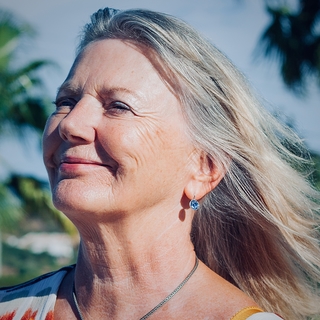
Hi,
This is Dr.
Jan Russell,
And today's session is called Let's Talk About Pain.
I've been a coaching psychologist,
A therapeutic psychologist and trainer in many,
Many approaches to communications and therapeutics.
And one of the areas that I have studied with my partner,
Who has a medical background,
Is the management of pain.
And chronic pain is something which seems to be quite common,
Can be debilitating,
Frightening,
Depressing,
So many ways we can see chronic pain.
Over my lifetime,
I've had various occasions to need to deal with pain in different ways.
And latterly,
I have been diagnosed with a condition called trigeminal neuralgia,
Which is where a nerve in my brain is pinched by a blood vessel.
Who knew?
And the outcome is that there can be considerable pain in the head,
The face,
The temple,
The jaw.
So,
In this last few months,
I've really learned to put into practice again things that I thought I knew and now know from the heart outwards.
So I wanted to share this session with you for any of those who are managing chronic pain and to offer a humble introduction really to some ways of thinking about how we approach our chronic pain.
Pain is challenging.
Acute pain is a clear signal.
It's an SOS.
It gives us information to note while chronic pain can be less clear.
It's tiring.
It's disturbing.
So,
Here,
I'm going to explore the language and a little of the science of pain and consider ways to support ourselves when we live with these experiences.
I will caveat this.
Acute pain is a clear SOS.
And if it's something that you have not yet become familiar with in your body that is sudden and distressing,
Then you must find medical help.
Pain used to be defined for many years in direct relationship to a specific trauma or injury.
But actually,
Some of the major world bodies like the International Association for the Study of Pain have changed their definition because pain,
After all,
Is a symptom with subjective,
Experiential,
And sensory aspects.
And so it can't be measured.
We can't measure pain as the same for every person.
And more importantly,
We can't identify pain as static,
Unchangeable,
And immovable.
In my view,
There's a great gift in this recognition because,
In other words,
Our experience of pain is a dynamic process,
Facilitated through neurological pathways and creating physiological states which are both emotional and sensational.
Anything dynamic can be within our circle of influence.
And when we understand our own responses to pain,
We can use our understanding as a lever for healing or,
At the very least,
More satisfying management of whatever it is we're experiencing.
My own history,
If you will,
With pain is probably notable for one or two incidents.
One when I was very young,
Maybe seven,
I had a horrendous experience at the dentist's where I was eventually carried upstairs,
Spread-eagled,
Between five adults,
Kicking and screaming so that I could have an injection in my mouth and subsequently be gassed so that I was anaesthetized while several of my teeth were extracted.
For decades after this,
I refused an injection for dental work,
Although I did need to have more dental work,
As you might imagine,
Having lost some teeth and being born in an era where if you were good at the dentist,
You were rewarded with a sweet,
Sticky toffee.
So when I was next at dentist,
I refused any injection and I would talk myself through any necessary procedures,
Closing my eyes and repeating over and over again to myself in quite a measured way,
This will all be over in a minute,
This will all be over in a minute,
This will all be over in a minute.
This enabled me to accidentally,
Almost,
Learn how the experience of pain is temporary in the degree which we feel it from minute to minute and that I could distract myself with thought and that I could relax my body and go inside rather than be terrified by the pain.
The other hugely significant events for me were having my two children and I knew that I wanted to be awake and alert when I birthed them.
If I had needed to have necessary medical intervention,
Then I would have accepted it,
But I felt I'd go into the process imagining that I would be able to birth them myself using the strongest muscle in my body,
My attitude,
My physical health and my desire.
I birthed each of them without pain relief,
Being very present to be with them as it were,
As they were coming into the conscious world.
Now that was hard work,
I know why they call childbirth labour and I'm not saying it was rah-rah happy all the way through,
But it was amazing to be able to be there and I felt that that was partly related to the cocktail of being in good health and also my intention and some strategies that I made for myself to be able to frame my pain as purposeful,
Different and I knew that any pain would all be over in a minute.
So perhaps these backgrounds have supported me to approach my current situation with some prior learnings.
As also understanding what pain is,
Pain is not an it,
Pain is the word we use to describe a responsive mechanism.
So we may feel pain in one part of our body,
Whereas it's been triggered by activity in another part of our body.
The trigger activity has created neurological responses.
Pain is also an habitual trigger response.
We expect pain from certain events and we might even begin to respond before the trigger happens just through thinking about the trigger,
Setting it up from a place of fear.
Chronic pain becomes embedded as a pattern.
Sometimes we move through transition from acute to chronic pain.
Some disorders are categorised by symptoms and syndromes rather than having an identifiable and tangible source.
The pain doesn't just come from one little bit that we could magically reduce or cut out.
When pain becomes chronic,
It's thought to be down to the brain's memory of a specific neural pathway,
A pain pathway that has been created.
The more often the trigger occurs,
The more deeply we carve this automatic pathway,
Like treading a path through a field of grass,
And the easier it becomes for the brain to respond habitually with a pain response to a physiological trigger.
We can,
I believe,
Though,
Open the gate and tread a different path across the grass by training our brains because the brain always remembers how to create a sensation.
It remembers how to create a response.
So let's give our brains some more options to the triggers that traditionally we have allowed to become pathways to a pain response.
Chronic pain is a sensitised response.
The more chronic pain we have,
The more we expect to have it.
We might find that once we cope with one stimulus,
Another stimulus,
Similar yet much weaker,
Can trigger the same pain response.
Maybe at one time,
For me,
A strong blast of cold air might have been a stimulus for neuralgia.
And then it could turn into a soft core breeze to develop the same response,
The response I was expecting.
The brain's activity is causing fear to strike,
Anticipation.
Not surprisingly,
Our holistic selves begin to fear aspects of life as threatening.
We begin to pay attention to the possibility of threat in actions that we used to do easily,
And attention informs our experience.
We create fear sometimes of capability and consequence.
Whereas of course we also need to anticipate what we may need in certain situations,
Just in case,
But the two are different.
If we assume pain,
Always,
Then we can be in danger of a negatively spiralling into a vicious circle.
Pain,
Fear,
Stress,
Attention only on the pain,
Sensitisation.
And unwittingly,
With the best of intentions,
The intention to protect ourselves,
We create a pattern of response which becomes our chronic pain.
It's self-fulfilling.
So the magic,
The potential in all this is in the word create.
Our body is not perfect and some of us suffer with particular physiological states and conditions and those are real.
They're not produced in our mind.
However,
We can create different responses.
We can create alternatives.
So to manage our experience,
We want to interrupt the habitual pattern and see if we can open other gateways across the fields of our minds.
One of the first strategies I would go for and recommend is to not fight whatever sensations arise.
Medical conditions are often discussed in the language of battling and fighting.
Personally,
I don't find that helpful.
Standing up for myself,
By all means.
I found myself,
When I experience a sensation which becomes painful,
I body scan and then stop and breathe in a deep way into any area of my body which is less than comfortable.
When I was experiencing the sudden sharp sensations out of nowhere in my temple,
I stopped what I was doing,
Relaxed my shoulders,
Breathed into the pain and imagined breathing through it and exhaling.
This simple action helped the rest of me to relax as well and for me to know that,
Guess what,
Without even thinking these words,
It would all be over in a minute.
I found this really useful because as well as being physiologically soothing,
I was being kind to myself too.
I was telling myself to take a pause,
To pay attention not just to the pain but pay attention to moving through it.
So breathing,
Pausing.
My next strategy quite naturally presented to me,
I found that if I was sitting on the sofa paying all my attention to the sensations in my head and the emotions that those brought up,
I just felt worse and worse.
Whereas if I got up and moved and went and did something else,
Even though that might take a little effort,
The sensations would change.
I would actively choose some music that I know I find soothing.
I might even go and tidy something,
Put something into order.
And I noticed that then I forgot to feel the pain so acutely or so consistently.
And when I began to go and play with paints and take a canvas and put it on my easel and just forgot about any expectations of what a picture should look like or whether it was good or bad and moved into my colour tray and created a large colourful canvas which now sits on my living room wall,
Which is not full of talent at all,
Yet it's full of healing energy.
Because during that process,
I wasn't thinking about the pains in my head,
The sensations in my head and I felt good and alive.
And this somehow aligns to finding purpose beyond the experience that we're having.
A little bit like I was saying,
Having my babies was painful yet purposeful pain and taught me,
Reminded me it was impermanent,
It was tolerable,
It could change.
So three tips from me so far is to relax into the sensations,
Breathe into them,
Pause,
Allow your breath without fear and find some purposeful intention in some kind of activity,
However mild,
Whatever you are able to do.
This gives both distraction and it also begins the rewiring process because what you're actually doing now is feeling the trigger sensation and then getting up and going and doing something different.
So you create a different neural pathway.
For me,
On that day where I discovered that I could do that,
I changed,
I began to change my pathway from ouch,
Pain sensation,
Concentrating on it,
Feeling it and feeling fearful to ouch,
Time to go do something I really enjoy.
My next go-to is my mental rehearsal processes which I discuss a lot in my programs,
My courses.
Mentally rehearse with care,
Mentally rehearse with attention to the language that you're using,
Mentally rehearse the visions of yourself that you want to create.
Do you want to talk about pain or about sensations?
One of the things I found in language when I was diagnosed with TN was that the narrative that goes with this condition is almost as horrifying as the condition itself.
People talk about stabbing pain like having a nail hammered into me,
Like having knives stuck in and I understand this,
It's descriptive and it is an intense kind of experience,
Yet to repeat this over and over seemed to create horror even for the people listening to me,
Let alone in my own mentality and in my heart.
Now I talk about sensations,
I talk about whether I'm as comfortable as I could be,
Whether I'm not so relaxed yet and if I do have a particularly intense moment,
I make it specific.
It's not me who's having the intense moment all over,
It's that currently my temple feels quite tense.
I can change that so that when I talk about what's happening to me,
It's more manageable and I'm giving my brain the words I want my brain to hear.
So I take this into the future too,
So instead of saying if it's cold and windy it will be agony,
I'm telling myself I do like walking outside so I'll make sure I take a face covering with me.
And this is an easy thing to change and it's not about fear,
It's about agency.
So you start to reprogram yourself even in your future.
So this is my introduction really to Let's Talk About Pain and it has been using me as an example and I hope that has offered you some insights,
Some ideas.
You are not me,
I am not you,
We do not know each other's experiences.
We do know though that some of the premises about carving new neurological pathways and attention informing experience are universal.
So thank you very much for listening this far and I wish you all the very best that you can have and universal love and peace.
Thank you.