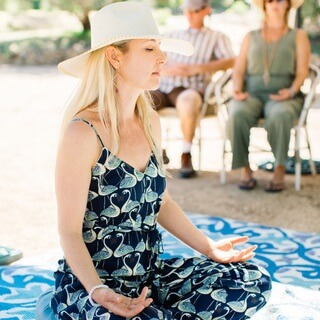
Welcome back to a special episode,
A Secret Sangha episode,
And today's episode is about context.
I want you to have a visual as I'm talking through this Secret Sangha because they had a big whiteboard and I got to see this and you don't get to see this.
A visual of at the center,
A small circle,
Actually a hexaflex.
It contains the content of your inner experience,
The content of your thoughts,
The content of your attention,
Your sense of self,
The content of your feelings,
The content of your values and motivation,
And the content of your behavior.
So that content,
That inner experience that we have,
That we carry around in ACT or in Acceptance Commitment Therapy,
We're working on developing psychological flexibility with.
How do we get more flexible with our thinking?
How do we get more flexible with our sense of self?
How do we get more flexible with our behavior?
That's what we talked about last time on the Secret Sangha,
But today I'm talking about this newer evolution of psychotherapy where we're expanding beyond just the individual content into context,
How context influences all of that.
So imagine some bigger circles around that little circle.
One circle is your biology.
Another circle is your social cultural context.
Another circle is your environment.
And then finally,
On the whiteboard,
There's one big circle that holds it all,
And that is the context of love.
So today I'm going to talk a little bit about how these different contexts influence the content of our experience,
And then I'm going to talk a little bit about love as the bigger context that I hope that we can all step into together and share and be in and open ourselves to because it is the one context that is healing to all contexts.
Enjoy this little Secret Sangha.
You're part of it now.
Hi,
Everybody.
Welcome.
For those of you that are new,
You're at the coffee truck.
And when you come in,
I'll let you know.
So we were talking about a topic for today,
And Aaron said context,
And I was like,
That is the hardest topic for me to talk about because context in psychology is a very complicated concept.
I'm going to go for it because it's a very important concept in that the type of psychology that I practice is something called contextual behavioral science,
And it's a whole field of study,
Contextual behavioral science,
And what that field of study means is that you as an individual,
We all think that we're separate,
But you as an individual,
Your whole experience,
The content of your experience,
Your thoughts,
Your feelings,
Your sense of self,
Your behaviors,
Do not operate separately as an individual.
They're completely dependent and interdependent on your context.
So I'm going to talk about that from a psychological perspective,
But then we're going to move it out to a more contemplative perspective,
And then we'll do a meditation.
So you are an individual in context.
Here's a way to understand this.
If you think about the last time you maybe were having a difficult day,
And in that difficult day,
What was happening for you in terms of how you were thinking,
How you're thinking about yourself,
How you're thinking about other people,
And how that may have been influenced by other things going on.
If I told you the difficult day may have been related to your biology,
Like what was happening for you biologically.
That can be everything from how did you sleep last night,
How are you eating,
Did you exercise or not.
Your difficult day may be related to what was happening for you socially and your environment.
That's all your context.
The original basics of psychology or behavioral psychology are all based on Skinner.
You may have heard of Skinner.
But there was another guy at about the same time in the 30s named Cantor.
What Cantor started looking at is that how our behavior is not just influenced by being rewarded by something or being punished by something,
But our behavior is influenced by what's called our interbehavioral field.
You in this circle are sitting on the floor.
But in most rooms,
You probably don't sit on the floor.
You're sitting on the floor because there's other people that are sitting on the floor and there's a context that encouraged you to sit on the floor.
So we start with sort of the content of what's happening inside of us.
And last week,
We talked a little bit about how to be more psychologically flexible with that content.
So when you have a thought show up,
Do you just follow the thought or can you be more flexible with it?
I love how you nod,
Really chronically nod towards me.
And when you nod towards me,
Craig,
It makes me feel like you understand and it shapes my behavior.
We are in an interbehavioral field.
Right.
And you are creating a context which supports me in being able to continue talking.
But then I also start to wonder,
Is he just a chronic nodder?
And so when you nod,
This is how my mind goes.
When you nod,
Does he nod at everyone like that?
And maybe I'm off somewhere and I'm not connecting.
So I need to go and look at some other people in this context that aren't nodding,
Right?
You were not nodding or you were nodding?
You were not.
So I want to do an experiment.
I want to do an experiment.
So my mind goes one step further and then I start saying stuff like,
Everybody hates apple pie,
Right?
And I just watch him and I wait for him to be like,
Yeah,
I knew it.
So you could turn it into an experiment for sure.
So that's an example of context,
Right?
And how our context can influence what we're thinking about,
Right?
And our context can influence how psychologically flexible we are.
The content of our experience is malleable.
So last night I was having a really,
I had a hard night.
I had a bad day.
I kind of had a bad day.
It started out as a good day,
But then it turned into a bad day.
Have you had that?
Did anyone have a bad day yesterday?
No one had a bad day besides me?
You had a bad day?
I went to bed at 7.
30.
Oh.
The day was done.
The day was done at 7.
30.
Like,
I would like the day to be over.
I could not fall asleep.
So I don't think I went to bed last night,
But I had a bad day.
But it started out as a good day.
I had a couple of 13-year-old boys at our house,
And it was for a slumber party.
And the context begins with the 13-year-old boys who decided they were both going to make a lemonade stand and pizza at the same time while I'm working from home,
Right?
So your environment,
Your physical environment,
Can shape how you feel.
And you may notice that there's a lot of things that we do in the context of this space to create a physical environment that shapes how you feel.
And you can look around just this physical environment to notice how it makes you feel to see the pictures up there,
Or how it makes you feel to see flowers,
Or how it makes you feel to be in a clean environment without clutter,
Right?
So that may shape you having a bad day,
Your environment.
And there's certain environments when you look at,
You know,
People that really struggle in terms of,
Like,
Mental health,
Some of the reasons why they're struggling with their mental health is because their environment is really problematic.
They may not have a safe environment to live in.
When we were writing,
Katie Bowman and I,
The interview that I'm doing is on this book on exercise.
And when we were writing this book,
We asked people,
We surveyed hundreds,
Thousands of people,
Why is it that you have a difficult time moving your body?
And a lot of people wrote in,
And they said things like,
I don't have sidewalks to walk on around our house.
People wrote in saying,
I don't have good air quality.
It was,
Like,
During the fires,
Like,
I don't have good air quality to go outside.
People wrote in saying,
I have no space in my tiny apartment with my roommates to do my,
Like,
Yoga video,
Right?
So your environment has a big impact on your day.
You have two kids,
You know,
Multiple teenagers making messes while you're trying to work.
Another aspect of your context is social cultural context and how that may impact you in terms of your day.
And I'm curious for you over here who had a bad day,
If environment was part of it.
Okay.
We'll get to biology.
Okay.
So the next one is social cultural.
So I had a bad day yesterday,
But on Saturday,
I had a really good day.
Susan and I went for a long walk on the beach,
And we were picking up trash.
Susan demonstrated how to pick up a condom in a very.
.
.
She grabbed.
.
.
She's like,
This is how it's done.
She grabbed,
Like,
A plastic bag.
She's like,
She turned it around,
And she picked it up and put it in the bag.
And it was,
Like,
It was,
Like,
The best.
We had,
Like,
The best day.
Picking up,
Like,
Huge pieces of trash,
Like,
Giant pieces of trash.
And your social world,
What's happening for you in terms of your relationships with others can really shape the content of your experience,
Whether you have a positive social interaction or a negative social interaction.
Back to exercise.
There was a study done.
MIT did this study of,
Like,
You know,
The Strava users?
So,
Like,
Over a million people that they were looking at the data on in terms of their Strava use.
And what they found was that for runners,
What they found is that if you have someone in your social network,
Your Strava social network,
That's,
Like,
Pushing themselves a little bit more,
That is increasing their speed or the amount of time that they're running,
Then you're more likely to increase your speed and the amount of time you're running.
And they argue it was a causal relationship,
Because they were looking at it in terms of not just association,
But also time.
You know,
The if you there's studies where they look at people holding planks.
And if you hold a plank with somebody that's a little bit stronger next to you,
You're gonna hold your plank for longer,
Right?
So,
There's a social contagion aspect of positive behavior in your experience.
You know,
If you go for a long walk on the beach with a friend and they,
Like,
Pick up a condom,
You may think that's,
Like,
Fun.
But if you're,
Like,
By yourself and there's a condom,
You might not pick it up,
Right?
Social contagion.
So,
Your social cultural world influences the content of your experience.
We're social creatures.
And then your biology influences your experience.
You said you ate a lot of sugar.
That may have influenced your day.
I had a migraine,
Like,
A hormonal migraine.
So,
I get,
Like,
My period and then I get a migraine on top of it every month.
Isn't that lovely?
I think women need to talk more about this.
This is,
Like,
The experience of being a woman,
You know?
Like,
You're dealing with messy kids and you have to work and you have a migraine and you have your period.
So,
Your biology has a big influence on the content of your inner experience.
And what we do in psychology is we often blame the individual.
Like,
You're too lazy.
That's why you didn't exercise.
Or you're irritable.
And we don't look at all these other things that are influencing us.
So,
That's interbehaviorism,
Contextual behavioral science is looking at the individual in their context and how the context may be influencing your ability to be flexible.
But then we can zoom out even more and look at it from a contemplative wisdom perspective and the perspective that we take here is a non-dual one.
The direct approach,
The non-dual approach.
And from a bigger contemplative perspective,
We can step out of all of it and see a bigger context which is one of love.
If we can step into the bigger context of love,
How would that change how you're relating to your environment?
You know,
How would that change how I'm relating to a bunch of 13-year-old boys having a slumber party in my living room making pizza and a lemonade stand?
You can just imagine this happening.
But if we step into love,
Whoa,
This is a different experience.
Love for myself,
Love for these kids,
Love for boys making lemonade stands at 13 years old instead of being on screens,
Like that's so great.
So great.
If we step into love,
That bigger,
Greater awareness,
The expansive space of love,
How does that impact your social cultural experiences?
Yesterday was Martin Luther King Day and if we've ever heard someone speak from a place of love,
It's Martin Luther King.
Speaking of context,
Martin Luther King and Thich Nhat Hanh met in 1969 in Washington and this was during the Vietnam War and they met for like 45 minutes.
It was I think the first time they ever met and soon after that,
Martin Luther King came out against the Vietnam War which was a very risky move for him.
You know,
He was murdered not soon after that.
But the conversation that they had in there,
I'm sure,
Had a lot of love in it,
A lot of understanding,
Very different cultural differences between these two men.
Very different but a lot of similarities in terms of both men that in their own country did not feel safe and that were activists for peace.
So love can impact your social cultural experience.
And then love can also impact your biological experience if you eat too much sugar.
Are you responding from a place of shaming yourself,
Mad at yourself,
Guilt?
Or are you responding from a place of love?
You have a migraine,
All those things.
Thank you so much for listening to this episode of the Wise Effort Podcast.
Wise Effort is about you taking your energy and putting it in the places that matter most to you.
And when you do so,
You'll get to savor the good of your life along the way.
I would like to thank my team,
My partner in all things,
Including the producer of this podcast,
Craig,
Ashley Hyatt,
The podcast manager,
And thank you to Bangold at Bell and Branch for our music.
This podcast is for informational and entertainment purposes only and is not meant to be a substitute for mental health treatments.
Bye-bye.