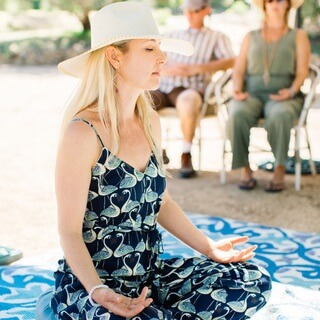
How can we practice the power of the pause?
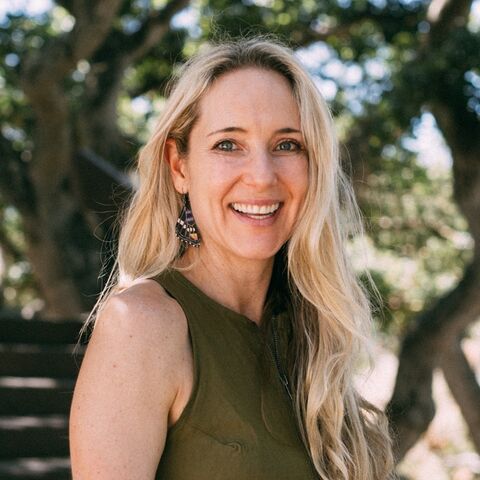
That's what we're going to explore today with Jillian Bransky on the Y's Effort Show.
Welcome back.
I'm Dr.
Diana Hill.
So glad you're here.
We're in this little bit of a bardo here if you're listening to this in real time.
The week between Christmas and New Year's when everything starts to slow down,
I went out to take my car to the car wash today and the streets were empty in my little town of Santa Barbara.
The car wash line was empty.
I was like the only one in line.
It was so surprisingly slow and sweet on this Sunday afternoon,
This Sunday evening.
That word bardo in Tibetan Buddhism that means the in-between state that we're in and it's a really good time to reflect.
This week,
We're going to have a couple of episodes coming out.
We're going to have this episode,
Which is the power of the pause with Jillian Bransky who I met in Costa Rica.
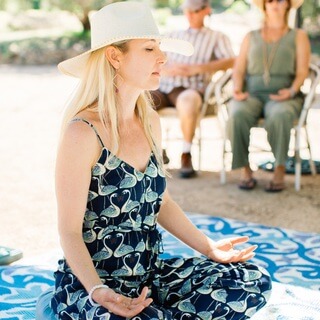
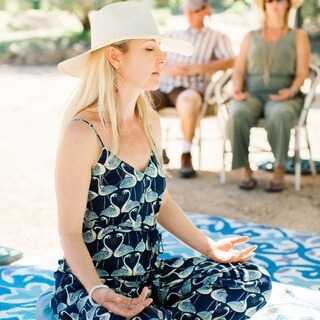
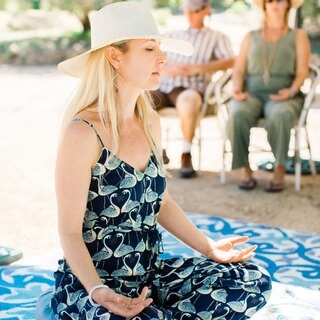
Jillian is a meditation and yoga teacher.
She's been teaching at Kerpalo and Omega for over 30 years and she actually taught alongside Pema Chodron as the yoga teacher for Pema Chodron's in-person workshops for over 27 years.
She infuses a lot of these beautiful Buddhist teachings with her own deep understanding of the body and embodiment into her method,
Which is the lar lar method.
She's going to walk us through it today.
You will hear her walking us through these steps of landing,
Arriving,
Relaxing,
Listening,
Allowing and responding.
Lar lar.
She's going to give us each and every piece and it will be in real time so you'll experience it as she teaches it.
I'm also going to be offering something very new on this podcast,
Which is my weekly Sangha Dharma talk.
Every week,
I give a live Dharma talk to a group of people in Santa Barbara and I'm going to be recording them and sharing them here for you alongside the meditation that I'll be putting up on Insight Timer.
So it'll be a place for you to just be part of a little Sangha with me and practice with me.
This is part of my own evolution as a therapist and a coach.
I'm constantly evolving,
Figuring out what works,
What doesn't work,
And using my own wise effort method in that evolution.
And it requires a pause in order to do that.
So I hope that during this transitional time in this bardo between Christmas and New Year's,
You have an opportunity to pause yourself to practice a little bit of what Jillian Pransky teaches us,
But also to start to reflect for yourself on what it means to enter into 2026 with wise effort.
How can you continue to do the things that are working for you,
The things that are nourishing to you,
That are a reflection of your inner beauty,
Your genius?
How can you discontinue and stop the things that are draining you,
That are not aligned with your values,
The courage to choose,
Even with the consequences that may be uncomfortable,
The courage to choose to stop some things?
How can you start doing some things that are aligned with your genius?
How can you play bigger?
How can you get out of the mold and the routine and the rules that your mind is keeping you stuck in so that you can have the life that you really want and the fullest expression of you?
And then finally,
How can you prevent,
How can you set up things ahead of time to make your path a little bit smoother,
A little bit easier?
And all of that happens in the pause.
So enjoy this conversation with my good friend,
Julian Pransky.
So let's work through this process and you call it the LAR,
LAR,
L-A-R,
L-A-R process.
And the first L in LARS is land,
Land.
And you physically mean land.
Oh yeah.
Oh,
Oh yeah.
Physically.
And you know,
My perspective,
If that's all you learn how to do,
Like if that's just the one thing you master in this lifetime or this week or this year or this decade,
That's enough to be a game changer.
That was born out of,
You know,
My panic and my anxiety and my tension is I came to realize as a restorative yoga expert where my tension lies and how I hold it.
And when I actually realized that I could lie down in my bed at night and not be allowing my mattress to hold me up,
What was that?
What was I?
How am I participating in a way that I'm holding myself together so much that I'm not letting go into the mattress that I'm sleeping on?
And you might not think that's possible,
But it's possible.
Even as I wake up in the middle of the night,
Over and over again,
I tension release.
I find that I'm in my neck,
Shoulders,
But you know,
You might,
This might be good imagery and then I'll bring us through,
You know,
Just a landing.
I liken it to,
If you've ever held an infant,
The same infant who was awake and active and interested in the world around them.
And then that same infant who fell asleep and they are literally like two different weights.
Yeah.
And when they fall asleep and they really just surrender,
They might even be doubled their weight.
I don't know,
But you can feel it.
We barely take that time to surrender and fall asleep.
We are like that active baby stressed all the time.
So even with that mattress underneath us,
We might think we're going to bed,
But are we really releasing our weight into the support that's there?
And it's not just the act of knowing there's support there.
It's trusting it will hold us up.
So it's a,
It's one thing my teachings begin with literally sensing the tactile support under your body,
The chair,
The couch,
The wood floor.
It's helpful.
And it's also meaningful to me to remind people that what's ever under your body under that is the earth.
And it's not just the earth,
It's our earth,
Which begins to soothe us a little bit more.
And,
You know,
Maybe referring to it as the whole planet is literally under your body and just getting people to come down to sense that there's something there.
And then step number two would be being willing to let it hold you up.
Trusting it will hold you up.
And I don't just do that once,
I do that all day long.
You know,
It's like,
I don't just do it at the beginning of the meditation or the beginning of the relaxation.
I circle back and circle back.
And I don't just do it when I wake up in the morning.
I land,
If not 20 times a day,
2,
000 times a day,
Remembering their support.
And even in one breath,
But you might imagine a sand timer,
An hourglass and the way it empties the sand from the top half to the bottom.
If we could take three breaths together and just let that sand drain down,
Yeah.
So you might imagine an hourglass in your body.
An hourglass.
And on the next exhale,
Imagine the sand,
The heaviness,
The weight draining from your head down to your shoulders.
And on the next from shoulders down to the torso,
You're lowering towards the support.
And one more breath,
Maybe exhaling out the mouth,
Letting your whole body land in the spot where you are here.
You write that landing is the foundation we need to feel safe enough to pause.
And you go on to say,
If we want to feel safe,
We begin with learning to sense support.
We return to remember the ground underneath our bodies.
Remember there is a whole earth underneath us.
We welcome ourselves back home into our body on the earth,
On our life partner,
The earth,
Again and again.
This is your first practice in the book.
And I just,
I mean,
You can,
I feel dramatically different from that 20 seconds of landing.
I love the hourglass.
It's so good.
Such a good visual.
Yeah.
Yeah.
You know,
I shifted too,
Even leading the practice.
So important for those who are therapists or those who are teachers listening.
As we offer the practice,
We also shift.
And if I could share,
Like,
I don't know if this is TMI,
But,
You know,
Landing myself,
Even in this practice,
You know,
I felt like I'm carrying a little tenderness today.
Like I'm holding a little sadness with everything that's happening right now.
And I think it's a farce to think that we're going to do these practices.
We're going to land so we can be okay.
You know,
We're going to land so we can be happy.
We're going to land so we can be light and bright and ready to go.
Like,
I just landed with you in real time and discovered I was sad.
So we don't know,
You know,
The landing gives us a place to recognize how we truly are.
And that is a safety.
It's kind of ignoring how we are that can also leave us feeling unsafe.
So I didn't mean to,
Like,
Bring a tinge of sadness into our conversation,
But it was true for me right now.
When we land,
It allows us then to tend to those experiences that are already there.
Like our nervous system is protecting against them.
It doesn't want to go there,
But it doesn't mean it's not there.
The sadness is there.
But until we land,
Do we recognizing and tend to be with it,
Which your next step of arriving,
Which is,
You know,
One would think these are the same thing.
Isn't landing just arriving?
But you write that arriving is the act of interrupting our stress response with a deep,
Full,
Slow breath.
So there's a landing,
Then there's arriving.
Yeah,
So I've been doing this practice,
You know,
For decades.
And me sensing my sadness so quickly might not be available to a lot of people.
Like,
We don't normally just,
Like,
All of a sudden,
Like,
Drop and be like,
Oh,
That's how I am.
Usually that can become after we,
Like,
Maybe are a little more conscious about checking in.
So some people might just land and just literally like,
Oh,
Okay,
I'm here.
Arriving.
But the dichotomy of being here,
Now,
Arriving now,
Now is kind of infinitely changing.
There's like an ever new now.
And people think of grounding and landing as like,
Oh,
I'm here.
I'm like,
I'm at home base.
I'm going to stay right here.
And I got,
Like,
It's a place.
But the arriving ever flow of the ever new now breath brings air and brings space and brings the continuity of newness into the place that we are.
It's not like if we just land,
Sometimes we can also freeze in that place.
You know,
Like,
It can be like,
Okay,
Pause,
Which means I'm just going to,
Like,
Block everything out for a second.
And that's actually not what we're doing.
We're pausing so we can lean more in to the moment.
And so the arriving on the breath is twofold.
It allows the breath to arrive on its own,
Which it actually does.
We allow ourself to be breathed and the breath to deepen,
Which directly affects our nervous system.
It starts to send messages up the vagus nerve.
The amygdala by breathing more deeply.
So we literally start to shift the nervous system physiologically,
Neurologically through a deeper breath.
We land on the ground.
We allow the breath to arrive in our body.
But I add,
We allow our mind to arrive on our breath as a way of opening up a sense of spaciousness and presence,
Real presence.
Presence isn't fixed.
It's not here,
Down,
On the ground,
In the spot.
Presence is,
I'm in the spot so I can see the more spacious new now.
And the arriving is a presencing moment.
It's the breath is present in us.
It arrives.
We happen to get that hit in our nervous system,
But we also bring our mind into a more open state.
We land on the ground.
And I like to use the sand timer again.
And as we imagine our weight on the ground,
For a breath or three,
We could imagine the breath arriving in our clear upper hourglass.
And as the breath arrives on its own,
Even just one breath,
Calming and filling your clear upper hourglass on its own,
Let your mind arrive on the breath.
Let your mind rest on the arriving breath,
Which allows us to be more grounded and present.
We land,
Arrive.
Sure,
They can happen in tandem.
They often do.
Just allowing our body to be on the ground starts to release tension.
And then the breath just starts to have more space in us.
There starts to be less tension and therefore more diaphragmatic movement.
So arriving is invited to initiate on its own,
But we can amplify our attention to that on purpose.
And I think once we're more grounded and present,
Even if that only took three breaths,
We start to notice where we're resisting grounding and presence more.
It starts to become more conscious,
How my jaw is clenching,
How my fists are curled,
How my shoulders,
After 30 years,
After a lifetime,
Are still in my shoulders.
You know,
Because I've been teaching this for so long and because I get in the mood so quickly,
People think I'm like a groovy,
Relaxed kind of girl.
You kind of are.
I'm not inherently relaxed.
I'm not inherently relaxed.
I am an expert re-relaxer.
Mm-hmm.
I am really good at continually relaxing.
Yeah.
And with practice.
With practice.
You do get there more quickly.
It's like that mantra,
The repetition of the mantra.
For me,
The sound of a bell because my,
You know,
So much practice around the bell and the continuation of the bell on every device in my home.
So whenever the bell happens or even if I'm traveling and a church bell rings in a town,
My nervous system,
Like I land and I arrive and I arrive back at the breath.
So the repetition of it just means that we can find it maybe more quickly and then can find,
As you were talking about,
That clear upper hourglass.
For me,
When you're talking about sadness,
It's the clarity to see the sadness.
Because when all the sand is up there,
You can't really see clearly what the experience is that this hourglass is holding.
So the hourglass is holding sadness.
Or for me,
It's holding exhaustion.
That's actually clear.
It's clarity.
So we have land.
We have arrived.
And this is your pause method that is outlined so beautifully and includes,
You have meditations that people can download from the book.
You're getting a sense of Jillian and her ability to guide you quickly and beautifully to these places and then her voice.
So you'll get these meditations with the book.
But the third step is relax.
Now,
This is the one that sometimes I was actually working with a client yesterday and I was like,
Okay,
Let's have you lie down on the couch and I'm going to guide you through visualization.
And as soon as he laid down on the couch,
He was like,
This is making me anxious.
As soon as I approach relaxation or thinking that I'm supposed to relax,
I get more anxious.
So sometimes even the word relax makes people scared because they feel like they can't relax.
So walk us through what you mean by relax.
Yeah,
Yeah.
And that is,
I would say that's a lot of the book because not only,
You know,
Not only our newsfeed for the past decade,
But we're wired to look for danger.
We're wired not to relax.
We're wired to stay alert.
So it might be in the best service of our survival.
And you mentioned bells.
I just want to share in my book.
There's a great Ethan Nickturn quote,
But bells resonate with me this way.
He said something like,
I'm just going to paraphrase it a little bit,
But he's like,
Living with a modern nervous system is like living in a house where the burglar alarm and the doorbell make the same sound.
Oh,
Boy.
Yeah.
So you can't relax when you're on alert,
Like period,
Full stop.
The nervous system,
It's designed to not relax,
Which is why I was really,
Really,
Really motivated to write this book.
Now,
I don't know anyone who doesn't have some level of anxiety.
I just don't.
I don't know.
Maybe it's the world I live in.
But telling someone to relax if their nervous system doesn't feel safe should make them more anxious because relaxation would be a threat.
Which is why I start with landing and arriving before we even get to relax.
The support and the breathing and the safety and the shift neurological messages wise and vagus nerve stimulation wise are in place before we're even exploring relaxation.
And I also talk a lot about relaxation doesn't necessarily mean a letting go.
It doesn't mean I have to let go of something.
It doesn't mean I even have to stop doing anything.
It's creating awareness around the way we're not relaxed,
Around our tension.
And I talk a lot about it physically first.
So physically,
Whether it's your jaw or your shoulders or your hands,
How we might notice that without judging it.
You know,
Christiana Wolf,
Who we both know as well,
Has a great phrase.
Self-compassion is throughout this whole practice,
But there's actually we practice compassion in the attend,
In the second lar.
But can we notice the tension we have and can we just have compassion for ourselves for having it?
She talks about that in the form of pain.
So maybe saying like recognizing our tension is a relaxation.
Grounding,
Breathing,
Noticing,
Yes,
Maybe you can unhinge your jaw.
Maybe you can drop your shoulders.
Maybe you can unfurl your hands to get to the deeper.
That's like surface tension.
That's the easy stuff to get to.
The deeper tension is much more a compassion practice.
It is much more a being with practice.
I have this in my first book,
Deep Listening.
I talk a lot about the difference between letting go and creating space.
And we think a lot about if I just let go of that,
I'll be okay.
But I think about it,
The more we ground and arrive,
The more we land and arrive,
The more space we have in our body,
The tension doesn't become as constricting,
As high focused.
If you're not grounded and breathing,
The tension is literally leading the show.
We are constantly reacting from our stress response.
Tension is the stress response finding a home in the body.
So we are living our life from a reactive place of this tension.
Grounding and breathing,
Bringing ourselves into an awareness,
Creating space so that this tension is A,
Not the lead of the show.
I liken it to if you have a shot glass and you have a teaspoon of salt and you put the salt in the shot glass,
You have a particular salty solution.
And then if you take a mug and you have the same teaspoon of salt,
Your attention,
The way you're not relaxed and you put it in the mug,
Same amount of salt,
Different solution.
If you take a huge thermos or a bathtub and you put the same teaspoon in the bathtub,
Still there,
More space as it dissipates,
It's less salty.
So when our attention gets a bigger body,
Gets a more grounded space,
Gets more breath,
Gets more support,
It's not as concentrated.
We can visit with it more easily.
We are more able to make friends with it,
Be compassionate.
We are able to choose to relax on purpose because we've already calmed our nervous system.
So that tension could be your physical tension.
Christiana Wolff is our expert on that in terms of pain and chronic pain and what she does with that.
But it also could be your worry,
Your worry about losing your job or I've been working a lot,
I mean,
This time of year with people around family and conflict within the families and conversations within the families.
And how do I sit at the dinner table with this group of people?
And it is creating that bigger space that learning to relax is learning to be with tension.
It's not getting rid of it,
Which I love,
Very act consistent.
I want to make sure we make it through all six of these practices.
Well,
These first three,
L-A-R,
The first L-A-R,
To me is a physical,
Somatic,
Bottom up rewiring,
Re-regulating the nervous system.
And practicing this regularly all the time,
To me,
Is the foundation for them working with listening,
Listening to our emotions,
Listening to our thoughts,
Listening to the messages of our body.
I feel like the more practical somatic embodiment sets the stage for them really checking in and noticing and listening,
What am I carrying in any part of my hourglass?
I might be stuck down there in the sand,
Not just in this clear,
Open,
What's here.
But the listening,
The attending,
The either repeating over and over again or responding,
I'll get to that in a moment.
But L-A-R,
L-A-R,
The first L-A-R is a bottom up job.
It's we communicate messages to our body,
From our body to our brain that there is support here,
There is safety here.
We switch our breathing to support that as well.
And we come into relationship with our body,
With the physical tension that we're carrying,
With our ability to relax on purpose,
Which may simply be acknowledging and befriending the state that we're in.
Do you feel that many of us fast forward through those three?
Well,
And then especially therapy would be,
Yeah.
We start with like,
Listen to your feelings.
What is it telling you?
And you're like,
I am so dysregulated.
I can't even hear it.
In meditation.
It's cacophony.
Yeah.
A lot of our meditative practice,
Listen,
I've been meditating all my life pretty much,
Except for nine years of my 57,
I've been a meditator.
But most,
Most meditators,
Meditation practices until more recently,
You know,
The last decade,
Especially,
Maybe the last two,
They're not very somatic.
There's most of the instruction.
Even if it's somatic,
The parts that have been pulled out and passed on and taught in group environments to beginners bypasses the body.
So even if that's not the lineage's intention,
A lot of the ways it's delivered in modern teaching has for many decades,
And for much of,
You know,
Many,
Many decades,
Bypass the body in these meditation,
Meditation lessons that have to do with working with the mind.
Yeah.
For me,
It was to come back.
My,
My place in this landscape is inviting people back to start with the body so we can set conditions to be able to work with the mind.
And that sort of is the,
The key component from yoga that I think that you bring,
Because we could flip it and say that modern yoga is over focused on the body and not tending to the second,
The second half of your lar lar,
Which has to do with the listening.
And how do you want to respond?
Like the actual,
I would say that's more of the also behavioral component of how does this,
How do we act in the moment?
How do we use the pause to choose the action that we want to be engaging in?
So you,
You have this beautiful blending of the two.
Yeah.
So,
So second lar,
Second lar.
So,
So I'll start by saying also as we get into the second lar,
The word lar in Portuguese,
And I had been teaching this formally from 2013.
It wasn't until like 2022 that I learned that lar means home in Portuguese.
I had a Portuguese student and,
And it like lar,
They'll say lar,
Home sweet home.
And I just love that by sheer coincidence,
The practice of pausing,
Using the techniques of lar lar is a deep coming home,
Like into our bodies,
Into our nervous system to,
To re have a,
To,
To renew a relationship with our body and our nervous system in a way that we can really feel at home and safe and at ease.
So we can begin to open up to the lifetime of experiences that our mind has taken in,
And maybe even our parents' experiences and our grandparents and our lineage and whatever we're carrying through,
You know,
What we,
The way we behave in the world,
The way we live and react.
And so the second lar is a way of working with our ability to be present with what we find now that we're,
Now that we feel more safe and grounded.
What's here?
Let's listen.
Let's notice.
And listening and attending really happen in tandem.
It is hard to separate them because the flavor of listening,
And I'm very inspired by the Chinese symbol for listening.
It is not only how we bring our attention to using the ear and the eye and our undivided attention,
But it's all held by the heart.
And so as we begin to notice,
If we just,
And if we just use the word,
Listen,
Listen to what,
Listen to what's there.
Who's not going to listen to their body and their mind and not be disappointed?
Who's not going to be more sad or upset or angry or judgmental or want to fix or want to change or,
You know,
It's time to switch this whole thing up.
I don't know anybody who's going to listen in and be like,
Yeah,
That's what I thought.
We are disappointed by often,
By what we find when we check in with ourselves.
So having some self-compassion,
Attending to ourselves,
Literally creating with warm awareness,
With more emphasis on friendship.
And like Christiana Wolf said,
As I quoted earlier,
She uses,
Could we just have compassion for the fact that we're in pain?
Could we just have compassion for what we find?
Something we're not trained to do or used to do.
You know,
It feels like pity or sympathy,
And that's not what I'm talking about.
But neurologically,
You know,
You know,
And I'm sure many people listening,
If you are,
If you add more aggression on top of what you find,
It's going to get better at digging into neural roots.
If you are,
You know,
More,
You know,
Just trying to hammer the changes and fix what's there instead of acknowledging the presence of what's there with friendship and warmth,
You create more ability to further react to those emotional patterns and those reactive patterns.
So if we want,
The moral of the story for the power of the pause is my wish is that we develop a new capacity to not only tolerate what we find,
But to befriend what we find.
So we keep our brain online in a way that allows us to make more wise,
Compassionate choices for ourselves and each other and the collective.
Like,
That is my greatest hope with this book.
Listening with a warmth is the ingredient that is essential to keep our brain online in a way that gives us more choice and doesn't limit us to the behaviors of,
You know,
Aggression,
Withdrawal,
Or avoidance,
But instead opens up the possibility of curiosity,
Creativity.
It might even,
You know,
Allow us to say,
You know,
Maybe I'm wrong.
Maybe I don't understand.
It allows us to stop repeating the same story in ourselves and believing it the same way,
But also more equally importantly,
Others.
I might be in the same fight with the same person and maybe for the first time,
Maybe I'll say,
Maybe I'm wrong.
Maybe I don't understand what's happening here.
Which is so liberating.
Yeah.
For all involved.
So you write with this step of listening,
We are learning to pause so we can listen without the filter of our habitual protective mechanisms.
So that rather than being hijacked by our reactive tendency to become defensive,
Shut down,
Or make assumptions about what is being said,
We are better able to meet whatever arises with curiosity.
And then you move on to attend and you write,
I am okay.
All of my feelings are welcome here.
Attending to ourselves,
We explore what is the sensation?
How do I feel?
What do I notice about my body right now?
What is here?
And all of these lead up to sort of the culminary,
Like the,
And all of these lead up to the culminating,
Like,
And all of these lead up to this final step of respond.
And you also said repeat.
The last R of lar,
Lar.
And I like lar,
Lar too,
Because I actually like how it feels to say it.
La,
Lar,
Lar.
In the same way that the word home is a very soothing word to say.
It's almost a little mantra too.
Lar,
Lar.
So we respond and we repeat.
Yeah,
Yeah.
Well,
I throw the repeat in there is because what I have learned.
And again,
You know,
I really want to emphasize,
I've been practicing most of my life,
Truly.
It's a lifestyle.
It's almost,
You know,
Yes,
It's a practice,
But it's a lifestyle.
I can still lose it.
Like I might get off this podcast and have an unskillful conversation with my 22-year-old who's living here with me.
It's hard.
So by repeat,
I mean,
You know,
There's no day when this is done.
And just because we,
And that was one of the biggest gifts I've gotten from,
You know,
Pema Chodron,
Even still in her last live workshop.
And I still am visiting with all of her live teachings online that she continues to do,
Which she still repeats the same thing.
She's almost 90.
And she's still saying,
Like,
Practice is a daily choice,
A daily choice.
It's something we choose again and again.
And we don't just do this practice and then we respond great for the rest of our lives.
Every single moment,
We deserve the opportunity to choose a response.
We deserve,
And it's going to be different.
We could,
It could look like the same opportunity.
It could look like the same situation.
We're never in the same situation.
And the other thing with respond is a lot of people believe if I,
If I learn how to pause and I get clear and I get more intentional,
Then I'll know how to respond.
And one of my favorite teachings,
This is another big teacher of mine is Eric Schiffman,
Is no,
You don't know.
Like,
We don't know how,
If you know how you're going to respond in advance,
You might want to stand guard against the idea that you are,
You know,
That that fixed idea of how you're going to respond is really going to be in best service of that moment.
That being able to open up our brains for wider awareness and still stay alert and attentive to what's happening and choose in the moment,
You know,
Like a GPS,
Conditions are always being updated at any given moment.
And what seemed to be the right route in one moment,
A second later may no longer be the right route.
We,
The better we get at being present and choosing our response in real time,
The closer we get to responding from our body,
Our heart,
Our mind,
The other person,
The conditions of the environment,
What's really truly going to be,
I don't know,
Just more organically helpful in that moment,
I think.
So the six practices all build on each other and then they become a circle,
A cycle,
A repetition.
And for those of you that want to,
You can also find a lot of resources from Jillian.
You can go with her to Costa Rica,
If you'd like.
She's all over the place.
And she has a lot of online teachings and trainings at her website.
We're a community of people all over the world.
And I think maybe I'll end by saying that as we wrap up,
Is that what became the real calling card for me to write this book now,
While it's been my practice all along,
Is 2020.
I went online with my teaching.
And even though these have been of interest to me my,
You know,
All these years,
My audience,
My community grew so diverse being online,
Not only all over the world,
But ethnicities and races and ages and experience levels.
And the power of the pause was really born out of an urgency of what I heard from everybody about the stress they're carrying to bring this practice off the mat and into our lives,
Into our families,
Our communities,
Into the world,
But also to make it simple enough that this book was written for the person who's not going to find a free meditation,
Who's not going to come to yoga class,
Who's never going to roll out a yoga mat or a cushion.
And may it serve all of us who've been practicing for decades.
And may it serve,
You know,
The person who is gifted it but would never even think of,
How do I do a meditation practice?
Exactly.
Because the last thing you want when you're overwhelmed is something that's complex.
So for all of us,
Even people that have been practicing for decades,
We all go back to the same,
Simple,
Most basic practices,
The ones that our nervous system crave.
Not that maybe our striving mind want.
Thank you for this beautiful piece of work.
And I'm so excited that this is launching into the world,
The power of the pause.
Yeah.
Thank you so much.
You are an inspiration.
I just,
I love your book.
I love how you are sharing it with the world.
I love all the ways you are showing up and,
You know,
Just sharing your energy,
Your insight and your wisdom.
So thank you.
And I hope we're at Costa Rica at the same time again sometime soon.
Yeah.
Or if not,
Somewhere on purpose.
Wonderful.
Thank you,
Julianne.
Thank you so much for listening to this episode of the Wise Effort Podcast.
Wise Effort is about you taking your energy and putting it in the places that matter most to you.
And when you do so,
You'll get to savor the good of your life along the way.
I would like to thank my team,
My partner in all things,
Including the producer of this podcast,
Craig,
Ashley Hyatt,
The podcast manager.
And thank you to Bangold at Bell and Branch for our music.
This podcast is for informational and entertainment purposes only,
And it's not meant to be a substitute for mental health treatment.