So this is called Dharma talk and Dharma means.
.
.
There are many ways to translate that word but one way of translating it is the way things are.
And so one example that everybody gets very easily,
That I use all the time is for instance the natural way of a tree is to grow towards the light.
This is the way things are.
And together we are looking into that way.
We are looking and trying to understand and experience the fullness and the simplicity of life and the way it really is.
Because we all can feel that sometimes we twist a little bit or sometimes much more than a little bit the natural expression of life within us.
We have the sense that we have the ability to make it much more complex and then bringing in much more suffering than needed.
So Dharma talk,
It's a way to look together into things.
It's not like me telling you this is the way things are.
I try to be very careful to not be too assertive as if I knew.
Sometimes it's difficult because I can be passionate and convinced by my own exploration and ideas.
But on your side you have to check how you receive and even my strongest affirmation I would like that you receive them as questions for you to explore deep and try to understand,
Experiment with.
And I would like to loosely explore a major topic of the spiritual path which is freedom.
To start with I have this little story that I said when we were at the table in the beginning with a few of you.
I have the great luck,
It's quite new for me to bring meditation to children.
I'm going in five different classes,
I meet around 80 children every week and I bring meditation and philosophy.
And it's the same thing as we're doing here.
It is meditation and philosophy,
Philosophy in the sense that we try to understand also.
That's already one thing you can take is like the spiritual path and the path of meditation can include a lot of thinking.
The understanding is very important,
The understanding aspect is crucial.
If we misunderstand something then we go in the wrong direction.
So in a different way but I'm doing the same with children and the meditation are more like small meditations of five,
Seven,
Ten minutes.
And then there's one little girl,
I think she's nine years old.
And every time when after I check with the children,
So how did it go the meditation?
Was it hard?
Did someone had absolutely no thoughts for instance?
Or did someone could not manage to stay a little bit with the breath?
And most important for children and for adult is how did you feel when you were with the breath?
And how did you feel when you were gone into thinking?
Because depending on where we are it impacts how we feel and we have to notice this.
We have to notice how we feel in meditation when the mind is calm and focused.
We have to intuitively recognize the feeling of that.
And we have also to intuitively recognize the feeling of how I feel when I'm in stories for instance.
Or if I'm in open awareness as Robert introduced a little bit today,
How does that feel?
It's a different feeling than concentration for instance.
And this little girl nine years old,
Every time I ask that,
Almost every time,
She raised her hand and she said I felt free.
And it's been so touching for me to hear that.
And also I'm so surprised that most of the children will say,
Oh,
Felt good.
Yeah,
Or no,
I didn't feel good or I felt tired or things,
You know,
Very kind of basic approach of feelings and emotions.
But I felt free.
It's quite a concept.
Yeah,
Because she's in school.
So what is freedom?
That's the question.
She's in school.
She's focusing on the breath,
Which means her awareness is not free to go wherever it wants.
There's a control aspect.
We're controlling the focusing,
Is controlling the awareness onto something.
So there doesn't seem to have much freedom in that.
And she's not even choosing the object I'm guided in the meditation.
And yet the feeling that she described is a feeling of freedom.
And I think this is a question that we need to cherish.
What is freedom?
We may have some already some ideas and they may be valid on some respect.
But for sure,
We can deepen our understanding of what freedom is and what freedom is not.
So in meditation,
We in my way and with my what is important for me is self discovery,
I could say,
Or self knowledge.
It's it's on my aspect.
And we all have different entry door to meditation.
But for me,
It's not so much about feeling calm or having experiencing positive things.
It's more just about knowing this craziness of life that is happening within me and and exploring,
Which is different than thinking.
Exploring is observing.
There is another distinction that we need to be very clear.
The difference between thinking about something and watching something,
Observing something.
Yeah.
So observing as well as looking for understanding and deepening the understanding.
And so freedom has been one of the main direction.
It's a direction for me.
It sets up a direction,
Freedom and then freedom from what?
That's the question.
That's the question that I would like to explore now.
One example that I can take now is a is a this cold that I have.
So I think I have some flu and stuff like this.
And they could be I see in in in my mind thoughts of self pity,
For instance,
Or disappointment.
So I know that if I engage in these thoughts,
I may find myself in a loop where it pulls me down.
These kinds of thoughts are not helping me.
So I don't want to engage when I see the thoughts.
I direct my awareness somewhere else.
So this is one of the freedom that we have with meditation that we develop with time.
Is knowing what is what kind of thoughts are useful and helping and what kinds of thoughts are unuseful and pulling down and then should choosing to enter to maintain them or not.
There are many thoughts that are very important to maintain and develop.
There are maybe more thoughts that are totally unneeded and they just spoil our experience.
And that's not the worst.
Like,
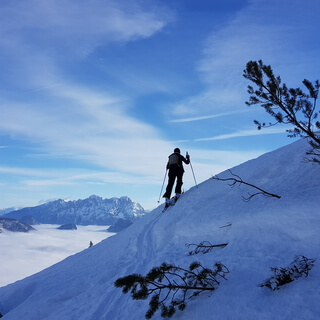
Let's say we were walking in the snow,
We think only about stupid things and then we don't see the building and down building.
We don't notice.
And the coming avalanche.
But we don't see the view.
We're not in the feeling of the deep nature because we're going into a story that is not either good or bad,
But it's just a story like this random.
So it is not a good or bad story,
But still it is already harming our experience of the moment.
And that's not the worst.
The worst is when the story itself is harmful.
And we know.
And this is what becomes even more obvious with meditation that we entertain and have a lot of harmful stories.
Harmful being stories,
For instance,
Of inner critic.
Yeah,
This is I have had the chance already with a few of you of speaking about inner critic.
And we all know that.
We all know that voice that say how bad we are and how worthless we are and how maybe not beautiful we are and how competent or inadequate for or that we won't succeed or all the thoughts or judging us so hard just because we've been spacing out for five minutes,
For instance.
You know,
So there's this inner critic is harming the quality of our life and is not bringing solution.
So what's the good about it?
Why do we need that?
So the path of meditation for me and the spiritual path is raise the question,
Is it possible to live without inner critic?
We can still self estimate to check,
But not with this dark attitude that comes often with it.
So is it free?
Is it possible to be free from inner critic?
That's a search.
That's a direction.
That is something that we can.
That is a question that we can keep and explore on the spot.
When there is inner critic in this retreat,
For instance,
And then after we try to bring this in life,
Of course,
Then we can say,
Oh,
Hello,
You know,
Critic back again.
Yeah.
And then just see what it says,
See what it speaks,
See which voice it takes,
For instance.
That's very interesting.
And noticing how hard it is not to believe that the thought is me speaking.
When in meditation,
Often there can be this kind of situation where we're here,
We're one with the breath or one with the sounds or one with the body or we open awareness,
Kind of we feel very present.
And the next minute we're gone.
We don't notice it's like falling asleep.
We don't notice we're going.
And sometimes that can last long.
And at the very,
This is a very interesting and crucial moment at the very moment where we realize,
Oh,
I was gone.
That very moment you see this moment.
There is a choice to keep being trapped in thoughts or to come back to the present moment through holding on to whatever is there.
That is not a thought.
But often we miss that chance because as soon as there's this moment of realizing,
Oh,
I'm lost in my thoughts.
There is.
There are other thoughts that come and comment,
Saying again,
Things like I'm not trying hard enough and this retreat will be soon over.
I won't have given myself the chance or whatever the comments,
It will comment the failure.
And what does happen then?
We're not back to the breath.
We're still in the thoughts and these thoughts are still thoughts.
It's just the same nature.
It's the same thing.
But this one,
We do believe we give credit to this one.
If we wouldn't give credit,
They wouldn't survive.
So freedom from just not having to discuss debate with inner critic,
Not trying to explain why.
Yes,
I can.
Yes,
I'm worth just disregarding this inner critic and being back is one possibility that we have.
And if we don't entertain and maintain this inner critic,
Then with time it will tend to come less and less.
I believe that the thought process is like any other system,
Like nervous system or the digestion system.
It is it has a task to perform.
It is very efficient.
And if there was not this functionment that we're exploring now,
It would come when needed and go when needed.
And now what we can notice is that it seems to be constant.
It's not,
But it seems that it's constant and often with bullshit.
So is it possible that we change our relation with the thinking?
Because it is what we do invest in the thinking process,
I think,
That makes it so mighty.
And so it's not only mighty.
It's not only that it's mighty and strong.
It's poor,
Poor brain that is demanded all the time to solve stuff,
To think about stuff,
To name stuff,
To recognize everything.
Compare thing.
You know,
I don't think it's made for working 24 hours a day.
I think there are moments where thoughts are needed and it would be like the digestion.
It would start and when it's not needed,
It would stop.
So there we could transform.
We could say this is freedom from having to think all the time.
I don't know if you notice this.
I notice often in meditation,
Like when there's a sense of quietness and space,
There's one thought that will come and say,
What could I think about now?
You've never noticed this?
Look for it.
Maybe I don't know if everybody has,
But for me,
Sometimes I notice this.
Then I'm surprised.
What can I think about now?
And of course,
We're born in a time and a place where there's a lot of emphasis on thinking.
Thinking is the big guru that will save us.
So without thinking through all your life,
Then you won't succeed.
You have to,
From the children age,
We're really told and there's a lot of pressure on having to master life with thinking.
This is why it's gone mad now and we can't have a break.
So is it possible to be free from the belief that we need to think all the time?
Is it possible to be and to fully exist without having thoughts?
I'm not saying like our full life.
I'm not saying even one full day.
I'm not saying an amount of time.
I'm saying is it possible and can we check if we have moments where we are fully present and we don't think?
There's no thought at all.
Just,
You know,
These kinds of exploration will lead us to wisdom,
To understanding,
To more intimacy with deeper and deeper,
What is deeper and deeper in ourselves.
So there's a word I like very much.
I don't know if it's Pali or Sanskrit.
It's called Papancha.
I find it lovely.
And Papancha means proliferation maybe.
And this is what we can notice.
You understand this word proliferation when there is maybe it's just French,
English.
It's when there is resurgence and a lot more and more of something.
So let's say it is,
For instance,
You hear a bird.
And that's an actual thing that doesn't need to think about.
Or we smell,
A smell,
Smell do that very much.
And then it brings us a memory.
And that memory brings another memory that has a link.
And from that memory,
We start to remember something and maybe that we should have done something different.
I'm inventing,
For instance,
Just a chain of thoughts.
And from I should have done something different,
Maybe we think,
Oh,
Now I have changed.
I'm different.
And now,
You know,
And so from this very actuality of just a smell or a bird singing,
We become,
We open up a whole world.
This is papanchaa.
This is just out of a very simple,
Very simple and authentic event.
There's a whole world of illusion,
Illusion in the sense that this is a thought.
It has not the same reality as matter or as any other perception.
And then we keep creating many worlds like this all the time.
It's amazing how many worlds you create.
Like when we imagine there's something beautiful in meditation,
I find,
When when really we're sitting still and not much happen.
How beautiful is that?
In this stillness,
There's such a power.
So the practice of mindfulness that we probably all heard about is,
We could say,
A search for freedom from papanchaa,
From elaboration.
Staying with the bare contact with life without directly adding a lot of stuff that is coming from memory and vocabulary and create all kinds of words and feelings and emotions.
So staying with the bare contact of the moment.
I think meditation,
We could say also,
Is a search for freedom from arrogance.
Arrogance,
You understand that?
Another,
Yeah,
Arrogance is like what I mean there is like this attitude that is everywhere around us and within us that we very much know what life is about and what who we are and what the world is and what the solutions are for whatever.
So coming back to a sense of humbleness somehow,
Freedom from arrogance,
Freedom from.
.
.
It's not even thinking that we know.
We're not even questioning,
Do I know or not?
We just get up in the morning and do and live our life as we know it's what it's all about.
It's very hard to question again things that we have acquired since our childhood.
And then there's of course freedom from the ego.
Yeah,
That comparing,
Judging and comparing,
We could say,
Voice.
That very misplaced sense of self,
Ego,
This big arrogant eye,
This sense of isolation that comes with it.
How much time do we spend building up the ego?
If we look into our thought,
There's a lot about that.
It's very interesting with my son,
He's eight and a half and he's very much building the ego.
And this is a very important phase,
Like finding out his specialness and trying to.
.
.
He's always comparing and.
.
.
Oh,
This one,
He can't play football.
I play much better than him.
He's three years old,
You're eight.
And anything is good.
Anything is good to feel a little bit uplifted.
And there's a construction of a sense of self,
Eye.
And since childhood we've been doing this and we believe this is us.
And then we're harming others and we're harming ourselves.
We live in fear because maybe I'm not the best or.
.
.
For instance,
There are many ways of constructing the ego.
Also,
The victim is also a construction of a sense of self that is separate from others.
So,
If we look into our thought,
There's a factory of building a person and in its all specialness.
This need to be special is something that is very useful and needed when the children come out of the fullness of life without an identity,
We could say.
And they need to take place in society and among others.
But there's a point where we kind of need to stop also,
I think.
To always need to be special.
Yeah,
It's driving a lot the need to be special.
In a positive way or in a negative way,
Whatever.
So,
Can we be free from building up an image of ourselves,
Building up image for others,
Comparing this image?
How much time we would save?
It would be a lot of space,
A lot of mind space,
Which means a lot of connection with life.
Because we're not disconnecting when we're in our story,
Constructed story.
It's a mind construction.
Ego is just a basic mind construction.
It has no root at all in reality.
It's just a basic myth created image that says nothing about who we are.
But how much time we spend,
We need to maintain this.
It takes a lot of maintenance,
The ego.
It's not like,
OK,
It's enough constructed and now it works and I can leave it like this.
It needs all the time that we come back to it and reassert it and keep it together.
So,
Is it possible to live with less of an image of ourselves and what would be the benefit?
And are there times where we have less this strong sense of self and isolation and self and others and times where we have it more,
For instance?
So,
A way to look at the ego and to see that it's a fake construct is to spend some time reflecting and seeing that anything that I am is because others are the way they are.
There's not something that has been constructed outside of life,
Outside of the world,
Outside of this totally,
This fullness of reality.
It is the way we are is the result of the way the rest is.
There's a saying,
I don't remember in which culture.
I heard this because I've installed my computer,
This thing to replace Windows,
Which is Ubuntu.
Some of you maybe know and it comes from a saying,
I don't remember Ubuntu,
Something like this.
But it means I am the way I am because everybody is the way they are.
So,
There is not a self-made Denis outside of the context.
Denis is emerging because the context is like this.
There's not this separation.
On a certain level,
If I look on the level of the body,
I can feel that.
But we're trying to deepen the way we connect to ourself and to who we are and to look deeper into who we are.
And there are levels where this sense of separation disappears and the sense of being one with others,
Or one with the Earth also,
Is more and more present.
And there's something very beautiful and very pleasant about that,
When this sense of separation is not that much there.
So,
For me,
The question of freedom is linked to the question of who I am.
And that's a good one.
That's a good one to keep all life,
I think.
So,
First,
Losing the arrogance and just humbly realizing that we don't know who we are.
We may have many ideas about who we are,
But we have no understanding of the inner forces and of our inner reality.
And no understanding of the world outside.
Nothing.
It's all beliefs.
And then there's a quest there.
Can I search and discover what is my essence?
And this quest leads to very surprising places.
And these places are very freeing again.
I now become more and more able to understand the possibility that I don't have a separate existence.
I start now to be able to understand that it may be that there is not a self-entity out there that is called any.
And that's just to.
.
.
Maybe some of you may feel that.
.
.
What is that?
Just to understand the possibility that we are not at a certain level of who we are,
We are not individuals.
Just to understand the possibility takes a lot of observation,
Exploration,
Reflection,
Trying to understand.
And of course,
That would be a great challenge for the ego because if there's this realization that there's nobody there,
Then there can't be an ego there,
A sense of separation.
The whole building process of the ego would collapse there.
So it's a root exploration.
And I'm not saying that it is like this.
And I wouldn't want anybody to hear that.
But I'm questioning.
And I'm lucky that I can question this because some people before me have questioned that and spoke about it.
And this is the view that is very much explored also in Buddhism with the emptiness practices.
It's also very much explored in some traditions of Hinduism.
Where the whole spiritual path leads to realizing that there is no self.
Wow!
You see,
So that needs a lot of humbleness,
No?
It's hard to question that.
It's like,
Okay,
Where do I start?
In Buddhism,
They have one way of explaining.
It was a text on the.
.
.
It was called the chariot,
I think.
Now we do it with the car because we don't have so many chariots anymore.
But it's like we assert that everything has separate identity.
So you have the car and the car is separated from the rest.
Then we look for the self of the car.
What is the essence of the car?
And we wonder,
Okay,
So if I take out one wheel,
Is it still a car?
Yeah,
You answer that for yourself.
Okay,
Now I take out this thing,
Steering wheel.
Is it still a car?
And little by little you take one seat out,
Still a car?
And when is it not a car anymore?
And what makes it a car?
And we can apply that to ourselves.
What makes the knee?
Is it an emotion?
Am I contained in my emotion?
Am I contained?
Is it the body?
Is the knee the body?
So when I say the knee,
I speak only about the body?
And if I think about this.
.
.
It's a way of entering into this search,
A way of questioning something that seems impossible to question because it seems,
Of course,
So obvious that I'm a separate entity or I don't know how to say it,
Person.
And it can be done like.
.
.
Now,
I have to say since a year maybe,
That's my game in meditation,
This question.
Looking for where is coming the sense of self.
Meditation,
You can meditate so many ways.
Have questions,
Go and check for yourself.
When new questions come,
Go and check for yourself.
You use some thinking during the meditation and then you observe.
When there is a good concentration,
You can like sometimes think about what is kind of my aim during this meditation?
What do I want to observe?
How will I apply this to my meditation?
And then you have kind of a plan of where you want to go with your awareness.
And then after you try,
You try to see and put again deep in the question.
And there are hundreds and thousands of other ways of meditating.
You know,
I'm not.
.
.
Please don't hear this is meditation.
I'm not saying this.
This is just one way.
But I find it quite funny.
It's interesting to do.
And it's very freeing.
I have a quick question.
When you say that you meditate over your sense of self or where your sense of self is,
Does that mean that you go into.
.
.
That you try to feel into the feeling of where the sense of self is?
Or how do you exactly.
.
.
How do you define meditating over that?
You know what I mean?
Yeah,
It's very difficult to kind of describe because it's always kind of different.
The intention is set,
But it depends on how the meditation happened.
It's not about the meditation,
It's about the way you come back to.
.
.
It's in between a very practical and feelings and feeling the way into it.
But one way is this car analogy,
Yeah,
Applying it to myself.
So this is a very reflective meditation,
Like really looking.
Or who is the thinker of the thoughts?
You know,
Questions like this.
And this question brings again the feeling of what I'm exploring.
And then it comes very quickly to.
.
.
Who is observing all these things?
Thoughts,
Body sensation,
Emotions,
Whatever comes and goes,
Sounds.
And whatever comes and goes,
Yeah.
What is the.
.
.
Because the sense.
.
.
I feel that my deepest sense of self comes from awareness itself.
The ability to be aware of something.
The witnessing aspect.
So things change,
Come and go,
Come and go.
I'm sitting in meditation.
When there's a good meditation.
.
.
Again,
In that style,
Because lying down is another world.
But I'm speaking more about sitting.
Sometimes also it happens in lying down.
But let's say I have a meditation where I am very present.
Then my sense is that there is a light that sees everything that comes and go.
And my sense of existence is from there.
Yeah.
And I read a very interesting sentence.
It is said that awareness.
.
.
There are debates.
Can awareness know itself?
Can awareness observe itself?
Because we can observe everything.
But can we observe.
.
.
It's like if the eyes want to see themselves.
Can I see my eyes?
Yeah,
Let's not go into mirrors and things like this.
Now,
I know that I have eyes because I see.
I see you,
So I know I have eyes.
But I can't see my eyes.
It's the same with awareness.
I know I'm aware because I'm witnessing what is there now.
So we can know awareness,
But we cannot observe awareness.
And this is things like.
.
.
It's like the knife that cannot cut itself.
Yeah,
So we can know awareness,
But we cannot observe awareness.
But when there is this awareness,
There is a strong sense of presence,
Which I would describe as my deepest sense of self.
But now the question that I'm putting in is,
Is this belonging to a specific entity?
This awareness.
And neuroscience are getting mad with this question also.
It's not only spiritual.
They're getting mad because now we live in a fantastic period with these brain scans.
They can see all activity of the brain.
It's great.
But it hasn't been found where the awareness itself is produced.
Where does it come from?
The awareness or the consciousness,
We can use these two words.
We don't see an activity of the brain producing consciousness,
Directing consciousness.
Yes,
But producing,
No.
Yeah,
So where is it coming from?
But this is,
In my feeling,
What gives life to life.
This is the aliveness,
Is this ability of contact with whatever happens.
That's what we're practicing again in meditation in a very basic way.
Get out of the thoughts and bring back contact to the actuality of the moment in order that we realize the presence of presence.
It's not so much about knowing everything about the breath.
The breath is a tool so that we realize our own presence.
And there are many,
Many ways to realize that.
And then once we have realized and we can,
It's like a,
It's a,
It's something that happened at some moment we were present and we know we're present,
Then the questioning goes on.
Where is that coming from?
Because there is curiosity,
But also because there's the understanding that the deeper we will go into the life that,
It is life expressing itself through us.
It is not Dhani expressing himself through me.
It is life.
It is a movement of life.
And the more I can connect with that,
The more I can be life itself,
The less I construct suffering,
The less I respond,
The more I respond accordingly to the way life presents itself.
So it's a path of freedom.
It's also a path of a detective.
Detective?
That was easy.
You know,
It's like there's a great mystery there.
It is very surprising that not everybody is like wondering about this.
And we get up in the morning and we do,
And there's a fantasy.
It's too big,
The mystery.
We don't see it.
It's that,
No?
And so it gives a meaning to life,
To explore that.
And it is freeing.
It is very,
It is like our understanding of life change.
And then we conceive life differently.
Does everybody understand this word conceiving?
It is a very interesting word.
I cannot conceive you did that to me.
Means I cannot think,
I cannot believe you did that to me.
Conceiving a child means creating,
Which means that the same word means think and believe or creating,
Which implies that in our thinking process,
The way we see life is the way life appears to us.
There's a process of creation.
So we need to check the quality of our thoughts and the depth of our thoughts,
To get rid of those who are not helpful and to develop those who are very uplifting and supportive and deepening the understanding of our interconnectedness.
Because it's really fun to live like that.
It's really pleasant.
So I'm going to read a question from a friend of mine.
He said,
I'm taking myself less seriously and my friends like it.
You know,
There's something that can sound shallow,
But actually not if you reflect on it.
This ego stuff is taking everything so seriously and destroying the planet and the human relationship.
This is the seriousness of it.
And so here,
These retreats,
They are a context in which you can explore.
I'm just phrasing my vocabulary.
And now whatever has been resonating within you is your own.
Don't take any belief.
It would be harmful to take belief.
Don't take any belief,
But direction of exploration.
Take questions,
Keep questions and cherish questions.
And explore these questions during the retreat in your own way.
In my understanding,
We need to develop our own way.
We cannot copy.
I don't think it works copying.
We can be inspired and practice some exercises that we have learned,
But really copying a way towards realization that has been taken by anybody.
I don't think it happens that way.
I think we have to trust that inside there is enough intelligence because it is life itself,
And life wants to be free.
So it is there.
And how will we free that?
First of all,
For sure,
By knowing that we don't know.
If we think we know everything about ourselves and life,
The quest is dead.
It's finished.
You don't need to meditate.
It's finished.
We need to have questions about our certainties.
Thank you for your listening.