Welcome to the Religion of the Month Club,
A podcast where we discuss texts from the world scriptural traditions.
Today is the first day of Dua Al-Qadha,
The eleventh month of the Islamic calendar in the year 1442 of the hijrah.
In this episode,
We will be discussing the opening of the Qur'an.
In the name of God,
The most gracious,
The dispenser of grace.
All praise is due to God alone,
The sustainer of all the worlds,
The most gracious,
The dispenser of grace,
Lord of the day of judgment.
The alone do we worship and unto thee alone do we turn for aid.
Guide us the straight way,
The way of those upon whom thou hast bestowed thy blessings,
Not of those who have been condemned by thee,
Nor of those who go astray.
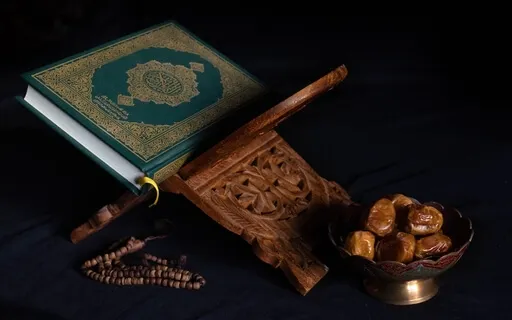
This is the first chapter of the Qur'an.
It's very short and it is a prayer,
Essentially,
In itself.
The second chapter,
Al-Baqarah,
Or the cow,
Is the longest surah in the Qur'an.
Surah is essentially a chapter of the Qur'an.
I think it literally means enclosure.
Now,
With the exception of this first chapter,
Most of the chapters in the Qur'an are in roughly descending order of length.
So,
The second chapter is the longest and then it goes down from there until you finally get to the last chapter,
Which is even shorter than this one.
For anyone approaching the Qur'an,
I think it's important to understand that the order of the chapters in the Qur'an are not in a order of recommended reading.
They're not in chronological order.
So,
For example,
In the Bible,
The chapters are,
The books are roughly in some kind of chronological order.
Not the order in which they were composed,
That is wildly different,
But more or less in the order in which the story takes place.
So,
It starts with,
In the beginning,
God created the heaven and the earth,
And then it moves on through the story of the Garden of Eden,
And so on and so forth,
On through the kings,
And then you get to the New Testament with the Gospels,
And then Acts,
And then the Epistles,
Right?
So,
The Epistles in the New Testament were written before the Gospels,
But they are placed afterwards because they are supposed to take place afterwards.
That is not the case in the Qur'an.
In the Qur'an,
It's essentially a collection of enclosures,
Of books,
And there's not a particular order in which you are expected to read them in.
Now,
When devout Muslims read the whole Qur'an during the month of Ramadan,
They do read it cover to cover,
But you also have to understand that when people do this,
They have read the Qur'an before.
This is not the first time that they've read it,
So it almost doesn't matter where they start or where they read it.
It's like,
If you read a book or watch a movie that you've seen over and over again,
You can jump right in the middle and it's fine,
Because you already know what's going on.
Now,
For people who are approaching the Qur'an for the first time,
This can be disorienting.
So,
You read the first chapter,
It's very short,
Very straightforward,
Like,
Okay,
I got this,
And then you turn the page and you go into Al-Baqarah,
Which is probably the most difficult surah to read,
Not just because of its length,
But because it has some problematic political implications,
Ethical implications.
It's just,
It's a difficult surah to read.
It's also very complex.
And in fact,
When Muslim children are learning the Qur'an,
They don't start at the beginning,
They actually start at the end,
Which makes a lot of sense.
If you think about the fact that it is in descending order of length,
The last time that they read the order of length,
The last chapters are the shortest,
Which means that they're the easiest to grasp.
Another interesting feature of this is that the shorter surahs,
The shorter chapters,
Tend to have been written earlier.
So,
There's two periods of the composition of the Qur'an.
There's the Meccan period and the Medinan period.
And the Meccan period is when Muhammad was in Mecca,
And he received his first revelation in,
I think,
610 CE,
Common Era,
Or 610 AD if you're Christian.
And he started prophesying.
And these chapters tend to be much more poetic.
They're often,
In my opinion,
Much more beautiful.
But he started angering people,
And he eventually had to leave Mecca,
And he went to Medina.
And when the travel from Mecca to Medina,
That is considered to be year one according to the Muslim calendar.
That's when they spread their calendar.
Because that's the beginning of the faith of Islam.
So,
Islam as an established religion.
That really began then.
It's kind of equivalent to,
Maybe kind of equivalent to,
When Moses left Egypt to go to Israel.
Of course,
Unlike Moses,
Muhammad did actually make it to Mecca to Medina.
But if we consider the travel of Moses from the Hebrews from Egypt to Israel as the beginning of the Hebrew tradition,
This migration,
This exodus,
Not really exodus,
But anyway,
This travel from Mecca to Medina is the beginning of the Islamic tradition.
So once he got to Medina,
Suddenly he had this community on his hands that he needed to start establishing.
And so the Medinan suras tend to be much more legalistic,
Much more focused on what you can and can't do,
All kinds of laws.
It's not as fun,
Right?
It's not beautiful like the earlier suras are.
But the second surah,
The longer surahs,
Including the second surah,
Belongs in that period.
So you turn the page from the first chapter,
Which has this beautiful invocation of God and this devotion,
And then suddenly you're getting into a lot of legalistic and historical stuff that is just,
I think,
Not as accessible to somebody approaching this text for the first time.
So if you do decide that you want to read more of the Qur'an,
And this is your first time approaching it,
I do strongly recommend reading the first chapter first,
It only takes a second,
And then flip to the back and start going from back to front.
Actually,
There's a particular order,
Reading it in chronological order in terms of the chronology of when the surahs were composed is also a good way to go about it.
So that would be starting with Surah 96,
Which is again towards the end.
But either way,
You'll be starting with smaller,
Easier to digest,
And frankly more beautiful pieces of writing or prose.
Another thing that's worth pointing out is that the Qur'an is meant to be recited.
It is not really meant to be read.
The act of writing it down was important to the establishment of the religion,
And it was written down right away,
It was written down during Muhammad's lifetime.
But that was really just meant to record it,
It was really meant to be recited.
And the Arabic of it is,
Again,
Very beautiful.
I recommend it,
I recommend finding recordings of professional reciters who are speaking or singing the Qur'an,
And only that way can you really get to hear the poetry,
The music of the Qur'an,
Which doesn't really come through in translation into English.
In fact,
Muslims do not think it's possible to translate the Qur'an.
This is really true of any scripture,
But especially texts that are very artfully composed.
So we saw this problem in the Tao Te Ching,
When we had the very sparse Chinese,
And in order to translate that into English,
A lot of interpretation needs to be done.
This is also true in the Qur'an.
Another thing that's important to understand,
And this is true,
Again,
Of any of these texts,
Is the historical context.
So we saw,
For example,
In Genesis that the author of the Book of E was defining the origin myth in contradistinction with the Babylonian story.
Now,
In the case of the Qur'an,
Muhammad is writing in the context of both the Jewish and Christian traditions,
Which he's well aware of and that are present,
And also in terms of the pagan pre-,
What we would now call a pre-Islamic Arabic religion.
And he considered himself in a lineage associated with the Jewish and Christian tradition,
But he considered himself to be the final prophet in that tradition.
So another thing that's important to understand is that he considered Jesus to be one of many prophets.
And it's possible that the early Christians also saw Jesus in that way,
And it's only later that Jesus became deified.
Well,
It's not that Paul was already deifying him in 50 CE,
But that Jesus's contemporaries perhaps didn't see him as God exactly.
So the Muslims don't see Jesus as God,
But they do see Jesus as one of many prophets in a lineage of prophets,
Starting with Adam,
Continuing through Moses,
And so on through Jesus to Muhammad.
At the same time,
He saw the problem that many critics of the Bible have seen,
Which is that the Bible has inconsistencies in it.
So the way that this is explained in the Qur'an is that the Bible has been adulterated.
It's been corrupted over the centuries.
And so the Qur'an is presented as the one true authentic word of God.
Now,
In a lot of ways,
We see this idea picked up by fundamentalist Christians who look at the Bible as the one true authentic word of God.
And we'll even say that the King James Version of the Bible is the one true authentic word of God that was somehow revealed that the Holy Spirit was involved in that translation.
And so any inaccuracies or anything that's wrong that scholars would say is wrong with the King James Version of the Bible,
They would say is actually a correction,
Or that that is the correct approach.
And it's interesting because that idea of creating a single coherent,
Or maybe even incoherent,
But in the minds of the believers,
A coherent depiction of the literal word of God really,
I think,
Finds its origin in the Qur'an,
In Muhammad.
Of course,
It's not the first time that we have this idea of a divinely inspired book.
In fact,
Even going back to the Torah,
The Torah is referred to in the Torah as the word of God.
But I don't think it is meant to be exactly literal in that case.
The Torah that's referred to in the Torah is not the Pentateuch that we have today.
With the Qur'an,
It's interesting because there is still this distinction between the Qur'an and the book.
So the book is,
And there's also,
There's actually like multiple books.
So there's a physical book,
But then there's also this sort of transcendent book of which the physical,
The book that you could hold in your hands is really just a representation of.
At the same time,
It is considered sacred.
And so there are certain prohibitions about the book that you're supposed to consider,
Like you don't put it on the floor,
A lot of Muslims will keep the Qur'an in a high place to show it respect.
Returning to Stephen Prothero's theory about religions,
To recap,
Every religion,
According to Prothero,
Is an answer or a solution to a question or problem.
So in Buddhism,
We saw how the problem was suffering and the solution is released,
Nirvana,
Through the Eightfold Path.
In Christianity,
The problem is sin and the solution is salvation.
In Islam,
The problem is pride and the solution is humility.
This is not necessarily apparent in this surah,
But it definitely is in some of the other surahs,
Especially the other Meccan surahs.
And I think that this is worth pointing out because I think there's a misunderstanding of Islam.
Islam actually literally means submission.
And the idea is that you are submitting yourself to that which is greater than yourself.
In some of the surahs,
It's shown how God is so powerful because God is able to make rain,
God is able to make life.
There's a word in Arabic,
Ayat,
Or ayat in plural.
And we see this word come up a lot as the word for verse.
So if you're reading the Qur'an,
You might see reference to ayat or ayat in the same way that we would use the word verse in English.
But the word ayat literally means sign.
And the signs that are described in the Qur'an are considered to be all around us.
So everything that we see,
Every miracle of nature is considered to be an ayat.
The verses of the Qur'an are just one or a set of many examples of ayat.
Another interesting distinction is that sin is not central in Islam as it is in Christianity.
The problem with humanity is not so much that we are sinners,
Which would be Paul's hypothesis.
Paul thought that humans are sinners and so we are in need of salvation.
Muhammad didn't see humans as intrinsically sinners so much as forgetful.
So in a way,
It's a much more generous approach to humanity.
The problem is not that we're inherently bad,
But that we just,
We have a tendency to forget.
And what it is that we're forgetting is God.
So we're forgetting the glory of the creation of the universe.
Now,
There is this notion of divine justice.
And so there's this problem where the people who forget,
Those are the people who go astray,
And these are the people who are condemned by God.
So you see this occurs a lot in the Hebrew prophets,
And it occurs again here.
So there's this idea that basically if you don't remember God,
If you forget,
You will be damned.
Now,
I for one don't care much for this idea of cosmic justice.
For one thing,
I think that trying to get people to behave by scaring the bejesus ahead of them is not really the best way to motivate people.
It may work for a short time,
But I don't think it's really practical in the long run,
And I don't think it teaches people to internalize a good ethical moral compass.
Although there are those who believe that if you are not afraid of God,
Then you will behave sociopathically,
Which unfortunately,
Well,
What that tells me is that they don't have a good moral compass themselves,
Frankly.
And it also just doesn't accord with reality,
Sadly.
While I'd love to believe that people who are behave poorly will get their just desserts,
I don't see any evidence of that.
What I do see is evidence that cultures,
Communities that act pro-socially do thrive better.
People are happier in those societies.
So I think that that itself has reason enough to behave well.
So that aspect of threatening damnation is definitely one of the aspects of the crumb that I don't particularly care for,
But I do really appreciate this idea of looking at humans as forgetful.
I think that that is true.
It's important to step back and stop and to recognize the miracle of creation around you.
Whether you are a naturalist,
A materialist who believes that this is all there is,
Or you believe something else,
Whatever you believe,
I think it's important to recognize the beauty of creation around you and to remember that.
And whether it takes Ayat from the Quran to help remind you,
Or some other scripture,
Or whether it's just going out into nature and watching,
Appreciating rain after a drought or sunshine after a cold winter,
Just to recognize this wonderful world that we live in.
So finally,
Returning to the text.
As in all of these cases,
There are many translations of the text that we're interested in.
The translation that I just read,
That I read at the beginning of this episode,
Is by Muhammad Asad.
This translation is called The Message of the Quran.
Another translation that I like is by Nazir Ahmed.
He's an experimental physicist,
And his translation reads thus.
In the name of Allah,
The Compassionate,
The Merciful.
Praise be to Allah,
The Raab of all the universes,
The Compassionate,
The Merciful.
Sovereign of the Day of Judgment,
You alone do we worship,
And you alone do we ask for help.
Guide us to the straight path,
The path of those upon whom you bestowed your grace,
Not those who encouraged your wrath and who went astray.
In this translation,
Nazir Ahmed felt the need to use the Arabic word Raab instead of the English word Sustainer,
And he translates Raab as a comprehensive term that means creator,
Sustainer,
And cherisher.
Another translation that's worth noting is by Laleh Bakhtiar.
Laleh Bakhtiar translated the Quran in a way that addresses the apparent misogyny that is occurs at certain points in the Quran.
She believes that the misogyny is actually a product of mistranslation and misinterpretation,
And so she translates certain passages differently.
Now those passages just don't occur in the first chapter,
Of course,
But nonetheless,
I thought I would read her translation as another possible interpretation of the first chapter of the Quran.
In the name of God,
The merciful,
The compassionate,
The praise belongs to God,
Lord of the worlds,
The merciful,
The compassionate,
One who is sovereign of the day of judgment.
You alone we worship,
And to you alone we pray for help.
Guide us on the straight path,
The path of those to whom you were gracious,
Not the ones against whom you aren't angry,
Nor the ones who go astray.
Finally,
I'll provide the translation by Abdullah Yusuf Ali.
In my episode on the Gospel According to Mark,
I closed that with the translation of the King James Version,
And I mentioned that translations,
Other translations of other things,
Have tried to ape that style.
So Abdullah Yusuf Ali was clearly imitating the style of the King James Version when he translated the Quran.
So this is the version,
The translation according to him.
With the name of Allah,
The merciful benefactor,
The merciful redeemer,
And the name of Allah,
Most gracious,
Most merciful.
Praise be to Allah,
The cherisher and sustainer of the worlds,
Most gracious,
Most merciful,
Master of the day of judgment.
Lead we worship,
And thine aid we seek.
Show us the straight way,
The way of those on whom thou hast bestowed thy grace,
Those whose portion is not wrath,
And who go not astray.
Thank you for listening.
I hope you will join us next month when we discuss the Heart Sutra.