One of the premises of this course is that it makes no assumptions or expectations about what you believe or don't believe.
I attempt to follow a purely phenomenological rather than metaphysical approach.
That is to say,
I try to avoid speculation about what does or does not actually exist.
I leave that to science.
On the question of God,
I find the question of whether he,
She,
Or it exists to be particularly meaningless.
In his book 21 Lessons for the 21st Century,
Yuval Noah Harari identifies two definitions of God.
One,
A cosmic mystery.
Two,
A worldly lawgiver.
To monotheists,
These two are one and the same.
But Harari argues,
Equating the two is confusing at best and deceptive at worst.
Deceptive because,
According to him,
Monotheists will cite the first definition in trying to refute atheists.
Then once you accept that argument,
They'll say something like,
Well,
Since we don't understand the Big Bang,
You must cover your hair and vote against gay marriage.
Harari,
An atheist,
Posits that it's improper to use the word God for definition one as it leads to confusion.
He reserves the word God for definition two and then dismisses it.
I am an atheist of this sort.
Or to quote a famous French Kabbalist of the 19th century,
That such a God as the majority of atheists conceive does not exist.
However,
I'm not an atheist,
Because I don't agree with Harari that it is improper to use the word God for definition one.
I instead agree with the Unitarian Frederick May Elliott,
Who wrote,
When I use the word God,
I am using a symbol for the reality that I believe exists behind the deepest convictions of my own mind and heart.
I believe that there is a reality behind the experience which has come to me,
And I use the word God to summarize and symbolize their reality and their authority over my life.
Perhaps it may seem unnecessary to use any particular word as the symbol for this reality and authority,
And it is at least theoretically possible to find some other and better word than God.
But the practical difficulties are very great.
Julian Huxley rejects the word God,
And offers as a substitute the phrase sacred reality.
It means the same thing,
And anyone who prefers to use it is,
Of course,
At perfect liberty to do so.
But it is obviously cumbersome,
And unfamiliar,
And awkward.
Furthermore,
It lacks the connotations which grow up about a word through long use in certain definite circumstances,
And for this reason it lacks the emotional quality which a religious symbol needs.
In other words,
The word God has a kind of power,
And we can go further faster if we claim that power than try to work around it.
Perhaps you are someone who simply finds that you cannot use the word God in that way.
It just has too many negative connotations.
Perhaps you were raised in a fundamentalist household,
And found liberation in the rejection of the word God.
Or perhaps you were raised in an atheist household,
And you associate the word God with all that is ignorant and humankind.
If this is the case,
I beg your forgiveness,
For I will continue to use the word God as it suits me.
Perhaps it will help if you imagine scare quotes around the word God every time I use it,
Or mentally substitute your own word or phrase.
As for the second definition,
That of worldly lawgiver,
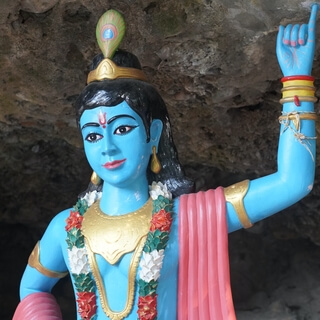
I say that as a god,
An archetype in the psychological sense,
Powerful,
Though not exactly real.
Cultures from all over the planet have concepts of non-human intelligences that sometimes interact with the human world.
They may be gods,
Spirits,
Angels,
Fairies,
Jinn,
Daemons,
Etc.
It is remarkable both how widespread this belief is,
And also how little conformity there is between the different cultures.
While I cannot rule out the possibility that such beings literally exist,
I have yet to see convincing evidence that they do.
What definitely does exist,
However,
Are aspects of the mind that appear independent of egoic thought.
If capital G God is the cosmic mystery,
We might also call this the real.
Then perhaps the gods,
Lowercase g,
Might be called the imaginary.
But being imaginary,
They are nonetheless useful and powerful,
Perhaps even more so than capital G God,
Who is unimaginably unknowable and transcendent.
Gods,
Saints,
Angels,
And even heroes personify forces in our unconscious that can affect us in powerful ways without us even realizing it.
When we interact with gods,
Fairies,
Angels,
Or daemons,
We are most likely interacting with aspects of our own unconscious,
Aspects of ourselves that are otherwise inaccessible to us.
And for this reason,
It can be useful to engage with them.