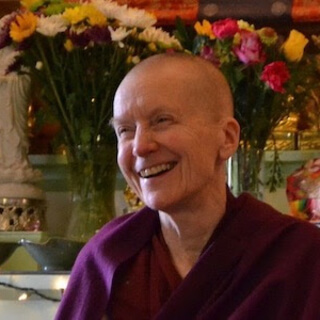
So what we normally do here at the Abbey before we share any type of insights and such is that we take a moment to bring our bodies and minds into the space,
Whether you're at home or you're at a friend's house or wherever you are.
And just bring your body and mind into the space,
Really connecting with yourself,
With the world around you.
And then I'd like to set a short motivation to kind of,
It's always good to know why we're doing what we're doing.
So this is kind of what my thinking has been for my motivation tonight,
Is that I would say that it's safe to say that most of us want to affect positive change in the world.
We want to make a difference in a really wholesome,
Virtuous way.
And when we start taking the Buddha's teachings to heart,
We begin to see more clearly how our minds work and how our minds are helping or hindering that aspiration.
And that at times we see that we're heading in a totally opposite direction of the direction in which the Buddha's teachings are pointing us,
As well as in a totally opposite direction of where our deepest aspirations are going.
So tonight may we open our hearts and minds to the teachings in order to not only grow our good qualities like love and compassion,
But to redirect our minds so that they are in harmony with the Dharma as well as in harmony with our deepest aspirations.
Just by doing that,
Then we're really going to be of benefit.
We're going to be able to acquire the skills and acquire the qualities that will really be able to help us support our aspiration to affect positive change in the world.
So let's really bring that into our hearts right now.
So tonight I wanted to share some thoughts and reflections,
As Lodra had said,
On beyond blame and how do we take responsibility for our emotions and our behaviors,
Our feelings,
Basically how do we take responsibility for our lives.
Because I don't know about you,
But sometimes the way my emotions and my behaviors are going is that they seem like something that I don't want to take responsibility for because they're just out of control,
Too much to deal with,
Too hard to handle.
So I just would prefer to give them to somebody else.
But what we discover when we start using our practice to really examine our minds is that a lot of our emotions and habits come from our conditioning.
I mean,
Ever since the day that we were born,
We've had someone or something influencing us,
Whether it was the family that we were born into,
Whether it was the socioeconomic structure,
Whether it was the culture we were born in,
Our gender,
Our ethnicity.
There's always something that has influenced us from the time that we were born and that these conditionings have left very,
Very deep impressions on our mind that color our life experiences so that we interpret things and react to things in very,
Very specific ways.
Now,
From my own personal experience and looking at my own conditioning is that a lot of the conditionings are pretty harmless.
They're pretty benign.
You know,
There's particular family rituals that we grew up around,
Little idiosyncrasies.
Even the way that I sometimes smile and the way that I kind of hold my mouth is a lot like the way my father used to do.
But there are some conditionings and habits that we have acquired through all this conditioning that may have served us well once upon a time,
But not only don't serve us well now,
But they're more trouble than they're worth and they continue to repeat patterns of behavior that aren't very helpful.
And some of this,
Like I'm 60 years old,
So I've had some of these conditionings for over 60 years now.
And so one of the ways that,
One of the conditionings that I have seen in my life experience is that there's this passing off of responsibility for my emotions onto somebody else.
So that,
And one of the ways that I've done that,
And I think it's somewhat of a cultural behavior that maybe Westerners have or maybe Americans have,
But we tend to blame other people,
We tend to blame them for all of our emotions and what's going on in any particular situation that we're having,
Or reverse,
Where we take on not only our own emotions responsible for them,
But we also take on the responsibility of the emotions and the behaviors of other people.
And this is one of the,
Probably one of the most painful,
Destructive sort of conditionings or experiences that we may have acquired through just the way that we were raised,
The families and the cultures and so forth.
Now I wanted to talk about blame because it's really a very insidious kind of state of mind and behavior,
But it has a kind of funny reasoning to it in that some of the famous lines of a blaming angry mind are things like,
You know,
You've hurt me so much,
You've pissed me off,
It's all your fault,
You made me.
I mean we have a whole litany of these quotes that we say when we pass off our responsibility for our emotions and how we react to the world to somebody else.
But it's almost like,
Like we're giving them total control over how we're reacting,
Almost like they have this disease or this virus called pissed-offness or hurtitis or something like that,
And that we're these innocent bystanders that are just sort of passing through their life and we contract it like a virus that is contagious,
That we have no responsibility for the altercation or the difficult situation or the afflictive emotions that are rising in our mind,
But it's your fault that I'm feeling this way.
And that is some sort of disease or some sort of virus that we're getting from them.
So then you take the logic and the reason that comes with practicing the Dharma and you start asking yourself,
I say,
Okay,
If that's true,
If this is something that I get from somebody and I'm just sort of an innocent passerby in this situation,
Then we would have to wait for that person to change in order for us to recover from whatever the sickness or this disease was that they gave us,
This disease of hurt,
This disease of anger,
This disease of guilt.
And since they were the cause,
We would have to wait for them to change in order for us to have a different result.
And that they would have to change to make us feel better.
So when you kind of look at this on a logical level,
It doesn't make any sense,
It doesn't hold any water.
So this is one of the ways in which the Dharma helps because the Buddha always asked us to use logic and reason and run through a scenario.
If this is true,
Then this is what should happen.
So if indeed people were responsible for our emotions and our behaviors,
Then we would have to count on them and wait on them to do all of this transforming so we would feel better.
Which then once again,
Unfortunately,
Feeds into this victim role that sometimes we play out also in our lives,
Which justifies the reactions.
Either we lash out at them because they've pissed us off or we beat ourselves up and think that we deserve what's going on between us and this difficult situation.
So then the deeper question then is,
Why blame it all?
Why blame somebody else for all of our emotions and our behaviors?
Or why take on the responsibility of other people's emotions and behaviors?
Do we or another person have the power to make or break a situation,
To make or break a relationship,
To make or break a business deal,
Or to make or break somebody's life?
You know,
There are so many causes and conditions,
Most of them we're not even aware of,
That brings something into happening.
And here we are by blaming either others or ourselves is that we are taking on full power and full responsibility that we are the sole cause of what's going on.
And that we can make everything go wrong.
And there's no way for that to happen.
I mean,
It just doesn't hold water.
You know,
There's so many causes and conditions.
We're just one cause in this difficult relationship,
This difficult situation,
This challenging scenario at work or in the family or at school or whatever.
So what the Buddha,
What the Dharma asks us to do,
And I think just a lot of healthy advice,
Is that we take responsibility only for our own minds.
Because in the end,
That's really the only thing that we have control over.
That we don't have control over other people's emotions.
We don't have control over other people's conditionings and have control over their behavior.
All we have is the ability to control our own minds.
And to really make a commitment to sort of start working on these destructive states of mind that get us into trouble in the first place.
So that's where I go back to these old conditioning patterns and habits that have been playing themselves out.
And the Dharma really helps us to sort of hit the pause button,
Go over these scenarios and really ask ourselves some very,
Very deep questions.
The other thing that's also very important is that in the Buddhist worldview,
We can look at these difficult situations through the light of karma.
That the Buddha taught that every action,
Whether virtuous or non-virtuous,
Leaves some sort of imprints or traces on our consciousness that will ripen as an experience in the future similar to the cause.
It's sort of like the boomerang effect,
What goes around comes around.
Which then brings us back to this whole idea that we really are only responsible for our own emotions,
But we are responsible for them.
We are not victims,
We are co-creators.
We reap the results of what we have created.
And if you can't wrap your mind around karma and if you can't wrap your mind around rebirth,
But maybe causes and conditions,
Just think of that maybe when you were a child,
You were really unkind to,
Let's say,
One of your siblings or you were into backbiting and gossiping about one of your classmates in school.
And as an adult,
You're experiencing people being unkind to you and people talking badly about you behind your back.
So this is sort of,
In this very life,
We can experience the results of causes and conditions that we have played out previously.
Because the whole universe runs on causes and conditions.
And why for some reason we think we're an exception to this experience always is puzzling.
So we have to kind of put also when difficult situations and afflictive emotions arise in our minds,
It's because we've created the causes and conditions to have them.
Now this doesn't mean,
However,
And the Buddha is very clear about this,
Is that we are victims of our past and our enemies are just doing us a favor.
That's not what the Buddha is trying to say.
What he's saying is that we can accept that we are just experiencing the results of past actions right now.
I'm not a bad person.
I'm not being punished.
It's due to my self-centered thought that in some previous time before,
I created the causes and conditions to experience these very unpleasant,
Painful results which are ripening right now and once they ripen,
They're done.
They're over.
I've made a mistake and I can learn from them.
I can grow from them.
So that's the power of understanding what's happening in our lives is due to creating the causes and conditions.
So if we want different results in our life,
What we have to do is use the Dharma to help us to create the causes and conditions for happiness,
For harmony,
For clarity,
For forgiveness.
Because in the end,
All of us want to be happy and not suffer.
So by extension,
If we can work on our own minds,
Transform them,
Let go of the habits and the emotions that no longer serve us,
But instead really cultivate the habits and the emotions that will be of benefit.
By extension,
Those people in our life will be inspired and they may be able to take a cue from what we're doing with our own minds.
And by extension,
People will benefit by our own efforts to transform our minds.
I mean,
That's really the only thing that we can do.
But taking responsibility for our emotions and behaviors is a very powerful way to really engage our lives kind of fearlessly and a very,
Very authentic way and not to be so afraid.
I think that blaming can be really propelled by fear.
It can be propelled by anger.
It can be propelled by attachment,
Jealousy,
Pride,
Confusion.
There's a lot behind blame.
So may we be able to do that and by extension,
Be able to really encourage other people to sort of hold their own emotions and not take ours on as well.
So anyway,
I just wanted to run by maybe a few little things to reflect on before we open it up to questions if we can.
Because this is really good.
Once we think about something and share the Dharma,
It's kind of nice to ask a few questions to ponder what has been said,
To see if it's true in our lives and how we can use some of the Buddhist teachings on really transforming our minds.
So I have a few questions just to sort of contemplate.
So look at a difficult situation in your life.
Just be as specific.
It could be something that's going on right now or it could have been something that happened in the recent past.
Just kind of set up the scenario.
Where are you?
Who are you with?
Kind of what's the layout,
The situation unfolding?
So,
What we're going to want to look at is when things get difficult,
Do we blame others for our emotions?
Or do we take responsibility not only for our emotions in that situation,
Are we taking on the responsibility of other people's emotions as well?
So let's do a little personal reality check here.
In this difficult situation you're having right now,
What's the dynamic?
Is there blaming first of all?
I mean there may not be blaming,
But in the event that it's a difficult situation that's usually in the mix somewhere,
Where do you stand?
Are you blaming them or are you blaming yourself?
Are you feeling regretful about not ribs?
Well there are games set up in order to feel,
To feel these emotions being taken over?
So,
How does this blaming play itself out?
What's your experience?
What's the state of your mind?
Don't be too interested or don't be too focused on what the other person's doing in this situation right now in your life.
Simply bring your attention into your experience,
Your thoughts,
Your emotions.
If there's blaming involved,
How is that unfolding?
Why is that blame there?
So,
Let's just assume that you're looking for a different result.
Maybe some understanding,
Maybe some agreement or acknowledgement,
Maybe some forgiveness.
What ideas do you have to replace the pattern of blaming with a mind that might be more open to getting a different result?
What causes and conditions might you have to create?
Besides pulling back on the blame a little bit,
What will you have to do?
And be creative.
It may not be in your scope of capacity right now,
But what would you like to be able to do?
What causes and conditions would you like to be able to create?
And what result would you like to have?
And once again,
If you're going to be into the Dharma,
It's got to be a result that's going to benefit as much as possible everybody involved.
So,
Let's just assume that you're looking for a different result.
So,
Let's just assume that you're looking for a different result.
And then imagine,
What would the situation look like if indeed those causes and conditions were created?
So,
Replay the difficult situation or the challenging relationship or the painful experience you're having right now.
And if you were to create the cause and conditions,
How would that situation change?
What would it look like?
How would you feel?
And then maybe open up your heart and mind to maybe making a determination to experiment with that.
Knowing that you can only be responsible for your own emotions and your own behavior,
But to know that sometimes by doing that,
It changes the situation completely,
Not only for yourself,
But for the other person.
Let's make that determination to maybe experiment with something new,
Beyond the blame.