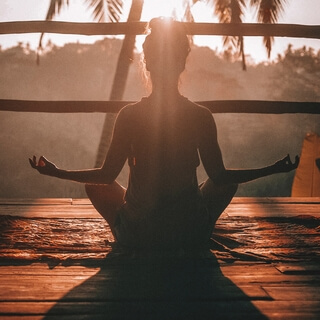
Many people who are about to start on a journey of meditating get caught up in thoughts on whether they are doing it right or not.
These thoughts and questions can often become obstacles in the actual practice,
So today we are going to look at breaking down some of these obstacles.
First of all,
How do I need to sit?
Well,
You can sit or lie down,
It's totally up to you.
Just make sure that you are comfortable.
You don't need to be cross-legged on a hard floor with your back rigid.
All that will happen is in a few minutes into your practice you will be fully focused on how much your hips,
Knees or back is hurting and the development of pins and needles in your bum.
So just make sure you are comfortable.
If you find that if you lay down you always fall asleep after a few minutes,
Then unless your aim is to fall asleep you might want to change your position.
If you choose to meditate while sitting,
Then sit upright but not rigid.
It's ok to sit with your back against a chair or a sofa.
Check out your position before you start and ask yourself,
Could I sit like this for 10 to 20 minutes?
But even so,
Don't suffer throughout your practice.
If you feel really uncomfortable it's ok to shift your position.
Do I need to close my eyes?
No you don't.
Again this is personal choice.
Many people do close their eyes as it blocks out any distractions around you.
It's really easy to see dog hairs on the carpet or dust on a surface and before you know it you're off in a sea of thoughts planning what you need to do.
But some people find it uncomfortable to close their eyes and start to have thoughts or feelings they really don't want.
So if you choose to keep your eyes open,
Just look slightly downwards and soften your gaze as if you are going slightly cross-eyed.
Again you can change your mind if you wish throughout your practice.
How long should I meditate for?
Well like any skill you are trying to develop you build up over time.
So maybe start for a few minutes,
Then five and so on.
You might want to dive straight in and do a 20 minute meditation and be absolutely fine with that,
But you might not so try what works for you.
You don't want to try to sit for half an hour and find yourself lost in thoughts and fidgety.
There's no point to that so even if you have just a few minutes that's a good start.
I can't stop thinking.
This is the biggest obstacle people face and this can be a problem for those who have been practicing for years too.
My answer is don't worry about it.
The trick is to notice it.
Usually our whole lives are on autopilot and we're not aware of the thousands of thoughts that go through our minds each day.
So becoming aware of our thoughts is the beginning of mindfulness.
If you sit for 20 seconds,
Get lost in thought and then you notice you are lost in thought,
Then right there you have practiced mindfulness.
Congratulate yourself.
The more you practice,
The more awareness you will develop.
Remember your mind's job is to think thoughts.
You're never going to not think them.
You might just get longer periods of stillness and awareness,
But the more you aim for that and have that as your goal,
The more you will think thoughts.
So just let it go.
We'll attempt a short practice now.
This will be two minutes of silence.
In this practice,
Try noticing whenever your thoughts go off on a tangent.
Try observing the thread of thoughts and whenever you notice anything,
A sound,
A smell,
A feeling in the body,
A thought about the past,
Planning for the future,
Just label them thinking.
Get yourself ready and comfortable.
Let's begin.
Okay.
Okay.
Okay.
How did you do?
Did you notice your thoughts?
Well done.
Our mind likes to have something to do,
So a practical tip is to give it something to do,
Something to focus on,
To anchor it.
This could be looking at an object or something that's more accessible.
You can do it at any time in any place is simply watching the breath.
Observing the breath is a terrific anchor for keeping the mind from wandering off.
So we will try another practice now,
This time for longer for three minutes,
And I will guide you through this practice of observing the breath and noticing the thoughts.
Close your eyes if you wish,
And we'll begin.
Just take your attention now to the breath.
Don't try and change the breathing.
You're just watching the breath.
The inhale.
The exhale.
Notice the breath around the nostrils.
Notice how on the inhale,
It's slightly cooler around the nostrils.
And on the exhale,
Slightly warmer.
And now move your attention to the chest area.
Notice what happens to the chest when you breathe in.
Notice how the chest expands.
When you breathe out,
The chest drops.
And now move your attention to the stomach area.
Watch what happens here on the inhale.
Notice how the stomach stretches and expands.
And on the exhale,
The stomach drops.
It rises and it falls.
If you notice that your thoughts have wandered off anywhere,
Just gently bring them back to just watching the breath.
In and out.
Take your attention to wherever the breath is more noticeable for you.
The nostrils or the chest or the stomach.
You can open your eyes now.
You might feel that you are constantly noticing the thoughts.
Good.
That's awareness.
That's mindfulness.
But you might have noticed a few seconds in between where there were no thoughts.
This period of stillness will become longer the more you practice,
So don't give up.
Don't entertain any thoughts such as,
I can't do this,
I can't stop thinking.
You can do this,
Just don't give up.
If you can notice the thoughts coming and going,
Just like weather patterns.
The clouds come,
They create a shape and then they change shape and then they're gone completely.
The rain comes and then the sunshine comes.
It's the same with our thoughts.
They come and they go.
The trick is not to get caught up in them.
Imagine the thoughts being like a train.
You have a choice.
You can watch the thought,
The train,
Go by and say,
There is the train.
There is the thought.
Or you can see the train,
Jump on it and head off into a direction you didn't particularly choose.
And then when you are somewhere down the line you think,
Whoa,
How did I get here?
So we see the thought,
There is thinking and we just watch it go away.
The spiritual teacher Mooji says that the actors won't come out on stage until the audience is sat down.
This means that your thoughts won't play up and continue to bombard you if you stop paying so much attention to them,
Being the audience to them,
Playing with them,
Getting caught up in them.
If you see them and watch them coming and going and not get swept away in stories and narratives that your mind tells you,
They will soon lessen.
Let's try again for another few minutes.
This time keep your attention on your breath,
On noticing the thoughts,
On labelling any thoughts,
Thinking,
On bringing your attention back to the breath,
And on congratulating yourself every time you notice,
And also noticing any stillness.
This time we'll be in silence.
Continue until you hear my voice again.
This time we'll be in silence.
This time we'll be in silence.
This time we'll be in silence.
This time we'll be in silence.
And you can open your eyes.
Another question some ask,
Should I meditate with music?
Again,
This is a personal preference.
Music is subjective,
So what I like,
You might not,
And vice versa.
But some find it really helpful to have a relaxing background of music playing.
So for the last practice,
We will have a period of another few minutes practicing the same things,
Simply watching the breath,
Noticing and labelling the thoughts,
And bringing the attention back to the breath if necessary.
And this time we will have some background music.
So close your eyes if you wish.
And we will begin.
.
.
.
.
.
.
.
.
.
.
.
.
.
You can open your eyes.
So what did you think?
Did the music help you or not?
It's good to know what your preference is so that you can set up your own environment which supports and is beneficial for your practice.
So today you've tried three different practices.
One sat in silence.
The second one was a guided meditation.
And the third one was by yourself but with background music.
Which did you prefer?
There are many benefits of meditation.
Emotionally,
Psychologically and physically.
But practicing regularly is key.
Try twice a day aiming to build up to at least 20 minutes a day.
And whether you are a beginner in meditation or a seasoned meditator,
It is good to sometimes get right back to basics.
So we are not just sitting for the sake of sitting.
I hope you've enjoyed this back to basics practice and encourage you to keep going.
Thank you.