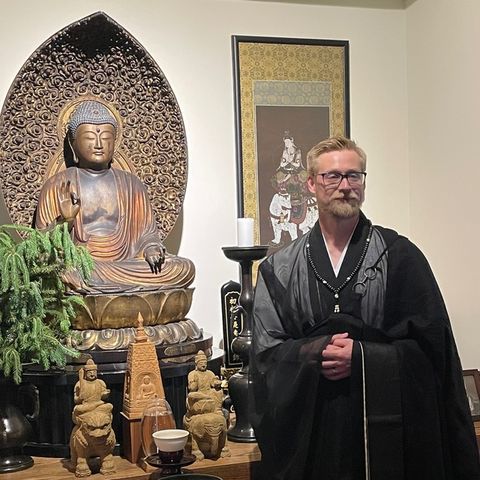
In this episode,
We will explore the fundamental concept of hollow bones Rinzai Zen,
Which is that our ego can be reconstructed.
This concept is based on a few fundamental ideas,
Or as we would call them fundamental truths,
About the human mind,
About our human psyche.
And some of them might seem a little bit challenging at first,
Especially if you are new to Zen Buddhism.
So to bring these things to light,
We're going to examine who we are,
And what the ego is,
And how we relate to each other and to ourselves in this world.
So one of the first things that we have to look at is who we are,
Or maybe more precisely,
What we are as human beings.
And the idea of what we are is centered around the realization of Siddhartha Gautama when he achieved enlightenment all those years ago,
About 2,
500 years ago,
And came forth and shared that the three marks of existence are impermanence,
Suffering,
And selflessness.
So to understand what we are,
Or what our existence is,
Perhaps more precisely,
We have to understand these three marks.
Impermanence is the truth that everything changes all the time.
Everything is changing at a very different pace from each other,
Depending on what it is,
But everything's changing.
For example,
We could say that right now your body is changing because you're constantly going through a process of cellular reproduction.
And there has been studies that show over the course of a few weeks,
Your entire skin organ will be different,
Right?
So if you check your skin at day 1 and a day 22,
There will be no cells in common.
So even things that we consider as very permanent,
Like our skin,
Are undergoing constant change.
Now I kind of started you off with a fairly difficult one to see on a daily basis,
But this is no different than watching a plant grow,
Or open and close with the sun,
Or understanding that each time we wash our clothes,
They get a little bit more faded,
A little bit more worn out,
A little bit more strained.
So you could point to a thousand different things.
You will,
Really,
You can point to everything and show how it is changing.
At the universal scale,
We are moving further and further away from the other galaxies at the moment.
We're accelerating,
We're constantly changing position.
At the microscopic scale,
Even things that we consider very permanent,
Like my desk and my computer monitor,
Are decomposing or changing very slowly over time at the molecular level.
So this is a truth of existence.
This is part of what makes existence as we know it existence,
That things will change.
And this also replies to non-physical things.
So the aging process,
Or the thought process from moment to moment,
The way we feel the information gathered by our senses,
Is all changing all the time.
And when we truly grasp the sense of impermanence that everything is changing all the time,
Nothing will last forever,
Nothing will last forever exactly as it is.
We can really appreciate this fleeting gift of life,
And it brings a sense of gratitude that's very helpful and generally just quite pleasant.
However,
Coming to the realization of impermanence and surrendering to the truth that everything is changing all the time,
Nothing is permanent,
Can be rather challenging,
Rather challenging for our egos,
Which is kind of the whole talk,
Right?
So we'll get to what an ego is here in a little bit.
But before we do that,
I wanted to take a quick look at the idea of suffering.
Now suffering is a translation of the word dukkha.
And I don't particularly feel like it captures dukkha very well.
But it's kind of the common use word of the Buddhist community.
Really dukkha is the inevitable feeling of discontent or dissatisfaction that comes from the experience of being a human being and seeking constantly improving conditions.
Dukkha is the idea that pain is unavoidable.
Things will be painful in our lives,
There will be loss,
There will be separation,
There will be physical pain,
There will be sickness,
But these are all natural parts of living.
These are natural parts of relationships,
And the pain of them is inescapable.
In that,
We understand that the suffering component isn't necessarily inescapable.
Suffering is a psychological process that we attach to pain,
That we put in addition to pain,
That makes it much more difficult for us to live our lives.
And now we get into perhaps the most important mark of existence,
At least in terms of ego reconstruction,
And kind of reorienting our psychology.
However,
Impermanence,
As we will see,
Will come in very closely as well.
But the third one is selflessness.
And selflessness,
Or non-self,
Is a very interesting and integral concept of all the Buddhist traditions,
But one that's particularly relevant to reconstructing our ego.
Selflessness is the idea that we are not a permanent self.
Who we think we are isn't necessarily who we are,
And in fact we are an aggregate of physical components,
And our physical components create thought processes that lead us to believe certain things,
Or to create certain frameworks in which to understand and live our lives.
And as we know within permanence,
Nothing stays the same.
And if we follow that through,
We can look at ourselves,
And we can understand that we have changed significantly throughout our lives.
So a lot of times,
At a certain point in our lives,
We get stuck.
And in getting stuck,
We start to think of who we are as a permanent,
Fixed entity.
I have become this person that I refer to as me,
Or I,
Or Dan,
Or whatever you're going to call yourselves.
And in that moment,
We are lost.
And so this whole process,
Zen,
Buddhism,
Enlightenment,
Refers to waking up to the truth of our own self-nature.
Wow.
I'm not necessarily who I think I am.
What does that mean?
Well,
One of the basic ways that we can look at it is the biomechanical,
Electrical,
Neurological process that makes up the human mind,
The human body,
The human experience.
So traditionally,
We have six sense organs which give rise to six dusts.
And this is old-school language,
But basically what I'm saying is that our perceptions arise from six sense organs,
Which are the eyes,
The ears,
The nose,
The tongue,
The body,
And the mind.
You'll notice the inclusion of the mind as a sense organ,
And this is a central concept.
So each of these six sense organs are responsible for providing us with information,
And that's what they do.
And so our eyes give us sight,
Our nose gives us smell,
Our ears give us hearing,
Our tongue gives us taste,
Our body gives us touch,
And our mind gives us thoughts,
Feelings,
And emotions.
With this view of the self,
Now all of a sudden we understand that our thoughts,
Feelings,
And emotions are part of our sensory system.
They are part of the information on which we base our life.
They're stimulus to which we can choose how to respond.
Similar to if you touch something that you enjoy,
For example,
You're petting your dog or a cat,
You can choose to keep doing it because,
Wow,
That's soft and fluffy and it's nice and it's giving me a sense of joy.
Conversely,
If you touch a hot stove,
As soon as you recognize it,
You're going to take your hand off and you're going to say,
Wow,
That hurt and was unpleasant.
Well,
Now our thoughts fall into the same category,
And that's the essential nature of this practice.
In addition to this concept behind selflessness,
There is another,
And it is the idea that our thoughts,
Feelings,
And emotions are kind of conditioned responses of a self narrative that we use to relate to the world,
And that's not necessarily who we are.
And through an accumulation of experiences,
Through an accumulation of stored memory that comes about in relation to our senses,
Specifically,
For example,
When I was growing up,
This event happened and it made me feel this way,
So I am going to choose to act in such a way to avoid that situation in the future.
Okay,
So now we have an accumulation of an experience that was received as sensory input from our sense organs that has put a narrative in our mind,
And this is somewhere where modern psychology uses the very similar concept in mindfulness studies,
But slightly different names.
So in our speaking,
We would call that the ego.
The ego is the one that holds this story,
This self-referencing story.
In modern psychology,
They can also call it the narrative self,
And this is the self who references itself in relationship to many other experiences with the outside world,
And then develops a story which we live out in our lives.
The other side of that is your.
.
.
There's many different names for it,
But in Rinzai Zen,
We call it the buddh nature.
You can also call it your true self.
You can also call it pure selfless awareness.
You can also call it Zen mind or Dhyana mind.
You can call it Chan,
Or you can call it your immediacy self,
And it fundamentally changes the neurological patterns in your brain when we see ourselves as a product of this moment,
And as an accumulation of experiences and information that we receive from our sense organs.
Now this is a philosophical concept that is very logical,
So I think if you sit with this for a little bit,
You'll find that it's very difficult to come to a conclusion that counters this,
And that's an important thing because when we sit,
When we're meditating,
And we're contemplating certain questions,
Or we're contemplating our existence,
And we're practicing our deep concentration meditation on questions like,
Who am I?
This framework is essential in realizing who we really are.
What is our essential nature?
And when we look at what our essential nature is through this lens,
We realize that we are impermanent,
And through this impermanence,
And through this impermanence,
We realize that we can change.
Or as we like to say,
If you don't like your play,
Fire your scriptwriter and hire a new one.
Wake up to who you really are.
Wake up to your pure,
Selfless,
Unconditioned,
True nature,
And allow that to inform and educate your story.
Allow the true information from your senses to be who you are,
And to exist in the immediacy of this moment.
And when we shift from that narrative self,
That self-referencing me,
Me,
Me,
Me,
Me,
Me,
Me,
Me,
Me,
Me,
Me,
Me,
Me,
And we stop a little bit,
Then we realize that that little part of us is part of a very big consciousness.
It's part of a very big mind,
And we go from,
I think therefore I am,
To,
I am therefore there is thinking.
And now our thoughts,
Feelings,
And emotions that we can process as sensory information,
No longer have the same kind of power that they used to have.
They no longer have the same relationship to us that we are accustomed to having.
In fact,
A lot of our negative habitual reactions,
We can now see as negative habitual reactions.
And this me that I think I am,
To give a personal example for me,
The me that I think I am,
In some cases,
Is an incompetent loser that will be unloved and,
Well,
Let's just say it's not very nice.
And a lot of this has arisen from conditioning that I received very early on in my life,
And how I responded to stimulus in my childhood around separated parents,
And the stoic nature of our household,
And being bullied at school,
And things that kind of set in this mindset.
And then for the rest of my life,
And until I decided to do otherwise,
Which took a lot of time,
Energy,
Passion,
Patience,
Practice,
And professional therapy,
As well as meditation,
I realized that I've been living out this life story over and over and over and over again,
Despite my best intentions.
So despite my need for deep personal relationships,
I continually acted in a way that would only self-verify that I was unlovable.
And so we see this very interesting pattern where this self-referencing me that developed long before I had capacity to deal with the issues that were presented with me,
Were presented to me by my stimulus,
As a protection mechanism,
Did nothing but cause additional suffering.
Now,
That sounds lovely,
And wow,
Cool,
Okay,
And whatever,
But now that's in there.
And these habits are strong.
And it's true,
They are.
Biologically,
Our brain,
Our neuropathways,
Have conditioned themselves,
Have wired themselves into these set patterns of thinking,
And and shame loops,
And depressive states,
And patterns that,
You know,
For example,
I have a tendency to get really frustrated and angry and shout and scream.
And that is a hard-coded neural pathway response to frustration and anger.
However,
Between stimulus and response,
There is a pathway.
And this pathway is a lot longer than we think it is,
And it gives us a lot more space.
And we can use this space,
We can train ourselves through deep concentration meditation to engage in the pathway between stimulus and response,
So that we can choose a different type of response.
And as we practice this ego reconstruction,
And as our mind adjusts to this new philosophical orientation,
And as we practice our concentration meditation,
Our Zen meditation,
And we develop the ability to stay with our immediacy self instead of getting caught up in the narrative self,
To stay with our pure selfless awareness instead of getting caught up in the ego,
We can start making changes.
And fortunately,
One of the marks of existence is impermanence.
Backed up by the concept of neuroplasticity,
Which says that we can change our minds through repeated action and through stimulus,
Our minds will actually rewire themselves,
We can choose different pathways.
So for example,
For me right now,
My habit to go into a shame loop when I think that I am not good enough at what I am doing,
And to beat myself up over simple mistakes or areas of this podcast that could have been spoken better,
For example,
That tendency is still quite strong.
However,
I have noticed it weakening over time as I have chosen to engage in different processes,
Chosen to engage in different forms of understanding of the stimulus,
Relating differently to shame,
So that instead of being in a shamed state that is terrible and miserable,
Now I am just experiencing shame.
And that shame asks me,
Did I act in integrity?
Am I doing the best that I can?
Yes.
And so,
From this new viewpoint,
From the point of the immediate self,
From the point of our pure selfless awareness,
We can be aware of these conditioned responses,
We can be aware of these thoughts,
Feelings,
And emotions,
We can be aware of their origin,
And with proper help and processing and additional therapy when required,
And medication if required,
And all of these other great things that we have scientifically,
We can engage in concentration meditation practice that allows us to leverage the marks of existence,
To leverage the idea of selflessness and impermanence and the truth of the inevitability of pain into something that allows us to create a new story.
And so,
Who I am goes from I am Dan to I don't know,
And that's okay,
And I don't have to relate to the world anymore in this same habitual negative pattern.
I can write my own story.
And this strong ego that has kept us alive this whole time,
Where does it go?
It certainly doesn't die.
It's there,
That self-referencing narrative will be present,
But it can change over time and we can understand it,
And it can work together with this deeper sense of self,
This true,
Unconditioned,
Pure awareness,
And this narrative that gives us an identity in our world and allows us to understand that we are relatively a part of it,
And that while I am here and you are there,
There is something that ties us together as well,
Which is this fundamental mind.
This basic capacity of human sentience is remarkably consistent throughout time and culture and many other factors.
So it's up to us.
It's up to us to wake up and to realize there is a truer message being presented by our senses than what we would normally experience,
And with work and dedication,
Or as we like to call it,
With clear intention,
Great faith,
Great determination,
Great passion,
Great doubt.
With these four elements,
Our practice can become transformational and we can engage in ego reconstruction on a scale that allows us to rewrite our life stories and no longer be victims of suffering and shame and depression and anxiety and violent anger,
Disconnection relationships.
All of these things are part of our habitual negative reactions and they don't have to be that way.
Now this isn't saying it's easy.
This isn't saying that you sit once and you accept these concepts and move on with your life as a perfectly enlightened human being who never says anything mean again or never gets down on yourself again.
That's not how it works.
That's not what enlightenment is.
Once you wake up to your true self nature,
That's where the real work begins.
So ego reconstruction starts with this philosophical reorientation and then the genuine insightful experience through concentration practice of the immediate self,
Of this pure selfless awareness.
And once you're awake to that pure selfless awareness,
Then the fun begins and you can begin writing your own story and applying this practice in your life.
This application of practice will be something that we will cover in a future episode,
So look out for that and thank you for listening.