The stang is a popular tool that is most heavily associated with traditional witchcraft,
Folk witchcraft,
And,
In some traditions,
Wicca.
One of its purposes is similar to that of the athame or wand,
The more recognizable Wiccan tools,
Which is,
Among other things,
Directing energy.
Traditions-wise,
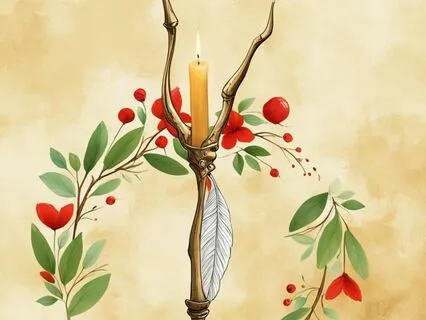
A stang is basically a walking staff with a forked top.
In fact,
The word stang comes from an Anglo-Saxon word that means pole.
Many find that the stang bears a resemblance to a pitchfork,
But it has nothing to do with the fabricated,
Negative connotations of such.
A stang can be of almost any height,
And it can be made from almost any wood,
Both mostly a matter of personal preference.
A stang can be minimalistic or ornate,
Again,
Dictated by the choice of the practitioner.
The use of a stang in rituals is centuries old,
But the tool became more familiar in modern times,
In the 1950s and 60s,
With the foundation of Robert Cochran's British mystery tradition,
Which some view as a form of Wicca,
While others see it as a separate entity.
Fundamentally,
It doesn't matter who the stang belongs to because it can be,
And is,
Widely used across various practices within paganism.
At its core,
The stang symbolizes the world tree,
Or the tree of life,
As it is known in Wicca.
In both cases,
It is a type of bridge between the earth and the sky.
The two prongs symbolize the witch father and the witch mother in a traditional witchcraft setting,
Or the god and goddess in Wicca.
It is also seen by many as a representation of the horn god,
Cernunnos.
In some traditions,
The stang is viewed as being both a tool and an altar.
One of the most common uses of a stang is in casting a circle or laying a compass.
In either case,
This means temporarily marking an area as a sacred space for conducting a ritual.
In Wicca,
This is done by calling upon the quarters,
Or elements,
Earth,
Air,
Fire,
And water,
Along with deities,
Spirits,
And or ancestors.
In doing so,
The practitioner energetically marks a circular boundary for this purpose using an athame or wand.
When using a stang and practicing outdoors,
The circle can also be physically drawn out on the ground,
And,
Thereafter,
The base of the stang is customarily driven into the earth,
In the center of the circle,
To stand as a marker.
In some group settings,
Ritual participants may dance around the stang as part of the ceremony.
In hedge witchcraft,
The stang is used heavily in hedge crossing or riding the hedge,
Which is the practice of journeying between spiritual realms.
In this context,
The stang becomes more or less a channel for doing so.
Some practitioners will choose to decorate their stang by suspending a wreath between or from the forks,
Or by crowning it with a candle.
Adding feathers to it is another common form of ornamentation.
When kept indoors,
The stang is rested in a pot of earth or by other suitable means.
Stangs are typically made of woods,
Such as ash,
Hawthorn,
Oak,
Rowan,
And yew.
Some base their decision on which type of wood to use on its magical properties,
Or,
Perhaps,
That of the tree of their birth month in the Celtic tree calendar.
If you would like to incorporate the use of a stang in your practice,
The choice of which wood to use,
And whether it should be polished or unpolished,
Forked or not,
Is completely yours.
As with any tool,
Be it for magical or mundane purposes,
It is just that,
A tool.
And,
Therefore,
An extension of you and your energy.
Similarly,
The choice to use one,
Or not at all,
Is entirely yours.
Intention is the non-negotiable ingredient in magic.
Tools are conduits.
That said,
I particularly enjoy the use of tools in my practice,
As they make my ritual experiences more visual and tangible.
After becoming Wiccan,
I practiced for years,
Using only an athame or wand for circle casting.
Down the road,
The practice of using a stang caught my attention,
And the more I learned about them,
The more I felt using one would be a good match for me.
Then I realized I'd already incorporated a stang each time I connected most deeply to nature,
Which is by taking walks,
In the desert,
Through my hiking staff.
That became my ritual stang,
And it remains as such today.
Mine is wooden,
But it's composed of several sections that screw together and unscrew easily,
So it fits nicely and inconspicuously in my backpack.
Aside from the faux black feather I've attached to the handle,
There's nothing about it that screams Wicca or witchcraft when I'm on a walk or using public transportation.
After using it to cast a circle,
I typically hold my stang throughout the ritual,
As this cements my awareness of being inside a sacred space.
Similarly,
I will hold and sometimes lean against my stang when I am in deep thought or meditating.
When not in ritual use,
My stang stands before my altar.
Aside from creating a measure of awareness as to what a stang is and how it is used,
It's my hope that I've also shown some of the commonalities of practice that transcend various labels or traditions under the umbrella of paganism.
Seek out the tools that resonate with you,
And always remember why they do so.
You are magic,
So you do you.
Blessed Be.