In Wicca,
Practitioners follow the Wheel of the Year,
Which marks eight distinct seasonal observances,
Known as Sabbaths.
Each Sabbath acknowledges and pays tribute to what is going on in nature at that time.
Among them are four of the most commonly known,
The summer and winter solstices and the spring and fall equinoxes.
All of the Sabbaths have something about them that is unique.
Three of the Sabbaths,
Though,
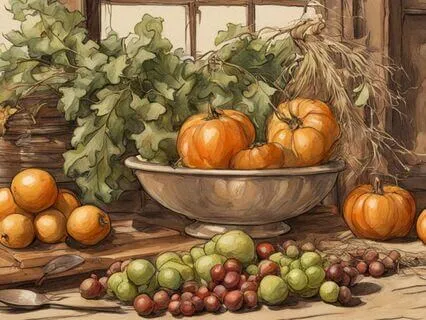
Center around distinct harvest celebrations,
All with a common theme,
But each in its own nature.
Most people in North America who practice mainstream spiritualities or follow more societal traditions recognize only one harvest celebration,
Which is Thanksgiving Day.
This holiday occurs well after the conclusion of the three harvest Sabbaths.
For Wiccans,
Recognition of the harvests begins with the Sabbath of Lammas.
The Wiccan or pagan Thanksgiving Day is at Mabon,
While the final harvest is observed at Samhain.
In the Northern Hemisphere,
These Sabbaths occur in August,
September,
And October,
Respectively.
In the Southern Hemisphere,
The timing is reversed.
The Sabbath of Lammas,
Or Lugnasa,
Occurs on August 1st.
For those of us who don't live on or near a farm,
The concept of this can seem a bit foreign,
But it wasn't at all to our ancestors.
At this point between the summer solstice and the autumnal equinox,
We experience a time when the first cuts of grain and corn were usually made.
In Celtic tradition,
It is also a day of honoring the pagan god Lu,
A multidisciplined master craftsman.
The term Lammas is often used interchangeably with Lugnasa,
But,
By definition,
They are two very different celebrations.
Lammas is an Old English term meaning loaf mass,
Which is a Christian observance that also centers around the early harvest season and bread.
Both,
However,
Are rooted in celebrating the first fruits from the fields.
The Sabbath of Mabon occurs at the autumnal equinox in September.
On this day,
There is equal time of daylight and darkness,
And we can see the earth giving a final push of its bounty before winter sets in.
Mabon is the Wiccan or pagan equivalent of Thanksgiving Day.
It was on this day that our ancestors would take inventory of the harvest to ensure stability throughout the coming harsh winter.
Crops are plentiful at this season,
So,
Just as Lugnasa,
It is very much a celebration.
Those with plenty,
Plus some to spare,
Would often share their excess with family,
Friends,
And neighbors who didn't have similar success with their crops for that year.
As we celebrate at this time,
A definite shift in nature is easily seen.
There is a crispness in the air that we haven't known for months,
Whispering to us that winter is on its way.
The Sabbath of Samhain occurs on the secular celebration of Halloween.
Accordingly,
Many see no association with it and any sort of harvest.
Samhain marks the beginning of winter,
So it is at this time when the final remnants of the growing season are collected and brought inside,
Making it the final harvest.
In a traditional growing sense,
Many fields are becoming barren by Samhain.
With that and daylight growing shorter,
This season became associated with death,
Thus remembrances,
Such as the Day of the Dead.
Wiccans recognize that the veil between our world and the spirit realm is at its thinnest at this time.
We also recognize that,
With nature as our teacher,
How nothing truly ends or is gone forever.
Just as our crops are grown from seeds and return to seeds only to be grown again the following year,
So too do all things.
This is another reason why Samhain is celebrated.
For those who aren't Wiccan or are new to the craft,
The idea of three harvests might seem very different at first.
One of the biggest challenges to understanding this concept stems from the modern conveniences that all of us enjoy,
Chiefly that regardless of where you live,
There is likely to be a grocery store stocked with just about any foods or vegetables at any given time of the year,
Regardless of the season.
By living with the wheel of the year,
However,
The uniqueness of each Sabbath becomes second nature in a very short amount of time.
Living with the wheel means observing each Sabbath in a way that is practical for and meaningful to you,
While making each of your observances mindful ones.
This can easily be done by taking nature walks or decorating your dinner table with seasonal colors.
Another great way of achieving this is by eating with the seasons.
You can do this without having a complete overhaul of your diet.
Many find it meaningful to incorporate seasonal produce for at least some meals during each Sabbath.
It can also be as simple as drinking lemonade during the summer and apple juice during autumn.
Gardening is another pathway to living by the wheel.
Again,
This does not need to be a big step.
Even a small patio garden will allow you to attune to the seasons more easily and offer an accessible understanding of or glimpse into what our ancestors were experiencing during those times.
However you choose to relate,
Make each Sabbath or each season a celebration.
Many cultures,
Spiritualities,
And traditions associate the concept of giving thanks with whatever time of year nature's offerings are plentifully received.
The same is true in a metaphorical sense,
For paydays and weekends.
Regardless of whatever fruits of our labor are received and the timing of it,
The mindset of joy and gratitude at that time is something that transcends all other differences that might exist.
That alone is worthy of celebrating.
Gratitude isn't limited to just one season or a particular religion.
Just like the great wheel,
It is meant to be lived.
Blessed Be.