Welcome to this very brief introduction to the labyrinth,
Which will end with a little opportunity to walk a labyrinth,
To experience walking a labyrinth yourself.
I wanted to take a little bit of time just to introduce what labyrinths are,
A little bit about their history and why they are so significant for a lot of people in their spiritual lives.
First thing to say is that a labyrinth is not the same as a maze.
That's something that's often confused.
Mazes came about really in the 15th and 16th century,
Particularly in England and France,
In the gardens of the aristocracy.
And of course today we think of many mazes we can visit as a game,
As a way of entertaining ourselves,
Amusing ourselves,
Mazes containing dead ends and paths that lead nowhere,
That are deliberately set up as a sort of puzzle.
And of course when we find our way to the middle we are typically very relieved.
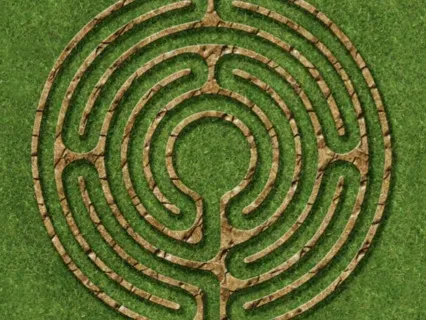
Labyrinths by contrast are single paths.
So if you follow the path of a labyrinth you should not be able to get lost.
It will take you eventually to the middle,
Albeit it will involve a few twists and turns along the way,
Following a particular pattern,
And there are many patterns which we'll talk a little bit about in a minute.
They may be painted on a path,
They may be mowed into a lawn,
They may be made out of concrete,
Or they may be the type that you can rest on your lap,
A sort of miniature version made out of wood or even drawn on paper or cardboard,
Which you can follow,
You can trace with your finger.
The larger labyrinth,
The larger outdoor labyrinths are the ones perhaps that normally come to mind when we talk about labyrinths,
Ones that we physically walk.
And there's something about the,
If I can describe it as a kind of body prayer,
Of making these twists and turns,
That is quite difficult to describe unless you actually experience it.
And this coming to the center,
This coming to what I like to describe as a way of coming home,
Coming to our core,
And coming to the common core,
If you like.
So the very pattern of a labyrinth is a kind of metaphor for life in general,
That we face many uncertainties,
We don't know very often how near we are to that center.
We are taking lots of twists and turns in our lives,
Lots of changes in direction perhaps,
Encountering new chapters,
But eventually finding our way home,
Coming to our center.
And indeed some cultures,
Particularly in the Native American traditions of the Tohono O'odham people,
The labyrinth is very much seen as a metaphor for life as a whole.
Just as we come to the center,
There is the path out,
And it's usually the same path that we are tracing as we come out of the labyrinth,
Make our way back into the world,
Although some labyrinths have an alternative way to lead out from the center.
And one of the things that I find particularly intriguing about labyrinths is that they are found across many cultures,
And they have a very,
Very long history.
In fact,
Their history seems to predate written history,
As far as we can tell.
Some of the very early ones are depicted in rock carvings in northwest Spain,
And these are thought to date to the early Bronze Age.
And from around the same time,
There are labyrinthine patterns found on Babylonian tablets,
As well as early examples from the Etruscan world as well.
Many Roman mosaics incorporate a labyrinth pattern in their design.
And of course there is the famous Greek story of Theseus and the Minotaur.
This is the story of a labyrinth designed to build to contain the Minotaur,
This ferocious beast that had been born to King Minos,
Which had an insatiable appetite.
Theseus,
Who was a prince from the mainland,
Volunteered with a group of his co-patriots to be an offering,
Essentially,
For the Minotaur.
And the story relates that King Minos' daughter,
Ariadne,
Had fallen for Theseus,
And she gave him a ball of thread that unraveled as he made his way through this labyrinth,
Which at that time was very much of the maze type,
Meant to trap and hold in not only the Minotaur,
But anybody that entered into it,
And supposedly being impossible to find your way out from.
But it was this thread,
This so-called red thread,
That allowed Theseus and his companions to retrace their steps once the hero of the story had found the center and killed the Minotaur.
Around the same time as this particular myth was gaining currency in Greece,
Labyrinths were also being described in the Mahabharata,
The great Hindu epic.
And here we find that the great warrior Arjuna is shown how to defeat his enemies using a particular battle formation which resembles a labyrinth,
Actually something very similar to the so-called classical style,
Which is very common in western examples of the labyrinth.
Generally speaking,
From the time of the Romans going forward,
Labyrinths have been considered a space for protection,
A safe space that holds us,
Even as we come into touch with our inner lives.
And I think this is one of the things that most people who walk a labyrinth experience,
They have a sense of being within a sacred space,
Within a held space,
Especially if that particular walk is being held by someone outside of the circle.
So labyrinths are places for discovery and growth,
Approaching perhaps with an open question,
Something that might be on our minds,
Something we want to gain wisdom about,
Or something we want to let go of.
And as we enter a labyrinth,
We are essentially entering into not only a sacred,
But a liminal space,
Stepping outside of the normal rules of time and space that normally guide us in the everyday world.
I mentioned the classical form of labyrinth.
There is another very common style that is found in the west,
Particularly in churches and in the Christian tradition,
And this is the medieval pattern or a specific variant of that known as the Chartres labyrinth type.
And this is a pattern that models and is exemplified in its most perfect form in a strikingly beautiful labyrinth at Chartres Cathedral in France,
Which actually is still possible to walk today,
At least outside the time of the pandemic.
It has near perfect symmetry and is as much a testimony to the grandeur of this outstanding cathedral as are its many stained glass windows,
Including some exceptional rose windows that bathe the north and south transepts.
The labyrinth at Chartres is already 800 years old,
And as I said,
It's a labyrinth that can still be walked today.
It's quite awesome if you have an opportunity,
Perhaps you have,
To visit the cathedral,
To think that you are following in the footsteps of pilgrims over many centuries.
And indeed during the times of the Crusades,
Walking a labyrinth was often the end of a journey coming to that heart,
Coming to that center,
Symbolic for Christians of coming to Jerusalem at a time when it was too dangerous for many of them to travel to the Middle East.
Following a different design,
There are many labyrinths of a particular pattern around the coast of Scandinavia.
In fact,
Around 600 labyrinths have been found very near the coast,
Formed of stones.
And it's thought that these were used for ceremonial purposes,
Perhaps for blessing fisher folk before they went out on very long and often hazardous journeys to catch fish,
And indeed to bless the catch when they returned.
And there's a variation of this style on the other side of the Baltic Sea in the German and Polish speaking countries of Europe,
Now commonly known as the Baltic Wheel style.
Some of the symbolism associated with the labyrinth includes its reference as a model of Mother Earth,
The giver of life.
And this is seen in,
Again,
Many Native American representations,
The idea of spiritual rebirth,
That we are going in to be transformed,
And we come out transformed,
Resolving to live our lives in a different manner.
They are often used in rites of passage,
So going in to this liminal space from a familiar way of living,
From one chapter in life,
If you will,
Giving up that way and opening up and being ready,
Committing to taking on board the new.
Geomancers have strong interests in the labyrinth as well.
They play a role very often in healing the earth in their understanding.
So it's not just we as people that can benefit by walking one.
The very energetic footprint of a labyrinth seems to be significant.
So as I've said,
Labyrinths come in all different shapes and sizes,
Some that you can walk physically with your feet.
Some,
Very commonly,
In the West today,
Are laid out temporarily at set times,
Perhaps painted on a large canvas.
Others are set in stone or painted or even chalked on the floor.
So they can be found in all sorts of places.
I mentioned the popularity in the Christian world,
But examples of the classical style of labyrinth can also be found in Jain,
Hindu and Buddhist manuscripts,
As well as designs seen in countries as far afield as Java,
Nepal and Afghanistan.
During the time of pandemic,
Finger labyrinths have become particularly popular.
These might be a little groove that's carved into a wooden artifact that you hold on your lap or just something that's printed on paper,
Which you trace with your finger.
The labyrinth we'll see today is displayed on the screen.
And there's a growing body of research,
Of evidence that suggests that walking a labyrinth,
Especially quite regularly if you have an opportunity,
Has all manner of health and other benefits,
Such things as reduced blood pressure,
Improved respiration,
Reductions in chronic pain,
Anxiety,
Coping with insomnia are among many conditions that have been claimed to be helped by labyrinth walking.
So look out for a labyrinth,
Perhaps in your local area,
When it's safe and you have an opportunity to do so.
There may well be one quite local to you that you didn't know about before.
As I say,
Churches,
University campuses,
Schools,
The grounds of hospitals,
There are so many places where labyrinths are now found.
And if all else failed,
Then accessing a finger labyrinth may be an alternative that you might want to consider.
The particular meditation that we will follow through in just a minute,
I will also include as a separate brief meditation among the Inside Timer offerings.
So you can use that as a practice if you wish from time to time.
So how do you go about walking a labyrinth?
Well,
The simple answer is there is no right way.
Every time we step into the labyrinth,
We should expect to have a new experience.
Again,
This is a little like life itself.
Every time we embark on something new,
We can't fully predict what may happen.
Some people like to take a question with them into the labyrinth or something to reflect upon or otherwise just noticing where their finger is or if they're walking physically,
How their feet are moving as they take each step as an anchor point,
As a basis for maintaining a meditation and just being open to whatever may come.
Generally speaking,
You may want to be silent as you walk.
However,
That's not always the case and certainly with large physical outdoor labyrinths where it's practical and not disturbing to other people,
Then singing,
Dancing,
Waving hands,
Practicing yoga,
Whatever it is,
I have seen all of these things in my travels and they are wonderful to see as well.
But as I say,
See the labyrinth as a special space if you don't like the word sacred.
It's a different place from the outside world and when you're in the labyrinth,
When you're walking the labyrinth,
An opportunity to step away from the busyness of normality for a little while.
So the actual act of entering the labyrinth and indeed when you come out is like stepping over a threshold.
I like to rest at the center.
When I come to the center,
I really do feel as though I've come home.
I feel generally very connected with my core and that's a wonderful place just for sitting in silence for prayer,
For meditation and having spent whatever time feels right at the center,
Then starting your journey outward.
Again,
Continuing the practice that you took in with you if you wish or reflecting on whatever may have come up for you and resolving to take that forward when you step back as it were into your everyday life.
And for me,
One other wonderful gift of the labyrinth is it's totally inclusive for everybody.
You don't need any qualification to walk a labyrinth.
You don't need to take a course.
You just need to be ready to step over that threshold.
So we're going to focus now on a brief labyrinth meditation,
A brief labyrinth walk.
This is with a very simple,
Quite small labyrinth.
Often they come with many more rings and twists and turns than this one that you will see on your screen.
I'm just going to invite you when you want to to begin your walk.
So you may want to hover your finger gently close to your screen on a phone or a tablet.
Touching the screen may obviously disrupt what you see,
So keeping the finger just a little bit above the screen is going to be necessary here.
Or I prefer very often just to very,
Very gently trace the path of this labyrinth with my eyes.
It's not a big labyrinth,
So I'm deliberately going to take my time very,
Very gently focusing on each step.
Imagining perhaps,
If you like,
That I am physically walking a labyrinth like this on a larger scale.
There will be some music playing in the background,
And I suggest maintaining silence,
Approaching with an open heart,
Ready to receive,
Seeing that when you begin your walk,
You are stepping into a special,
Or if you prefer,
Sacred space.
You are taking a step outside of the boundaries of time and space that normally limit us,
Holding open a question if you want,
Reflecting on a verse or a poem or something that is meaningful to you,
Or just keeping your anchored focus on this act of walking,
Following with your eyes or your finger.
So I will be silent now,
And when you're ready,
Start your walk.
Come to the center.
You may stop on the way,
If you wish,
As many times.
There are no rules about how fast to go.
Sometimes you may find your pace speeding up,
At other times walking,
As it were,
Very slowly,
And then coming to a point of rest at the center.
And when you reach that point and are ready,
Making your return,
I will ring a bell a minute or two before closing this time of held space.
While we are in virtual time,
This is held space.
And then,
If you haven't already,
You may wish to begin your walk out of the labyrinth and come back to where you are.
And when you reach the outside of the labyrinth,
If you have time,
You may want just to,
Setting So if you haven't already,
Now is the time to start your return walk.
In just a minute or two more,
I will ring the bell again to bring our walk to a close.
Blessings.
You you you you you