Well,
I'm here with Mr.
Stephen Malillo and his beautiful son actually sitting in the second row of StormWorks back there.
It's so good to see the gathering.
This is a very special occasion because I remember back in November of 2022,
Seems like only yesterday,
That I was told that by Stephen that the new work was done,
The Mass.
And so immediately I go to check it out and to listen.
And the first thing that occurs to me is like,
What is it going to be like to experience a Mass when I'm not really taking Mass,
But I'm hearing it?
And I thought that might be an interesting way to start because by hearing it without really a priest there,
The music really lifts you.
Even without some of the words,
It lifts you to a certain point where you're open to feeling the energy of that communion.
So what inspired you to try to take on such a massive project?
So coming to the Mass,
I'm like,
Well,
What do these words feel like?
And because as you know,
That's the job of the composer is to find the feeling of it so that even if the words were in Latin or if they were in German or if they were in Italian or if there were no words at all,
You would still feel what is being said.
And so that's what I wanted to do.
So I didn't take a situation like Bach's Mass or Leonard Bernstein's Mass or the Passion of Mark.
I didn't do it that way.
I actually took the regular,
Ordinary Catholic Mass where they sing the Kyrie and the Gloria and these different rather short excerpts when the Mass is sung.
And I decided to set those to music the way I feel them.
So like if I'm a person just in the,
What do you call it,
The congregation,
Right?
I'm listening to it.
What do I want to experience here?
What do I want to feel when they say these words?
There's a couple of points to that because,
Okay,
The key that you're talking about,
So important is the feeling.
But as you well know,
There's an energy and frequency and there's also a collective energy that happens through time,
Which you can feel when you're playing something like Ave Maria because it has its own energy field from all the times people have been lifted with that.
And anything that's coming with a feeling that has inspiration also through music carries with it,
As you well know,
Light and that inspiration to lift you up.
And that is a beautiful,
Beautiful gift between both of them because you do have the traditional Ave Maria and you have some beautiful new pieces you created.
So it's almost like,
It's almost like a wedding cake with layers on it.
It's almost like you've got these different layers of music happening in this Mass.
You know what I'm saying?
There's so many layers and you really can't explain them all,
Right?
I put together a libretto and I try to clue people in on all these different layers and you can listen to it at any layer that you want to.
But if you actually looked at the libretto,
You'd have a deeper experience.
Let's look at the Ave Maria,
For instance,
Right?
So first of all,
I did two Ave Marias on this one.
I did the one by Gounod and I did the one by Schubert.
Who's singing this?
This is very important,
Right?
It's Catherine Geach.
Where is she singing it?
She's singing it in the Ukrainian Orthodox Church in Rome.
None of this is by accident,
Right?
Now,
Who sang Ave Maria in the 1940s as a way of having her life spared from the Nazis because she was a POW of the Nazis?
It was Dame Mary Sigilo Bracco.
Those are just some of the layers of feeling that go into this new way of looking at the Ave Maria.
Now,
I gave the mass CD to many of the people at church.
There's one guy,
Dave Maltby,
And he says,
I have the Ave Marias on a perpetual loop because I just listened to it over and over and over and over again.
You can only imagine what happens.
You hear something once,
That's hitting you a certain way,
Right?
You listen to something a hundred times like I did with Mahler when I was 16 years old.
And that has a different effect.
There's a woman named Meredith Hudson who has listened to Godspeed every morning for about 1800 days.
That means that for 1800 mornings,
She's listened to one piece over and over and you know what?
She always hears something different.
You know,
When you talk about,
Again,
A hero,
You talk about Beethoven,
Bach,
Mahler,
You talk about those people,
How deep do you want to go?
There's no limit.
There is no limit to the depth.
It's as deep as your own soul is in reflecting in that music.
Because I always think that music is a mirror,
Right?
You're going to see what it is that you have inside of yourself in a piece of music that's the right way.
He's doing it.
Every time he plays,
I remember Clifford and the jazz people out there will really appreciate this.
Every single time he plays this,
It's something new,
Right?
And he's discovering in a tactile way and in a listening way.
So yeah,
Music's pretty deep.
It's as deep as you want to go.
Well,
And you brought up an interesting point.
There's a difference between playing music and listening.
Now,
When you're playing,
Again,
You're just allowing yourself to be as I know you are,
To be that instrument where the energy comes through and at some point it takes over if you're really in that zone,
You know.
And when you're listening,
People can listen in background of it playing or they're doing other things.
I do often listen to stuff in the background,
But then when I sit in the silence and just listen in quiet,
That also is very beautiful.
But when you're open to receive,
When you're ready from whatever life circumstances brought you,
I noticed in the Mass,
Of course,
I didn't know this.
I didn't know Kyrie Elason meant mercy.
This is the first time I actually decided to look up what does Kyrie Elason mean?
Because I always liked the term Kyrie Elason,
But I never knew it meant mercy.
So when you're asking for mercy,
You're ready in a way to receive because you're at that point where you're open enough because something in your life actually is like,
I need mercy.
And that brings up a point I want to talk to you about.
The Mass was performed one time,
And I'm not going to go into it,
But it was performed one time by Jesus.
That was in that beautiful hall at the Last Supper.
Now,
There's debates on whether his disciples knew if that was going to be the last time they saw him.
I think that definitely some there did know that that was a special time.
They knew there was a lot of hints,
Right?
But that could have been in their minds the last time they were going to be in that place.
And that's the person that they have devoted their life to,
Right?
When you receive that Mass in that place,
Have you gone there to that beautiful room in Jerusalem?
Have you been there?
No.
Oh,
It's amazing.
You can go to the room and you think about that moment where,
Okay,
This is really going to be happening.
This isn't a dress rehearsal at this point,
Right?
This is me saying goodbye,
And I am turning this over to you in this way.
It brought me a realization of looking at this Mass also in a little different way.
Now,
When you experience that Mass as like if you were there in that room,
It's funny because you have that beautiful piece where you're there.
You know,
That was when Jesus came off the cross.
But if you were there in the room receiving the first Mass with Jesus saying goodbye,
How would you receive that Mass?
I think it's the duty of people in every Mass since then to actually experience the first Mass.
So what's really interesting is,
You know,
You hear things differently depending on the person who's saying it,
Right?
Because you put accents on different words and it changes the meaning,
Right?
So for instance,
That Mass,
The first Mass,
Now come all the way to the year 2023.
And what does the priest say when he starts to consecrate the bread?
He says,
And I'm going to do it bad first on purpose.
Ready?
Okay,
Here we go.
On the night he was betrayed,
He took bread and he broke the bread and gave it to his disciples and said,
Take this and eat it.
Now,
Wait a minute.
Another priest,
A guest priest came one time and he went like this.
On the night he was betrayed,
Comma,
Pause,
He took bread.
And I went,
Oh my God.
This entire thing starts with a betrayal.
The entire story of the consecration of the body of Christ happens with a betrayal.
On the night he was betrayed,
That's when he did what he did.
It's like,
I get chills every time I think about it.
This profound yin and yang of betrayal and all the pain that that represents and the destiny it represents.
And then the creation of everything that's to follow.
And so that time goes away.
We take part in the mass as if it's the first mass and if it's the last mass and everything in between when we're paying attention.
And I also got this morning when I was listening,
How the mass is created as a communication,
As,
Okay,
I'm getting this energy and I am communicating.
And if you communicate at that time with Jesus Christ,
If you stop seeing the symbol or the person acting as the instrument,
But if you really are,
Because I practiced that this morning,
If you listen to that music of the mass and you see Jesus in front of you and you are responding and you are open enough because you've let go of any sin or anything that you thought was sin or guilt,
And you're finally open to be worthy to receive and you can respond,
Then you have this exchange of energy where literally you're being given the disciplehood.
And that's what I noticed you can do with this music.
And it's so powerful when you put yourself in that real position,
Not like,
Oh,
Okay,
This is just something I'm listening to,
But you're really there.
See,
This brings in,
Stephen,
This brings in the presence,
Which then brings in the Holy Spirit,
Which was the gift also conveyed at that time,
Which is how we can still do this with that presence is by allowing that Holy Spirit and that presence to be there when you're listening to the mass.
I think you're open to the Holy Spirit when you create your music.
That is the presence that comes through.
Right.
But,
And I thank you for hearing it that way,
But it's not something that I try to do.
It's,
It's,
It's something.
No,
You can't try.
Yeah.
Yeah.
It's something that's just sort of there.
It's a gift.
It is a gift.
Yeah.
And I want to mention some of the beautiful music.
I have to say,
You know,
Listening to this,
Of course,
You know,
I have a very,
Very deep love for Mother Mary and I kind of feel like I'm her advocate.
I do feel like I'm her disciple many times after having a.
Is that the medal?
What's the medal you have on?
Well,
This is the the medal that,
Um,
This is the medal,
Which actually was the experience I had with the visitation of Mother Mary.
And I,
When I had the visitation with Mother Mary,
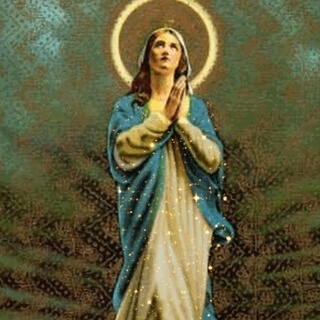
I saw Mother Mary with living stars around her head,
Come in a beautiful blue robe.
That was a living robe with more stars.
That was a robe of protection.
And she handed me a golden globe.
And in the golden globe was the gift of sharing that energy with the world.
Now I didn't know this,
But I looked,
I,
You know what I did after I Googled,
I Googled Mother Mary with golden globe.
And lo and behold,
That this had happened to this lady,
The saint in the 1800s who created a medal with that same image on it.
So,
I mean,
This is one of the things I do love about in the mass where you do have that energy of Mary and coming in.
And of course,
May I just mention that I feel through Mary that we are delivered.
She delivered Jesus,
But she also delivers us to be able to go through the process we need to go through to be open also to Jesus,
Because that's how she was delivered.
I want to talk about what you added,
Which were some songs in there that others may not have quite understood fit so beautifully,
But they do.
And I think I've told you one of my very favorite pieces on the mass is a piece that just expresses this heart.
And it's a piece you wrote for the church you go to.
You have it twice.
Once it's an instrumental,
Once sung by Catherine.
I'd like you to explain that piece because for me,
It's just that moment after we have exchanged the energy with Christ and feeling the energy of the Holy Spirit and Mary who uses the Holy Spirit.
But then there's this lovely moment of just like,
Wow,
Just that feeling of thank you comes through in the song for me.
I originally wrote that for our church.
And the idea was,
I don't know if you know this,
But I did it.
Absolutely powerful version of God bless America.
Yes.
It's part of the piece that we're going to do on the 21st.
But I thought to myself,
Wait a minute,
We need a piece about God blessing the world,
Not just God bless America.
So I wrote God bless the world.
I mean,
Nothing ever,
Never,
Never happened with it.
Oh yeah.
Something did happen with it.
You have it in the mass.
And I think it's one of the most beautiful pieces in there.
I can play that one over and over and over again.
And for me,
It expresses this,
Just this,
This receiving and this gratitude back that has that,
Just like that moment of,
It has that moment of grace.
So yes,
I think in God blessing the world,
Which you express in that is this beautiful grace.
And I,
I alone,
I could just listen to that over and over and it's so,
So beautiful.
And I also want to talk about,
Were you there?
Were you there?
I mean,
Cause when you listen to that moment and you put yourself again,
Not just listening,
But put yourself at the cross.
Now,
According to the records,
Mother Mary was there.
Magdalene was there in this point.
And this day,
If you're putting yourself yourself in the real situation of sitting at the cross on the ground,
And you would be at this point of looking at Jesus on the ground,
Right?
Jesus there,
As he took him from the cross,
It's a very profound moment.
And it's interesting cause you just sent me some pictures of,
They were very,
Very deep about the laying of the shroud over him as well.
Cause you were at the shroud of Turin church,
But there is that moment where for me,
It's complete.
Okay.
This is,
You've gone through the mass.
You've done the last supper.
He went through his moment on the cross and fulfilled his duty that he promised to do for God to help save the world.
And then it's done.
And then you see his body laying there.
Now,
If you have faith like Mary did,
Mother Mary,
She knew that he was going to go on.
She,
She had,
She knew that he was going to be risen.
And I believe Magdalene,
Mary Magdalene did also,
But there is that moment where you just say,
There's the body.
I mean,
What,
What do you feel when you,
When you wrote this,
There's this combination of sadness and understanding there's,
It's a powerful piece.
Were you there?
Were you there?
That's one of the pieces that I wrote for a band to play.
So even though I'm not a band member,
Even though like the mass proper is just me on keyboards and virtual instruments and Catherine singing the part of the congregation,
The soprano part of the congregation in Ukraine,
That's all an important part of this.
The,
There's a couple of pieces on there that are actually band pieces like the prayer of our Lord and arena behold the lamb of God theme that comes out of the church.
And I wrote that piece for a band.
Were you there?
So were you there in the old days?
They don't do it much anymore,
But when you used to do the stations of the cross,
There used to be that song.
And it would be just like that.
Right.
And to me,
That was like,
On the night it was pretend you took the bread and you broke the bread.
That's,
That's always the case.
It doesn't,
The music doesn't feel like that.
If you,
If you ask the question,
Were you there,
Were you there to see this?
Or can you go back in time in your imagination and put yourself there?
Well,
The music doesn't sound like,
No,
It doesn't.
You're right.
It's not that.
And so it's a,
It's a cold,
Hard look at what is that thing really feel like?
What is it?
What's it like to be there?
So that's the sort of purging that you put yourself through,
That I put myself through.
Like I want to be there.
I want to actually do it.
That's going to be my way of praying.
So how close do I get to what I think he really wants me to say about this?
Speaking of band pieces,
It's a sacred piece that the Navy's always used.
I believe they use it for burials,
Even at burials at sea.
And there's something about that that's very powerful as well,
Because as I was saying earlier,
Music like Abimaria and others,
Music holds energy.
And if you think of the people who were at a site where someone was buried,
Especially maybe at sea or buried in some place,
And you hear that song,
There's something about that song that carries with it that energy.
I'm going to go over here and grab the score to Eternal Father.
And if you look at this,
You can see that I have the signatures on here and Schaefer met them.
My son Schaefer met these guys.
These are the survivors from the USS Indianapolis.
Amazing.
So powerful.
I mean,
There's so many pieces to this amazing mass that have such a story,
A powerful story to it.
And that's why something like this,
Your music,
As you mentioned at the beginning of this,
You have someone listens to the Storm Works every day.
I listen quite often,
Not every day,
But I have been listening to the mass and I think it's very appropriate for any Sunday,
But also for Easter.
I think it's very appropriate for Easter Sunday.
And I think it gives it that meaning if you listen to it in the receptive mode.
And if you really can be humble and believe enough to be open to really commune,
You know,
There's something about communicating in the commune with God.
There's something about that.
Okay.
I am worthy.
I am going to receive.
I am going to believe,
And I am going to allow myself to be in that presence of Mary and of Jesus Christ and all the heavenly beings that are present at that time of resurrection.
But the resurrection is a very hard thing.
And I think about it,
You know,
It's interesting.
We have,
Think of all the songs that were done for Christmas,
Including ones you've done,
And then we did some,
But there are not a lot of songs for Easter.
And it kind of,
I've thought about this before.
It's like,
Well,
How come they don't have more songs for Easter?
Right?
Because this is the resurrection,
Right?
This is a very important time.
It's like when you're really being reborn.
Easter is a time of new birth,
Of course.
And I wonder if people don't know how to maybe grasp it enough.
You want to see how good I am at like reading my son's mind?
Okay,
Let's read your son's mind.
Right now,
He's sitting in the back going,
Gee,
We could do a really interesting album.
He's going to smile now.
Really interesting.
Sam,
I know.
I know.
We're going to do an interesting album for a flugelhorn solo and trumpet solo and whatever.
You see him laughing?
Well,
I mean,
Of course,
It's going to have to be the Hallelujah Chorus.
It's going to have to,
You're going to have to equal the Hallelujah Chorus,
Which I think was done in 21 days or something,
Wasn't it?
Well,
I don't know about,
We don't want to put ourselves up in competitions,
But give me a 300-piece chorus and I'll show you a Hallelujah,
Baby.
I mean,
That's why people haven't done more because you've got the Hallelujah Chorus and that's like,
Wow.
But the resurrection is so powerful because you think about Christmas and the birth and then you think you get to Easter and there's the death and then there's the rebirth.
And when you're reborn,
There's life eternal,
Right?
Which is the reward,
Right?
This is the big reward,
You know,
And this is the moment of celebration.
So it's an interesting and fascinating journey and I think your Mass is really very appropriate for that.
But you know what?
We're going to have to get to work on that Easter piece next year at this time.
Yeah,
Sounds good to me.
The next year at this time,
It'll be an interesting resurrection piece,
Which I know you could do in one day.
Or for those of you that don't know,
Stephen has this obsessive quality where he gets started on something and can't stop until he's finished.
Well,
Quite often,
Right?
Oh yeah,
You too?
Okay.
So you understand that.
But again,
Isn't that the Holy Spirit?
And I think in the Hallelujah Chorus,
If we go back to the writing of that,
That is what happened when he wrote the Hallelujah Chorus.
Bach was not afraid to write always in God's name.
Oh,
I didn't know that.
Really?
Yeah.
Wow.
Wow.
Unabashed love.
That's it.
No fear.
Yeah.
Yeah.
At that point,
Right?
You know,
You know it,
You recognize it,
You give it over and you turn it back over to God.
I mean,
It's,
How would you like when you think about the Mass and it being out there for people,
How do you,
In your mind,
See people receiving this and the gift they get from it?
How would you like that gift to be carried forward from the Mass?
See,
That's a good question because first of all,
If you think the Mass,
You think,
Oh,
This is a piece written for Catholics or this is a piece written for Christians.
I don't think that way.
I would love it if people who are Muslim would listen.
I would love it if people who are Jewish would listen.
And in it,
Not hear the dogma of the things that separate us,
But hear instead the same love of the one God that unites us.
Beautifully said.
Maybe you should have called it the universal Mass.
Well,
It is,
It is the Catholic Mass,
But musically,
It is the universal Mass.
Well,
And again,
You represent that and God,
God bless the world.
I have friends who are Jewish.
I have friends who are Muslim.
I have friends who are Buddhist.
Yeah.
I have friends who are Shinto.
None of them ever makes a distinction.
I mean,
It's like they listen to it and it's either right or wrong.
I mean,
It's like they listen to it and it's either beautiful and it speaks to them or it's not.
And that's the only criteria.
Is it beautiful?
Does it speak to you?
I mean,
It's not trying to convert anybody.
It's not trying to,
You know,
Proselytize.
It's not doing any of that.
You know,
We can get on our knees together.
It doesn't matter what the actual denomination,
None of that matters.
It's when we look up,
What do we feel?
What do we feel?
Who do we love?
Do we honor the creator of the universe?
And it's interesting because when I was doing the book on prayers for peace,
The inner peace manual,
I was amazed to see all of the prayers from all of the religions doing such a beautiful job when they could put it in the name of peace,
Expressing the same message.
And that message was universal in that case.
And here we know that at Christmas,
All of the religions have something they celebrate.
You know,
At Easter,
Most all the religions have something they celebrate.
The Buddhist,
And even I just was talking to them,
There's going to be a Indian New Year.
There's also Ramadan that just started,
I believe.
It's not a mistake that all of the religions celebrate something at these times.
But it's so beautiful to have you say,
Yes,
It's a universal thing.
It's a way of sharing without getting bogged down in any kind of judgment or words or terminology.
That it's just that communication and honoring and representing the energy of God coming through us and to us and us responding in the way we can express it,
Which you do very well.
We should take a minute or two just to say what you're doing right now,
Because you've got this huge,
Huge project.
This will be running out even after the 21st,
But you've got this huge project you're going to be doing soon,
Which has been,
It's got a huge history as well.
It's got a backstory.
I think you have a little bit of a history.
I think you have a leather book that's about two feet high.
And then on that project you're doing for April 21st,
Which is going to be done there at the Naval Base,
Jared?
Yeah,
That's big.
I could do a year course.
A year course at a university on everything that's going on in that piece.
And this is the piece,
By the way.
It's a pretty big work.
And when you watch it live,
It's about an hour and a half long.
It's one piece.
Homage to the survivors and the sacrifice of World War II,
Specifically the Bataan Death March,
And those POWs who survived three and a half years as prisoners of the Imperial Japanese.
Then hell ships,
Then slave labor camp in Japan.
It's about them.
But it's also to all veterans and to all active duty,
Because it's a piece about the price of freedom.
And it isn't one of these kind of concerts like,
Let's get everybody together and let's all play excerpts from The Cowboys and let's do excerpts of the latest Disney movie and we'll end with Sousa and everybody can wave their flags and we can all feel good.
And isn't it great?
We just did a veterans concert.
It's not that.
This morning,
I played for him the first six minutes of film that introduces this piece.
And I looked at him,
Both of us had tears in our eyes.
That's how it starts with the sacrifice that is being made for that we might live.
Right.
That's the name of the piece that kind of fits in with the crucifixion.
Well,
Absolutely that we might live.
I mean,
That we might.
Yeah.
The crucifixion that the sacrifice,
It was the sacrifice,
The same thing.
Right.
Just a side note on that.
I he's passed on,
But there was a wonderful Zen teacher,
Roshi Aiken,
That lived in Hawaii here for years.
And I interviewed him and he told me a story.
He was captured as a prisoner of war and he went to Japan.
And while he was there,
One of his prison guards and him became friends,
Even though they didn't speak the same language.
And he learned how to do Zen meditation from this prison guard.
And this prison guard changed his life and got him started on the path of being a really wonderful teacher who has done many books,
Actually,
Because the guard realized that to survive that prison camp,
He was going to need being able to practice that Zen to be able to survive,
Which did work and which changed his life on top of that.
So his sacrifice there gave him at that point after that,
He became truly a Roshi,
Like a high end teacher.
And so,
You know,
We never know exactly what's going to happen with these sacrifices that we make.
We never know what the bigger plan,
The bigger picture is.
I do think and I do believe that Christ did know,
I believe Mary knew also the bigger picture and the sacrifice that was made.
And I do believe that's why Christ didn't allow himself to be saved in the Garden of Gethsemane,
That he said,
Nope,
Nope,
Nope,
Nope,
Nope,
Nope,
Nope.
This don't you understand?
This is part of the plan.
This is what,
In a way that's even more difficult when you know that you came here and you could stop it,
But you're saying,
No,
Don't do this.
I have to do this.
This is my night in the Garden of Gethsemane is saying,
This is what I have to do.
And it's a very,
What's the word that hard cup to swallow a hard?
It is definitely bitter cup.
It's a very bitter cup.
Of course,
That was after he'd had the last supper and he knew that the disciples had in some levels and Zen as well.
There's this thing that you take on where you are being handed down the gift of taking on the teachings.
And of course,
With Jesus,
He,
At that point handed over the teachings to the disciples and knowing that also he knew that it was going to be a bitter,
Very bitter cup for them.
When you think of what sacrifices they had to make as well,
You know,
And it's an amazing journey,
But we can't always see that sacrifice.
But then if we remember Easter Sunday morning in the resurrection and the hallelujah chorus,
Think of your peace and how you gathered all of those people who sacrificed so much to now bring it as a gift to honor the sacrifices made.
There's a lot of that that you can't answer.
Why?
Why does Jesus have to get sacrificed at the cross?
Why did these people have to go on that death march?
And there's people who can't easily forgive God for the sacrifices people have to make in war.
I mean,
I see it now in the Ukraine and I go,
Oh my gosh,
How are they ever going to get back without understanding the power of forgiveness?
Because so many of them have this deep,
Deep hatred,
Right?
I mean,
So until you take that sacrifice and can let go of it,
As you do at that moment where you release yourself to God,
As you do at the last supper,
As you do at that moment where you were there at the cross,
And then finally say,
All right,
It is done,
Right?
It is done.
I turn it over.
It's free.
There's a term in Hawaiian that you say after a prayer.
It's called a mama,
A mama,
Ua noa.
And it means the prayer is freed.
Now we pray and pray,
But it's interesting because we pray and we pray and we pray.
Now,
If you're really praying and you're really believing that it is heard and you're turning it over to God,
The prayer is free.
So there's so much to this work that you're doing.
And a lot of it for you,
I know,
I know that what you go through,
It's a lot of your work entails a lot of time and sacrifice.
And who knows how much sacrifice,
Right?
That you put into what you're doing because you are a servant of God.
But that is that moment.
There is some moment.
And I'm wondering for you when you get that moment where you go,
Oh,
Okay,
I get it.
I've got my reward.
Do you ever feel like you get your reward for all the hard work you do beyond just a little award?
There's an award,
The greater,
The greater award.
No,
It's interesting you even ask that because there is a moment where I know that the piece is finished.
And that moment is,
It literally turns around and I'm hearing it and it's not coming from me anymore.
It's like,
I already did everything.
I think I can make the analogy to like Michelangelo working on the statue of David.
So he's chiseling,
He's doing all this stuff,
He's knocking all this stuff off,
Dust,
All kinds of stuff going on.
But there's one moment where finally he steps back and he sees that David's looking at him.
And at that moment,
He realizes that that's the most profound moment for him.
This is a moment of reward because the infinite is literally telling you,
Telling you,
Hey man,
Good job.
It is done.
Yeah.
Well,
Using that terminology,
I think it's about time for this interview to be done.
I am really,
Really happy that we,
I know how busy your schedule is,
Even taking a half hour out.
It's hard for you at this time,
But to take this much time out is really an honor and a blessing.
And I just wanted to say thank you for the work that you do so beautifully to serve.
And it's really a beautiful,
Beautiful job.
And I know it's a sacrifice,
But it is appreciated.
And I know that there's so many that are touched and will be touched when you do that special event on April 21st.
And I still,
You know,
I listen to your music and when I need to get inspired,
As many people do,
You can listen to Steve Malillo.
You can go to StormWorks,
Right?
And there's so much you have there.
I mean,
Gosh,
It's massive.
Talk about massive.
You got a massive amount of stuff on StormWorks.
Com.
It's StormWorks.
Com?
StormWorld.
Com.
Yeah.
My company is StormWorks,
But the website is StormWorld.
Com.
You have things for students and teachers and all the pieces.
You have librettos and just an amazing amount there at StormWorld.
Com.
And on Spotify,
You can find your pieces as well and many more.
So I thank you.
I thank you.
Yeah,
It's been wonderful being here with both of you.
And I really.
.
.
That's the most quiet you'll ever hear him.
Oh,
Go yell and scream and play that horn.
Thank you.
God bless you and have a wonderful journey with this next huge piece that you're going to be doing.
Thank you.
Thank you.
Aloha.