I am so honored to be able to have Steven on his birthday here to do this special recording.
There's so many things we wanted to talk about.
It's like just a couple days before Christmas when we're recording this and we had a wonderful conversation with Steven who has like 1200,
An 80,
Is it 1280 or have you done two more pieces?
1280 pieces.
And I have always felt so blessed to be able to listen to his inspired music.
And I think I figured out what it is on an email that he sent out the other day about a piece that he did of Christmas Passion called Gloria.
So we're going to talk about what happens when you create music that comes from that place of the highest place and capture it and how that music can heal you and lift you up.
So aloha Steven,
How are you today on your birthday?
We good?
I know birthdays are kind of an interesting time because it marks another year and you kind of reflect back.
Have you been reflecting back because you're very into numbers and sinks.
Have you been reflecting back?
I'm in a constant state of reflection.
So it's just a normal day for me.
But it's not.
It's your birthday.
You put out a beautiful post that we're going to do a share here,
A screen share.
We're going to go into how you were able to create not just in the piece called Gloria,
Which we refer to here,
But how you do in the gray two and three and so many of your other pieces.
And I also have to comment because people,
If they're seeing the video,
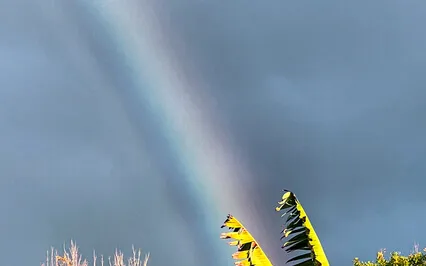
Can see a beautiful rainbow,
Which I love rainbows,
Over,
Was that a lake or clouds that rainbow was over?
And it's across the street from me.
Usually that is a cotton field or a corn field.
And just one day there was double rainbow out there and over the snow.
Beautiful.
And you put in here some beautiful words that I read and I went,
That's it.
Talk about that beautiful song,
Which I just love Gloria,
Or people know it as angels.
And we have heard on high.
And you talked about an interesting thing here,
Recursive space time continuum.
That's such a great line.
I could go off into the matrix resurrection with that one.
I just was watching a little bit of the matrix.
Such a deep subject with space time continuum.
But you said when listening,
I feel all moments at once.
And that is such a metaphysical truth of the highest.
When you were in the now and you feel all moments at once.
Though I know what is coming,
I surrender it,
Forcing myself away from the emotion.
I try to listen as detached composer arranger.
So let's just do a breakdown.
Let's dive deep and unpack that sentence.
Okay,
Steven.
The idea of feeling all the moments at once.
So Einstein said that the reason we have time or the feeling of time being lapsed is so that everything doesn't happen at once.
So I think that if you're a physics person or a science person,
You can look at that sentence and take it from a completely theory of relativity point of view,
Which is that everything is in fact happening at once and except that's in the illusion of time.
Now jump to what music is.
Music is a time arc.
So you need time in order to unwrap the journey and the story of a piece of music.
When I wrote this,
Okay,
So this piece,
But probably every piece that I've written,
I experience all the moments of the music at once,
Right?
In other words,
For me then to write it out in a timeline in which time is passing so that a person can experience it,
I have to unpack what is like a dock in my mind.
So in other words,
Again,
I think of math,
I think of a point.
So the music is all in a point,
But now it has to be pulled out into a line,
Right?
So in the line of course is going out across and if you picture an XY coordinate graph and the X part of the graph is the intensity level,
The dynamic level and the Y axis is the flow of time so that what you're experiencing is a dock,
A complete meaning of the piece has to be pulled,
You know,
Extruded like over time so that a listener can embrace the journey and hopefully put it back into the feeling of the dock again where everything becomes one thing,
One point.
It is everything in one moment.
So let's take that and it's so interesting because I say a prayer or an affirmation from the point of light within the mind of God that light streamed forth into the minds of men and then I go from the point of love within the heart of God that love streamed forth and when I,
Because I've said that every day of my life for,
I don't know how many decades,
But you know,
So I've thought a lot about that point without putting it in the context you're just putting music in.
So when I think of that point within myself or soul and then I think of the point of light within the mind of God,
There's so much that then goes on and if I were to put that in a point with music that could also contain that point within the center of all things within the mind of God or the heart of God,
Then music could be the bridge,
Couldn't it?
Yeah,
You know,
I actually addressed this too.
There's a piece on the gray,
The grade two and three called We the Timeful in the Hands of the Timeless.
Yes.
In other words,
It's the same idea.
We are beings that are extruded over time,
But our destiny and our existence is actually in the hands of the timeless because God is timeless.
Right.
Right?
So if you picture that God is every single point on that line at the exact same time and we have to experience the flow of time.
So it's a paradox.
It's yin and yang,
Right?
Because we're moving towards something,
But from another perspective,
We're already there.
Well,
You know,
That's what's behind all Zen,
Zen colons,
Of course.
You do know that.
I mean,
In Zen,
That's what you're supposed to try to get at is the fact that you can't figure it out.
And when you realize you surrender to not being able to figure it out,
Then you just experience it.
So it's interesting.
We're talking about it and saying you can't figure it out because there is,
It's an interesting paradox there.
And if we were to try to bridge music,
And I'd like to tie in something you did on a lovely piece with 34 matrix,
You're talking about healing power of music as well.
Cause you just mentioned matrix and I did too.
So when we tie this in with the matrix,
Understanding the 34 matrix,
You wrote this 1991,
Steven.
1991.
That's a long time ago you wrote this.
I was a physics major before I went into music and I was very drawn to math.
Now my kid's got that DNA.
He's a naval architect,
You know,
Student at Virginia Tech.
So the first thing that I devised was what you see there,
A four by four matrix in which there are numbers one through 16.
Now here's the cool thing.
Any way that you add those up,
Whether it's in rows like this or columns or diagonals or the corners or the inside or the inside,
They always add up the 34.
This whole thing has been designed to be a massively recursive,
Symmetrical organization.
The next step is then to get the 16th note,
The third note,
The third of the key,
Right?
The second of the key,
The 13th of the key.
Vertically,
These are the harmonies,
Right?
The 16th,
The five,
The nine,
The four.
And then consider all of the ways that you could move in that matrix and always have 34 as the result and never ever leave 34.
So the reason why there's a huge historical significance to the number 34,
And it's great that we're talking about it now Christmas time because 34 is in the,
First of all,
It's in the Fibonacci series,
Which Bach wrote in the Fibonacci series,
And the other thing is that 34 is the symbolic number of resurrection because Jesus was crucified when he was 33 and therefore the number 34 is symbolic of resurrection.
So that is all of the thinking that goes into designing this thing that I call a 34 matrix,
Which I think I even,
I explain it in the notes there.
It's not really music.
In other words,
It's not like the Beethoven Ninth Symphony.
It's not an outpouring.
It's not an expression that way.
Instead,
It's a totally mathematical cohesive unit that actually takes 34 minutes to listen to because the 34 matrix is spread out over 34 minutes and it's designed solely for meditation and self-reflection and yoga.
So anything that's spiritual,
Tai chi chuan,
No matter what it is,
You put this on in the background and you don't listen to it the way you would listen to music.
You just hear it.
My belief in this is that the vibrations,
The sympathetic vibrations created by these numerical interconnectedness and the proportions and so on have a sympathetic effect on your body.
And you recreate this idea of the 34 matrix in the piece.
Which piece did you write that was based on this 34 matrix?
That's the name of the piece.
Oh,
Okay.
And where is that?
What release is that on?
It's not.
It's its own track.
I think if you go to stormworld.
Com tracks,
Stormworld.
Com slash tracks,
And you just scroll until you see 34 matrix.
Amazing.
Here I give an example of how the organization can be done to create music.
But the thing is that this music is not romantic,
It's not jazz,
It's not classical,
It's not anything.
What it is is a purely mathematical interrelatedness.
That's what it is.
Okay,
So let's take that and go back to the screen share of what you wrote about Gloria,
Which I think is just heavenly.
And then in that piece,
You expressed perfectly how you were able to feel with music because music is a feeling instrument.
And there you're just talking about something that isn't feeling.
You're talking about what happens within the matrix of just experience.
So how do you keep that experience with the feeling of that power of the 34 matrix and put it into something that is an emotional experience of the higher energy?
That's got to be an interesting thing.
I mean,
Because you can't use your mind that way and still create a piece or like Gloria,
That it would be in the same context.
Okay,
So did you want me to share the screen again?
Well just because there's another paragraph you put on there on the one on Gloria,
The next paragraph down,
Which is amazing,
Which I love,
You know,
This is the first moment where a goal,
Namely that of extending Gloria,
Which is a beautiful,
Beautiful piece that's on the Christmas Passion without modulating it and without breaking the flow of it by exceeding its own predetermined limits brings tears.
I cannot fight it.
I will cry.
Then at,
And then you even down to the minute,
Three minutes and 52 seconds,
That piece makes a strategic move to the key of G,
Which is so beautiful.
And I hear that,
But I'd never thought about it,
Breaking it down to God,
Gloria,
Despite knowing in advance what will come,
Tears of joy flow.
And then I weep these harmonies,
That sequence of events,
Those orchestrations,
Does it sound as if I'm not writing this music?
And that's the magic.
That's what happens when that comes.
So what do you do when you arrange to allow that to flow through you where you are even letting that music and the energy flow through you,
Stephen?
Okay,
So this is very deep,
But I'm gonna go for it.
Okay,
Good.
So when I'm writing any piece of music,
Okay,
There is a process where it's me pushing out of myself onto paper and ideas and so on.
There is a moment somewhere in that process where the music is no longer coming from me,
But it's coming back at me.
And it's then that these little,
Small,
Little changes allow it to speak to me rather than me speaking to it.
And when that happens,
I cry.
That's how I know the music is right,
Because it achieves that moment of absolute prayer,
Of absolute connection.
And then I can't take credit for it anymore.
It's sort of frustrating,
You know?
Because I really can't take credit for anything that comes from God.
I mean,
The music definitely is coming from God.
It starts off with me asserting,
I want to say this.
I want to try this.
I have this idea.
But at some point,
I'm looking in the mirror,
And all of a sudden,
I'm gone,
And there's only the reflection.
And then I hear God speaking to me in that music.
And a lot of times,
He'll,
I hear,
Thank you.
Thank you for letting me hear you,
You little,
Untalented guy.
Well,
And that is called grace.
That's that moment of amazing grace.
That's when you turn your will over to God,
And something else takes over that is called grace.
And that grace is such a gift,
And it can be addictive.
Because it feels so good when the grace takes over.
But at the same time,
You do what I do.
When I hear a piece like Gloria,
Or the one we're working on that you wrote this amazing music for,
Which isn't out yet,
Love Conquers All.
When I hear a piece like that,
Or some of the pieces in the gray,
In the Valley of Heaven and Tears Will Fall,
When I hear a piece like that,
I want to listen to it over and over and over again,
Because something in me needs to have it in my DNA,
In my energy field.
And you do that.
Not a lot of people do that.
So I don't even tell a lot of people that I just listen to this over and over and over again.
You do that as well,
Right?
Well,
You were speaking about Zen before,
And of course,
That the Chinese word for that is Chan.
And one of the things that they say in Chan Buddhism is,
How can a caged man teach you to fly?
And by that,
I mean,
You have to,
If you expect anything,
Your listener to experience something,
You have to live it.
That's why I say,
And I always tell kids this too,
On my tombstone,
I want the inscription,
You can't fake real.
Because what's going on is that many,
Many people try to fake real.
They don't really sound like themselves anymore,
Because they're too busy in the assertion part of the music making,
And not in the reflective part of the music making.
Because that's what you're ultimately after.
You're ultimately after purity.
So it doesn't make any kind of guarantee about you being a genius,
Or you going down in history,
Or you being the next Beethoven.
There's no guarantee or promise of that.
The only thing that you could do is be sincere.
And when you do that,
Then you're opening the doors of the infinite and letting it take the course,
Not you.
You know,
That's so beautifully said,
And it creates another conundrum,
Which is like,
Okay,
That is what my goal is.
And at the same time,
We've talked about this,
We just keep creating and creating.
And you obviously have done that with 1280 pieces.
And then there's the issue of like,
What do you do with and how do you manage all of this great gift that comes to you?
And for an artist like Van Gogh,
Or like,
You know,
Beethoven,
Or all these people,
You've seen the tortured life,
Sometimes genius artists have is that they have a hard time doing anything but wanting to create because that energy is flowing through them.
And then but how do you do it if you're trying to do it all yourself?
Well,
You know,
There's a very autobiographical piece that I wrote called the concerto for violin and orchestra.
Now,
The first movement is called tormentations.
So this deals with torment,
Right?
This deals with the person who isn't sleeping,
Who can't sleep even if they wanted to.
And this is their life.
The second movement is called romance.
And what I always tell people about that is at my funeral service,
When you're looking for music,
You want to play the second movement of violin concerto,
Romance,
Because it's everything that I pray about,
Think about,
Hope for.
It's everything I fear.
It's every kind of emotion.
And it's really like an engram of who I was when I was alive.
That's the piece.
So how do you control it?
You say you surrender to it.
We talked about that.
We talked about that too,
Right?
I mean,
That's a Daoist concept,
Right?
So you fall off of a cliff or something into a raging river,
Right?
And the Daoist master,
He doesn't fight the water,
Right?
He just relaxes his body and lets the water take him where it is.
And I've actually done stuff like that,
By the way.
I mean,
I've actually lived through what it feels like to fight against the water and then go with the water.
So they sound poetic and metaphysical and all this other worldly stuff,
But it's actually very,
Very down to earth pragmatic.
Well,
It is.
And at the same time,
It's such a gift.
And I mean,
When I keep listening to music,
I'm going,
There's something here that really,
Really lifts my spirit.
There's something here that expresses what I feel in myself.
And at the same time,
They can't help but be part of going,
Well,
What is the secret behind it?
Of course,
In that Zen thing,
You do accept it,
You surrender to it.
But at the same time,
I think it's helpful for other people to know what you're saying because in a way,
It's a master course in composition and creating because music is a healing force and music is a gift.
And everyone's path and it's a little different,
But I think we all,
I mean,
Obviously,
You've learned from Beethoven and many other masters.
So when we go back and reflect on that work of people like you and other people that we are inspired by,
We can take a part of that,
That point that we started with that point within the point.
And we can relate to that point within us.
And part of that point can be in our psyche.
And once you get that,
You don't own it,
But at least you have a way of communicating with it,
I think.
I mean,
You know what I'm saying?
You feel that about other great artists,
Right?
How do I strip myself down to a point where whatever I'm making is sincere?
Does it guarantee the goodness of it?
Does it guarantee the Grammy Award?
None of that.
But if you're talking about how do you get down to the sincere thing,
That's a question of,
You know,
There's a book by Sabatini called Scaramouche,
And there's a dialogue in there between a great fencing master and his student.
And the guy,
The student's getting really,
Really good,
Right?
And he's like getting next to the level of the master,
But the master always beats him.
And so he's,
And then the student says,
I just don't get it.
I just don't understand why I can't get to this other level.
And he says,
The master says,
I love this line.
He says,
Don Quixote's mistake was that he attacked the windmill when he should have attacked the wind.
It's a great line.
Yeah.
Because if you translate that to you're a music student,
Or you want to be a composer,
Or you want to do anything that involves expression,
You have to go to the source.
You can't,
You can't say,
Well,
I want to be like Beethoven and therefore I'm going to look at all his scores and stuff like that.
You have to do what Beethoven did.
Right?
So there's a thing called Dao shi.
And Dao shi in Chinese means a return to the origin.
How's that for cool?
A return to the origin.
Very cool.
Why don't you come back to our,
Get off the share screen and let's just see you talking in real time.
Yeah,
There you are.
Because we're,
You know,
Again,
We could talk for hours.
I said,
We're going to try to keep it less than an hour,
But it's so hard,
You know,
Because this is the kind of thing that I love and that's why I love your work.
And I know it's your birthday day.
I hope you're going to have some nice celebration with friends and family and get to do something you can enjoy the day with.
Me and my kids are going to make biscotti.
Biscotti!
For all the people on our street,
We eat every Christmas Eve,
We go around,
We make the rounds and so I'm going to give them like a bottle of wine and some biscotti.
Oh,
Wonderful.
Well,
I just thank you for your sincerity and I want to write down actually,
I'm going to put it in my notes.
Let me put in my notes,
Let me put in my notes what you said about what you want to put on your gravestone because I want to remember that because that was a good line.
I want to write that down.
What did you say?
You can't fake real.
That's a message for all the people and there's a lot of them out there who imitate me.
Okay,
Stop imitating me.
Not because you're offending me but because you're offending yourself.
You need to be the kung fu student who goes back into the woods.
He doesn't learn kung fu by learning from this guy,
This guy,
This guy.
He goes back into the woods himself,
Puts himself in the woods and watches the snake defend himself against the bird.
You have to go all the way back to the beginning.
Tao shih.
That's t-a-o-s-h-i-h.
You have to go back to the beginning,
The root of all things.
Everybody makes that voyage.
What happens when I just listen to the universe and what comes out of me and you have to trust yourself.
You never want to devalue yourself by imitating unless of course you're paying them homage.
That's different.
I'm talking about actually taking another guy's soul and another guy's essence and pasting it into something that you're doing and calling it your own.
You don't want to do that.
Well on top of that I think that what you just mentioned is very valuable for music teachers as well or people teaching piano or something like that.
We're raised reading,
If you're taking piano lessons,
You're raised reading music and you read music and you read music intensely,
Intensely,
Intensely.
And yet some of these people who read music get so concentrated and focused on reading music that if they were to take the music away and try to play it'd be so difficult because for years I've only read what's written on those scores of music.
And when you take away the music and just try to play,
You know that moment,
Right?
I mean because I'm sure you were raised.
You take away the notation.
Notation.
There's a difference,
Right?
Yes.
And we need those people.
Yes.
You know,
Imagine Beethoven writing a symphony but there aren't a group of musicians who are dedicated to it.
Right.
Notation like,
We need the guys who are wired to write.
We need the guys who are wired to conduct.
We need the guys who,
And girls of course,
Who are wired to play.
We need them.
We're all part of one gigantic picture.
All different points within a point in the moment of now.
We turn a moment of now.
Well I tell you it's always a treat talking to you.
I always feel like I learn so much.
And it's just such a treat to be able to talk to you and delve into these subjects together.
Let people know the best way to go to where all these pieces of work are if they want to reference them,
Find them,
Get them,
Buy them.
Where do they go?
When you go to the website you'll see Stormworks in chapters because when music's organized in chapters you can explore there all the pieces.
Or you can go directly to tracks and those are all the recorded pieces.
It's a wonderful journey and I thank you so much from the bottom of my heart and myself for what you do because it speaks to me and it always inspires me and I think that's one of the greatest gifts of music and composers and creators and conductors such as you is to be able to inspire people what you do so beautifully.
And I'm looking forward to working more with you in the future and I hope you have a blessed birthday and Christmas and I again deep bow of gratitude to you for who you are and how you express it so beautifully in your life of music.
Thank you.
Happy birthday.