So hi there,
Welcome to the session today.
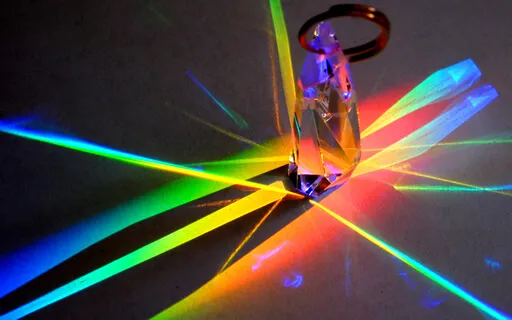
So the mind can be seen as being a little bit like a glass prism.
Now this can be seen as kind of true in two respects and I'm going to sort of just go over briefly these two respects today and I hope this analogy can be helpful to you in some way.
So the first respect in which the mind is like a prism and by the way I'm saying prism with an M not with an N,
I'm talking about a glass prism not a prism.
So the first respect here we have is that the mind sort of refracts light.
It's similar to a glass prism refracting light.
So what do I mean by this?
So you see a glass prism in physics or something,
You see you know a ray of white light going into it and it refracts the light and a kind of rainbow kind of a ray of these beautiful rainbow colours coming out the other side and this is one respect in which the mind is like a prism.
So okay let's go into this in a bit more detail,
What do I mean by this?
So essentially the white light in this analogy can be seen to represent external inputs.
Something happens to you,
Maybe it's a sensory thing but I think it's more applicable as it were to think of it as like I say a thing happening.
So you know someone says something to you that was upsetting or someone you know gives you a bunch of flowers and that makes you really happy or they give you a bunch of flowers and you have hay fever so it makes you really frustrated.
This is the ray of white light coming into the prism,
Okay this is the external kind of stimulus.
Now the prism here kind of represents the mind so the prism refracts the light in the same way the mind refracts this kind of stimulus and how does it refract the stimulus?
Well it refracts it into a sort of array of responses and these responses will be essentially determined by your life experiences,
By your kind of general personality or kind of disposition towards various things and so we get this resultant kind of as I say array this kind of combined array of reactions of responses.
So for example let's say you have to go to the doctors,
Okay there's something wrong you know you have to book a trip to your local doctors or something it's not urgent but you just want to be safe and you want to go to there go to the doctors and get it checked out.
So knowing that you're going to have to go to the doctors that is the stimulus or the kind of external fact that you need to phone the doctor and all this stuff that is the stimulus that is the white light coming to the prism okay and the prism is the mind okay is all the you know neurons and synapses and everything in the brain and all of these things and of course that is the essence of the mind that is what's refracting the light and stuff so this takes this input okay this this has this input of of having to go to the doctors and having to phone them and everything like this and it refracts it into this array of responses so for example you might have anxiety okay from you know memories of you know being going to the doctors as a child and having to have an injection or something which was unpleasant so you have that kind of fear anxiety you also have kind of apprehensive anxiety from sitting in a waiting room makes you makes you kind of anxious and sort of stressed with the pressure of it you might however also have a kind of more objective feeling of sort of personal righteousness sort of sort of you know or personal kind of doing the right thing for yourself okay you're going to the doctors you're going um you know to to to be healthy to be to make sure that you are well and that you are not ill or injured or anything like this so in this way we've got this single input the fact that you're having to go to the doctors the white light and it's being refracted by the mind and it's giving out this array this consequent array of reactions which could be anything good bad all of it good all of it bad it could be anything and so this is the first respect I think in which the mind can be seen as being like a prism insofar as it sort of refracts these kind of stimuli from the world around us into first reactions and of course that we use this example where there's one in reality that there may be many there may be different ones which combine so the resultant arrays combine as well it could be anything but but we take this kind of in isolation as an example of how this how this could work so I hope that this aspect this first aspect of the analogy can be kind of helpful to you to maybe sort of visualize how sort of certain things can cause certain emotions maybe for dealing with anxiety this can be useful working out what it is that's causing anxiety and being kind of very aware when anxiety does arrive arise of the fact that this is a process of a stimulus giving rise to several reactions there could be other applications of this different different emotions all sorts hopefully it can be sort of applicable to whatever you need it to be applicable to so this is the first respect in which the mind is like a prism the second respect in which the mind can be compared to a glass prism is the one I personally have used more but that is just down to chance it just works better for me and is more applicable to my circumstances and that is thinking of the mind as a prism which you find yourself inside okay so normally obviously if you look around you you see things pretty much as they are okay you could see you know and you know I'm looking at a table I can see that that's a table and I can see it's no bigger or smaller or more or less or any different than how I think it would be you know it is a table I could see that this sounds like a very strange thing to say but if you think of the mind like this okay I'm talking about eyes and senses seeing this table if we think of the mind then and rather than a table it's emotions okay suddenly it becomes much less defined okay it becomes much less clear-cut it becomes much less predictable in that respect so it's not a given that you're going to be able to see everything for what it is okay an example of this which I see quite a lot in myself and in other people I've talked to is stress okay people could feel very stressed very anxious about absolutely everything but in fact it's just because one thing is pressing and once you've kind of solved that thing once you've resolved that thing it stops pressing and suddenly you can feel a lot more chill you can feel a lot more relaxed about everything so that's an example where it's not obvious what is actually going on from what you are feeling what the mind is kind of as it were quote-unquote seeing so if we think of the mind as being kind of you are inside a prism suddenly it changes it it makes you aware of the fact that you are not able to see things as they are or you're not always able to see things as they are because the glass prism just as it refracts the light in the first example it once you're inside it as it were it warps what's around you okay and distorts it and it magnifies and elongates and it minimizes and all of these things right so this is this is the respective the second respective which the mind can be seen as being like a prism okay now it's this one might sound a bit a bit more kind of crazy a bit more abstract than the first application the first example but let me sort of illustrate this with a with a kind of practical example which i've used in the hope that it might make a bit more sense if it's if it seems a bit crazy so my example is if if i find myself in very very strong anxiety like raging anxiety that comes back and it sort of you know it gives you some physical sensation unpleasant physical sensations tightening in the chest maybe with adrenaline sort of zaps now and then all of this stuff and if i'm in that situation and i remember the technique then i say to myself okay i'm inside the prism now in other words this anxiety is not as things are okay i'm worrying that things are the case which are not actually the case sort of thing you might worry that something terrible is going to happen which isn't actually going to happen you might worry that something terrible has happened that actually almost certainly hasn't but because you can't know it and because you're worried about it happening anxiety takes it away with you and makes you worry as if it has happened so things like this it's distorted okay it's based in reality just as looking outside the prism you are looking at things around you but because of the presence of the prism it warps the light it changes it magnifies it minimizes all of these things okay and so you cannot see things exactly as they are you see things differently like i said it's based on reality it's based on the world around you but it's warped and so this is how i personally can apply it to things like anxiety or how i how i do apply it to things like anxiety by sort of realizing that okay this anxiety is not things as they are it is anxiety is warped and i think i'm inside the prism and when i think that i can identify with the analogy of it which is what i hope you could be able to do if it's a technique that you find useful and in doing that i become aware again of the kind of relative fleetingness of the anxiety shall we say and the relative kind of lack of import that this anxiety carries okay this is not a genuine worry based in stuff that you might be sort of you know warranted to genuinely genuinely worry about this is a magnification this is a warping of the image and so this is the second respect then in which we can kind of draw that kind of analogous equivalence between the mind and the glass prism now i do hope this helps i thought i would sort of explain this this analogy and this this concept in case it is helpful because i i have found it quite helpful and i thought it might be something worth sharing with people so i hope it is helpful do feel free to leave a review and leave a comment to let me know well let me know if there's anything you think i should have done differently or something or if you you think anything should have been explained better i can always do another recording that's more in depth but like i say i hope this has been useful i hope you can find ways to apply it even if it doesn't feel obvious at first quite how in your kind of day-to-day life and i hope it can help you to realize that whatever sort of dark times or difficult emotions and stuff you might be going through it is temporary and it is only within the mind and you can overcome it and you can be strong and keep on going through it so with that i hope all is well i hope it is useful again and thank you for coming today and i'll see you next time bye