Hi,
And welcome to this introduction to the practice of meditation.
This is just one session for those completely new to meditation,
And it will teach you some of the basics of a meditation practice.
Let's get straight into it,
And I'm going to start with how to sit.
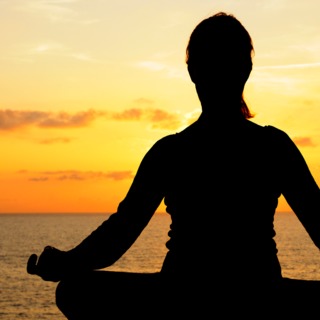
Everyone knows the stereotypical meditation posture,
Sitting cross-legged on the floor with your fingers fanned out.
While this position can be very comfortable,
It's not mandatory at all.
You can sit cross-legged normally on the floor,
Or sit in a chair,
Or lie down,
Although only do this if you know you won't fall asleep.
There's no particular position needed to meditate,
But many meditators and meditation teachers suggest a position that is comfortable and relaxed,
But alert.
That's why sitting up with a straight back is best.
It might also be a good idea to invest in a small meditation cushion,
Or if you have a cushion in your home that's a good size and shape,
You can use this.
Rather than buying a new one.
Cushions are good because they support your torso,
And make keeping a straight back while sitting much easier and more comfortable.
When I started meditation,
I started sitting in a chair,
But actually found it easier to sit cross-legged like I just described on the floor,
Because I found it harder to maintain that soft alertness as I relaxed back in the chair.
This is about hands.
Many meditators put their hands palm up on their knees while sitting cross-legged on the floor.
This is because there are more nerves in the palm of the hand for feeling things than there are on the back of the hand.
Sitting with palms facing up means you are less likely to be distracted by little touch sensations from the hands during meditation.
This is totally up to you though.
Sitting palms up can also help to feel more spiritually connected,
If that's the nature of your meditation.
Or,
Alternatively,
What I like to do is lace my fingers together and rest my hands in the middle of my shins.
As I say,
This is totally up to you,
So feel free to experiment with what works best.
We're almost ready to start meditating now,
But one more thing first.
A potentially difficult obstacle in meditation is understanding intention.
What should you be trying to do during meditation?
What should you aim for?
Well,
During meditation we usually use something,
A sound,
Sensation,
Or most commonly,
The breath,
As a focal point to ground the attention.
Many people think that the objective of meditation is to totally clear the mind of thoughts and thinking.
While a few practices might strive for this,
In secular mindfulness meditation,
This is not the goal at all.
The goal is instead to just become aware of thoughts,
To observe the mind,
Without trying to control it or change it.
Rather than seeing the objective focus as a focal point,
I find it more helpful to see it as a reference point instead.
This way it's easier to accept getting lost in thought,
Rather than feeling it's something bad or wrong that we need to avoid.
That's another important thing to note.
Thinking is not bad,
It's natural and something we should embrace.
We need the object,
The reference point,
So that we are more aware of thinking,
Not so that we can get rid of it.
Mindfulness meditation is just taking time to relax,
Shut off all the inflows of information for a bit,
And just stepping back from the mind temporarily.
There is no real aim in meditation other than this.
Stepping back and with a very soft awareness,
Noticing what the mind is doing today and how it's behaving.
So,
Let's start shall we?
Sitting in the posture and position you chose,
Or that feels right in the moment,
I'd like you to just keep your eyes open for a moment.
Take a few deep breaths in through the nose and out through the mouth.
I'll let you do that on your own for a minute.
On the next out breath,
Just gently close the eyes and let breathing return to normal.
What you do to warm into the meditation here is up to you.
But I like to just feel the weight of the body on the floor or on the chair,
And then feel the shape and the space of the room around me.
So go ahead and try that for a moment now.
Now,
Just gently bring your attention to the breath.
Notice how air travels into and out of the lungs as you breathe.
You don't really need any effort here.
Just watch the natural rhythm of the breath.
Your body could breathe by itself after all.
If it helps,
You can draw your attention to where you feel the breath most,
In the stomach area,
The chest,
Or in the nose,
For example.
Remember,
It'll get easier with practice,
And you can experiment with how and where you focus during the meditation to find what works best for you.
I'll give you a little time to breathe now.
Remember,
Every time you notice the mind has drifted off into deep thought,
Thinking,
To-do lists,
Anything like that,
Just notice it,
Note it,
And bring the attention gently back to the breath.
There's nothing wrong with it,
Nothing bad.
It's just how the mind behaves naturally.
Just returning the attention to the breath every time you notice.
Now we're coming to the end of the practice today.
Just release your focus from the breath.
At this point,
You might like to let your mind go where it likes for a moment,
Having no control over it at all,
Just letting it weave in and out all of the thinking it wants to,
Or perhaps the mind doesn't want to do any thinking.
Perhaps it's just happy where it is,
Calm.
Otherwise,
You might like to bring your attention back to your surroundings straight away,
Keeping the eyes closed for just a little longer.
Again,
Feel the weight of the body,
Feel the space around you,
And tune into the general ambient sounds going on in your environment.
Take a few more deep breaths to come back into your body,
In through the nose and out through the mouth,
And maybe wiggle your toes and fingers to wake up your circulation again.
When you're ready,
You can gently open the eyes again.
That was it.
You just did your first meditation.
Well done.
Hopefully this has taught you some of the basics of meditation and showed you some of the options you have to experiment.
I encourage you to have a look around the Insight Timer Library for more meditations.
There are lots of different sorts,
Types,
Practices of meditation out there,
And I encourage you to go and explore.
Any questions?
Feel free to leave a comment,
And I'll answer as soon as I can.
Thanks again for coming,
And good luck with your meditation practice.