Hi,
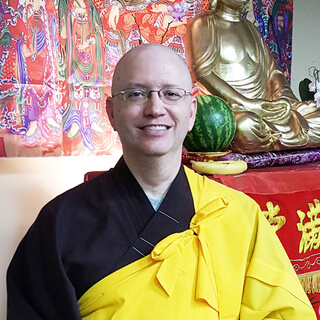
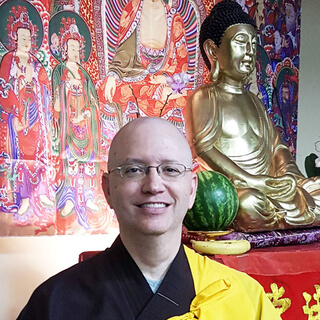
I'm Jolesung,
A monk with the Five Mountain Zen Order,
And you've probably heard this joke.
A Zen master goes up to a hot dog vendor and says,
Make me one with everything.
So what does that mean exactly?
What is it within Buddhism,
And especially Zen,
We mean when we're talking about being one with everything?
Is it a special magical feeling?
Is it just a cute metaphor?
What is it?
And to understand it,
The classic example is ten coins.
So imagine I put out in front of you in kind of a circle three pennies,
Two nickels,
Two dimes,
And three quarters.
Now we count them.
One,
Two,
Three,
Four,
Five,
Six,
Seven,
Eight,
Nine,
Ten.
The tenth one is tenth because of the other nine.
It can't be tenth without the other nine.
And the second is second because of all the others.
And if we start counting with a different one,
We find the same thing.
There are no ten coins without all of them.
None of them actually is the tenth or the first or sixth or eighth without the others.
They get their tenness from each other together.
Now if we take one of the nickels out,
For example,
Then there are no ten coins.
So that nickel alone has the power to make the tenness.
But if instead we take one of the quarters,
It's the same thing.
That quarter can solely cause the tenness.
Each of the coins,
Therefore,
Is identical in this way.
Each one has the same power to create the ten.
Yet although they're identical in this way,
They don't lose their individuality.
The quarters don't become pennies.
Now this is a simplistic analogy for the universe,
Which is a whole lot more complicated than ten coins.
Yet each individual thing in it implies the whole.
So let's do a little contemplative meditation now.
I'd like you to take a meditative posture and I'm going to ask you to spend about three,
Four minutes.
And so what I'd like you to do is to consider a mouse.
Picture it in your mind however you like.
Now take a few minutes to think of everything you can know,
Given that this mouse exists.
That is,
If we assume that the mouse is real,
What else do we know is real?
What else must exist because the mouse exists?
So sit for a few minutes and brainstorm as much as you can about what you know because you know a mouse.
What else is real?
A mouse.
A mouse.
A mouse.
A mouse.
A mouse.
Okay,
Now let that meditation go.
And you might have come up with millions of different things.
Different people will go about this different ways.
But they'll come to some similar conclusions,
I think,
That one mouse means there were other mice,
Such as parents.
And therefore,
They must have had food to be alive.
And it must have had air.
And food suggests an environment where it could live,
Where things could grow.
And if things grow,
Then there must be a place for them to grow,
Such as dirt and water and heat and all the conditions to be able to have something grow to become food.
And so quickly,
We can infer a whole planet,
An ecosystem.
But then we need a sun as well.
So we can infer a solar system.
And of course,
Then the solar system needs a place to be.
And so now we've gotten out to the universe just from this one mouse.
And no matter what we start with,
We find the same thing.
A leaf,
For example,
If you start with that,
It implies a tree.
And the tree then implies sun and water and earth and insects and all these other things.
If we start with a person,
That implies parents.
And that implies years of evolution and descent and culture and food and everything.
We get the whole every time.
Because every specific part requires many other parts to exist.
And each of those things requires many parts to exist.
And so on until we've arrived back at the whole universe.
This is one of the reasons Zen and other Buddhists talk about being one with everything.
It's not just a feeling you have,
Although it can be that.
And it's certainly not just a cute metaphor.
It's a literal truth.
Any one coin has the power to create the tenderness,
Just as any one person,
Mouse,
Leaf or grain of sand for that matter,
Has the power to create the universe's thusness or isness,
The wholeness of it.
The tenderness of the coins is co-created by all of the alleged parts working together.
This is a different view of causality than most of us grew up with,
Certainly in the West,
Where we're used to thinking of linear causality,
One thing then causing something else.
This is contemporaneous causality,
Where one thing is co-creating all the other things and all those other things are co-creating it as well.
Everything working together at the same time to co-create reality.
Now the classic example of that is a house and one of its parts,
For example,
A rafter.
So a rafter is a beam that holds up the roof.
Well there is no house without a rafter.
Because there'd be no roof,
The roof would fall in.
And there's no rafter,
By the way,
Without a house.
If you just have that piece of wood,
But it's not part of the house,
It's not a rafter.
So it gets its rafter-ness from the whole.
And the whole gets its wholeness from the parts.
And it doesn't matter what part we talk about.
We could talk about a roofing tile.
The roofing tile doesn't exist without the rafter,
Doesn't exist without the whole house.
It's not a roof tile unless it's part of a roof.
And the house isn't a house unless it has all of those parts.
So all of the individual parts are the same in the respect that they are working together all at once to co-create the whole.
But again,
They don't lose their individuality.
The roof tiles are still roof tiles and the rafters still a rafter.
They don't become each other.
They don't become amorphous once they become part of the whole.
But they're only what they are specifically because they're all the same in their ability to create the house.
So in this way,
All of the parts of the world are constantly co-creating the world.
And as one of them changes,
The others change.
And yet they keep exerting this collective power to maintain the whole building,
Which is our reality.
Now all this might sound esoteric and like we're just playing with philosophy,
But Buddhism is never just about that.
It's always about trying to understand the nature of reality.
Because the clearer we can see reality,
The easier it is to live with ease.
I sometimes say the whole goal of Zen is to stop pretending.
Once we see what is,
We can act in accordance with it in a way that reduces or eliminates our suffering and the suffering of others.
So how does seeing the deep,
Codependent,
Interpenetrating,
Co-arising of all things help us?
One way is perhaps we stop feeling so separate,
Which was always an illusion.
But nonetheless,
It's a powerful illusion.
And it's one that causes a lot of suffering.
We see ourselves as separate and alone and apart when nothing could be further from the truth.
There is nothing apart from the whole.
It's only what it is because of the whole.
It's being created by the whole and it is helping to co-create the whole.
One of the interesting things about this viewpoint is you start realizing there are no things.
Things are just a way we use our language to divide the world.
So we talk about things like winter becomes spring.
But that's clearly false.
There is no thing called winter and whatever it is,
It doesn't become spring.
It doesn't change into spring.
Winter isn't a thing.
Spring isn't a thing.
They're all of these millions of parts working together to create winterness and to create springness but no one of them changes and now all of a sudden has become spring.
And so once we see that there is nothing separate,
We're part of it all,
That we're so deeply interconnected between everyone else around us and the earth and everything that is,
We start to realize that none of it is unimportant.
Furthermore,
It means that every single one of our decisions and our actions are of deep importance because they can influence the whole world.
Nothing is left out in this vision.
Everything matters and I think that's the central teaching of all of Buddhism.
Everything matters.
That means you.
So thank you for your practice because it not only can but does change the world.