Whether or not you consider yourself a Christian,
The Christian narrative is inescapable this time of year.
It can be uncomfortable when you're in a faith transition.
If you are sure of what you believe,
Then you are certainly welcome to listen to this meditation I would never want to take any certainty away from you and I think you could still benefit from this.
This meditation,
However,
Is speaking to those who no longer have certainty and in its place is something else,
Perhaps pain,
Loss,
Or grief.
Something that has helped bring me peace is searching for the universal or deeper meaning in familiar stories.
If you no longer see bible stories as literal,
That doesn't mean that they have to be totally lost or abandoned by you.
In this meditation,
I'll take you through the four parts of the Christmas liturgy and share some insights on the gospel readings.
Much of this has been inspired by Alexander John Shia,
A writer and scholar whose perspective has imbued these familiar Christmas stories with fresh meaning.
I hope that thinking through the Christmas story in this way provides some sort of path for helping you navigate situations this holiday season where you may be in a religious space that no longer fits you the way it used to.
May these fresh perspectives spark some new thoughts in you.
Take a few minutes now to settle in,
Adjusting your posture if you'd like,
Scanning your body,
Your thoughts,
Your emotions.
Bring your awareness to this moment.
Take a deep inhale and let out a sigh as you prepare to receive knowledge and spend some time in reflection.
To begin the Christmas liturgy,
On Christmas Eve after nightfall,
The gospel reading is the genealogy of Jesus found in Matthew 1.
There's a subversive nature all throughout this genealogy.
It takes a jab at King David,
And many of the people mentioned found themselves in a nighttime experience,
What we call a dark night of the soul.
Women like Tamar,
Bathsheba,
And Ruth.
The very fact that the genealogy includes women is subversive.
These women are examples of people who use their wit and strength to endure their difficult situations,
To see themselves through that night to a new dawn.
The season of Christmas reminds us that grace bursts forth from the deepest dark.
Later in the night,
On the 24th,
We have the second gospel reading from Luke 2,
1 through 14.
In this story,
The angels come to the shepherds to announce the good news that Christ is born.
There's some debate around who these shepherds were.
People in those times often regarded shepherds as dishonest and prone to violating Jewish law.
The fact that they heard the news first reminds us that God prioritizes those on the margins,
And that while you are awaiting the birth of something new and hopeful,
You can look for this new birth in your need,
In your places of woundedness,
In the places that are on the periphery where you feel that you don't belong or that you're not trusted.
At dawn on Christmas morning on December 25th,
The liturgy continues with a reading from Luke 2,
15 through 20.
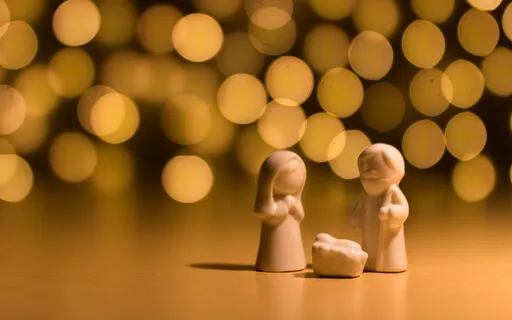
We pick back up with the shepherds coming and seeing the baby in the manger.
In the middle of the night,
They heard the promise from the angels,
And they've now made the journey to dawn.
For these shepherds,
It was a literal journey from night to morning,
But in our lives,
We can trust the promise that at some point the night will end and we will see a new dawn.
We may dwell in our dark night of the soul for much longer than a literal night,
But morning will come,
And the 24-hour cycle reminds us of that truth.
4.
The Prologue Finally,
In the full light of Christmas day,
The fourth gospel reading occurs.
This one is the prologue from the Gospel of John.
This prologue widens the scope of the Christmas story.
In the voice translation,
It says,
Yes,
The Christmas story is about the birth of a baby in one specific place and time.
And yet,
This story that happened in Bethlehem centuries ago is the story that has been happening since the creation of the world and that continues to happen up to this day.
As we transition out of this time together,
I will end with a benediction from a book called 365 Days of Peace by Jessica Kantrowicz.
She writes,
Peace to those who have been in the world for a long time.
365 Days of Peace by Jessica Kantrowicz.
She writes,
Peace to those who have faith.
Peace to those who don't.
Peace to those who had to choose between loving the God they were sold and loving themselves and chose themselves.
Peace to those whose love of God lets them love others enough to trust their choice.
Peace to all tonight.
Peace.