How to sit for meditation.
To sit for meditation,
You'll want to create a quiet space.
It's best to return to the same space at the same time every day for meditation.
This builds a momentum.
But if this isn't possible,
Then simply make the best with what you can.
So,
To sit on your chair,
I'm going to talk about sitting on your chair,
And then I'll talk about sitting on the floor.
So to start with,
Sitting on your chair,
The best way to use a chair for meditation is to sit more towards the edge of your seat.
This allows an upright spine.
If you're exhausted or sick and convalescing,
Or that you simply don't have the energy to meditate,
Then you can sit towards the back of the chair.
Otherwise,
Sit towards the edge of the chair,
And this can be energizing and boost your energy.
Sitting towards the edge of the chair,
What you're going to do is take both hands to your left thigh,
One to the inside,
One to the outside.
Lean towards the right hip.
Lift your left hip up and draw your thigh,
Your inner thigh,
Back and apart.
So you're turning your left thigh bone in and moving your flesh back and apart so that you feel a solid connection with your left leg bone in the chair.
And then do the same thing on the right side.
Grabbing a hold of the inner and outer thigh,
Turning the thigh in,
Moving it from the knee back into the hip,
And apart from the inside to the outside.
And then sit with your hands resting on your thighs,
With your palms up.
Good.
Now with your hands with your palms up on your thighs,
Bring your elbows beneath your shoulders.
So if your hands are way far out and your elbows are in front of you,
Just go ahead and slide your hands back.
And feel your feet flat on the floor.
You want your ankles to be beneath your knees,
Your heels beneath your knees,
And your feet pointing straight forward,
Not in,
Not out,
But straight forward.
This alignment allows for the natural energy flows of the body.
When we sit out of alignment,
It can create more pain in the future.
It can also create more stagnation in the mind,
Or stagnation in the emotions.
And for meditation we want everything to be able to flow in a more natural state.
Yet with an awake,
Aware,
Uplifted attitude.
So it's not sedentary.
You might feel now that there's a little bit of rigidity,
It might feel very artificial,
And that's okay.
This will heighten your awareness.
So now,
With a deep breath,
Let breath go down towards your pelvis,
And then up into your lungs,
Up into the top part of your lungs,
And you can even use your hands to lift your arm bones,
And lift your skull,
Lift the roof of your mouth,
Lift your skull.
Now keep that lift even as you exhale.
What you may notice from that breath,
From that breathing,
First down into the lungs,
Then up,
Lifting through the arm bones,
Through the roof of your mouth,
That you're very upright,
That your spine is erect.
Your spine is awake.
And your spine and your skull house the nervous system,
The central nervous system that carries the subtle energy vibration from the cosmos into your body,
Into you.
So you're simply optimizing this flow.
When we look at the Buddha,
A photo of the Buddha,
Or a statue of the Buddha,
You can see this upright nature of the spine.
Within this uprightness,
There's not a rigidity,
But an ease.
So finding that balance between upright and easeful.
Good.
And now allow your pelvis to be even more heavy,
Feet heavy,
And spine lifted.
Shoulders on your back,
Heart open,
Throat relaxed,
Eyes relaxed,
Gaze slightly downward,
And eyes can either be half open,
Semi-open,
Gently open,
Gazing down at a space,
A yard or so in front of you,
Or the eyes can be closed,
Also with your gaze downward,
Eyes relaxed.
Just take a moment to feel this seat,
Which might feel unnatural.
It will start to become more familiar as you spend more time here.
If at any time during your meditation you need to move,
You need to shift,
Then go ahead and move.
Go ahead and adjust.
It's generally good to set a period of time that you'll sit without moving.
In the beginning that might be five minutes.
It might eventually stretch to ten minutes,
Or half an hour,
Or even an hour.
And part of the reason we sit still is it creates a strong container,
The physical body and stillness creates a strong container for our awareness,
For our consciousness,
To deepen our practice of meditation.
Okay.
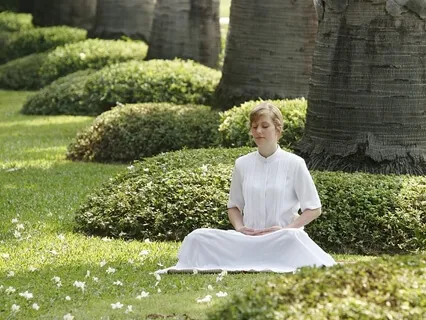
Now to sit in a cross-legged posture or folded-legged posture,
The biggest importance of sitting on the floor and how much height to take underneath your hips is that the top of your pelvic bones,
The rim of your hip bones,
That needs to be higher than your knees.
So go ahead and take your hands onto your hip bones and notice as you sit cross-legged on the floor or heel to heel to pelvic bone on the floor that your hips are higher than your knees.
Now if your knees are higher than your hips,
You're going to need to take folded blankets and stack them under your hips until they're high enough that your hips are higher than your knees.
Don't let this go because if the knees are higher than your hips it won't allow for the natural flows of consciousness to move through your body and it'll create more difficulty than necessary,
Which is really not what we need for meditation.
Okay.
So now that you have the proper amount of height,
You want the blankets to be folded in a way that are stable,
That they're not wobbly,
And that there's no tilt in your pelvis,
That you're not tilting your pelvis forward,
But you're sitting grounded,
The four corners of your pelvis grounded on the support of the floor or of your blankets.
So adjusting as needed.
And then doing that same inner rotation of the thigh bones that we did on the chair,
Turning the thighs in,
Pulling them back,
Moving them apart,
Right where the femur bone inserts into the hip socket,
Creating that nice space.
So now the femur bones,
The long leg bones,
Are stretching the hip sockets apart and that allows the energy to flow downward in the torso.
And taking your hands on your thighs,
Palms can face up if you want to express energy or you want energy to move out of your body.
Hands can be down on your thighs if you want to contain energy or build your inner energy.
And then elbows right beneath your shoulders.
Then with a breath,
Using the in breath to lift your arm bones up towards your ears and slightly back so you feel the shoulder blades on your back.
As you exhale,
Letting the pelvis be heavy,
Letting your tailbone be heavy so the lowest part of your belly is gently lifted.
Feeling that tone of support beneath you.
With your next inhale,
Feeling the lift of your heart,
The subtle lift,
Lift of the roof of your mouth out of your pelvis.
Notice that your spine is erect.
And create an intention to hold this upright,
This awake posture for the period of your meditation.