Good evening.
This is Carrie Grossman.
Tonight I'm so happy to share with you an adaptation from one of my favorite books,
The Life of Buddha by Andre Ferdinand Herald.
This magical tale tells the story of Prince Siddhartha,
Who was born into a life of luxury and went on to find enlightenment and become the Buddha.
Originally published in French in 1922 and later translated into English by Paul Blum,
The book is a compilation of several classic Buddhist texts,
Including the Buddha Charita,
The Lalita Vistara and the Jataka Tales.
All of these ancient texts have a lyrical beauty and devotion that make the mystical life and times of the Buddha come alive.
Like all of us,
Siddhartha was a man who struggled and searched,
Longed and loved.
He thirsted for truth like a wanderer lost in the desert,
And ultimately he found this truth in the depths of his being.
A soulful explorer and an extraordinary sage,
His life is a reminder of the awakened presence that lives inside us all.
Whether you experience this story as legend,
Myth or reality,
I hope these beautiful words touch your heart as they've touched mine.
So sit back and relax,
Rest your body and mind as you travel back in time to the mystical world of the Buddha.
May his journey inspire your own quest to remember who you are.
Serene and magnificent was this city,
Where once had dwelt the great hermit,
Kapila.
It seemed to be built out of some fragment of the sky.
The walls were like clouds of light,
And the houses and gardens radiated a divine splendor.
The earth's stones glistened everywhere.
Within its gates,
Darkness was as little known as poverty.
At night,
When silver moonbeams fingered each turret,
The city was like a pond of lilies.
By day,
When the terraces were bathed in golden sunshine,
The city was like a river of lotuses.
King Shudodhana reigned in Kapila Vastu.
He was its brightest ornament.
He was kindly and generous,
Modest and just.
He brought light into the world,
And he pointed out the true path to those who were close to him.
His great wisdom gained for him many friends,
And his starlight intensifies the brightness of the moon.
So did their brilliance enhance his splendor.
Shudodhana,
King of the Shakya race,
Had wed many queens.
His favorite among these was Maya.
She was very beautiful.
It was as if the goddess Lakshmi herself had strayed into the world.
When she spoke,
It was like the song of birds in the spring,
And her words were sweet and pleasant.
Her hair was the color of the black bee.
Her forehead was as chaste as a diamond.
Her eyes as cool as a young blue lotus leaf.
She was virtuous.
She desired the happiness of her subjects.
She was truthful,
And her conduct was exemplary.
King Shudodhana and Queen Maya lived quietly and happily in Kapilavastu.
One day,
The same hour that spring was born,
A dream came to Maya as she slept.
She saw a young elephant descending from the sky.
It had six great tusks.
It was as white as the snow on mountaintops.
Maya saw it enter her womb,
And thousands of gods suddenly appeared before her.
They praised her with immortal songs,
And Maya understood that never more would she know disquietude or hatred or anger.
Then she awoke.
She was happy.
It was a happiness she had never felt before.
Arising,
She walked in the gardens until she came to a little wood,
Where she found a shaded seat.
Then she sent two of her maidens to King Shudodhana with this message,
That the king should come to the wood.
Queen Maya wishes to see him and will await him there.
The king promptly complied.
He left the hall,
Where with the help of his counselors,
He had been administering justice to the inhabitants of the city.
He saw her quietly,
Without arrogance,
And he asked,
Why did you send for me?
What do you wish?
The queen told him of the dream she had had,
Then added,
My lord,
There are Brahmins who are clever at interpreting dreams.
If we are good for them,
They will know if the palace has been visited by good or evil,
And if we should rejoice or mourn.
The king agreed,
And Brahmins familiar with the mystery of dreams were summoned to the palace.
When they had heard Maya's story,
They spoke in this manner.
A great joy is to be yours,
O King,
O Queen.
A son will be born to you,
Distinguished by the favor of the gods.
If one day he should renounce royalty,
Leave the palace,
And live the wandering life of a monk,
He will deserve marvelous praise.
He will richly deserve magnificent gifts.
He will be adored by the worlds,
For he will give them that which they hunger after.
O Master,
O Mistress,
Your son will be a Buddha.
Years passed,
Then one day the queen knew that the time was approaching for her son to be born.
They came to a wood where the trees were in bloom,
And Maya stepped out and began wandering about aimlessly.
She was happy,
And behold,
She found a rare tree,
The branches drooping under their burden of blossoms.
She went up to it,
Gracefully extending her hand.
She drew down a branch.
Suddenly she stood very still.
She smiled,
And the maidens who were near her received a lovely child into their arms.
At that same moment,
All that was alive in the world trembled with joy.
The earth quivered.
Songs in the powder of dancing feet echoed in the sky.
Trees of all seasons burst into flower,
And ripe fruit hung from the branches.
The sick were rid of their suffering.
The hungry were satisfied.
The wicked were cleansed of all evil.
One of Maya's maidens hastened to King Shudodhana and joyously exclaimed,
My lord,
My lord,
A son is born to you,
A son who will bring great glory to your house.
He was speechless,
But his face was radiant with joy,
And he knew great happiness.
Presently he summoned all the shakyas,
And he commanded them to accompany him into the garden where the child had been born.
They obeyed,
And with a host of Brahmins in attendance,
They formed a noble retinue as they gravely followed the king.
When he came near the child,
The king made a deep obeisance,
And he said,
Do you bow as I bow before the prince to whom I give the name Siddhartha?
The great hermit Asita,
Whose austerities were pleasing to the gods,
Heard of the birth of him who was to save humankind from the torment of rebirth.
In his thirst for the true law,
He came to the palace of King Shudodhana and gravely approached the women's quarters.
His years and his learning lent him great dignity.
The king showed him the courtesies that custom prescribed,
And addressed him in a seemly manner.
May it be indeed am I.
Truly this child of mine will enjoy distinguished favor,
For the venerable Asita has come purposely to see me.
Command me.
What must I do?
I am your disciple,
Your servant.
The hermit,
His eyes shining with the light of joy,
Gravely spoke these words.
This has happened to you,
O noble,
Generous,
And hospitable king,
Because you love duty,
Because you are ever kind to those who are wise and to those who are full of years.
This has happened to you because your ancestors,
Though rich in land and rich in gold,
Were above all rich in virtue.
Know the reason for my coming,
O king,
And rejoice.
In the air I heard a divine voice speaking and it said,
A son has been born to the king of the shakyas,
A son who will have the true knowledge.
I heard these words and I came,
And my eyes shall now behold the glory of the shakyas.
Overwhelmed with joy,
The king went to fetch the child.
Taking him from his nurse's breast,
He showed him to the aged Asita.
The hermit noticed that the king's son bore the marks of omnipotence.
His gaze hovered over the child,
And presently his lashes were wet with tears.
Then he sighed and turned his eyes to the sky.
The king saw that Asita was weeping,
And he began to fear for his son.
He questioned the old man.
You say,
O venerable Rhone,
That my son's body differs little from that of a god.
You say that his birth was a wondrous thing,
That in the future his glory will be supreme.
Yet you look at him with eyes that are filled with tears.
Is his life,
Then,
To be a fragile thing?
Was he born only to bring me sorrow?
Has this new branch withered before it has burst into flower?
Speak,
O saintly man,
Speak quickly.
You know the great love a father bears his son.
Be not distressed,
O king,
Replied the hermit.
What I have told you is true.
This child will know great glory.
If I weep,
It is for myself.
My life draws to a close,
And he is born,
He who will destroy the evil of rebirth.
To those wandering in the forest of existences,
Like travelers who have lost their way,
He will point out the road to salvation.
Therefore,
Do not grieve,
O king.
He alone is to be pitied who will not hear the voice of your son.
And that is why I weep.
I,
Who in spite of my austerities,
In spite of my meditations,
Will never know his message and his law.
Yes,
Even he is to be pitied who ascends to the loftiest gardens of the sky.
They pleased Suddhodana at first,
These words of Asita's,
And he pondered them.
So my son will live,
And live gloriously,
He thought.
But then he became anxious,
For it had been said that the prince would renounce royalty,
That he would lead the life of a hermit.
And did that not mean that at his death,
Suddhodana's family would cease?
But his anxiety was short-lived,
For since the birth of Siddhartha,
The king could undertake nothing that did not prosper.
Like a great river whose waters are swollen by many tributaries,
Each day new riches poured into his treasury.
The kingdom was rich in fertile lands and sleek,
Fatted cattle grazed in the meadows.
Women bore their children without suffering.
Men lived at peace with their neighbors,
And happiness and tranquility reigned in the land of Kapilavastu.
But the joy that had come to Maya proved too sweet.
It soon became unbearable.
The earth knew her as a mother but seven days,
Then she died and ascended to the sky,
To be received among the gods.
Maya had a sister,
Maha-Prajapati,
Who in beauty and virtue was almost her equal.
The prince was given into Maha-Prajapati's care,
And she looked after his wants as tenderly as if he were her own child.
And like fire fanned by an auspicious wind,
Like the moon,
Queen of the stars in the luminous skies,
Like the morning sun rising over the mountains in the east,
Siddhartha grew in strength and stature.
Shudodhana kept thinking of what Asita had told him.
He did not want his family to die out,
And he said to himself,
I will arouse in my son a desire for pleasure.
Then perhaps I shall have grandchildren,
And they shall prosper.
So he sent for the prince,
And he spoke to him in these words.
My child,
You are at an age when it would be well to think of marriage.
If there is some maid that pleases you,
Tell me.
Siddhartha replied,
I am not one of those who seek the company of women.
It is my lot to live in the silence of the woods,
There through meditation my mind will find peace.
But does not the lotus grow and flourish even amid the tangle of swamp flowers?
Have there not been men with wives and sons who found wisdom?
I shall follow their example.
Give me seven days to consider father.
In seven days you shall have my answer.
He thought of the qualities he would value most highly in a woman.
Then on the seventh day,
He returned to his father.
My father said he,
She whom I shall marry must be a woman of rare merit.
She whom I shall marry will have the flower of beauty,
Yet her youth will not make her vain,
Nor will her beauty make her proud.
She whom I shall marry will have a sister's affection,
A mother's tenderness for all living creatures.
She whom I shall marry will be pure in body,
In speech and in thought.
Father,
If you know a maid who possesses these qualities,
You may give her to me in marriage.
The king summoned the household priest.
He enumerated the qualities the prince sought in the woman he would marry,
Then said,
Go Brahmin,
Visit all the houses of Kapilavastu,
Observe the young girls and question them.
And if you find one to possess the necessary qualities,
Bring her to the prince,
Even though she be of the lowest caste.
For it is not rank nor riches my son seeks,
But virtue.
The priest scoured the city of Kapilavastu.
He entered the houses.
He saw the young girls.
He cleverly questioned them,
But not one could he find worthy of Prince Siddhartha.
Finally he came to the home of Dandapani,
Who was of the Shakya family.
Dandapani had a daughter named Gopa.
At the very sight of her,
The priest's heart rejoiced,
For she was beautiful and full of grace.
He spoke a few words to her,
And he doubted no longer.
The priest returned to King Sudodhana.
My lord,
He exclaimed,
I have found a maid worthy of your son.
Where did you find her,
Asked the king.
She is the daughter of the Shakya,
Dandapani,
The Brahmin replied.
Though he had great confidence in his household priest,
Sudodhana hesitated to summon Gopa and Dandapani.
Even the wisest men can make mistakes,
He thought.
The Brahmin may be exaggerating her perfections.
I must put the daughter of Dandapani to a further test,
And my son himself shall judge her.
He had many jewels made out of gold and silver,
And by royal command a herald was sent through the streets of Kapilavastu,
Crying.
On the seventh day,
From this day,
Prince Siddhartha,
Son of King Sudodhana,
Will present gifts to the young girls of the city.
So may all the young girls appear at the palace on the seventh day.
On the day announced,
The prince sat on a throne in the great hall of the palace.
All the young girls of the city were present,
And they filed before him.
To each one he presented a jewel.
But as they approached the throne,
His striking beauty so intimidated them that they lowered their gaze or turned their heads away.
Gopa was the last one to appear.
She advanced fearlessly,
Without even blinking her eyes.
But the prince had not a single jewel left.
Gopa smiled and said to him,
Prince,
In what way have I offended you?
You have not offended me,
Replied Siddhartha.
Then why do you treat me with disdain?
I do not treat you with disdain,
He replied.
You are the last one,
And I have no jewel to give you.
But suddenly he remembered that on his finger he was wearing a ring of great value.
He took it off and handed it to the young girl.
She would not take the ring.
She said,
Prince,
Must I accept this ring from you?
It was mine,
Replied the prince,
And you must accept it.
No,
Said she,
I would not deprive you of your jewels.
It is for me,
Rather,
To give you a jewel.
And she left.
When the king heard of this incident,
He was elated.
Gopa alone could face my son,
He thought.
She alone is worthy of him.
Gopa,
Who would not accept the ring that you took from your finger.
Gopa,
Oh my son,
Will be your fairest jewel.
Prince Siddhartha lived happily with his wife,
The princess,
And the king,
Whose love for his son now verged on adoration,
Took infinite care to spare him the sight of anything that might distress him.
He built three magnificent palaces for him,
One for the winter,
One for the summer,
And the third for the rainy season.
And these he was forbidden ever to leave,
To wander over the broad face of the earth.
In his palaces,
White as autumn clouds,
And bright as the celestial chariots of the gods and goddesses,
The prince drained the cup of pleasure.
He led a life of voluptuous ease,
And he spent languid hours listening to music played by the princess and her maidens.
Then beautiful Gopa bore the prince's son,
And he was given the name Rahula.
King Shudodana was happy to see his family prosper,
And he was as proud of the birth of his grandson as he had been of the birth of his son.
He continued in the path of virtue.
He lived almost like a hermit,
And his actions were saintly.
Yet he kept urging on his beloved son to new pleasures,
So great was his fear to see him leave the palace and the city and seek the austere refuge of the holy forests.
One day,
Someone spoke in the presence of the prince and told how the grass and the woods had become a tender green,
And the birds and the trees were singing of the spring,
And how,
In the ponds,
The great moduses were unfolding.
Nature had broken the chains that winter had forged,
And around the city,
Those gardens so dear to young maidens were now gaily carpeted with flowers.
Then,
Like an elephant too long confined in his stable,
The prince had an irresistible desire to leave the palace.
The king learned of his son's desire,
And he knew no way to oppose it.
But he thought,
Siddhartha must see nothing that will trouble the serenity of his soul.
He must never suspect the evil there is in the world.
I shall order the road cleared of beggars,
Of those who are sick and infirm,
And of all who suffer.
The city was decorated with garlands and streamers.
A magnificent chariot was prepared,
And the cripples,
The aged,
And the beggars were ordered off the streets where the prince would pass.
When the time came,
The king sent for his son,
And there were tears in his eyes as he kissed him on the brow.
And then he said to him,
Go.
And with that word,
He gave him permission to leave the palace,
Though his heart spoke differently.
The prince's chariot was made of gold.
It was drawn by four horses capricened in gold,
And the charioteer held gold reins in his hands.
Only the rich,
The young,
And the beautiful were allowed on the streets he drove through,
And they stopped to watch him as he went by.
Some praised him for the kindness of his glance.
Others extolled his dignified bearing.
Still others exalted the beauty of his features,
While many glorified his exuberant strength.
And he,
At the sight of the city's splendor,
At the sight of the wealth of the men and the beauty of the women,
Felt a new joy pour into his soul.
But the gods were jealous of the celestial felicity enjoyed by this city of the earth.
They made an old man,
And in order to trouble Siddhartha's mind,
They set him down on the road the prince was traveling.
The man was leaning on a staff.
He was worn out into crepit.
His veins stood out on his body.
His teeth jattered,
And his skin was a maze of black wrinkles.
A few dirty gray hairs hung from his scalp.
His eyelids had no lashes and were red-rimmed.
His head and limbs were palsied.
The prince saw this being,
So different from the men around him.
He gazed at him with sorrowful eyes,
And he asked the charioteer,
What is this man with gray hair and body so bent?
He clings to his staff with scrawny hands.
His eyes are dull,
And his limbs falter.
Is he a monster?
Has nature made him thus,
Or is it chance?
The charioteer should not have answered,
But the gods confused his mind,
And without understanding his mistake,
He said,
That which mars beauty,
Which ruins vigor,
Which causes sorrow and kills pleasure,
That which weakens the memory and destroys the senses,
His old age,
It has ceased this man and broken him.
He too was once a child,
Nursing at his mother's breast.
He too once crawled upon the floor.
He grew,
He was young,
He had strength and beauty.
Then he reached the twilight of his years,
And now you see him,
The ruin that is old age.
The prince was deeply moved.
He asked,
Will that be my fate also?
The charioteer replied,
My lord,
Youth will also leave you someday.
To you too will come troublesome old age.
Time saps our strength and steals our beauty.
The prince shuddered like a bull at the sound of thunder.
He uttered a deep sigh and shook his head.
His eyes wandered from the wretched man to the happy crowds,
And he spoke these solemn words.
So old age destroys memory and beauty and strength in man,
And yet the world is not frantic with terror?
Turn your horses around,
Oh charioteer,
Let us return to our homes.
How can I delight in gardens and flowers when my eyes can only see old age,
When my mind can only think of old age?
The prince returned to his palace,
But nowhere could he find peace.
He wandered through the halls,
Murmuring,
Old age,
Oh old age!
And in his heart there was no longer any joy.
He decided nevertheless to ride once more through the city.
But the gods made a man afflicted with a loathsome disease,
And they set him down on the road Siddhartha had taken.
Siddhartha saw the sick man.
He stared at him,
And he asked the charioteer,
What is this man,
With a swollen paunch?
His emaciated arms hang limp.
He is deathly pale,
And pitiful cries escape from his lips.
He gasps for breath.
See he staggers and jostles the bystanders.
He is falling.
Charioteer,
Charioteer,
What is this man?
The charioteer answered,
My lord,
This man knows the torment of sickness,
For he has the king's evil.
He is weakness itself.
Yet he too was once healthy and strong.
The prince looked at the man with pity,
And he asked again,
Is this affliction peculiar to this man,
Or are all creatures threatened with sickness?
The charioteer answered,
We too may be visited with a similar affliction,
O prince.
Sickness weighs heavily upon the world.
When he heard this painful truth,
The prince began to tremble like a moonbeam reflected in the waves of the sea,
And he uttered these words of bitterness and pity.
Men see suffering and sickness,
Yet they never lose their self-confidence.
Oh,
How great must be their knowledge!
They are constantly threatened with sickness,
And they can still laugh and be merry.
Turn your horses around,
Charioteer,
Our pleasure trip is ended.
Let us return to the palace.
I have learned to fear sickness.
My soul shuns pleasure and seems to close up like a flower deprived of light.
Wrapped in his painful thoughts,
He returned to the palace.
King Shudodana noticed his son's somber mood.
He asked why the prince no longer went out driving,
And the charioteer told him what had happened.
The king grieved.
He already saw himself forsaken by the child he adored.
He lost his usual composure and flew into a rage at the man whose duty it was to see that the streets were clear.
He punished him.
But so strong was his habit of being indulgent that the punishment was light,
And the man was astonished at being thus upbraided,
For he had seen neither the old man nor the sick man.
The king was more anxious now than ever before to keep his son from leaving the palace.
He provided him with rare pleasures,
But nothing,
It seemed,
Could arouse Siddhartha.
And the king thought,
I shall let him go out once more.
Perhaps he will recover the joy he has lost.
He gave strict orders to have all cripples and all who were ill or aged driven out of the city.
He even changed the prince's charioteer,
And he felt certain that this time there would be nothing to trouble Siddhartha's soul.
But the jealous gods made a corpse.
Four men carried it,
And others followed behind,
Weeping.
And the corpse,
As well as the men who carried it and the men who were weeping,
Was visible only to the prince and to the charioteer.
And the king's son asked,
What is he that is being carried by four men,
Followed by those others,
Wearing dark clothes and weeping?
The charioteer should have held his peace,
But it was the will of the gods that he replied.
My lord,
He has neither intelligence nor feeling nor breath.
He sleeps without consciousness,
Like grass or a piece of wood.
Pleasure and suffering are meaningless to him now,
And friend and enemy alike have deserted him.
The prince was troubled.
He said,
Is this a condition peculiar to this man?
Or does this same end await all creatures?
And the charioteer answered,
This same end awaits all creatures.
Whether of humble or of noble birth,
To every being who lives in this world,
Death comes inevitably.
Then Prince Siddhartha knew what death was.
In spite of his fortitude,
He shuddered.
He had to lean against the chariot,
And his words were full of distress.
So to this does destiny lead all creatures.
And yet,
Without fear in his heart,
Man amuses himself in a thousand different ways.
What death is about,
And he takes to the world's high roads with a song on his lips.
Oh,
I begin to think that man's soul has become hardened.
Turn your horses around,
Charioteer.
This is no time to wander through the flower gardens.
How can a sensible man,
A man who knows what death is,
Seek pleasure in the hour of anguish?
But the charioteer kept on driving toward the garden,
Where the king had ordered him to take his son.
There,
At Shuddhodana's command,
Udayan,
Who was the son of the household priest and Siddhartha's friend since childhood,
Had assembled many beautiful maidens,
Skilled in the art of dancing and of song,
And skillful also in the game of love.
The chariot entered the wood.
The young trees were in bloom.
Birds fluttered about joyously,
As though intoxicated by the light and atmosphere.
And on the surface of the pools,
The lotuses had cupped their petals to drink in the cool air.
Siddhartha went unwillingly,
Like a young hermit,
Still new to his vows,
Who fears temptation and is taken to some celestial palace,
Where lovely apsarasis are wont to dance.
Filled with curiosity,
The maidens rose and came forward,
As though to greet a betrothed.
Their eyes were bright with admiration,
And the hands they extended were like flowers.
But the prince was not smiling.
He was unhappy,
For he was thinking on death.
He thought,
They do not know,
These maidens,
That youth is fleeting,
And that old age will come and strip them of their beauty.
They are blind to the menace that is sickness,
Though it is already master of the world.
They know nothing of death,
And that is why they can laugh.
That is why they can play.
I have seen old age,
I have seen sickness,
I am certain of death.
Nothing now can give me peace of mind.
The sun was setting.
The maidens had ceased their laughter.
The prince had no eyes for their garlands and their jewels.
They felt their charms were of no avail,
And slowly they took the road back to the city.
The prince returned to the palace.
King Shudodana heard from Udayan that his son was shunning all pleasure.
And that night,
He fell no sleep.
Siddhartha could no longer find peace.
He strode through the halls of his palace like a lion stung by some poisoned dart.
He was unhappy.
One day,
There came to him a great longing for the open fields and the sight of green meadows.
He left the palace,
And as he strolled aimlessly through the country,
He pondered the misery of mankind.
He knew no longer joy or grief,
Doubt or weariness,
Desire or love,
Hatred or scorn.
Suddenly,
He saw a man approaching,
Who looked like a beggar,
And who was visible to him alone.
Tell me,
Who are you?
The prince asked him.
Hero,
Said the monk.
Through fear of birth and death,
I became an itinerant monk.
I seek deliverance.
I think not as other men.
I shun pleasures.
I know nothing of passion.
I look for solitude.
Sometimes I live at the foot of a tree.
Sometimes I live in the lonely mountains,
Or sometimes in the forest.
I own nothing.
I expect nothing.
I wander about,
Living on charity and seeking only the highest good.
He spoke.
Then he ascended into the sky and disappeared.
A god had taken the form of a monk in order to arouse the prince.
Siddhartha was happy.
He saw where his duty lay.
He decided to leave the palace and become a monk.
He went to the king,
Bowed and said to him,
King,
Grant the request I have to make.
Do not oppose it,
For I am determined.
I would leave the palace.
I would walk in the path of deliverance.
We must part,
Father.
The king was deeply moved.
With tears in his voice,
He said to his son,
Son,
Give up this idea.
You're still too young to consider a religious calling.
Our thoughts in the springtime of life are wayward and changeable.
Besides,
It is a grave mistake to perform our steer practices in our youth.
Our senses are eager for new pleasures.
Our firmest resolutions are forgotten when we learn the cost and effort.
First know the joys of youth,
Then those of later years,
Before you can take yourself to the woods and become a hermit.
The prince answered,
Promise me four things,
Oh father,
And I shall not leave your house and repair to the woods.
What are they?
Asked the king.
Promise me that my life will not end in death,
That sickness will not impair my health,
That age will not follow my youth,
That misfortune will not destroy my prosperity.
You are asking too much,
Replied the king.
Give up this idea.
It is not well to act on a foolish impulse.
Solemn as Meru Mountain,
The prince said to his father,
If you cannot promise me these four things,
Do not hold me back,
Oh father.
When someone is trying to escape from a burning house,
We should not hinder him.
The day comes inevitably when we must leave this world.
But what merit is there in a forced separation?
A voluntary separation is far better.
With tears in his eyes,
He returned to the palace.
In the great hall,
Gopa's companions were laughing and singing.
He paid no heed to them.
Night came on and they were silent.
They fell asleep.
The prince looked at them.
Gone was their studded grace,
Gone the sparkle of their eyes.
Their hair was disheveled,
Their mouths gaped,
Their breasts were crushed,
And their arms and legs were stiffly outstretched,
Were clumsily twisted under them.
And the prince cried.
Dead,
They are dead.
I am standing in a graveyard.
And he left and made his way toward the royal stables.
He called his equary,
Fleet Chandika.
Bring me my horse,
Khandika,
At once,
He said.
I would be off to find eternal beatitude.
Chandika knew the king's orders,
But he felt some superior power urging him to disobey.
He went to fetch the horse.
Khandika was a magnificent animal.
He was strong and supple.
Siddhartha stroked him quietly and said to him in a gentle voice,
Many times,
O noble beast,
My father rode you into battle and defeated his powerful enemies.
Today I go forth to seek supreme beatitude.
Lend me your help,
O Khandika.
Lend me your strength and your speed.
The world's salvation and your own is at stake.
The prince had spoken to Khandika as he would have to a friend.
He now eagerly climbed into the saddle and he looked like the sun has dried an autumn cloud.
The horse was careful to make no noise,
For the night was clear.
No one in the palace or in Kapilavastu was awakened.
Heavy iron bars protected the gates of the city.
An elephant could have raised them only with great difficulty.
But to allow the prince to pass,
The gates opened silently of their own accord.
Leaving his father,
His son and his people,
Siddhartha went forth from the city.
He felt no regret and in a steady voice he cried,
Until I have seen the end of life and of death,
I shall not return to the city of Kapila.
Khandika bravely carried him a great distance.
When the sun finally appeared between the islands of night,
The most noble of men saw that he was near a wood where dwelt many pious hermits.
Deer were asleep under the trees and birds fluttered about fearlessly.
Siddhartha felt rested and he thought he need go no further.
He dismounted and gently stroked his horse.
There was happiness in his glance and in his voice as he said to Chandika,
Truly a horse has the strength and swiftness of a god.
And you dear friend,
By bearing me company,
Have proved to me how great is your affection and your courage.
Take the horse now and return to the city.
I have found the forest I was seeking.
Siddhartha had entered the hermitage where holy Arhatakalama taught the doctrine of renunciation to a great number of disciples.
Whenever he appeared,
They all admired him.
Wherever he went,
They are shown a marvelous light.
The monks listened with joy when he spoke,
For his voice was sweet and powerful and he was persuasive.
One day Arhatakalama said to him,
You understand the law as well as I understand it.
All that I know,
You know.
Hereafter,
If you wish,
We will share the work.
We will both teach the disciples.
The hero asked himself,
Is the law that Arhatakalama teaches the true law?
Does it lead to deliverance?
He thought,
Arhatakalama and his disciples lead lives of great austerity.
They refuse food prepared by man.
They will only eat fruit,
Leaves and roots.
They will drink only water.
When they sleep,
It is under a canopy of branches.
The heat of the sun scorches them.
They expose their bodies to the bitter winds.
They bruise their feet and their knees on the stones of the highway.
To them,
Virtue comes only with suffering.
And they think they are happy,
For they believe that by practicing perfect austerity,
They will earn the right to ascend to the sky.
Yes,
They will ascend to the sky,
But the human race will continue to suffer old age and death.
To lead a life of austerity and be indifferent to the constant evil of birth and death is simply to add suffering to suffering.
Thus did he ponder in the Hermitage of Arhatakalama.
He saw the vanity of the doctrine that the master was teaching and he said to him,
I will not teach your doctrine,
Arhatakalama.
Who knows it will not find deliverance?
I shall leave your Hermitage and I shall seek the rule to which we must submit before we can have done with suffering.
The clear waters of the Naranjana flowed through a rich and fertile land.
Little villages drowsed in the shade of magnificent trees and great meadows stretched away into the distance.
The hero thought,
How pleasant it is here.
What an inviting spot in which to meditate.
Perhaps here I shall find the path to wisdom.
Here I shall dwell.
For six years,
The hero remained on the banks of the river and meditated.
He never sought shelter from the wind,
From the sun,
Or from the rain.
He allowed the gadflies,
The mosquitoes,
And the serpents to sting him.
He was oblivious to the boys and girls,
The shepherds and woodcutters who jeered at him as they passed by,
And who sometimes threw dust or mud at him.
He hardly ate.
A fruit and a few grains of rice or of sesame composed his fare.
He became very thin.
His bones showed prominently,
But under his gaunt forehead,
His dilated eyes shone like stars.
And yet true knowledge did not come to him.
He felt he was becoming very weak,
And he realized that if he wasted away,
He would never reach the goal he had set for himself.
So he decided to take more nourishment.
There was a village called Urruvilva near the spot where Siddhartha spent long hours in meditation.
The head man of this village had ten daughters.
They revered the hero,
And they brought him grain and fruit by way of alms.
He rarely touched these gifts,
But one day the girls noticed that he had eaten all they had offered him.
The next day they came with a large dish full of boiled rice,
And he emptied that.
The following day,
Each one brought a different delicacy,
And the hero ate them all.
He began to gain flesh,
And presently he started going to the village to beg his food.
The inhabitants vied with one another in giving him alms,
And before long he had regained his strength and his beauty.
When night came on,
Siddhartha fell asleep,
And he had five dreams.
First he saw himself lying in a large bed that was the whole earth.
Under his head there was a cushion which was the Himalaya.
His right hand rested on the western sea,
His left hand on the eastern sea,
And his feet touched the southern sea.
Then he saw a reed coming out of his navel,
And the reed grew so fast that it soon reached the sky.
Then he saw worms crawling up his legs and completely covering them.
Then he saw birds flying toward him from all points of the horizon,
And when the birds were near his head,
They seemed to be of gold.
Finally he saw himself at the foot of a mountain of filth and excrement.
He climbed the mountain,
He reached the summit,
He descended,
And neither the filth nor the excrement had defiled him.
He awoke,
And from these dreams he knew that the day had come,
When having attained supreme knowledge,
He would become a Buddha.
He rose and set out for the village of Uruvilva to beg.
Sujata,
The most devout of the ten young girls who had been bringing him food,
Had just finished milking eight wonderful cows that she owned.
The milk they gave was rich,
Oily,
And of a delicate savor.
She added honey and rice flour to it,
Then set the mixture to boil in a new pot,
On a new stove.
Huge bubbles began to form and kept floating off to the right without the liquid rising or spilling a single drop.
The stove did not even smoke.
Sujata was astonished,
And she said to Purna,
Her servant,
Purna,
The gods are favoring us today.
Go and see if the holy man is approaching the house.
Purna,
From the doorstep,
Saw the hero walking towards Sujata's house.
He was diffusing a brilliant light,
A golden light.
Purna was dazzled.
She ran back to her mistress.
Mistress,
He is coming,
He is coming!
And your eyes will be blinded by his splendor.
Let him come,
Oh let him come,
Cried Sujata.
It is for him that I have prepared this wonderful milk.
And she awaited the hero.
He entered.
The house was lighted up by his presence.
Sujata,
To do him honor,
Bowed seven times.
He sat down.
Sujata kneeled and bathed his feet in sweet scented water.
Then she offered him the golden bowl full of milk mixed with rice flour and honey.
He thought.
The Buddhas of old,
It is said,
Had their last meal served to them in a golden bowl,
Before attaining supreme knowledge.
Since Sujata offers me this milk and honey in a golden bowl,
The time has come for me to be a Buddha.
The hero sauntered along the banks of the river.
Night slowly descended.
The flowers wearily closed their petals.
The sweet fragrance rose from the fields and gardens.
The birds timidly rehearsed their even songs.
It was then that the hero walked toward the tree of knowledge.
The road was sprinkled with gold dust.
Rare palms covered with precious stones lined the way.
He skirted the edge of a pool whose blessed waters exhaled an intoxicating perfume.
White,
Yellow,
Blue and red lotuses spread their massive petals over the surface,
And the air rang with the clear songs of the swans.
He approached the tree.
The hero went to the east of it and bowed seven times.
He threw the handfuls of grass on the ground,
And suddenly a great seat appeared.
The soft grass covered it like a carpet.
The hero sat down.
His head and shoulders erect.
His face turned to the east.
Then he said in a solemn voice,
Even if my skin should perch,
Even if my hands should wither,
Even if my bones should crumble into dust,
Until I have attained supreme knowledge,
I shall not move from this seat.
And he crossed his legs.
The light emanating from the hero's body reached even to those realms where Mara,
The evil one,
Reigns supreme.
It dazzled Mara,
And he seemed to hear a voice saying,
The hero who has renounced royalty is now seated under the tree of knowledge.
He is concentrating his mind.
He is making the supreme effort,
And soon he will bring to all creatures the help which they need.
Because of him,
The city of the gods will be crowded.
Because of him,
The city of the evil one will be deserted.
And you,
Mara,
A commander without an army,
A king without subjects,
Will not know where to take refuge.
Mara was filled with apprehension.
He tried to sleep,
But his slumber was disturbed by terrible dreams.
He awoke and summoned his servants and his soldiers.
When they saw him,
They became alarmed,
And Sartavaha,
One of his sons,
Said to him,
Father,
You look pale and unhappy.
Your heart beats fast and your limbs tremble.
What have you heard?
What have you seen?
Speak.
Son,
Replied Mara,
The days of my pride are over.
I heard a voice crying in the light,
And it told me that the son of the Sakyas was seated under the tree of knowledge,
And I had horrible dreams.
A black cloud of dust settled over my palace.
You had all deserted me.
I wanted to fight my enemy,
But I could not draw my sword from the scabbard.
All my subjects fled in horror.
Impenetrable darkness closed in upon me,
And I heard my palace crashing to the ground.
Sartavaha said,
Father,
It is disheartening to lose a battle.
If you have seen these omens,
Bide your time,
And do not run the chance of being ingloriously defeated.
But Mara paid no heed.
He ordered the army to advance at once.
Mara's army was a fearful sight.
It bristled with pikes,
With arrows,
And with swords.
Many carried enormous battle axes and heavy clubs.
The soldiers were black,
Blue,
Yellow,
Red,
And their faces were terrifying.
Their eyes were cruel flames,
Their mouths spewed blood.
Some had the ears of a goat,
Others the ears of a pig or of an elephant.
There were many with two,
Four,
And five heads,
And others with ten,
Twelve,
And twenty arms.
In place of ornaments,
They wore jawbones,
Skulls,
And withered human fingers.
And shaking their hairy heads,
They advanced with hideous laughter and savage cries.
Before attacking the hero,
Mara sought to frighten him.
He roused against him the fury of the winds.
Fierce gales rushed toward him from the horizon,
Uprooting trees,
Devastating villages,
Shaking mountains.
But the hero never moved.
Not a single fold of his robe was disturbed.
The evil ones summoned the rains.
They fell with great violence,
Submerging cities and scarring the surface of the earth.
But the hero never moved.
Not a single thread of his robe was wet.
The evil one made blazing rocks and hurled them at the hero.
They sped through the air,
But changed when they came near the tree and fell,
Not as rocks,
But flowers.
Mara then commanded his army to loose their arrows at his enemy.
But the arrows also turned into flowers.
The army rushed at the hero,
But the light he diffused acted as a shield to protect him.
Swords were shivered,
Battle axes were dented by it,
And whenever a weapon fell to the ground,
It too at once changed into a flower.
And suddenly,
Filled with terror at the sight of these prodigies,
The soldiers of the evil one fled.
And Mara wrung his hands in anguish,
And he cried,
What have I done that this man should defeat me?
For they are not a few,
Those whose desires I have granted.
I have often been kind and generous.
Those cowards who are fleeing could bear witness to that.
The troops that were still within hearing answered,
Yes,
You have been kind and generous.
We will bear witness to that.
And he,
What proof has he given of his generosity?
Continued Mara.
What sacrifices has he made?
Who will bear witness to his kindness?
Whereupon a voice came out of the earth,
And it said,
I will bear witness to his generosity.
Mara was struck dumb with astonishment.
The voice continued,
Yes,
I,
The earth,
I,
The mother of all beings,
Will bear witness to his generosity.
A hundred times,
A thousand times in the course of his previous existences,
His hands,
His eyes,
His head,
His whole body have been at the service of others.
And in the course of this existence,
Which will be the last,
He will destroy old age,
Sickness and death.
As he excels you in strength,
Mara,
Even so does he surpass you in generosity.
And the evil one saw a woman of great beauty emerge from the earth,
Up to her waist.
She bowed before the hero,
And clasping her hands she said,
O most holy of men,
I bear witness to your generosity.
Then she disappeared.
And Mara,
The evil one,
Wept,
Because he had been defeated.
By sunset,
The army of the evil one had fled.
Nothing had disturbed the hero's meditation.
And in the first watch of the night,
He arrived at the knowledge of all that had transpired in previous existences.
In the second watch,
He learned the present state of all beings.
In the third,
He understood the chain of causes and effects.
And the hero thought,
How miserable is this world that is born,
Grows old and dies,
That is reborn only to grow old and die again.
And man knows no way out.
And in profound meditation he said to himself,
Thus does ignorance lie at the root of death,
Of old age,
Of suffering,
Of despair.
To exist is to suffer.
Desire leads from birth to rebirth,
From suffering to further suffering.
By stifling desire,
We prevent birth,
We prevent suffering.
By leading a life of holiness,
Desire is stifled,
And we cease to endure birth and suffering.
When dawn appeared,
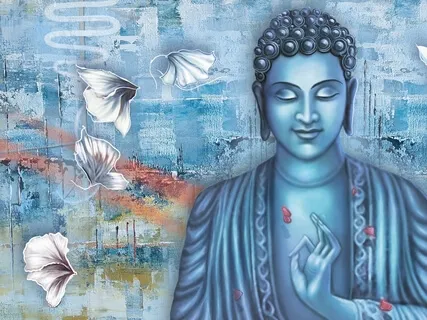
This most noble of men was a Buddha.
He exclaimed,
I have had numerous births.
In vain have I sought the builder of the house.
Oh,
The torment of perpetual rebirth.
But I have seen you at last,
Oh builder of the house.
You no longer build the house.
The rafters are broken.
The old walls are down.
The ancient mountain crumbles.
The mind attains to nirvana.
Birth is no more.
For desire is no more.
Twelve times the earth shook.
The world was like a great flower.
The gods sang,
He has come.
He who brings light into the world,
He has come.
Long blinded,
The eye of the world has opened,
And the eye of the world is dazzled by the light.
Oh conqueror,
You will give all beings that which they hunger after.
Guided by the sublime light of the law,
All creatures will reach the shores of deliverance.
You hold the lamp.
Go now,
And dispel the darkness.