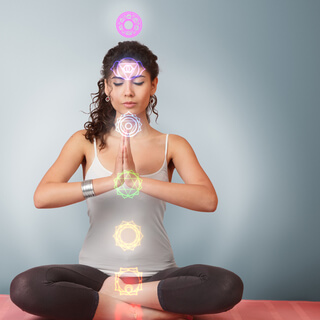
Welcome to this yoga nidra practice exploring the acceptance of emotion.
You cannot control your emotions.
Your emotions are very natural physiological responses to experience.
To try to control them is to experience suffering.
To accept emotion is to love what is.
To experience the fullness of life and to be deep in the present moment.
Let us begin by setting up the position of yoga nidra.
Yoga nidra is practiced lying down.
So take care to set up comfort and support for your body.
A pillow under your head.
Another under your knees.
A blanket for warmth and perhaps an eye mask for complete internal focus are all helpful.
Yoga nidra is practiced in stillness.
And so we take our time now to really create comfort so that we may rest deeply.
Find equal weight on both sides of your body.
Move and shift your body into alignment.
Tuck your shoulder blades under and allow your arms and hands to fall open beside you.
Position your hips so that they are at equal height.
And if you have any discomfort in your hips or your lower back it can be helpful to use more pillows under your knees.
Your legs are relaxed.
Weight hip width apart and the feet naturally falling open.
Yoga nidra is a system of progressive relaxation.
Designed to offer you a direct experience with all layers of self.
These layers are also known as koshas.
You can think of these koshas as a set of nesting dolls.
Each layer contained within another.
There are five layers of self that we explore in yoga nidra from external to internal.
And these are anamayakosha,
The physical layer,
Pranamayakosha,
Which is the vital energy layer or breath sheath.
Manamayakosha,
This is the sheath of the mind or layer of thought perception.
Vijnanamayakosha is the layer of creative expression.
And the innermost is anandamayakosha,
Which is bliss and unity consciousness.
Typically in our waking life,
We tend to engage primarily through the physical layer of self.
And yet,
As we will experience,
This is only one aspect of our multi-layer,
Multi-dimensional self.
As you feel yourself settle into comfort,
Relaxation spreads throughout your body.
If you need to make any last minute adjustments,
Now is the time to do so.
Once complete,
I invite you to settle your body into stillness.
When we maintain stillness throughout the practice,
We are able to explore more fully the depths of our inner layers of consciousness.
Sankalpa.
Yoganidra also offers us the opportunity to work with a sankalpa or personal resolve.
This personal resolve is typically linked to a limiting belief that we are reworking in order for it to become a liberating belief.
A limiting belief is one that we hold that is no longer benefiting us.
If you already have a personal sankalpa that you are working with,
Please do use this.
If you would like a suggestion,
In keeping with the theme of this meditation,
I offer you this sankalpa.
I accept and honor my emotions.
In the relaxed state of mind of Yoganidra,
Your sankalpa holds immense power,
Moving easily past the layers of externalized self.
We are able to plant our resolve deep in the subconscious.
This deep acceptance will translate into natural manifestation as your belief and your reality align.
State your resolve now,
Your sankalpa,
Three times to yourself with focused attention,
Meaning and clear awareness.
We now begin the practice of Yoganidra.
The Anumayakosha is the outermost layer of consciousness.
It is the layer of self that we tend to engage most often in our daily life,
Experiencing the world around us through our five senses.
The Anumayakosha is considered to be the gateway to our internal experience.
The bridge between the outer physical reality and our inner more energetic and spiritual reality.
Emotions are felt physically.
They are the physiological response to a deeper experience.
In the Anumayakosha,
We feel emotions in different parts of the body based on the energetics and patterning of experience.
In this meditation,
We will be exploring the Anumayakosha through progressive relaxation,
Pausing at each major energy center and experiencing the felt emotions there.
Begin by settling your attention into the base of your spine,
Just above your perineum,
Your root chakra.
Allow the light of your awareness to sense the physical experience of your lower pelvis,
Your legs,
Your feet and your toes.
Simultaneously releasing and relaxing.
In your root chakra,
You experience emotions related to stability and security.
As I name the following experiences,
See if you can feel the emotion in the root area.
Fear,
Insecurity,
Materialism,
Security,
Stability.
Now,
Draw your attention up to your upper pelvis,
To your sacral chakra.
Your awareness fills the area of your pelvis,
Including your sexual and reproductive organs.
Your sacral chakra houses the emotions of pleasure,
Sexuality and creation.
As I name the following experiences,
Feel the emotion that comes up in the sacral area.
Obsession.
Dependency.
Addiction.
Pleasure.
Sexual expression.
Creativity.
Play.
Next,
We move up to the middle of your abdomen,
Just below your ribs,
Your solar plexus chakra.
Your awareness filling your belly,
Releasing and relaxing any tension or holding here.
Your solar plexus chakra is the seat of your personal power and governs many primary emotions leading to your sense of self and personality.
As I name the following experiences,
Feel the emotion that comes up in the solar plexus area.
Frustration.
Anger.
Intuition.
Confidence.
Your attention draws further upward to the center of your chest,
Your heart chakra.
This fills the entire chest,
Bringing with it relaxation and softness.
Your heart chakra deals with love,
Compassion and emotional power.
As I name the following experiences,
Feel the emotion that comes up in the heart area.
Possessiveness.
Resentment.
Grief.
Loneliness.
Commitment.
Trust.
Compassion.
Gratitude.
Draw your attention up now to your throat.
Your throat chakra.
Awareness and a sense of ease fills the throat,
Jaw and mouth.
Your throat chakra deals with communication.
As I name the following experiences,
Feel the emotion that comes up in the throat area.
Being ignored.
Feeling invalidated.
Sharing boundaries.
Sharing your truth.
Now draw your attention up to your third eye chakra,
Located in the center of your forehead,
Slightly above your eyebrows.
This fills the forehead and into the center of the brain,
Bringing with it a feeling of relaxation.
Your third eye chakra deals with spirituality and clear sight.
As I name the following experiences,
Feel the emotion that comes up in the third eye.
Spiritual disconnection.
Intuition.
Spiritual inspiration.
And finally,
You draw your attention up to the top of your head,
To your crown chakra.
Awareness and ease fills the crown of the head,
Extending upwards and out in all directions.
Your crown chakra is associated with the energy of pure consciousness.
As I name the following experiences,
Feel the emotion that comes up in the crown and surrounding energy body.
Divine connection.
Unity.
Bliss.
Pranamaya Kosha.
Pranamaya Kosha is the layer of consciousness related to movement and flow of energy.
Emotion is a form of energy.
In fact,
It can be thought of as e-motion.
Energy in motion.
Often times when we experience emotional suffering,
It is because emotion has become trapped.
Failing to flow freely.
When we allow ourselves to fully feel our emotion,
It naturally moves,
Carried on the energy of prana,
Of breath.
Draw attention now to your breath.
Watch as your breath flows into your body,
Filling your lungs.
And then witness this energy move into the pathways of your body,
Spreading to touch every part of your being.
Notice any area where this flow of energy seems to be stuck.
Allow your attention to settle in this area.
Now breathe gently and deeply into this area.
Feel the emotion coming up.
Allow it to be there.
Notice the pranic energy of life meeting the emotion.
Breathing deeper into the experience.
Continue to breathe deeply.
Until you feel the intensity of emotion dissipate.
Notice the energy begin to flow once again in the area.
Follow your breath as it releases the transmuted emotional energy.
Feeling now a softening,
An ease.
Enter your body and fill this area once again.
You may repeat this practice in other areas that feel stuck.
Drawing your awareness to the area.
Breathing deeply.
And allowing the emotion to move through.
Manomaya Kosha.
In Manomaya Kosha we have a direct experience with our mind and our mental processes.
This layer is the first of the more subtle layers of consciousness.
The mind is the source of emotional response.
Past associations,
Memories and projections all cause emotion to be triggered.
When we engage with the mind and come to know the truth of experience via the mind,
We realize that physical and emotional experience can be altered when we alter the experience of the mind.
In Yoganidra we utilize the practice of opposite sensations.
Recalling intense physical or emotional experiences.
Recalling the experience to take its natural course and then releasing.
We pair feelings that are often seen as dualistic.
This helps us to harmonize the brain and balances our understanding of reality.
The practice of opposite sensations also helps to develop our experience of willpower.
Bringing about emotional relaxation.
Happiness and sadness.
Imagine first the feeling of happiness.
Feel happiness flood your body.
Bringing a smile to your face and softening the skin of your forehead.
Imagine yourself free,
Joyful and content.
Now feel sadness begin to enter your emotional experience.
A gloom begins to settle over you as you feel the weight of sadness.
With sadness still present,
Begin to feel happiness also.
Feel the gentle weight of sadness and at the same time feel a lightness of contentedness,
Of gratitude and happiness entering your experience.
Notice the power of your mind to hold seemingly opposing feelings.
All is welcome.
All emotions are valid.
Free and calm.
Open to the feeling of anxiety.
Recollect the experience of anxiety.
Intense worry.
Feel the stress that anxiety brings to your mind and body.
There is no need to concentrate on the source but rather watch as the feeling of anxiety increases.
Do not attach to the feeling but rather observe it.
Now allow the feeling of complete calm to wrap you in its arms.
Observe the experience of calm.
Allow the calm to envelop you completely.
Feel the sensations of calm,
Of relaxation,
Of peace.
You are completely calm.
Feel both the sensations of anxiety and calm.
Notice both the feelings and experiences of anxiety and calm as being present at the same time.
Realize the power of your mind.
Observe the experience as a reaction to thought and intention.
Sit with your realizations and offer full acceptance and compassion to your patterned experiences.
Visnana Mayakosha.
As you open and expand your awareness and compassion of self,
You have the opportunity to dive further into your subconscious.
Let's explore now the creative and psychic sheath next through visualization.
I will name different things and you will imagine them without thought.
Moving from image to image with ease and flow of movement.
Realize on all levels,
Feelings,
Awareness,
Emotion,
Imagination.
Experience without association.
So simply create and then allow your creation to dissipate.
Stone temple.
Red bird.
Warm ocean.
Purple clouds floating by.
A hailstorm.
A flashlight in the woods.
Crackling fire.
Beautiful music.
Beautiful music.
Beautiful music.
A cross.
A ringing telephone.
Green circle.
A coffin beside a grave.
A full moon.
The softest sand beach.
Softest sand beach.
Softest sand beach.
Anandamaya kosha.
We now move into the innermost layer of consciousness.
Into the space of grace.
Of loving kindness.
Acceptance.
Compassion.
In this space all is welcome.
Rest here in the light of pure awareness.
For a hundred years now.
You You You You You You You San Calpa San Calpa San Calpa Remember the personal resolve you stated at the beginning of your practice.
Return to this heartfelt desire so that you can plant the seed of your creation deep within.
The San Calpa that was suggested is,
I accept and honor my emotions.
Your mind is ready to receive your San Calpa now.
State your San Calpa again three times to yourself.
Planting your resolve with focused attention,
Meaning and clear awareness.
Bring your awareness now back into the body.
Hear the breath.
Feel its warm touch in your body.
Observe the natural movements of your body as your breath flows in and out.
Feel your nostrils as you exhale.
Observe the natural movements of your body as your breath flows in and out.
Remember the position of your body in space.
Visualize the surroundings that you're in.
Take in the sounds of the world around you.
Maintaining stillness yet with external awareness.
Begin to make very gentle movements of your body as though you are experiencing this physical movement for the first time.
Feel it with curiosity,
With amazement.
Awaken now to your new experience of reality.
The practice of Yoga Nidra is now complete.
Ariyom Tat Sat.