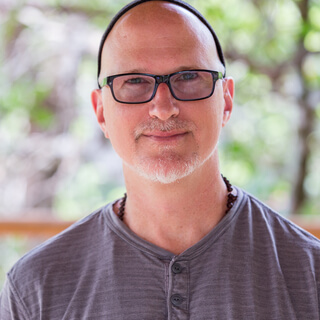
Enlightenment Within Conflict- Vayeira & Hebrew Letter ב BET
Spiritual awakening means transcending the ordinary problems, conflicts, and emotional dramas of life through an inner shift, whereby we dis-identify from the "Me" made out of thoughts and feelings, or "ego," and know ourselves as the field of awareness at the ground of all experience – open, spacious, and free. You can do this by "welcoming" everything arising in your experience, moment to moment. This is the practice of the Hebrew letter ב BET, and we explore it through the Torah portion, Parshat Vayeira, followed by a guided meditation.
Transcript
Shalom.
Welcome to the Tour of Awakening podcast,
Teachings and meditations rooted in Kabbalah and Chassidism through an integral lens.
I'm your host,
Rabbi Brian Yosef Schachter Brooks.
Spiritual awakening means transcending the ordinary problems,
Conflicts,
And emotional dramas of life through an inner shift,
Whereby we disidentify from the sense of me that is made out of thoughts and feelings,
Otherwise known as ego,
And instead come to know ourselves as the field of awareness at the ground of all experience,
Open,
Spacious,
And free.
This shift is nurtured by specific practices,
And one of the most fundamental and effective of these practices is the deliberate welcoming or saying yes to everything arising in our experience moment to moment.
This practice of inner hospitality is represented by the Hebrew letter Bet,
And we'll be exploring it through the Torah portion,
Parshat V'era,
Followed by a guided meditation.
Enjoy.
So this is the opening verse of the Parsha,
V'era Elav Adonai,
The divine appeared to him,
Meaning that Hashem is appearing to Avraham,
Be'elonei Mamre,
In the plains of Mamre.
He was sitting at the entrance of the tent,
V'hu Yoshev Petach Ha'ohel Kichom Hayom,
In the heat of the day.
So how do we see this in the deeper metaphorical level?
What is a tent?
A tent is just a barrier that defines your personal space.
There's a vast world outside,
But you put this flimsy material around you,
Call it a tent,
And you have some sense of separateness from the rest of the world,
Just like the ego.
There is a vast reality,
And we are in no way separate from that reality,
But we tend to identify with our bodies,
With our personalities,
Our personal stories,
And so on,
And call that me.
That's the ego,
That is the tent.
Yoshev Petach Ha'ohel,
He sits at the opening of his tent.
So Avraham,
Rather than shutting himself up inside the tent,
Sits in the opening.
In other words,
There's still a tent,
There's still a sense of me,
In that sense of the tent being the ego,
But he sits in the petach,
In the opening,
So there's also a sense that the space inside the tent and the space outside the tent are just one thing,
One space.
We can practice this by being aware that everything arising in our experience in this moment,
Both our perception of things outside the tent,
Meaning outside of our bodies,
Right,
What's going on right now around us in the room,
Wherever we are,
All of that stuff outside the body,
And also things inside the tent,
Such as our emotions and our thoughts,
Our sensations,
They're all arising in the one space that is our awareness.
You can still think of this tiny corner of your awareness that encompasses your body and heart and mind as me,
But the entirety of your experience,
Even your perception of the stars millions of light years away,
Are all arising in the one space that is your field of awareness,
And that is actually the deepest,
Truest you,
That formless,
Borderless field of awareness.
Vayar vayarat likratam.
When he saw them,
He ran to greet them,
Mi petach ha'ohel,
From the opening in the tent,
Meaning,
If you want to know this deepest you as spaciousness,
Then you have to consciously invite everything within your experience to exist,
Even if it's unpleasant.
And that is the key,
Because when you resist certain aspects of your experience,
That's the equivalent of shutting the flap on your tent and hiding inside,
So there's no more petach,
No more opening.
That's why Avraham is seen as the embodiment of hospitality.
He runs from the opening to greet his guests and offers them food.
He sits in the opening of his tent,
And whatever happens to come by,
He invites in.
Vayera elav Adonai,
The divine appeared to him.
So these opening words of the Parsha are really a description of how to relate to whatever appears in the moment,
Because when you consciously invite everything to be as it is,
You sit in the open space between separateness and oneness,
And you receive everything as a manifestation of the one thing.
Whether it appears as three men or as two angels,
It doesn't matter,
Because everything are forms of the one thing.
This verse here comes a little later in the part of the story when Avraham realizes that God is going to destroy Sodom,
And he protests.
Vayigash Avraham.
Abraham came forward,
Vayomar,
And he said,
Ha'af tispe tzadik imrasha?
Will you sweep away the innocent along with the guilty?
And this brings us to a kind of paradox,
Because when it is revealed to Abraham that God is going to destroy Sodom and Gomorrah,
He argues with God.
He tries to change the course of what's happening.
So on one hand,
He invites everything to be as it is,
But on the other,
He's arguing and trying to change it for the sake of compassion.
And this is really the supreme spiritual teaching.
It's a little hard to understand.
When we talk about acceptance,
About inviting everything to be as it is,
Our minds tend to go in the direction of passivity.
But this creates a false duality.
If we really invite everything to be as it is,
Then that includes our own desire for things to be different.
So on one hand,
We accept everything as it is,
But on the other,
Reality includes our own desire to change things.
Reality is not something static.
It's alive.
It's dynamic.
It's always in motion.
The distinction is that when we are hospitable to reality as it arises,
Inviting things to be as they are,
Rather than resisting how things are,
We can work for change from the spirit of love and openness,
Rather than from judgment and anger.
There is a hint in the opening words.
V'hu yoshev petah ha'ohel kechom ha'yom.
He was sitting in the opening of his tent in the heat of the day.
The word for the day is ha'yom,
Which can also mean today.
In other words,
Right now.
The word for heat,
Chom,
Can also mean warmth.
So in this sense,
Chom ha'yom could mean the warmth of presence.
In other words,
If you want to pierce through the separateness of things to the underlying divine unity,
You open your heart to this moment.
Warmly invite reality to be as it is,
And then when you act to change things,
Do it from a place of inviting change rather than forcing.
Even in those rare times when you do have to force something,
You can still do it from a place of love rather than resistance and anger.
Just like when you abruptly grab a child away from the danger of a precipice or an oncoming car,
Externally there might be a violent force in quality,
But of course you're not angry at the child,
You just have to act swiftly and effectively.
If you have the right kavanah,
The right attitude that arises from presence rather than resistance,
Then your action toward change will flow from the oneness and will be an expression of the oneness,
Even when there's conflict.
That's why Avraham can argue with God,
And yet the argument itself is an expression of God,
Because Avraham is arguing that God's compassion become manifest.
In a sense,
It is like God's prayer to himself,
Just as our practice is a kind of prayer to ourselves.
So let's do it.
May we welcome this moment as it is.
To do that,
We have to notice what is present right now in this moment.
Don't leave anything out.
Don't separate yourself from it.
Noticing the sensations of the senses.
What sounds do you hear?
What mood are you feeling?
Bringing attention to the sensation of the flow of breathing.
Letting the inside be as it is.
Letting the outside be as it is.
A prayer to ourselves.
May we let go of all resistance,
Being the welcoming space within which this moment arises.
May we be rachum v'chanun,
Erich apayim,
Compassionate,
Gracious,
Slow to anger.
This is the path of the letter Bet,
Which means house,
And represents this mida of hospitality,
Of welcome.
So let's take the pose of the letter Bet.
To create the shape of Bet,
You can bring your hands palms up in front of you,
And bowing your head slightly so that between your hands and your head,
You're creating the shape of the letter Bet.
Chanting the Kavanah,
The affirmation,
I am welcoming,
I am inviting,
I am hospitality.
A long out-breath,
Deep breath in,
And a chant for the letter Bet.
Ma tovu ohalecha Yaakov,
How good are your tents,
Your tents of welcome,
Oh Jacob.
Mishkanotecha Yisrael,
Translated here,
Your places of presence,
Because the word Mishkan is also a word for the temple in the wilderness,
The place where the divine presence manifested,
And also in that word is the word Shekhinah,
Which is divine presence,
The mystery of being,
The living presence in all things.
Ma tovu,
And preparing to come into meditation,
Bringing forth once again this attitude of generous offering of your attention to whatever is present,
Bringing your right hand to your heart,
And offering attentiveness with Lecha,
Deep breath in,
And bringing your left hand to your belly as awareness flows down and fills your belly with consciousness.
Radiating like light,
Permeating your organs,
Bringing life,
Healing energy to your organs,
Extending downward through the floor into the earth,
Rising up,
Chest,
Shoulders,
And neck,
Arms,
And hands,
And fingers,
Back to your heart and belly,
Bringing your attention more deeply into the flow of the breath,
Letting your breathing become a bit slower,
A bit more deep,
Rising into your face,
Facial muscles,
Brain and nervous system,
Bringing a little smile to your lips,
Being the loving,
Benevolent,
Indwelling presence,
Presence in the temple of the body,
Na'ase,
Deep breath in,
And bringing right hand to lightly touch your forehead as awareness shines out from the body into the space around you,
And recognizing that your perception of the world around you,
Objects,
The room,
The light,
The sounds,
All of it are arising in the field of consciousness,
And beyond the body,
Beyond thoughts,
Beyond feelings,
You are this field,
This field of sentience,
This field of awareness,
And affirming v'nishma,
Deep breath in,
Kissing your fingers,
Relaxing your hands,
Bono shalom,
May our focus be consistent,
May our memory be deep,
To remember moment to moment what we're doing,
Thoughts will come,
Distractions will come,
Bringing ourselves back again and again to this simple repetition of the tefilah,
Atyahu,
Atyahu,
Singing out loud first,
Atyahu,
Taking the tefilah to the inside,
Resting the mind in the silent repetition,
Atyahu,
Atyahu,
And bringing your body back into some movement from the stillness,
Giving your body a nice stretch,
May we remain grounded and integrated with this recognition that we can meet the divine in each moment through our relationship,
Through our attitude with whatever is arising in the moment,
Becoming skilled and practiced at this spirit of active welcoming of what is present,
Oh say shalom bimromav hu ya'aseh,
Shalom aleinu,
V'al ko yisrael,
V'al ko yoshvei tevel,
V'imru,
Amen.
4.0 (2)
Recent Reviews
Mary
November 10, 2025
I am weeping with delight and shaking with recognition. Thank you for such a powerful and awakening teaching. 🙏