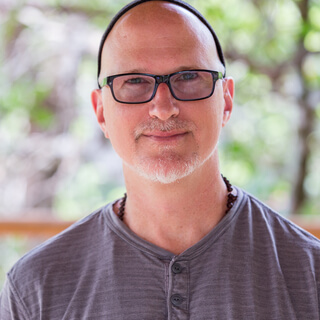
Welcome to the Torah of Awakening podcast,
Exploring meditation and consciousness in Kabbalah and Hasidism through an integral lens.
I'm your host,
Rabbi Brian Yosef Schachter-Brooks.
In this episode,
I'll be talking about the paradox of how humility and gratitude,
The attitudes of seeing oneself as small and insignificant,
And giving thanks for the simple blessing of being,
Can open up the experience of inner vastness,
Wholeness,
And completeness.
We'll be looking at all this through the lens of the Torah reading Parshat Ki Tisa,
Shemot,
Exodus 30.
11 through 34.
35.
We'll then have a guided meditation,
Including Hebrew chants for the Sphira of Hod on the Tree of Life,
And the letter Gimel.
We'll then have some time for quiet meditation,
During which I'll play soft piano music.
If you like,
You can pause the recording at that point,
Either to lengthen the silent meditation or to meditate without the piano.
I hope you enjoy,
And if you do,
You can help support this work by giving a like or a rating,
Leaving a comment or a review,
And subscribing or following.
And now,
On with the episode.
Enjoy.
This is our opening verse of the Parshat Ki Tisa et Rosh B'nei Yisrael,
Lif Kudei Hem.
When you take a census of the children of Israel according to their numbers,
V'natnu ish kofer nafsho ladonai bifkodotam.
Each shall give an atonement for their soul to the Divine when they are counted.
V'lo yiyeh vahem negev bifkodotam,
So that there won't be a negev,
A plague,
Among them when they are counted.
There's a story that a disciple once asked Rabbi Yechiel Michal,
The Magid of Zlochov.
Why is it that humility is the most important virtue,
Yet the Torah doesn't command us to be humble?
It only says that Moses was the most humble of men,
But it doesn't ever say that humility is a mitzvah,
A commandment.
That's because,
Replied the master,
If humility were a mitzvah,
We wouldn't be able to accomplish it.
We would end up having pride in our humility.
See,
That's the paradox.
6.
The essential quality of authentic spirituality involves wholeheartedly meeting reality as it appears on its own terms.
Which is to say,
Meeting the Divine in whatever happens.
The opposite of this is ego,
Which instead is concerned with how things conform or don't conform to our ideas of how we think things should be.
In this evaluating of everything not on its own terms,
But in relation only to the me of thoughts,
Opinions,
Feelings,
And so on,
The ego centers itself as the main character in the story.
To accomplish the task of transcending ego and meeting the Divine,
That is,
Meeting reality on its own terms,
Religion provides many traditions and devices,
But the irony is that the ego can co-opt all of these for its own self-bolstering purpose.
We all know that,
Right?
The person who is very religious and very knowledgeable,
But they're also very arrogant.
It's sad,
But it's true.
It happens sometimes.
Thus,
According to the Magid,
Humility must remain free from being a mitzvah.
It cannot become a quantifiable task to be accomplished.
It is at a level higher than any particular religious practice.
וְלֹוֹ יִיֵּוָהָם נֶּגֵּף בִּכֹּד אֹתָּם Then there will be no plague among them when they are counted.
So what does this verse mean?
The ego wants to count.
There is a self-image to maintain.
This is the Negev,
The root plague of being human.
זה יתנו כל העובר על הפקודים This they shall give all who pass through the counting.
מחזית השקל,
A half shekel,
תרומה לאדוני an offering to the Divine.
The ego is insatiable,
Never satisfied for long because it is by nature incomplete.
It is only a half shekel,
So to speak.
The only way to become complete and avert the plague is to make it a תרומה לאדוני an offering to the Divine.
So how do you do that?
First of all,
We have to notice within that impulse to be something.
To be recognized,
To be validated,
To be seen in a certain way.
Let that impulse be there.
There is no need to try to get rid of it because the trying to get rid of it is itself more ego.
It's itself not accepting the truth of the moment.
Let it be there,
But don't buy into it.
Don't give the ego any reality.
Recognize it's just a bundle of thoughts and feelings.
Offer it up like a תרומה,
Like an offering.
Oh HaShem,
I am only here to serve your purpose.
Let me be in alignment with you so that I may partake in your wholeness.
This is just one suggestion.
It's best in your own words.
And so part of the practice of prayer is becoming skillful in articulating these kinds of things.
In our own words,
Not just from a שדור,
From a prayer book.
In that letting go of the incomplete self into the One,
There can arise a completeness that is not dependent on any particular thing,
But it emerges and blossoms as a quality of awareness.
See,
From the perspective of the body and the perspective of ego,
Which is like the psychological body,
We are incomplete.
We constantly have to do things to chase after completeness just to survive.
That's natural.
But on the level of awareness,
Which is the aim of meditation,
Is to allow our sense of self to let go of the creature,
Let go of the person,
Let it be there,
But shift our identity into that field of awareness.
In that field is the experience,
The gift,
And the birthright of this wholeness.
This is represented by the letter Gimel,
Which describes the Divine as Gadol.
We could define that as great,
Vast,
Transcendent,
Whole,
Complete.
And as a counterpart to this recognition of the Divine as Gadol is a recognizing of the ego self,
That is,
Our normal,
Ordinary self,
As Katan,
Small,
Temporary,
Receiving its being from the greater reality.
And this is humility,
The antidote to ego creating a fertile field from which gratitude can sprout.
These are represented by the Sfira on the Tree of Life,
The Eitzchayim of Chod,
Humility and gratitude.
So this is an affirmation for the Sfira of Chod,
This one really centering on the gratitude aspect,
Which again is more,
It's easier to call forth,
Because if we say,
If we say,
I am humble,
It doesn't really work.
It's like the Maggid's insight at the beginning.
So,
I'm giving thanks,
I'm grateful,
That we can say.
Chanting together,
Feeling the vibrations of the words.
I am giving thanks.
I am grateful.
I am gratitude.
Now that you're comfortable with the words,
One more time.
Moday ani lefanecha,
Or modah.
Modah is the feminine,
Moday is the masculine.
Ha'machazir neshamot,
The one who returns souls.
This phrase,
Ha'machazir neshamot,
Is referring to just being alive in the morning.
Awakening from a state of lesser consciousness into the new day,
Which we all did recently.
But on a deeper level,
Neshamot,
Which means soul,
Can refer to the growing of consciousness,
The evolution of consciousness,
That we are not stuck at one level,
But we can put forth the energy to practice.
Thank God,
Baruch Hashem,
That we can practice together.
Moday,
Moday ani lefanecha,
Modah ani lefanecha,
Der neshamot,
Neshamot.
And preparing for meditation.
Bringing forth an attitude of offering your attention from your heart.
Attention as a gift of love.
Giving it unconditionally to however this moment is arising for you.
Bringing your right hand to your heart and offering with lecha,
Deep breath in,
And bringing your left hand to your belly Touch of the hand to the belly helping to bring awareness down to the body.
Feeling awareness shining down,
Pouring down,
Saturating your organs with consciousness,
Gratitude,
And healing energy.
Flowing downward through your legs down to your feet and toes.
Rising up,
Upper back,
Chest,
Shoulders and neck,
Flowing down,
Arms and hands and fingers,
Filling your body with consciousness,
Taking a nice deep conscious breath.
And awareness rising up,
Face,
Facial muscles,
Brain and nervous system.
Bringing a little smile to your lips,
Being the loving,
Benevolent,
Indwelling presence,
Life in the body.
And affirming,
Na'ase,
Deep breath in,
And bringing right hand to your forehead,
As the awareness filling the body shines out into the space around you.
Recognizing that beyond the body,
Beyond thoughts,
Beyond the personality,
Beyond the feelings,
You are this field of openness,
This field of awareness.
Essentially not separate from the whole,
From this mystery that we call the divine.
And affirming,
Benishma,
Deep breath in,
Kissing your fingers,
Relaxing your hands,
Erbono shel ulam,
Bless our practice today.
May we tap into and drink from the well of peace and wholeness inherent in our essence.
May we all be blessed to participate in this.
May it come to be reflected in our thoughts,
Our words and actions that this peace and wholeness,
This benevolence and love come to imbue the world with a movement in positive directions.
Atyahu Atyahu Atyahu The mind in a silent repetition,
Atyahu As we come into the silence,
Each moment in the silence allowing yourself to sink a little deeper from the world of thought into the world of awareness.
From doing into simply being.
Meditate for about 15 minutes.
Coming back together,
Taking a stretch.
Path that we mentioned in the teaching,
The path of Gimel.
Wholeness,
Abundance qualities describing the field of awareness that we are and let's affirm I am overflowing,
I am whole,
I am abundance.
And our chant Gadol Hashem what we call the divine is this inner wholeness completeness.
We are not aved we are not a slave to any particular experience we are the free and open space Shelo Asani Aved Gadol Hashem Shelo Asani Aved Shelo Asani Aved Shelo Asani Aved Shelo Asani Aved Shelo Asani Aved Preparing to close the meditation bringing right hand to your heart offering attention from the heart with Lecha deep breath in and bringing left hand to your belly feeling awareness filling the inner space of the body Nase Nase and bringing right hand to lightly touch your forehead awareness opening out into space being the open and vast Gadol the field of awareness itself Venishma Venishma kissing your fingers relaxing your hands let these qualities of Gimel of wholeness of completeness overflowing generosity as well as that inner sense of humility of being part of something much larger and that we can take the focus off of our own egoic impulses and instead open to that vastness inherent in everything that we meet Oseh Shalom Bimromav Hu Yaaseh Shalom Aleinu V'Yalko Yisrael V'Yalko Yishve Tevel V'Yimru Amen I hope you've enjoyed this learning and practice session if you have you can help support by giving a like or a rating leaving a comment or a review and subscribing or following until next time all blessings