Hello and welcome.
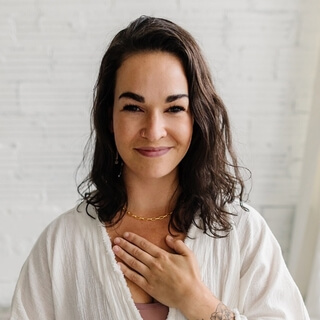
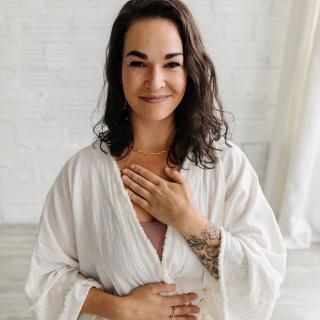
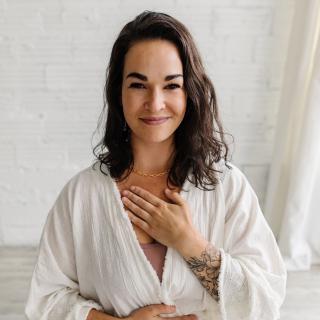
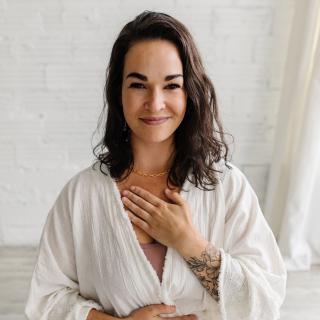
My name is Caitlin and today I will be guiding you through a breath practice called Lion's Breath also known as Simha or Simhasana Pranayama.
Lion's Breath focuses on the force to exhale with a vocalization that sounds like ha.
So as we exhale,
You're going to be opening your mouth,
Letting the tongue come out of the mouth and saying ha as you're pushing the air out of the lungs.
Another layer of this breath is that you can gaze up either towards the sky or towards your third eye chakra while you are exhaling as well.
What this does is we are opening and activating all of the muscles in the in the neck,
In the throat,
Throughout the face,
The forehead,
And even in the ocular band where the eyes are.
There's a lot of tension that gets stored in the face and in the head and behind the eyes and this can be really relieving for a lot of stress.
This can be helpful for headaches and also again it can be helpful for bringing energy into the body.
So we're going to be starting in a seated position.
So you can either start with your knees bent,
Sitting back on your heels on the floor or on a yoga mat,
Or if you would like you can sit in a chair or on the side of a bed with your feet firmly planted on the ground.
Whichever way you choose,
Come into that posture now and we're going to be placing both of the hands on the tops of the legs.
So just above the knees on the thighs.
We're going to keep our hands really firmly planted here throughout this practice.
It is easy to over activate some of the muscles in the neck and the throat and maybe even across the shoulders.
So there's value in keeping the hands here really planted on the thighs so that you can use use that to push against.
So you are kind of pushing your shoulders down away from the ears.
You could even pull your shoulder blades together if that feels supportive,
Opening up that space across the chest,
Across the heart as well.
Not a requirement,
But just an additional suggestion to support the body.
So let's begin just starting by connecting with the ground.
Really wanting to feel centered and anchored into this moment.
Feeling the ground either beneath your shins if you are sitting on your knees or beneath your feet if you're seated in a chair.
Feeling the firmness and the support of the earth beneath you.
Trusting and knowing that you are held that you are supported.
And you're just breathing normally here.
We're not trying to change the breath yet.
Not trying to activate the lion's breath.
Just noticing the breath moving into your lungs and then back out into the world.
And taking a moment to notice your body.
Noticing if there's any areas of tension.
Noticing if there's any discomfort or openness.
Feeling the blood running through your veins,
That energy surging through your body.
And if you can,
Tune into the beating of your heart.
Quieting the mind.
Listening to the body.
We're going to begin breathing more intentionally.
Inhaling through the nose.
And exhaling through the nose.
Allowing your inhales and your exhales to be the same length.
If it's helpful,
You can count.
Inhale two,
Three,
Four.
Exhale two,
Three,
Four.
Raising and lowering your shoulders to relax them.
Inviting in just a deeper sense of calm into the body.
And now together let's invite a full inhale.
And at the top of it,
Open the mouth.
And on the exhale with the mouth as wide open as you can get it and the tongue out,
Let it go with the ha.
Squeezing all of the air out of the lungs,
Still keeping the spine straight.
Breathing in through the nose.
Letting it go with the ha.
Bringing that gaze up to the sky.
Another breath in through the nose.
Mouth open,
Tongue out.
Relax the jaw and the neck.
Breathe in through the nose.
Letting it go with the ha.
Breathe in.
Mouth open,
Let it go.
Letting those eyes gaze up to the sky or to the third eye.
We're going to do two more big breath in.
Letting it go,
Lion's breath.
Last one here,
Breathe in.
Nice and full.
And letting it go,
Mouth open as wide as possible,
Stretching all the muscles in your face.
Eyes up to the sky.
Now coming back to a normal slower breath,
Breathing just in the nose and maybe gently out the mouth.
Noticing what is happening in the body.
Noticing any discomfort,
Any emotions that may be present,
Just allowing yourself to breathe with them.
Let your breath really support you.
Connecting again with the crown beneath you.
Maybe squeezing the thighs,
Touching the legs,
Feeling the energy in this lower half of the body as well,
Grounding down into the earth.
Feel free to continue this cycle.
I would like you to feel free to continue this cycle.
I would recommend starting with doing five lion's breaths and then coming back into a calm,
More regulated breath pattern and then moving up into ten or more times.
Trusting each inhale and really allowing that exhale to be supportive in releasing this excess energy,
The face,
In the eyes,
In the neck,
The jaw,
Allowing that ah to really vocalize and force that breath out of the lungs.
I hope that you enjoy and that this is supportive.
If needed,
As always,
You can spend some time coming into a journaling exercise and just writing down what you notice moving through your body.
Maybe recalling how you felt at the beginning of this practice and then notating the difference in how you feel at the end.
And feel free to alter the number of breaths,
Take additional resourcing,
Inhales in between,
Whatever feels most supportive and nourishing to your body.
Thank you so much and I hope that you enjoyed Lion's Breath.