Hi,
And welcome to Spiritual Sobriety.
I'm your host,
Chris McDuffie.
Today we will discuss the Three Jewels of Buddhism and how they relate to the principles of AA and the 12-step programs.
I won't go into great detail about the life of the Buddha or his entire path of becoming awoken.
I will do that more in future podcasts,
But for now,
Here's a brief primer.
Buddha's birth name was Siddhartha Gautama,
Born in a wealthy noble family in India,
Roughly 500 years before the birth of Christ.
The term Buddha is a Hindu term,
Which comes from the root Pali word budh,
Which means to awaken.
In the Hindu religion,
The Buddhas were seen as ranking higher than the gods.
The term to enlighten one comes from the Victorian English translation,
And I find that that term doesn't do justice to the original Pali definition,
And I tend not to use it.
As I introduce each jewel,
Consider how it relates to spirituality and your own recovery work.
I'd also like you to consider how each jewel might correspond to the 12-step principles.
You may recall I chose to define spirituality in a recent podcast,
Defining Spirituality.
There I chose to define spirituality as bonding in love or simply love.
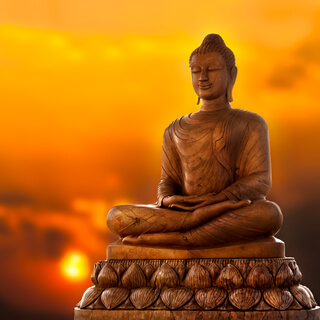
The first jewel is the Buddha.
Here Buddhists celebrate the man and his triumphant ability to awaken himself to the causes of suffering.
Remember,
In Buddhism,
The Buddha is generally not considered a god or a saint in any sense.
Rather,
The Buddhists celebrate the realization that if this one man could attain awakening,
They too might awaken in this present lifetime.
To be clear,
Awoken refers to being mindfully present and fully aware of one's actions and their true nature.
Consider the modern-day opposite,
Trudging through life drunk,
High,
Or mindlessly marching through a marriage or career,
While feeling numb and asleep,
Walking through life while fixed on the past or future.
Yes,
Humans did this too,
500 years before the birth of Christ.
Another key component of the first jewel is the concept of taking refuge and awakening.
Here Buddhists are referring to having a spiritual awakening,
Which allows them to finally see the spiritual essence within all of us.
This includes realizing that we are all born with what Buddha called our Buddha nature.
The Buddha nature could be defined as loving awareness.
The second jewel of Buddhism is the Dharma.
The term Dharma is a Pali word that has many meanings in Buddhism.
The Dharma is typically referred to the canon of public teachings of the Buddha that offered steps towards awakening and living a spiritual life.
In this second jewel,
We again see the concept of taking refuge.
Here,
Buddhists take refuge in the path of mindfulness,
Understanding,
And love,
Which is accomplished through the learning and practices of Buddha's teachings.
Consider the image of a refuge as a safe sanctuary.
For many of us,
It may be the rooms of AA.
To be clear,
Buddha's teachings are generally not considered to be heaven sent or sent from God or the gods.
Also,
It is important to point out that Buddha offered his Dharma teachings as suggestions,
Not moral laws or mandates.
As Buddhist scholar Joseph Goldstein points out,
The Buddha essentially said,
This is what works for me.
See for yourself if my suggestions help you to awaken in this lifetime also.
Note that I mentioned in this lifetime,
Which refers to the Buddhist and Hindu concept of reincarnation.
Buddha was basically saying,
Why wait to begin while you're suffering right now?
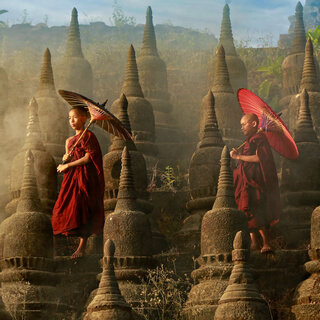
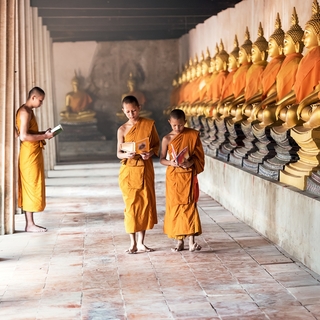
The third jewel of Buddhism is the Sangha.
The word Sangha is probably for the community itself.
Here,
Buddhists take refuge in their community,
The family,
Or as we see in AA,
The fellowship.
In the Sangha,
Buddhists learn to practice loving awareness and loving kindness in their relationships with one another,
While developing trust in each other.
Buddha was asked by a student,
Of the three jewels,
Which is the most important?
The Buddha is said to have replied,
The Sangha.
It is the spiritual bonding and love with others that is the ultimate objective in Buddhism.
Buddha was then asked by a student,
What about a bad Sangha?
Should we leave it or stay?
The Buddha is said to have replied,
A bad Sangha is better than no Sangha.
I like to tell this to my clients who don't want to go to sober living or attend 12-step meetings.
So consider for yourself how you might use the three jewels of Buddhism as spiritual objectives to enhance your sobriety and living.
Were you able to see the commonalities of the three jewels of Buddhism and the 12-step principles?
I hope that you found today's discussion helpful to your spiritual sobriety.
Before we end,
I'd like to lead you through a brief meditation.
This will be a sitting meditation.
I invite you to sit in a relaxed,
Attentive posture.
I invite you to have your eyes open or closed or shaded.
And just feel for a moment the body relaxing,
Not too tense,
Not too relaxed,
Grounded and centered right through the floor,
The ground,
And the chair that's holding you.
See if you can sit 5% more comfortably,
Relaxing any tension that may have arisen.
If your eyes are closed,
I invite you to gaze gently between the third eye,
Between your eyebrows.
In Sanskrit,
That inner gaze is called your drishti.
So here our drishti is gently relaxed between our eyebrows.
At the same time,
I have awareness of my body.
And now the breath itself.
Please do not sit in discomfort.
If you ever need to stand up and stretch or relax,
Please do.
As you come back to the awareness of the body,
Now bring awareness to the breath.
If you'd like,
You could even put your hand over your heart and feel the gentle rising nature of your inhale and the falling and calming,
Relaxing exhale that brings you relaxed and closer to the chair and the ground that's holding you.
Long,
Slow awareness of that inhale.
And a long,
Slow,
Relaxing awareness of the exhale.
Here we are not controlling the breath.
Instead,
I invite you to watch your breath like watching leaves floating down a stream.
There's the inhale.
And there's the exhale.
Distractions are part of the practice.
The mind and the ego will wander off the body,
Off the breath,
Distracted by the six senses.
In Buddhism,
There's considered six senses,
Not five.
And here you get a chance to draw your awareness back from the distractions and bring your awareness back home to the body and home to the breath anytime the mind wandered away.
Noticing there's a beginning,
A middle,
And an end to the inhale.
And notice there's a beginning,
A middle,
And an end to the exhale.
Relax the body with any tension that may have arisen.
Our eyes are still between our third eye if our eyes are closed.
And being aware of the breath cycle,
Let the breath breathe you.
Now notice that the top of the inhale is a gap just before the exhale starts.
Now notice there's a gap at the bottom of the exhale just before the inhale begins.
Let's conclude by drawing our awareness now finally back to our nostrils.
And we'll end with a final cleansing inhale.
In the nose,
The chest rises to the blue sky above.
Hold it in.
And a long,
Slow exhale out your mouth if you prefer.
Maybe the mouth or the nose.
And gently opening your eyes.
Thank you for joining me today.
I look forward to hearing your feedback and thoughts on today's segment.
And I look forward to seeing you next time.
Namaste.