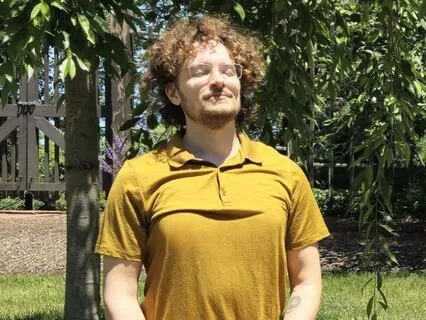
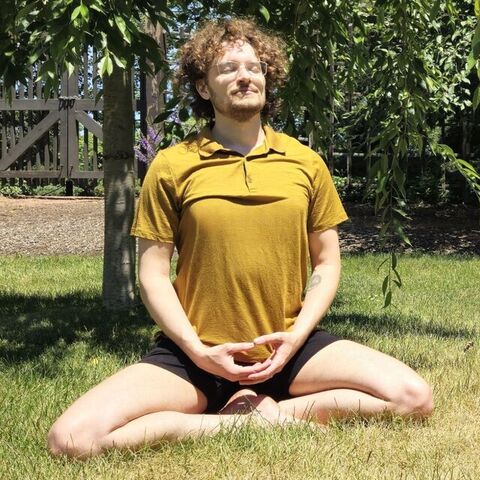
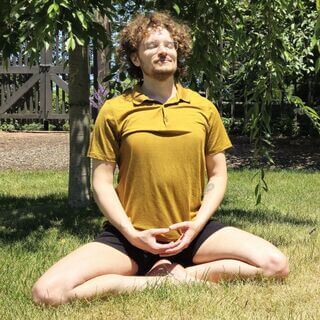
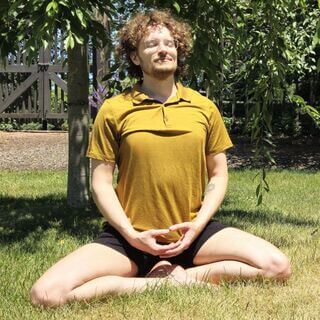
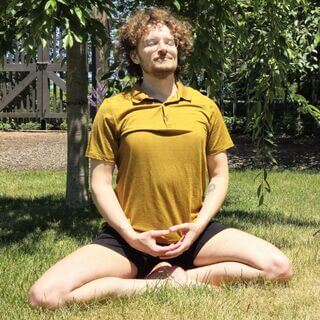
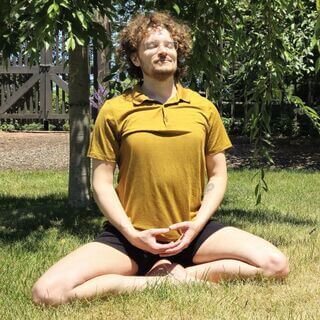
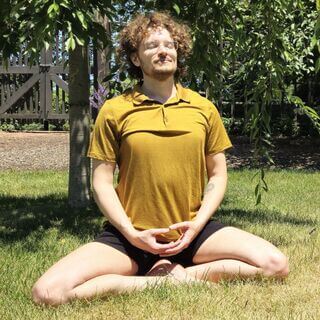
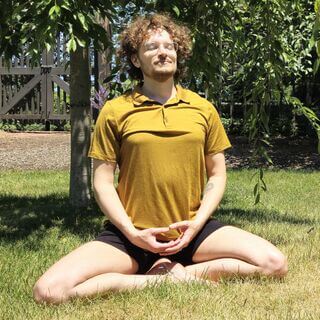
Let's begin by settling into a comfortable position.
If you're sitting on a chair,
Try sitting on the front third of your seat,
With your back tall and upright,
Allowing the natural curve of your spine to stay intact.
Place your feet flat on the floor and rest your hands in your lap,
Wherever feels natural.
This posture helps the body stay alert,
Yet relaxed.
If it feels comfortable,
Lower your gaze or gently close your eyes.
The meditation will begin at the sound of the bell.
Start by noticing the physical sensations in your body.
Bring your awareness to where your body makes contact with the surface beneath you.
Feel the stability of the chair,
Cushion,
Or floor supporting you.
Notice any tension in the body and see if you can soften just a little,
Not forcing,
Just allowing.
We're going to practice 4-7-8 breathing,
A technique that helps regulate the nervous system.
It can be especially useful when you're feeling activated or overwhelmed,
Helping to bring the body back to baseline.
Even if you're not experiencing heightened stress,
This technique promotes relaxation and overall well-being.
If at any point this breathing pattern feels uncomfortable,
Simply return to a natural breath.
The goal is to support your body,
Not force anything.
On my count,
We will inhale for a count of 4,
Hold for the count of 7,
And exhale slowly to the count of 8.
I will guide us through 3 rounds of this.
Inhale 2 3 4 Hold 2 3 4 5 6 7 Exhale 2 3 4 5 6 7 8 Inhale 2 3 4 Hold 2 3 4 5 6 7 Exhale 2 3 4 5 6 7 8 Inhale 2 3 4 Hold 2 3 4 5 6 7 Exhale 2 3 4 5 6 7 8 Allow your breathing to return to its natural rhythm.
Simply observe it,
No need to change or control it.
Now,
Shift your attention to the sensations of your breath.
You might notice the coolness of the air as it enters your nostrils or the warmth as it leaves.
Perhaps you feel the gentle expansion and contraction of your belly with each breath.
When your mind begins to wander,
That's completely okay.
Each time you notice,
Gently guide your focus back to the breath.
This is a moment of mindfulness.
If it feels okay,
You might bring to mind a recent challenge,
Difficulty,
Or moment of self-doubt.
Nothing too overwhelming,
Just something that has caused discomfort or stress.
We're looking for a challenge the size of a stone you can hold in the palm of your hand,
Avoiding a boulder or large rock.
If this feels too much,
You can also focus on a general sense of discomfort rather than a specific situation.
Once you have your difficulty,
Notice how it feels in your body.
Is there tightness?
A heaviness?
A sensation in your chest,
Throat,
Or stomach?
Rather than resisting or pushing it away,
Simply acknowledge the struggle.
You might say to yourself,
This is a moment of suffering.
This is hard for me right now.
I'm feeling sad,
Frustrated,
Overwhelmed,
And that's okay.
Recognizing our pain is the first step towards self-compassion.
The next step is to offer ourselves kindness.
This can be very challenging because many of us were not taught to speak kindly to ourselves,
And we may even believe that self-compassion is selfish or self-indulgent.
However,
Research shows that self-kindness actually builds resilience and emotional well-being,
Allowing us to show up more fully for ourselves and others.
Imagine a dear friend sitting beside you,
Someone you deeply care for.
How would you comfort them in this moment?
What words might you say?
Now,
Let's try offering ourselves that same kindness.
You might say to yourself,
I'm doing the best I can.
May I be kind to myself in this moment.
I deserve compassion,
Just like everyone else.
If it feels comfortable,
Place a hand on your heart,
Belly,
Or another soothing spot as a physical reminder of care and support.
Feel the warmth and gentle pressure connecting with yourself in a loving way.
You might silently repeat a self-compassion mantra,
Such as,
I am enough.
I choose to treat myself with kindness.
I am worthy of love and care.
If you are really struggling,
You can incorporate the mantra with the breath,
Saying to yourself,
I am,
On the inhale,
And enough on the exhale.
I am enough.
Let these words settle in.
Let's borrow some phrases from Dr.
Kristen Neff,
The pioneer in self-compassion research.
Say to yourself,
May I be safe.
May I be peaceful.
May I be kind to myself.
And may I accept myself as I am.
May I be safe.
May I be peaceful.
May I be kind to myself.
And may I accept myself as I am.
May I be safe.
May I be peaceful.
May I be kind to myself.
And may I accept myself as I am.
On your next exhale,
Let those words go.
Take a moment to notice how you feel.
Give yourself gratitude for choosing to make time to find and cultivate some self-compassion.
As the meditation slowly comes to a close,
Feel the support beneath you.
Slowly begin to bring movement back into your body.
Wiggle your fingers and toes.
Bring any small,
Light movement that calls to you.
When you feel ready,
Gently open your eyes,
Carrying this sense of compassion with you.
The meditation will end at the sound of the bell.
Thank you for listening.
Thank you for this practice and for your commitment to healing yourself and treating yourself with the gentleness and kindness you deserve.
This act also helps us heal those we surround ourselves with,
And for that,
I'm immensely grateful.
See you next time.