Welcome to this guided meditation for sleep and storytelling.
Focus on the sound of my voice and feel free to fall asleep at any time.
Tales of Greek Mythology Herakles,
Also known as Hercules.
Herakles,
The most renowned hero of antiquity,
Was the son of Zeus and Alcmene and the great grandson of Perseus.
At the time of his birth,
Alcmene was living at Thebes with her husband Amphitryon and thus the infant Herakles was born in the palace of his stepfather.
Aware of the animosity with which Hera persecuted all those who rivaled her in the affections of Zeus,
Alcmene,
Fearful lest this hatred should be visited on her innocent child,
Entrusted him soon after his birth.
To the care of a faithful servant with instructions to expose him in a certain field and there leave him,
Feeling assured that the divine offspring of Zeus would not long remain without the protection of the gods.
Soon after the child has been thus abandoned,
Hera and palace Athena happen to pass by the field and were attracted by its cries.
Athena pittingly took up the infant in her arms and prevailed upon the queen of heaven to put it to her breast,
But no sooner had she done so than the child,
Causing her pain,
She angrily threw him to the ground and left the spot.
Athena moved with passion,
Carried him to Alcmene and entreated her kind officers on behalf of the poor little fawnling.
Alcmene at once recognized her child and joyfully accepted the charge.
Soon afterwards Hera,
To her extreme annoyance,
Discovered whom she had nursed and became filled with jealous rage.
She now sent two venomous snakes into the chamber of Alcmene,
Which crept,
Unperceived by the nurses,
To the cradle of the sleeping child.
He awoke with a cry and,
Grasping a snake in each hand,
Strangled them both.
Alcmene and her attendants,
Whom the cry of the child had awakened,
Rushed to the cradle where,
To their astonishment and terror,
They beheld the two reptiles dead in the hands of the infant Heracles.
Amphitryon was also attracted to the chamber by the commotion,
And when he beheld this astounding proof of supernatural strength,
He declared that the child must have been sent to him as a special gift from Zeus.
He accordingly consulted the famous seer Tiresias,
Who now informed him of the divine origin of his stepson and prognosticated for him a great and distinguished future.
When Amphitryon heard the whole noble destiny which awaited the child entrusted to his care,
He resolved to educate him in a manner worthy of his future career.
At a suitable age he himself taught him how to guide a chariot,
Eurytus how to handle the bow,
Aetolicus dexterity in wrestling and boxing,
And Castor the art of armed warfare,
Whilst Linus,
The son of Apollo,
Instructed him in music and letters.
Heracles was an apt pupil,
But undue harshness was intolerable to his high spirit,
And old Linus,
Who was not the gentlest of teachers,
One day corrected him with blows,
Whereupon the boy angrily took up his lyre and with one stroke of his powerful arm killed his tutor on the spot.
Apprehensive lest the ungovernable temper of the youth might again involve him in similar acts of violence,
Amphitryon sent him into the country where he placed him under the charge of one of his most trusted herdsmen.
Here as he grew up to manhood,
His extraordinary stature and strength became the wonder and admiration of all beholders.
His aim,
Whether with spear,
Lance,
Or bow,
Was unerring,
And at the age of eighteen he was considered to be the strongest as well as the most beautiful youth in all Greece.
THE CHOICE OF HERACLES Heracles felt that the time had now arrived when it became necessary to decide for himself how to make use of the extraordinary powers with which he had been endowed by the gods,
And in order to meditate in solitude on this all-important subject,
He repaired to a lonely and secluded spot in the heart of the forest.
Here two females of great beauty appeared to him,
One was vice,
The other virtue.
The former was full of artificial wiles and fascinating arts,
Her face painted and her dress gaudy and attractive,
Whilst the latter was of noble bearing and modest mien.
Her robes of spotless purity.
Vice stepped forward and thus addressed him,
If you will walk in my paths and make me your friend,
Your life shall be one round of pleasure and enjoyment.
You shall taste of every delight which can be procured on earth.
The choicest wines,
The most delicious wines,
The most luxuriant of couches shall be ever at your disposal,
And all this without any exertion on your part either physical or mental.
Virtue now spoke in her turn,
If you will follow me and be my friend,
I promise you the reward of a good conscience and the love and respect of your fellow men.
I cannot undertake to smooth your path with roses or to give you a life of idleness and pleasure.
For you must know that the gods grant no good and desirable thing that is not earned by labor,
And as soon as you sow,
So you must reap.
Herakles listened patiently and attentively to both speakers,
And then,
After mature deliberation,
Decided to follow in the paths of virtue,
And henceforth to honor the gods and to devote his life to the service of his country.
Full of these noble resolves,
He sought once more his rural home,
Where he was informed that on Mount Sitheron,
At the foot of which the herds of Amphitryon were grazing,
A ferocious lion had fixed his lair,
And was committing such frightful ravages among the flocks and herds that he had become the scourge and terror of the whole neighborhood.
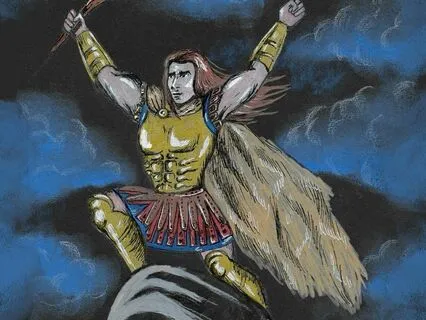
Herakles at once armed himself and ascended the mountain,
Where he soon got sight of the lion,
And rushing at him with his sword,
Succeeded in killing him.
The hide of the animal he wore ever afterwards over his shoulders and the head served him as a helmet.
As he was returning from this,
His first exploit,
He met the heralds of Erginus,
The king of Minions,
Who were proceeding to Thebes to demand their annual tribute of a hundred oxen.
Indignant at this humiliation of his native city,
Herakles mutilated the heralds and sent them back with ropes round their necks to their royal master.
Erginus was so incensed at the ill treatment of his messengers that he collected an army and appeared before the gates of Thebes,
Demanding the surrender of Herakles.
Creon,
Who was at this time king of Thebes,
Fearing the consequences of a refusal,
Was about to yield when the hero,
With the assistance of Amphitryon and a band of brave youths,
Advanced against the Minions.
Herakles took possession of an arrowed phial through which the enemy were compelled to pass,
And as they entered the pass,
The Thebans fell upon them,
Killed their king Erginus,
And completely routed them.
In this engagement,
Amphitryon,
The kind friend and foster father of Herakles,
Lost his life.
The hero now advanced upon Archiminus,
The capital of the Minions,
Where he burned the royal castle and sacked the town.
After this signal of victory,
All Greece rang with the fame of the young hero,
And Creon,
In gratitude for his great services,
Bestowed upon him his daughter Megara in marriage.
The Olympian gods testified their appreciation of his valor by sending him presents.
Hermes gave him a sword,
Apollo a bundle of arrows,
Hephaestus a golden quiver,
And Athena a coat of leather.
Thank you so much for listening,
And enjoy the rest of your sleep.
Good night.