Welcome to this guided meditation for sleep and storytelling.
Focus on the sound of my voice and feel free to fall asleep at any time.
Tales of Greek Mythology Herakles,
Also known as Hercules.
Herakles,
The most renowned hero of antiquity,
Was the son of Zeus and Alcmene and the great grandson of Perseus.
At the time of his birth,
Alcmene was living at Thebes with her husband Amphitryon,
And thus the infant Herakles was born in the palace of his stepfather.
Aware of the animosity with which Hera persecuted all those who rivaled her in the affections of Zeus,
Alcmene,
Fearful lest this hatred should be visited on her innocent child,
Entrusted him soon after his birth.
To the care of a faithful servant with instructions to expose him in a certain field and there leave him,
Feeling assured that the divine offspring of Zeus would not long remain without the protection of the gods.
Soon after the child has been thus abandoned,
Hera and Pallas Athena happen to pass by the field and were attracted by its cries.
Athena pittingly took up the infant in her arms and prevailed upon the queen of heaven to put it to her breast,
But no sooner had she done so than the child,
Causing her pain,
She angrily threw him to the ground and left the spot.
Athena moved with passion,
Carried him to Alcmene and entreated her kind officers on behalf of the poor little foundling.
Alcmene at once recognized her child and joyfully accepted the charge.
Soon afterwards,
Hera,
To her extreme annoyance,
Discovered whom she had nursed and became filled with jealous rage.
She now sent two venomous snakes into the chamber of Alcmene,
Which crept,
Unperceived by the nurses,
To the cradle of the sleeping child.
He awoke with a cry and,
Grasping a snake in each hand,
Strangled them both.
Alcmene and her attendants,
Whom the cry of the child had awakened,
Rushed to the cradle where,
To their astonishment and terror,
They beheld the two reptiles dead in the hands of the infant Heracles.
Amphitryon was also attracted to the chamber by the commotion,
And when he beheld this astounding proof of supernatural strength,
He declared that the child must have been sent to him as a special gift from Zeus.
He accordingly consulted the famous seer Tiresias,
Who now informed him of the divine origin of his stepson and prognosticated for him a great and distinguished future.
When Amphitryon heard the whole noble destiny which awaited the child entrusted to his care,
He resolved to educate him in a manner worthy of his future career.
At a suitable age,
He himself taught him how to guide a chariot,
Eurytus how to handle the bow,
Atollicus dexterity in wrestling and boxing,
And Castor the art of armed warfare,
Whilst Linus,
The son of Apollo,
Instructed him in music and letters.
Heracles was an apt pupil,
But undue harshness was intolerable to his high spirit,
And old Linus,
Who was not the gentlest of teachers,
One day corrected him with blows,
Whereupon the boy angrily took up his lyre and with one stroke of his powerful arm killed his tutor on the spot.
Apprehensive lest the ungovernable temper of the youth might again involve him in similar acts of violence,
Amphitryon sent him into the country where he placed him under the charge of one of his most trusted herdsmen.
Here,
As he grew up to manhood,
His extraordinary stature and strength became the wonder and admiration of all beholders.
His aim,
Whether with spear,
Lance,
Or bow,
Was unerring,
And at the age of eighteen he was considered to be the strongest as well as the most beautiful youth in all Greece.
The Choice of Heracles Heracles felt that the time had now arrived when it became necessary to decide for himself how to make use of the extraordinary powers with which he had been endowed by the gods,
And in order to meditate in solitude on this all-important subject,
He repaired to a lonely and secluded spot in the heart of the forest.
Here two females of great beauty appeared to him.
One was vice,
The other virtue.
The former was full of artificial wiles and fascinating arts,
Her face painted and her dress gaudy and attractive,
Whilst the latter was of noble bearing and modest mien,
Her robes of spotless purity.
Vice stepped forward and thus addressed him,
If you will walk in my paths and make me your friend,
Your life shall be one round of pleasure and enjoyment.
You shall taste of every delight which can be procured on earth.
The choicest wines,
The most delicious wines,
The most luxuriant of couches shall be ever at your disposal,
And all this without any exertion on your part either physical or mental.
Virtue now spoke in her turn,
If you will follow me and be my friend,
I promise you the reward of a good conscience and the love and respect of your fellow men.
I cannot undertake to smooth your path with roses or to give you a life of idleness and pleasure,
For you must know that the gods grant no good and desirable thing that is not earned by labour,
And as soon as you sow,
So you must reap.
Herakles listened patiently and attentively to both speakers,
And then,
After mature deliberation,
Decided to follow in the paths of virtue,
And henceforth to honour the gods and to devote his life to the service of his country.
Full of these noble resolves,
He sought once more his rural home,
Where he was informed that on Mount Sitheron,
At the foot of which the herds of Amphitryon were grazing,
A ferocious lion had fixed his lair,
And was committing such frightful ravages among the flocks and herds that he had become the scourge and terror of the whole neighbourhood.
Herakles at once armed himself and ascended the mountain,
Where he soon got sight of the lion,
And,
Rushing at him with his sword,
Succeeded in killing him.
The hide of the animal he wore ever afterwards over his shoulders and the head served him as a helmet.
As he was returning from this,
His first exploit,
He met the heralds of Urginus,
The king of Minions,
Who were proceeding to Thebes to demand their annual tribute of a hundred oxen.
Indignant at this humiliation of his native city,
Herakles mutilated the heralds and sent them back with ropes round their necks to their royal master.
Urginus was so incensed at the ill treatment of his messengers that he collected an army and appeared before the gates of Thebes,
Demanding the surrender of Herakles.
Creon,
Who was at this time king of Thebes,
Fearing the consequences of a refusal,
Was about to yield when the hero,
With the assistance of Amphitryon and a band of brave youths,
Advanced against the Minions.
Herakles took possession of an arrowed file through which the enemy were compelled to pass,
And as they entered the pass the Thebans fell upon them,
Killed their king Urginus and completely routed them.
In this engagement Amphitryon,
The kind friend and foster father of Herakles,
Lost his life.
The hero now advanced upon Archiminus,
The capital of the Minions,
Where he burned the royal castle and sacked the town.
After this signal of victory,
All Greece rang with the fame of the young hero and Creon,
In gratitude for his great services,
Bestowed upon him his daughter Megara in marriage.
The Olympian gods testified their appreciation of his valor by sending him presents.
Hermes gave him a sword.
Apollo,
A bundle of arrows,
Hephaestus,
A golden quiver,
And Athena,
A coat of leather.
Herakles and Eurystheus,
And now it will be necessary to retrace our steps.
Just before the birth of Herakles,
Zeus,
In an assembly of the gods,
Exultingly declared that the child who should be born on that day to the house of Perseus should rule over all his race.
When Hera heard her lord's boastful announcement,
She knew well that it was for the child of the hated Alcmene that this brilliant destiny was designed.
And in order to rob the son of her rival of his rights,
She called to her aid the goddess Elythia,
Who slowed down the birth of Herakles and caused his cousin Eurystheus,
Another grandson of Perseus,
To precede him into the world.
And thus,
As the word of the mighty Zeus was revocable,
Herakles became the subject and servant of his cousin,
Eurystheus.
When,
After his splendid victory over Erginus,
The fame of Herakles spread throughout Greece,
But Eurystheus,
Who had become king of Mycenae,
Jealous of the reputation of the young hero,
Asserted his rights and commanded him to undertake for him various difficult tasks.
But the proud spirit of the hero rebelled against this humiliation and he was about to refuse compliance when Zeus appeared to him and desired him not to rebel against the fates.
Herakles now repaired to Delphi in order to consult the oracle and received the answer that,
After performing ten tasks for his cousin Eurystheus,
His servitude would be at an end.
Soon afterwards,
Herakles fell into a state of the deepest melancholy and through the influence of his inveterate enemy,
The goddess Hera,
This despondency developed into raving madness in which condition he killed his own children.
When he at length regained his reason,
He was so horrified and grieved at what he had done that he shut himself in his chamber and avoided all intercourse with men.
But in his loneliness and seclusion,
The conviction that work would be the best means of procuring oblivion of the past decided him to enter,
Without delay,
Upon the tasks appointed him by Eurystheus.
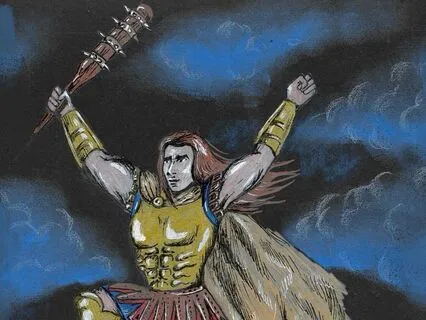
His first task was to bring to Eurystheus the skin of the much-dreaded Nemean lion which ravaged the territory between Cleon and Nemea and whose hide was invulnerable against any mortal weapon.
Herakles proceeded to the forest of Nemea where,
Having discovered the lion's lair,
He attempted to pierce him with his arrows,
But finding these of no avail,
He felled him to the ground with his club and,
Before the mighty animal had time to recover from the terrible blow,
Herakles seized him by the neck and,
With a mighty effort,
Succeeded in strangling him.
He then made himself a coat of mail of the skin and a new helmet of the head of the animal.
Thus attired,
He so alarmed Eurystheus by appearing suddenly before him that the king concealed himself in his palace and henceforth forbade Herakles to enter his presence but commanded him to receive his behests for the future through his messenger,
Capreous.
2.
The Hydra His second task was to slay the Hydra,
A monster serpent and the offspring of Typhoon and Echidna,
Bristling with nine heads,
One of which was immortal.
This monster infested the neighborhood of Lerna where she committed great depredations among the herds.
Herakles,
Accompanied by his nephew Eulaus,
Set out in a chariot for the marsh of Lerna in the slimy waters of which he found her.
He commenced the attack by assailing her with his fierce arrows in order to force her to leave her lair,
From which she at length emerged and sought refuge in a wood on a neighboring hill.
Herakles now rushed forward and endeavored to crush her heads by means of well-directed blows from his tremendous club,
But no sooner was one head destroyed than it was immediately replaced by two others.
He next seized the monster in his powerful grasp,
But at this juncture a giant crab came to the assistance of the Hydra and commenced biting the feet of her assailant.
At his command Eulaus set fire to the neighboring trees and with a burning branch seared the necks of the monster as Herakles cut them off,
Thus eventually preventing the growth of more.
Herakles next struck off the immortal head which he buried by the roadside and placed over it a heavy stone.
Into the poisonous blood of the monster he then dipped his arrows,
Which ever afterwards rendered wounds afflicted by them incurable.
The third labor of Herakles was to bring the horned hind Serenitis alive to Mycenae.
This animal,
Which was sacred to Artemis,
Had golden antlers and hoofs of brass.
Not wishing to wound the hind,
Herakles patiently pursued her through many countries for a whole year and overtook her at last on the banks of the river Ladon.
But even there he was compelled,
In order to secure her,
To wound her with one of his arrows,
After which he lifted her on his shoulders and carried her through Arcadia.
On his way he met Artemis with her brother Phoebus Apollo when the goddess angrily reproved him for wounding her favorite hind.
But Herakles succeeded in appeasing her displeasure whereupon she permitted him to take the animal alive to Mycenae.
The fourth task imposed upon Herakles by Eurystheus was to bring alive to Mycenae their Mantean poor which had laid waste the region of Arimantia and was the scourge of the surrounding neighborhood.
On his way thither he craved food and shelter of a centaur named Pholus who received him with generous hospitality setting before him a good and plentiful repast.
When Herakles expressed his surprise that at such a well-furnished board wine should be wanting his host explained that the wine cellar was the common property of all the centaurs and that it was against the rules for a cask to be broached except all were present to take part of it.
By dint of persuasion,
However,
Herakles prevailed on his kind host to make an exception in his favor.
But the powerful luscious odor of the good old wine soon spread over the mountains and brought large numbers of centaurs to the spot all armed with huge rocks and fir trees.
Herakles drove them back with firebrands and then,
Following up his victory,
Pursued them with his arrows as far as Melia where they took refuge in the cave of the kind old centaur Chiron.
Unfortunately,
However,
As Herakles was shooting at them with his poisoned darts one of these pierced the knee of Chiron.
When Herakles discovered that it was the friend of his early days that he had wounded,
He was overcome with sorrow and regret.
He at once extracted the arrow and anointed the wound with a salve the virtue of which had been taught him by Chiron himself.
But all his efforts were unavailing.
The wound imbued with the deadly poison of the hydra was incurable and so great was the agony of Chiron that the intercession of Herakles Death was sent him by the gods for otherwise being immortal he would have been doomed to endless suffering.
Pholus,
Who had so kindly entertained Herakles also perished by means of one of these arrows which he had extracted from the body of a dead centaur.
While he was quietly examining it astonished that so small and insignificant an object should be productive of such serious results the arrow fell upon his foot and fatally wounded him.
Full of grief at this untoward event Herakles buried him with due honours and then set out to chase the boar.
With loud shouts and terrible cries he first drove him out of the thickets into the deep snowdrifts which covered the summit of the mountain and then having at length wearied him with his incessant pursuit he captured the exhausted animal bound him with a rope and brought him alive to Mycenae.
Cleansing the stables of Ogeus After slaying the Aromantean boar Eurystheus commanded Herakles to cleanse in one day the stables of Ogeus.
Ogeus was a king of Elis who was very rich in herds.
Three thousand of his cattle he kept near the royal palace in an enclosure where the refuse had accumulated for many years.
When Herakles presented himself before the king and offered to cleanse his stables in one day provided he should receive in return a tenth of the herds Ogeus,
Thinking the feat impossible accepted his offer in the presence of his son Phileas.
Near the palace were the two rivers Peneus and Alpheus the streams of which Herakles conducted into the stables by means of a trench which he dug for this purpose and as the waters rushed through the shed they swept away with them the whole mass of accumulated filth.
But when Ogeus heard that this was one of the labors imposed by Eurystheus he refused the promised girden.
Herakles brought the matter before a court and called Phileas as a witness to the justice of his claim whereupon Ogeus without waiting for the delivery of the verdict angrily banished Herakles and his son from his dominions.
VI.
THE STYMPHOLIDES The sixth task was to chase away the Stympholides which were immense birds of prey who,
As we have seen in the legend of the Argonauts shot from their wings feathers sharp as arrows.
The home of these birds was on the shore of the lake Stympholis in Arcadia after which they were called where they caused great destruction among men and cattle.
On approaching the lake Herakles observed great numbers of them and while hesitating how to commence the attack he suddenly felt a hand on his shoulder.
Looking round he beheld the majestic form of Athena who held in her hand a gigantic pair of brazen clappers made by Hephaestus with which she presented him whereupon he ascended to the summit of a neighboring hill and commenced to rattle them violently.
The shrill noise of these instruments was so intolerable to the birds that they rose into the air in terror upon which he aimed at them with his arrows destroying them in great numbers while such as escaped his darts flew away never to return.
The seventh labor of Herakles was to capture the Cretan boar.
Minos,
The king of Crete Having vowed to sacrifice to Poseidon any animal which should first appear out of the sea the god caused a magnificent bull to emerge from the waves in order to test the sincerity of the Cretan king who,
In making this vow had alleged that he possessed no animal among his own herds worthy the acceptance of the mighty sea god.
Charmed with the splendid animal sent by Poseidon and eager to possess it Minos placed it among his herds and substituted as a sacrifice one of his own bulls.
Hereupon Poseidon in order to punish the cupidity of Minos caused the animal to become mad and commit such great havoc in the island as to endanger the safety of the inhabitants.
When Herakles therefore arrived in Crete for the purpose of capturing the bull Minos,
Far from opposing his design gladly gave him permission to do so.
The hero not only succeeded in securing the animal but tamed him so effectively that he rode on his back right across the sea as far as the Peloponnesus.
He now delivered him up to Eurystheus who at once set him at liberty after which he became as ferocious and wild as before roamed all of Greece into Arcadia and was eventually killed by Theseus on the plains of Marathon.
The eighth labor of Herakles was to bring to Eurystheus the mares of Diomedes a son of Ares and king of the Bystonians a warlike Thracian tribe.
This king possessed a breed of wild horses of tremendous size and strength whose food was consisted of human flesh and all strangers who had the misfortune to enter the country were made prisoners and flung before the horses who devoured them.
When Herakles arrived he first captured the cruel Diomedes himself and then threw him before his very own mares who,
After devouring their master became perfectly tame and tractable.
They were then led by Herakles to the seashore when the Bystonians enraged at the loss of their king rushed after the hero and attacked him.
He now gave the animals in charge of his friend Apderus and made such a furious onslaught on his assailants that they turned and fled.
But on his return from this encounter he found,
To his great grief that the mares had torn his friend in pieces and devoured him.
After celebrating due funereal rites to the unfortunate Apderus Herakles built a city in his honor which he named after him.
He then returned to Tyrens where he delivered up the mares to Erestias who set them loose on Mount Olympus where they became the prey of wild beasts.
It was after the performance of this task that Herakles joined the Argonauts in their expedition to gain possession of the Golden Fleece and was left behind at Chios as already narrated.
During his wanderings he undertook his ninth labor which was to bring to Erestias the girdle of Hippolyte Queen of the Amazons The Amazons who dwelt on the shores of the Black Sea near the river Thermodon were a nation of warlike women renowned for their strength,
Courage and great skill in horsemanship.
Their queen Hippolyte had received from her father Ares a beautiful girdle which she always wore as a sign of her royal power and authority and it was this girdle which Herakles was required to place in the hands of Erestias who designed it as a gift for his daughter and Metis.
Foreseeing that this would be a task of no ordinary difficulty the hero called to his aid a select band of brave companions with whom he embarked for the Amazonian town Themyscira.
Here they were met by Queen Hippolyte who was so impressed by the extraordinary stature and noble bearings of Herakles that on learning his errand she at once consented to present him with the coveted girdle but Hera his implacable enemy assuming the form of an Amazon spread the report in the town that a stranger was about to carry off their queen.
The Amazons at once flew to arms and mounted their horses whereupon a battle ensued in which many of their bravest were killed or wounded.
Among the latter was their most skillful leader Melanipi whom Herakles afterwards restored to Hippolyte receiving the girdle in exchange.
On his voyage the hero stopped at Troy where a new adventure awaited him.
During the time that Apollo and Poseidon were condemned by Zeus to a temporary servitude on earth they built for the king Almidon the famous walls of Troy.
Afterwards so renowned in history but when their work was completed the king treacherously refused to give them the reward.
The incensed deities now combined to punish the offender.
Apollo sent a pestilence which decimated the people and Poseidon a flood which bore with it a marine monster who swallowed in his huge jaws all that came within his reach.
In his distress Almidon consulted an oracle and was informed that only by the sacrifice of his own daughter Hesione could the anger of the gods be appeased.
Yielding at length to the urgent appeals of his people he consented to make the sacrifice and on the arrival of Heracles the maiden was already chained to a rock in readiness to be devoured by the monster.
When Almidon beheld the renowned hero whose marvelous feats of strength and courage had become the wonder and admiration of all mankind he earnestly implored him to save his daughter from her impending fate and to rid the country of the monster holding out to him as a reward the horses which Zeus had presented to his grandfather Tros in compensation for robbing him of his son Ganymede.
Heracles unhesitatingly accepted the offer and when the monster appeared opening his terrible jaws to receive his prey the hero,
Sword in hand,
Attacked and slew him.
But the perfidious monarch once more broke faith and Heracles,
Vowing future vengeance,
Departed from Iceni where he presented the girdle to Eurystheus the oxen of Geryones.
The tenth labor of Heracles was to capture the magnificent oxen belonging to the giant Geryon or Geryones who dwelt on the island of Erythia in the bay of Gadria.
The giant who was the son of Cursor had three bodies with three heads,
Six hands and six feet.
He possessed a herd of splendid cattle which were famous for their size,
Beauty and rich red color.
They were guarded by another giant named Eurythion and a two-headed dog called Orthros the offspring of Typhon and Echidna.
In choosing for him a task so replete with danger Eurystheus was in hopes that he might rid himself forever of his hated cousin.
But the indomitable courage of the hero rose with the prospect of this difficult and dangerous undertaking.
After a long and wearisome journey he at last arrived at the western coast of Africa where,
As a monument of his fearless expedition he erected the famous Pillars of Hercules one of which he placed on each side of the Straits of Gibraltar.
Here he found the intense heat so insufferable that he angrily raised his bow towards the heaven and threatened to shoot the sun god.
But Helios,
Far from being incensed at his audacity was so struck with admiration at his daring that he lent to him the golden boat with which he accomplished his nocturnal transit from west to east and thus Heracles crossed over safely to the island of Eurythia.
No sooner had he landed than Eurythion accompanied by his savage dog Orthrus fiercely attacked him.
But Heracles,
With a superhuman effort slew the dog and then his master.
Hereupon he collected the herd and was proceeding to the seashore when Geryones himself met him and a desperate encounter took place in which the giant perished.
Heracles then drove the cattle into the sea and seizing one of the oxen by the horns swam with them over to the opposite coast of Iberia,
Spain Then driving his magnificent prize before him through Gaul,
Italy,
Illyria and Thrace he at length arrived after many perilous adventures and hairbreadth escapes at Mycenae where he delivered them up to Eurystheus who sacrificed them to Hera.
Heracles had now executed his ten tasks which had been accomplished in the space of eight years but Eurystheus refused to include the slaying of the Hydra and cleansing of the stables of Ogias among the number alleging as a reason that the one had been performed by the assistance of Iolaos and the other had been executed for hire.
He therefore insisted on Heracles substituting two more labors in their place.
The eleventh task imposed by Eurystheus was to bring him the golden apples of the Hesperides which grew on a tree presented by Gaia to Hera on the occasion of her marriage to Zeus.
This sacred tree was guarded by four maidens daughters of night called the Hesperides who were assisted in their task by a terrible hundred-headed dragon.
This dragon never slept and out of its hundred throats came a constant hissing sound which effectively warned off all intruders.
But what rendered the undertaking still more difficult was the complete ignorance of the hero as to the locality of the garden and he was forced in consequence to make many fruitless journeys and to undergo many trials before he could find it.
He first traveled through Thessaly and arrived at the river Echidorus where he met the giant Cygnus the son of Ares and Pyrene who challenged him to single combat.
In this encounter Heracles completely vanquished his opponent who was killed in the contest but now a mightier adversary appeared on the scene for the war-god himself came to avenge his son.
A terrible struggle ensued which had lasted some time when Zeus interfered between the brothers and put an end to the strife by hurling a thunderbolt between them.
Heracles proceeded on his journey and reached the banks of the river Eridanus where dwelt the nymphs daughters of Zeus and Themis.
On seeking advice from them as to his route they directed him to the old sea-god Nereus who alone knew the way to the garden of the Hesperides.
Heracles found him asleep and seizing the opportunity held him so firmly in his powerful grasp that he could not possibly escape so that notwithstanding his various metamorphoses he was at last compelled to give the information required.
The hero then crossed over to Libya where he engaged in a wrestling match with king Antaeus son of Poseidon and Gaia which terminated fatally for his antagonist.
From thence he proceeded to Egypt where reigned Vosiris another son of Poseidon who acting on the advice given by an oracle during a time of great scarcity sacrificed all strangers to Zeus.
When Heracles arrived he was seized and dragged to the altar but the powerful demigod burst asunder his bonds and then slew Vosiris and his son.
Resuming his journey he now wandered on through Arabia until he arrived at Mount Caucasus where Prometheus groaned in unceasing agony.
It was at this time that Heracles as already related shot the eagle which had so long tortured the noble and devoted friend of mankind.
Full of gratitude for his deliverance Prometheus instructed him how to find his way to that remote region in the far west where Atlas supported the heavens on his shoulders near which lay the garden of the Hesperides.
He also warned Heracles not to attempt to secure the precious fruit himself but to assume for a time the duties of Atlas and to dispatch him for the apples.
On arriving at his destination Heracles followed the advice of Prometheus.
Atlas who willingly entered this arrangement contrived to put the dragon to sleep and then having cunningly outwitted the Hesperides carried off three of the golden apples which he now brought to Heracles.
But when the latter was prepared to relinquish his burden Atlas having once tasted the delights of freedom declined to resume his post and announced his intention of being himself the bearer of the apples to Eurystheus leaving Heracles to fill his place.
To this proposal the hero feigned assent and merely begging that Atlas would be kind enough to support the heavens for a few moments while he contrived a pad for his head.
Atlas good-naturedly threw down the apples and once more resumed his load upon which Heracles paid him adieu and departed.
When Heracles conveyed the golden apples to Eurystheus the latter presented them to the hero whereupon Heracles placed the sacred fruit on the altar of Athena who restored them to the garden of the Hesperides.
The twelfth and last labor which Eurystheus imposed on Heracles was to bring up Cerberus from the lower world believing that all his heroic powers would be unavailing in the realm of shades and that in this,
His last and most perilous undertaking the hero must at length succumb and perish.
Cerberus was a monster dog with three heads out of whose awful jaws dripped poison.
The hair of his head and back was formed of venomous snakes and his body terminated in the tail of a dragon.
After being initiated into the Eleusinian Mysteries and obtaining from the priests certain information necessary for the accomplishment of his task Heracles set out for Tenerum in Lacolia where there was an opening which led to the underworld.
Conducted by Hermes,
He commenced his descent into the awful gulf where myriads of shades soon began to appear all of whom fled in terror at his approach.
Malaegor and Medusa alone accepted.
About to strike the latter with his sword Hermes interfered and stayed his hand reminding him that she was but a shadow and that consequently no weapon could avail against her.
Arrived before the gates of Hades he found Theseus and Peritheus who had been fixed to an enchanted rock by Hades for their presumption in endeavoring to carry off Persephone.
When they saw Heracles they implored him to set them free.
The hero succeeded in delivering Theseus but when he endeavored to liberate Peritheus the earth shook so violently beneath him that he was compelled to relinquish this task.
Proceeding further,
Heracles recognized Ascapholus who,
As we have seen in the history of Demeter had revealed the fact that Persephone had swallowed the seeds of a pomegranate offered to her by her husband which bound her to Hades forever.
Ascalophus was groaning beneath a huge rock which Demeter in her anger had hurled upon him and which Heracles now removed releasing the sufferer.
Before the gates of his palace stood Hades,
The mighty ruler of the underworld and barred his entrance but Heracles,
Aiming at him with one of his unerring darts shot him in the shoulder so that for the first time the god experienced the agony of mortal suffering.
Heracles then demanded of him permission to take Cerberus to the upper world to this Hades consented on condition that he should secure him unarmed.
Protected by his breastplate and lion skin Heracles went in search of the monster whom he found at the mouth of the river Acheron.
Undismayed by the hideous barking which proceeded from his three heads he seized the throat with one hand and the legs with the other and although the dragon which served him as a tail bit him severely he did not relinquish his grasp.
In this manner he conducted him to the upper world through an opening near Trozen in Argolea.
When Eurystheus beheld Cerberus he stood aghast and despairing of ever getting rid of his hated rival he returned the hellhound to the hero who restored him to Hades and with this last task the subjection of Heracles to Eurystheus was terminated.
Free at last Heracles now returned to Thebes and it being impossible for him to live happily with Megara in consequence of his having murdered her children he,
With her own consent gave her marriage to his nephew Iolaos.
Heracles himself sought the hand of Iole daughter of Eurytus king of Ocalia who had instructed him when a boy in the use of the bow.
Hearing that this king had promised to give his daughter to him who could surpass himself and his three sons in shooting with the bow Heracles lost no time in presenting himself as a competitor.
He soon proved that he was no unworthy pupil of Eurytus for he singly defeated all his opponents.
But although the king treated him with marked respect and honor he refused nevertheless to give him the hand of his daughter fearing for her similar fate to that which had befallen Megara.
Iphitus,
The eldest son of Eurytus alone espoused the cause of Heracles and essayed to induce his father to give his consent to the marriage but all to no purpose and at length stung to the quick.
At his rejection the hero angrily took his departure.
Soon afterwards the oxen of the king were stolen by the notorious thief Aetolicus and Heracles was suspected by Eurytus of having committed the theft.
But Iphitus loyally defended his absent friend and proposed to seek out Heracles with his assistance to go in search of the missing cattle.
The hero warmly welcomed his staunch young friend and entered cordially into his plan.
They at once set out on their expedition but their search proved altogether unsuccessful.
When they approached the city of Tyrens they mounted a tower in hopes of discovering the missing herd in the surrounding country.
But as they stood on the topmost summit of the building Heracles became suddenly seized with one of his former attacks of madness and mistaking his friend Iphitus for an enemy hurled him down into the plain below where he was killed on the spot.
Heracles now set forth on a weary pilgrimage begging in vain that someone would purify him from the murder of Iphitus.
It was during these wanderings that he arrived at the palace of his friend Admetus and whose beautiful and heroic wife Alcestis he restored to her husband after a terrible struggle with death as already related.
Soon after this event Heracles was struck with a fearful disease and betook himself to the temple of Delphi hoping to obtain from the oracle the means of relief.
The priestess however refused him a response on the ground of his having murdered Iphitus whereupon the angry hero seized upon the tripod which he carried off declaring that he would construct an oracle for himself.
Apollo who witnessed the sacrilege came down to defend his sanctuary and a violent struggle ensued.
Zeus once more interfered and flashing his lightnings between his two favorite sons ended the combat.
The Pythia now vouchsafed an answer to the prayer of the hero and commanded him,
In expiation of his crime to allow himself to be sold by Hermes for three years as a slave the purchased money to be given to Eurytus in compensation for the loss of his son.
Heracles becomes the slave of Omphale.
Heracles bowed in submission to the divine will and was conducted by Hermes to Omphale queen of Lydia.
The three talents which she paid for him were given to Eurytus who however declined to accept the money which was handed over to the children of Iphitus.
Heracles now regained his former vigor he rid the territory of Omphale of the robbers which infested it and performed for her various other services requiring strength and courage.
It was about this time that he took part in the Caledonian boar hunt details of which have already been given.
When Omphale learned that her slave was none other than the renowned Heracles himself she at once gave him his liberty and offered him her hand and kingdom.
In her palace Heracles abandoned himself to all the enervating luxuries of an oriental life and so completely was the great hero enthralled by the fascination which his mistress exercised over him that while she playfully donned his lion skin and helmet he attired in female garments sat at her feet spinning wool and beguiling the time by the relation of his past adventures.
But when at length his term of bondage having expired he became master of his own actions the manly and energetic spirit of the hero reasserted itself and tearing himself away from the palace of the Maonian queen he determined to carry out the revenge he had so long meditated against the treacherous Laomedon and the faithless Ogeus.
Heracles executes vengeance on Laomedon and Ogeus.
Gathering round him some of his old brave companions in arms Heracles collected a fleet of vessels and set sail for Troy where he landed,
Took the city by storm and killed Laomedon who thus met at length the retribution he had so richly deserved.
To Telamon,
One of his bravest followers,
He gave Hesioni,
The daughter of the king,
In marriage.
When Heracles gave her permission to release one of the prisoners of war she chose her own brother Podarches whereupon she was informed that he was already a prisoner of war she would be compelled to ransom him.
On hearing this Hesioni took off her golden diadem which she joyfully handed to the hero.
Owing to this circumstance Podarches henceforth bore the name of Primus or Priam which signifies the ransomed one.
Heracles now marched against Ogeus to execute his vengeance on him also for his perfidious conduct.
He stormed the city of Elis and put to death Ogeus and his sons sparing only his brave advocate and staunch defender Phileas on whom he bestowed the vacant throne of his father.
Heracles and Daenera Heracles now proceeded to Caledon where he wooed the beautiful Daenera,
Daughter of Aeneas,
King of Aetolia but he encountered a formidable rival in Achelous,
The river god and it was agreed that their claims should be decided by single combat.
Trusting to his power of assuming various forms at will Achelous felt confident of success but this availed him nothing for having at last transformed himself into a bull his mighty adversary broke off one of his horns and compelled him to acknowledge himself defeated.
After passing three happy years with Daenera an unfortunate accident occurred which for a time marred their felicity.
Heracles was one day present at a banquet given by Aeneas when,
By a sudden swing of his hand he had the misfortune to strike on the hand of a youth of noble birth who,
According to the custom of the ancients was serving the guests at table and so violent was the blow that it caused his death.
The father of the unfortunate youth who had witnessed the occurrence saw that it was the result of accident and therefore absolved the hero from blame.
But Heracles resolved to act according to the law of the land banished himself from the country and bidding farewell to his father-in-law set out for Trachan to visit his friend King Seax taking with him his wife Daenera with his young son Hillus.
In the course of their journey they arrived at the river Evanus over which the centaur Nessus was in the habit of carrying travelers for hire.
Heracles with his little son in his arms hoarded the stream unaided entrusting his wife to the care of the centaur who,
Charmed with the beauty of his fair burden attempted to carry her off.
But her cries were heard by her husband who without hesitation shot Nessus through the heart with one of his poisoned arrows.
Now the dying centaur was thirsting for revenge.
He called Daenera to his side and directed her to secure some of the blood which flowed from his wound assuring her that if,
When in danger of losing her husband's affection she used it in the manner indicated by him it would act as a charm and prevent her from being supplanted by a rival.
Heracles and Daenera now pursued their journey and after several adventures at length arrived at their destination.
THE DEATH OF HERACLES The last expedition undertaken by the great hero was against Heretus,
King of Eucalia to revenge himself upon this king and his sons for having refused to bestow upon him the land of Iole after having fairly won the maiden.
Having collected a large army Heracles set out for Euboea in order to besiege Eucalia,
Its capital.
Success crowned his arms.
He stormed the citadel,
Slew the king and his three sons reduced the town to ashes and carried away captive the young and beautiful Iole.
Returning from his victorious expedition Heracles halted at Cuneus in order to offer a sacrifice to Zeus and sent to Daenera to Trachan for a sacrificial robe.
Daenera having been informed that the fair Iole was in the train of Heracles was fearful lest her youthful charms might supplant her in the affection of her husband and calling to mind the advice of the dying centaur she determined to test the efficacy of the love charm which he had given to her.
Taking out the phial which she had carefully preserved she imbued the robe with a portion of the liquid which it contained and then sent it to Heracles.
The victorious hero clothed himself with the garment and was about to perform the sacrifice when the hot flames rising from the altar heated the poison with which it was imbued and soon every fiber of his body was penetrated by the deadly venom.
The unfortunate hero suffering the most fearful tortures endeavored to tear off the robe but it adhered so closely to the skin that all his efforts to remove it only increased his agonies.
In this pitiable condition he was conveyed to Trachan where Daenera on beholding the terrible suffering of which she was the innocent cause was overcome with grief and remorse and hanged herself in despair.
The dying hero called his son Helos to his side and desired him to make Iole his wife then ordering his followers to erect a funeral pyre which he then mounted and implored the bystanders to set fire to it and thus in mercy to terminate his insufferable torments.
But no one had the courage to obey him until at last his friend and companion Philoctetes yielding to his piteous appeal lighted the pyre and received in return the bow and arrows of the hero.
Soon flames on flames ascended and amidst vivid flashes of lightning accompanied by awful peals of thunder Athena descended in a cloud and bore her favorite hero in a chariot to Olympus.
Heracles became admitted among the immortals and Hera in token of her reconciliation bestowed upon him the hand of her beautiful daughter Hebe the goddess of eternal youth.
Thank you for listening and enjoy the rest of your sleep.
Good night.
Good night.