Welcome to the I Can't Sleep Podcast,
Where I help you drift off one fact at a time.
I'm your host,
Benjamin Boster,
And today's episode is about nebulas.
A nebula,
Which is Latin for cloud or fog,
And plural as nebulae or nebulas,
Is a distinct luminescent part of interstellar medium,
Which can consist of ionized neutral or molecular hydrogen and also cosmic dust.
Nebulae are often star-forming regions,
Such as in the Pillars of Creation and the Eagle Nebula.
And these regions of formations of gas,
Dust,
And other materials clump together to form denser regions,
Which attract further matter and eventually become dense enough to form stars.
The remaining material is then thought to form planets and other planetary system objects.
Most nebulae are of vast size.
Some are hundreds of light-years in diameter.
A nebula that is visible to the human eye from Earth would appear larger,
But no brighter,
From close by.
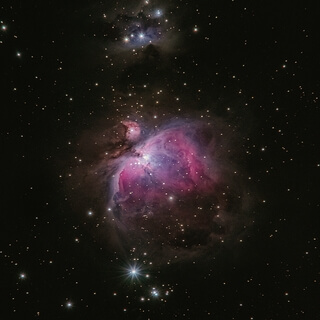
The Orion Nebula,
The brightest nebula in the sky,
And occupying an area twice the angular diameter of the full moon,
Can be viewed with the naked eye,
But was missed by early astronomers.
Although denser than the space surrounding them,
Most nebulae are far less dense than any vacuum created on Earth.
10 to the 5th to 10 to the 7th molecules per cubic centimeter.
A nebular cloud the size of the Earth's would have a total mass of only a few kilograms.
Earth's air has a density of approximately 10 to the 19th molecules per cubic centimeter.
By contrast,
The densest nebulae can have densities of 10 to the 4th molecules per cubic centimeter.
Many nebulae are visible due to fluorescence caused by embedded hot stars,
While others are so diffused that they can be detected only with long exposures and special filters.
Some nebulae are variable illuminated by T Tauri variable stars.
Originally,
The term nebula was used to describe any diffused astronomical object,
Including galaxies beyond the Milky Way.
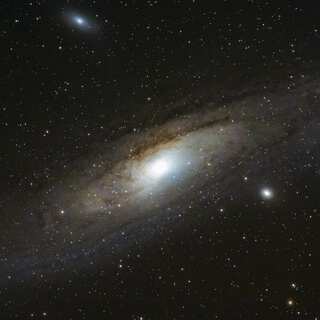
The Andromeda Galaxy,
For instance,
Was once referred to as the Andromeda Nebula,
And spiral galaxies in general as spiral nebulae,
Before the true nature of galaxies was confirmed in the early 20th century by Vesto,
Slipher,
Edwin Hubble,
And others.
Edwin Hubble discovered that most nebulae are associated with stars and illuminated by starlight.
He also helped categorize nebulae based on the type of light spectra they produced.
Around 150 AD,
Ptolemy recorded in his books 7 through 8 of his Almagest,
Five stars that appeared nebulous.
He also noted a region of nebulosity between the constellations Ursa Major and Leo that was not associated with any star.
The first true nebula,
As distinct from a star cluster,
Was mentioned by the Muslim-Persian astronomer Abd al-Rahman al-Sufi in his book of Fixed Stars,
964.
He noted a little cloud where the Andromeda Galaxy is located.
He also cataloged the Omicron Valorum star cluster as a nebulous star,
And other nebulous objects,
Such as Brocchi's cluster.
The supernovas that created the Crab Nebula,
SN 1054,
Was observed by Arabic and Chinese astronomers in 1054.
In 1610,
Nicolas-Claude Fabri de Peyresque discovered the Orion Nebula using a telescope.
This nebula was also observed by Johann Baptiste Cicade in 1618.
However,
The first detailed study of the Orion Nebula was not performed until 1659 by Christian Huygens,
Who also believed he was the first person to discover this nebulosity.
In 1715,
Edmund Halley published a list of six nebulae.
This number steadily increased during the century,
With Jean-Philippe de Chizot compiling a list of twenty,
Including eight not previously known in 1746.
From 1751 to 1753,
Nicolas-Louis de Lacaille cataloged 42 nebulae from the Cape of Good Hope,
Most of which were previously unknown.
Charles Messier then compiled a catalog of 103 nebulae,
Now called Messier Objects,
Which included what are now known to be galaxies,
By 1781.
His interest was detecting comets,
And these were objects that might be mistaken for them.
The number of nebulae was then greatly increased by the efforts of William Herschel,
And his sister,
Caroline Herschel.
Their catalog of 1,
000 new nebulae and clusters of stars was published in 1786.
A second catalog of 1,
000 was published in 1789,
And the third and final catalog of 510 appeared in 1802.
During much of their work,
William Herschel believed that these nebulae were merely unresolved clusters of stars.
In 1790,
However,
He discovered a star surrounded by nebulosity,
And concluded that this was a true nebulosity rather than a more distant cluster.
Beginning in 1864,
William Huggins examined the spectra of about 70 nebulae.
He found that roughly a third of them had the emission spectrum of a gas.
The rest showed a continuous spectrum and were thus thought to consist of a mass of stars.
A third category was added in 1912 when Vesto Slipher showed that the spectrum of the nebula that surrounded the star Merope matched the spectra of the Pleiades open cluster.
Thus,
The nebula radiates by reflected star line.
In 1923,
Following the Great Debate,
It became clear that many nebulae were in fact galaxies far from the Milky Way.
Slipher and Edwin Hubble continued to collect the spectra from many different nebulae,
Finding 29 that showed emission spectra and 33 that had the continuous spectra of star line.
In 1922,
Hubble announced that nearly all nebulae are associated with stars and that their illumination comes from star line.
He also discovered that the emission spectrum nebulae are nearly always associated with stars having a spectral classification of B or hotter,
Including all O-type main-sequence stars,
While nebulae with continuous spectra appear with cooler stars.
Both Hubble and Henry Norris Russell concluded that the nebulae surrounding the hotter stars are transformed in some manner.
There are a variety of formation mechanisms for the different types of nebulae.
Some nebulae form from gas that is already in the interstellar medium,
While others are produced by stars.
Examples of the former case are giant molecular clouds,
The coldest,
Densest phase of interstellar gas,
Which can form by the cooling and condensation of more diffuse gas.
Examples of the latter case are planetary nebulae formed from material shed by a star in late stages of its stellar evolution.
Star-forming regions are a class of emission nebulae associated with giant molecular clouds.
These form as a molecular cloud collapses under its own weight,
Producing stars.
Massive stars may form in the center,
And their ultraviolet radiation ionizes the surrounding gas,
Making it visible at optical wavelengths.
The region of ionized hydrogen surrounding the massive stars is known as an HII region,
While the shells of neutral hydrogen surrounding the HII region are known as photodissociation region.
Examples of star-forming regions are the Orion Nebula,
The Rosette Nebula,
And the Omega Nebula.
Feedback from star formation in the form of supernova explosions of massive stars,
Stellar winds,
Or ultraviolet radiation from massive stars,
Or outflows from low-mass stars,
May disrupt the cloud,
Destroying the nebula after several million years.
Other nebulae form as a result of supernova explosions,
The death throes of massive short-lived stars.
The materials thrown off from the supernova explosion are then ionized by the energy and the compact object that its core produces.
One of the best examples of this is the Crab Nebula in Taurus.
The supernova event was recorded in the year 1054,
And is labeled SN1054.
The compact object that was created after the explosion lies in the center of the Crab Nebula,
And its core is now a neutron star.
Still,
Other nebulae form as planetary nebulae.
This is the final stage of a low-mass star's life,
Like Earth's Sun.
Stars with a mass up to 8-10 solar masses evolve into red giants,
And slowly lose their outer layers during pulsations in their atmospheres.
When a star has lost enough material,
Its temperature increases,
And the ultraviolet radiation it emits can ionize the surrounding nebula that it has thrown off.
The Sun will produce a planetary nebula,
And its core will remain behind in the form of a white dwarf.
Objects named nebulae belong to four major groups.
Before their nature was understood,
Galaxies,
Spiral nebulae,
And star clusters too distant to be resolved as stars,
Were also classified as nebulae,
But no longer are.
HII regions,
Large diffuse nebulae containing ionized hydrogen,
Planetary nebulae,
Supernova remnants,
E.
G.
Crab Nebula,
Dark Nebulae.
Not all cloud-like structures are nebulae.
Herbig-Haro objects are an example.
Integrated-flux nebulae are a relatively recently identified astronomical phenomenon.
In contrast to the typical and well-known gaseous nebulae within the plane of the Milky Way galaxy,
IFNs lie beyond the main body of the galaxy.
The term was coined by Steve Mandel,
Who defined them as high-galactic-latitude nebulae that are illuminated not by a single star,
As most nebulae in the plane of the galaxy are,
But by the energy from the integrated flux of all the stars in the Milky Way.
As a result,
These nebulae are incredibly faint,
Taking hours of exposure to capture.
These nebulae clouds,
An important component of the interstellar medium,
Are composed of dust particles,
Hydrogen and carbon monoxide,
And some other elements.
They are particularly prominent in the direction of both the north and south celestial poles.
The vast nebula close to the south celestial pole is MW9,
Commonly known as the South Celestial Serpent.
Most nebulae can be described as diffuse nebulae,
Which means that they are extended and contain no well-defined boundaries.
Diffuse nebulae can be divided into emission nebulae,
Reflection nebulae,
And dark nebulae.
Visible light nebulae may be divided into emission nebulae,
Which emit spectral line radiation from excited or ionized gas,
Mostly ionized hydrogen.
They are often called H2 regions,
H2 referring to ionized hydrogen,
And reflection nebulae which are visible primarily due to the light they reflect.
Reflection nebulae themselves do not emit significant amounts of visible light,
But are near stars and reflect light from them.
Similar nebulae not illuminated by stars do not exhibit visible radiation,
But may be detected as opaque clouds blocking light from luminous objects behind them.
They are called dark nebulae.
Although these nebulae have different visibility at optical wavelengths,
They are all bright sources of infrared emission,
Chiefly from dust within the nebulae.
Planetary nebulae are the remnants of the final stages of stellar evolution for mid-mass stars,
Varying in size between 0.
5 to roughly 8 solar masses.
Evolved asymptotic giant branch stars expel their outer layers outwards due to strong stellar winds,
Thus forming gaseous shells while leaving behind the star's core in the form of a white dwarf.
Radiation from the hot white dwarf excites the expelled gases,
Producing emission nebulae with spectra similar to those of emission nebulae found in star formation regions.
They are HII regions because mostly hydrogen is ionized,
But planetary are denser and more compact than nebulae found in star formation regions.
Planetary nebulae were given their own name by the first astronomical observers who were initially unable to distinguish them from planets,
Which were of more interest to them.
The Sun is expected to spawn a planetary nebula about 12 billion years after its formation.
A protoplanetary nebula,
Or planetary nebula,
PPN,
Plural PPNE,
Is an astronomical object which is at the short-lived episode during a star's rapid evolution between the late asymptotic giant branch,
LAGB phase,
And the subsequent planetary nebula,
PN phase.
A PPN emits strongly in infrared radiation and is a kind of reflection nebula.
It is the second from the last high-luminosity evolution phase in the life cycle of intermediate-mass stars,
1 to 8 solar masses.
A supernova occurs when a high-mass star reaches the end of its life.
When nuclear fusion in the core of the star stops,
The star collapses.
The gas falling inward either rebounds or gets so strongly heated that it expands outwards from the core,
Thus causing the star to explode.
The expanding shell of gas forms a supernova remnant,
A special diffuse nebula.
Although much of the optical and X-ray emission from supernova remnants originates from ionized gas,
A great amount of the radio emission is a form of non-thermal emission,
Called synchrotron emission.
This emission originates from high-velocity electrons oscillating within magnetic fields.
The Eagle Nebula,
Cataloged as Messier 16 or M16 and as NGC 6611 and also known as the Star Queen Nebula,
Is a young,
Open cluster of stars in the constellation Serpens,
Discovered by Jean-Philippe de Chezaux in 1745-46.
Both the Eagle and the Star Queen refer to visual impressions of the dark silhouette near the center of the nebula,
An area made famous as the Pillars of Creation imaged by the Hubble Space Telescope.
The nebula contains several active star-forming gas and dust regions,
Including the aforementioned Pillars of Creation.
The Eagle Nebula lies in the Sagittarius arm of the Milky Way.
The Eagle Nebula is a diffuse emission nebula,
Or HII region,
Which is cataloged as IC 4703.
This region of active current star formation is about 5,
700 light-years distant.
A spire of gas that can be seen coming off the nebula in the northeastern part is approximately 9.
5 light-years,
Or about 90 trillion kilometers long.
The cluster associated with the nebula has approximately 8,
100 stars,
Which are mostly concentrated in a gap in the molecular cloud to the northwest of the pillars.
The brightest star,
HD 168076,
Has an apparent magnitude of plus 8.
24,
Easily visible with good binoculars.
It is actually a binary star formed of an 03.
5 V star plus an 07.
5 V companion.
This star has a mass of roughly 80 solar masses and a luminosity up to 1 million times that of the Sun.
The cluster's age has been estimated to be 1 to 2 million years.
The descriptive names reflect impressions of the shape of the central pillar rising from the southeast into the central luminous area.
The name Star Queen Nebula was introduced by Robert Burnham,
Jr.
,
Reflecting his characterization of the central pillar as the Star Queen shown in silhouette.
Images produced by Jeff Hester and Paul Skowron using the Hubble Space Telescope in 1995 greatly improved scientific understanding of processes inside the nebula.
One of these became famous as the Pillars of Creation,
Depicting a large region of star formation.
Its small dark pockets are believed to be protostars,
Bach globules.
The pillar structure resembles that of a much larger instance in the Sol Nebula of Cassiopeia,
Imaged with the Spitzer Space Telescope in 2005,
Equally characterized as Pillars of Star Creation,
Or Pillars of Star Formation.
These columns,
Which resemble stalagmites protruding from the floor of a cavern,
Are composed of interstellar hydrogen gas and dust,
Which act as incubators for new stars.
Inside the columns and on their surface,
Astronomers have found knots or globules of denser gas,
Called EGGs,
Evaporating gaseous globules.
Stars are being formed inside some of these.
X-ray images from the Chandra Observatory compared with Hubble's Pillars image have shown that X-ray sources from younger stars do not coincide with the pillars,
But rather randomly dot the nebula.
Any protostars in the pillars' EGGs are not yet hot enough to emit X-rays.
Evidence from the Spitzer Space Telescope originally suggested that the pillars in M16 may be threatened by a past supernova.
Hot gas observed by Spitzer in 2007 suggested they were already,
Likely,
Being disturbed by a supernova that exploded 8,
000 to 9,
000 years ago.
Due to the distance,
The main blast of light would have reached Earth for a brief time,
1,
000 to 2,
000 years ago.
A more slowly moving,
Theorized shock wave would have taken a few thousand years to move through the nebula,
And would have blown away the delicate pillars.
However,
In 2014,
The pillars were imaged a second time by Hubble in both visible light and dark space.
The images being 20 years later provided a new,
Detailed account of the rate of evaporation occurring within the pillars.
No supernova is evidenced within them,
And it is estimated in some form they still exist and will appear for at least 100,
000 more years.
The Horsehead Nebula,
Also known as Barnard 33 or B33,
Is a small dark nebula in the constellation Orion.
The nebula is located just to the south of the Alnitak,
The easternmost star of Orion's belt,
And is part of the much larger Orion Molecular Cloud Complex.
It appears within the southern region of the dense dust cloud known as Lens 1630 along the edge of the much larger active star-forming HII region.
Called IC 434.
The Horsehead Nebula is approximately 422 parsecs or 1,
375 light-years from Earth.
It is one of the most identifiable nebulae because of its resemblance to a horse's head.
The nebula was discovered by Scottish astronomer William Ena Fleming in 1888 on a photographic plate taken at the Harvard College Observatory.
One of the first descriptions was made by E.
E.
Barnard describing it as dark mass,
Diameter 4,
On nebulous strip extending south from Zeta Orionis,
Cataloging the dark nebula as Barnard 33.
The dark cloud of dust and gas is a region in the Orion Molecular Cloud Complex where star formation is taking place.
It is located in the constellation of Orion,
Which is prominent in the winter evening sky in the northern hemisphere and the summer evening sky in the southern hemisphere.
Color images reveal a red color that originates from ionized hydrogen gas predominantly behind the nebula and caused by the nearby bright star Sigma Orionis.
Magnetic fields channel the gases leaving the nebula into streams shown as foreground streaks against the background glow.
A glowing strip of hydrogen gas marks the edge of the enormous cloud and the densities of nearby stars are noticeably different on either side.
Heavy concentrations of dust in the Horsehead Nebula region and neighboring Orion Nebula are localized into interstellar clouds resulting in alternating sections of nearly complete opacity and transparency.
The darkness of the horsehead is caused mostly by thick dust blocking the light of stars behind it.
The lower part of the horsehead's neck casts a shadow to the left.
The visible dark nebula emerging from the gaseous complex is an active site of the formation of low-mass stars.
Bright spots in the Horsehead Nebula's base are young stars just in the process of forming.
The Orion Nebula,
Also known as Messier 42,
M42,
Or NG-1976,
Is a diffuse nebula in the Milky Way situated south of Orion's Belt in the constellation of Orion and is known as the middle star in the Sword of Orion.
It is one of the brightest nebulae and is visible to the naked eye in the night sky with an apparent magnitude of 0.
1.
It is 1,
344 plus or minus 20 light-years away and is the closest region of massive star formation to Earth.
M42 is estimated to be 25 light-years across,
So its apparent size from Earth is approximately 1 degree.
It has a mass of about 2,
000 times that of the Sun,
Older texts frequently refer to the Orion Nebula as the Great Nebula in Orion or the Great Orion Nebula.
The Orion Nebula is one of the most scrutinized and photographed objects in the night sky and is among the most intensely studied celestial features.
The nebula has revealed much about the process of how stars and planetary systems are formed from collapsing clouds of gas and dust.
The nebula has revealed much about the process of how stars and planetary systems are formed from collapsing clouds of gas and dust.
Astronomers have directly observed photoplanetary disks and brown dwarfs within the nebula,
Intense and turbulent motions of the gas and the photoionizing effects of massive nearby stars in the nebula.
The Orion Nebula is visible with the naked eye even from areas affected by light pollution.
It is seen as the middle star in the Sword of Orion,
Which are the three stars located south of Orion's belt.
The star appears fuzzy to sharp-eyed observers and the nebulosity is obvious through binoculars or a small telescope.
The peak surface brightness of the central region of M42 is about 17 magnitude per squared arcsecond and the outer bluish glow has a peak surface brightness of 23.
3 magnitude per squared arcsecond.
The Orion Nebula contains a very young open cluster known as the Trapezium Cluster due to the asterism of its primary four stars within a diameter of 1.
5 light years.
Two of these can be resolved into their component binary systems on nights with good seeing,
Giving a total of six stars.
The stars of the Trapezium Cluster,
Along with many other stars,
Are still in their early years.
The Trapezium Cluster is a component of the much larger Orion Nebula Cluster,
An association of about 2,
800 stars within a diameter of 20 light years.
The Orion Nebula is in turn surrounded by the much larger Orion Molecular Cloud Complex,
Which is hundreds of light years across,
Spanning the whole Orion constellation.
Two million years ago,
The Orion Nebula cluster may have been the home of the runaway stars A.
E.
Origi,
53 Oriatus,
And Mu Colombi,
Which are currently moving away from the nebula at speeds greater than 100 km per second.
Observers have long noted a distinctive greenish tint to the nebula,
In addition to the regions of red and blue-violet.
The hue is a result of the hydrogen-alpha recombination line radiation at a wavelength of 656.
3 nm.
The blue-violet coloration is the reflected radiation from the massive O-class stars at the core of the nebula.
The green hue was a puzzle for astronomers in the early part of the 20th century because none of the known spectral lines at that time could explain it.
There was some speculation that the lines were caused by a new element,
And the name nebulium was coined for this mysterious material.
With better understanding of atomic physics,
However,
It was later determined that the green spectrum was caused by a low-probability electron transition in doubly ionized oxygen,
A so-called forbidden transition.
This radiation was impossible to reduce in the laboratory at the time because it depended on the quiescent and nearly collision-free environment found in the high vacuum of deep space.