Welcome to the I Can't Sleep Podcast,
Where I read random articles from across the web to bore you to sleep with my soothing voice.
I'm your host,
Benjamin Boster.
Today's episode is from a Wikipedia article titled,
The Andromeda Galaxy.
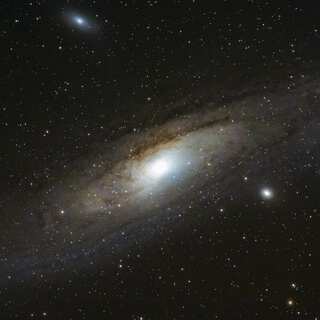
The Andromeda Galaxy is a barred spiral galaxy and is the nearest major galaxy to the Milky Way.
It was originally named the Andromeda Nebula and is catalogued as Messier 31,
M31,
And NGC 224.
Andromeda has a D25 isofotyl diameter of about 46.
56 kiloparsecs,
Or 152,
000 light years,
And is approximately 765 kiloparsecs,
Or 2.
5 million light years from Earth.
The galaxy's name stems from the area of Earth's sky in which it appears,
The constellation of Andromeda,
Which itself is named after the princess who was the wife of Perseus in Greek mythology.
The viral mass of the Andromeda Galaxy is of the same order of magnitude as that of the Milky Way,
At 1 trillion solar masses.
The mass of either galaxy is difficult to estimate with any accuracy,
But it was long thought that the Andromeda Galaxy was more massive than the Milky Way,
By a margin of some 25-50%.
However,
This has been called into question by early 21st century studies,
Indicating a possibly lower mass for the Andromeda Galaxy and a higher mass for the Milky Way.
The Andromeda Galaxy has a diameter of about 46.
56 kiloparsecs,
Making it the largest member of the local group of galaxies in terms of extension.
The Milky Way and Andromeda Galaxies are expected to collide with each other in around 4-5 billion years,
Merging to potentially form a giant elliptical galaxy,
Or a large lenticular galaxy.
With an apparent magnitude of 3.
4,
The Andromeda Galaxy is among the brightest of the messier objects,
And is visible to the naked eye from Earth on moonless nights,
Even when viewed from areas with moderate light pollution.
The Andromeda Galaxy is visible to the naked eye in dark skies.
Around the year 964 CE,
The Persian astronomer Abd al-Rahman al-Sufi described the Andromeda Galaxy in his book of fixed stars as a nebulous smear,
Or small cloud.
Star charts of that period labeled it as the Little Cloud.
In 1612,
The German astronomer Simon Marius gave an early description of the Andromeda Galaxy based on telescopic observations.
Pierre-Louis Maupertuis conjectured in 1745 that the blurry spot was an island universe.
Charles Messier cataloged Andromeda as Object M31 in 1764,
And incorrectly credited Marius as the discoverer despite its being visible to the naked eye.
In 1785,
The astronomer William Herschel noted a faint reddish hue in the core region of Andromeda.
He believed Andromeda to be the nearest of all the great nebulae,
And based on the color and magnitude of the nebula,
He incorrectly guessed that it was no more than 2,
000 times the distance of Sirius,
Or roughly 18,
000 light-years.
In 1850,
William Parsons,
3rd Earl of Ross,
Made a drawing of Andromeda's spiral structure.
In 1864,
William Huggins noted that the spectrum of Andromeda differed from that of a gaseous nebula.
The spectrum of Andromeda displays a continuum of frequencies,
Superimposed with dark absorption lines that help identify the chemical composition of an object.
Andromeda's spectrum is very similar to the spectra of individual stars,
And from this it was deduced that Andromeda has a stellar nature.
In 1885,
A supernova was seen in Andromeda,
The first and so far only one observed in that galaxy.
At the time,
It was called Nova 1885.
The difference between novae in the modern sense and supernovae was not yet known.
Andromeda was considered to be a nearby object,
And it was not realized that the nova was much brighter than ordinary novae.
In 1888,
Isaac Roberts took one of the first photographs of Andromeda,
Which was still commonly thought to be a nebula within our galaxy.
Roberts mistook Andromeda and similar spiral nebulae as star systems being formed.
In 1912,
Vesto Slipher used spectroscopy to measure the radial velocity of Andromeda with respect to the solar system.
The largest velocity yet measured had 300 km per second.
As early as 1755,
The German philosopher Immanuel Kant proposed the hypothesis that the Milky Way is only one of many galaxies in his book Universal Natural History and Theory of the Heavens.
Arguing that a structure like the Milky Way would look like a circular nebula viewed from above and like an ellipsoid if viewed from an angle,
He concluded that the observed elliptical nebulae like Andromeda,
Which could not be explained otherwise at the time,
Were indeed galaxies similar to the Milky Way,
Not nebulae,
As Andromeda was commonly believed to be.
In 1917,
Herbert Curtis observed a nova within Andromeda.
After searching the photographic record,
11 more novae were discovered.
Curtis discovered that these novae were,
On average,
10 magnitudes fainter than those that occurred elsewhere in the sky.
As a result,
He was able to come up with a distance estimate of 500,
000 light-years.
Although this estimate is about five-fold lower than the best estimates now available,
It was the first known estimate of the distance to Andromeda that was correct to within an order of magnitude.
Curtis became a proponent of the so-called island universes hypothesis that spiral nebulae were actually independent galaxies.
In 1920,
The great debate between Harlow Shapley and Curtis took place concerning the nature of the Milky Way,
Spiral nebulae,
And the dimensions of the universe.
To support his claim that the great Andromeda nebula is,
In fact,
An external galaxy,
Curtis also noted the appearance of dark lines within Andromeda that resembled the dust clouds in our own galaxy,
As well as historical observations of the Andromeda galaxy's significant Doppler shift.
In 1922,
Ernst Uppig presented a method to estimate the distance of Andromeda using the measured velocities of its stars.
His result placed the Andromeda nebula far outside our galaxy at a distance of about 450 kiloparsecs.
Edwin Hubble settled the debate in 1925 when he identified extragalactic Cepheid variable stars for the first time on astronomical photos of Andromeda.
These were made using the 100-inch Hooker telescope,
And they enabled the distance of the great Andromeda nebula to be determined.
His measurement demonstrated conclusively that this feature was not a cluster of stars and gas within our own galaxy,
But an entirely separate galaxy located a significant distance from the Milky Way.
In 1943,
Walter Bata was the first person to resolve stars in the central region of the Andromeda galaxy.
Bata identified two distinct populations of stars based on their metallicity,
Naming the young high-velocity stars in the disk,
Type I,
And the older red stars in the bulge,
Type II.
This nomenclature was subsequently adopted for stars within the Milky Way and elsewhere.
Bata also discovered that there were two types of Cepheid variable stars,
Which resulted in doubling the distance estimate to Andromeda as well as the remainder of the universe.
In 1950,
Radio emissions from the Andromeda galaxy were detected by Robert Hanbury Brown and Cyril Hazard at the Jodrell Bank Observatory.
The first radio maps of a galaxy were made in the 1950s by John Baldwin and collaborators at the Cambridge Radio Astronomy Group.
The core of the Andromeda galaxy is called 2C56 in the 2C Radio Astronomy Catalog.
In 2009,
An occurrence of microlensing,
A phenomenon caused by the deflection of light by a massive object,
May have led to the first discovery of a planet in the Andromeda galaxy.
In 2020,
Observations of linearly polarized radio emission with the West Bork Synthesis Radio Telescope,
The Effelsberg 100M radio telescope,
And the Very Large Array revealed ordered magnetic fields aligned along the 10 kiloparsec ring of gas and star formation.
The estimated distance of the Andromeda galaxy from our own was doubled in 1953,
When it was discovered that there is a second,
Dimmer type of Cepheid variable star.
In the 1910s,
Measurements of both standard red giants as well as red clump stars from the Hipparchus satellite measurements were used to calibrate the Cepheid distances.
A major merger occurred two to three billion years ago at the Andromeda location,
Involving two galaxies with a mass ratio of approximately four.
The discovery of a recent merger in the Andromeda galaxy was first based on interpreting its anomalous age-velocity dispersion relation,
As well as the fact that,
Two billion years ago,
Star formation throughout Andromeda's disk was much more active than today.
Modeling of this violent collision shows that it has formed most of the galaxy's metal-rich galactic halo,
Including the giant stream,
And also the extended thick disk,
The young age thin disk,
And the static 10 kiloparsec ring.
During this epoch,
Its rate of star formation would have been very high,
To the point of becoming a luminous infrared galaxy,
For roughly 100 million years.
Modeling also recovers the bulge profile,
The large bar,
And the overall halo density profile.
Andromeda and the Triangulum galaxy,
M33,
Might have had a very close passage two to four billion years ago,
But it seems unlikely from the last measurements from the Hubble Space Telescope.
The Andromeda galaxy is surrounded by a massive halo of hot gas that is estimated to contain half the mass of the stars in the galaxy.
The nearly invisible halo stretches about a million light-years from its host galaxy,
Halfway to our Milky Way galaxy.
Simulations of galaxies indicate the halo formed at the same time as the Andromeda galaxy.
The halo is enriched in elements heavier than hydrogen and helium,
Formed from supernovae,
And its properties are those expected for a galaxy that lies in the Green Valley of the Galaxy Color Magnitude Diagram.
Supernovae erupt in the Andromeda galaxy's star-filled disk and eject these heavier elements into space.
Over the Andromeda galaxy's lifetime,
Nearly half of the heavy elements made by its stars have been ejected far beyond the galaxy's 200,
000 light-year diameter stellar disk.
A study in 2005 by the Keck telescopes shows the existence of a tenuous sprinkle of stars,
Or galactic halo,
Extending outward from the galaxy.
The stars in this halo behave differently from the ones in Andromeda's main galactic disk,
Where they show rather disorganized orbital motions,
As opposed to the stars in the main disk having more orderly orbits and uniform velocities of 200 km per second.
This diffuse halo extends outward away from Andromeda's main disk,
With a diameter of 67.
45 kiloparsecs.
The galaxy is inclined an estimated 77 degrees relative to Earth,
Where an angle of 90 degrees would be edge-on.
Analysis of the cross-sectional shape of the galaxy appears to demonstrate a pronounced S-shaped warp,
Rather than just a flat disk.
A possible cause of such a warp could be gravitational interaction with the satellite galaxies near the Andromeda galaxy.
The galaxy M33 could be responsible for some warp in Andromeda's arms,
Though more precise distances and radial velocities are required.
There are approximately 460 globular clusters associated with the Andromeda galaxy.
The most masses of these clusters,
Identified as MILE-2,
Nicknamed Globular-1,
Has a greater luminosity than any other known globular cluster in the local group of galaxies.
It contains several million stars,
And is about twice as luminous as Omega Centauri,
The brightest known globular cluster in the Milky Way.
Globular-1,
Or G1,
Has several stellar populations,
And a structure too massive for an ordinary globular.
As a result,
Some consider G1 to be the remnant core of a dwarf galaxy that was consumed by Andromeda in the distant past.
The globular with the greatest apparent brightness is G76,
Which is located in the southwest arm's eastern half.
Another massive globular cluster,
Named 037-B327,
And discovered in 2006,
As is heavily reddened by the Andromeda galaxy's interstellar dust,
Was thought to be more massive than G1,
And the largest cluster of the local group.
However,
Other studies have shown it is actually similar in properties to G1.
Unlike the globular clusters of the Milky Way,
Which show a relatively low age dispersion,
The Andromeda galaxy's globular clusters have a much larger range of ages,
From systems as old as the galaxy itself,
To much younger systems,
With ages between a few hundred million years to five billion years.
In 2005,
Astronomers discovered a completely new type of star cluster in the Andromeda galaxy.
The newfound clusters contain hundreds of thousands of stars,
A similar number of stars that can be found in globular clusters.
What distinguishes them from the globular clusters is that they are much larger,
Several hundred light-years across,
And hundreds of times less dense.
The distances between the stars are therefore much greater within the newly discovered extended clusters.
The most massive globular cluster in the Andromeda galaxy,
B023-G078,
Likely has a central intermediate black hole of almost 100,
000 solar masses.
PA-99-N2 was a microlensing event detected in the Andromeda galaxy in 1999.
One of the explanations for this is the gravitational lensing of a red giant by a star with a mass between 0.
02 and 3.
6 times that of the Sun,
Which suggested that this star is likely orbited by a planet.
This possible exoplanet would have a mass 6.
34 times that of Jupiter.
If finally confirmed,
It would be the first ever found extragalactic planet.
However,
Anomalies in the event were later found.
Like the Milky Way,
The Andromeda galaxy has smaller satellite galaxies,
Consisting of over 20 known dwarf galaxies.
The Andromeda galaxy's dwarf galaxy population is very similar to the Milky Way's,
But the galaxies are much more numerous.
The best known and most readily observed satellite galaxies are M32 and M110.
Based on current evidence,
It appears that M32 underwent a close encounter with the Andromeda galaxy in the past.
M32 may once have been a larger galaxy that had its stellar disk removed by M31 and underwent a sharp increase of star formation in the core region,
Which lasted until the relatively recent past.
M110 also appears to be interacting with the Andromeda galaxy,
And astronomers have found in the halo of the latter a stream of metal-rich stars that appear to have been stripped from these satellite galaxies.
M110 does contain a dusty lane,
Which may indicate recent or ongoing star formation.
M32 has a young stellar population as well.
The Triangulum galaxy is a non-dwarf galaxy that lies 750,
000 light years from Andromeda.
It is currently unknown whether it is a satellite of Andromeda.
In 2006,
It was discovered that nine of the satellite galaxies lie in a plane that intersects the core of the Andromeda galaxy.
They are not randomly arranged as would be expected from independent interactions.
This may indicate a common tidal origin for the satellites.
The Andromeda galaxy is approaching the Milky Way at about 110 km per second.
It has been measured approaching relative to the Sun at around 300 km per second,
As the Sun orbits around the center of a galaxy at a speed of approximately 225 km per second.
This makes the Andromeda galaxy one of about 100 observable blue-shifted galaxies.
Andromeda's galaxy's tangential or sideways velocity concerning the Milky Way is relatively much smaller than the approaching velocity and,
Therefore,
It is expected to collide directly with the Milky Way in about 2.
5 to 4 billion years.
A likely outcome of the collision is that the galaxies will merge to form a giant elliptical galaxy or possibly a large disk galaxy.
Such events are frequent among the galaxies and galaxy groups.
The fate of Earth and the solar system in the event of a collision is currently unknown.
Before the galaxies merge,
There is a small chance that the solar system could be ejected from the Milky Way or join the Andromeda galaxy.
Under most viewing conditions,
The Andromeda galaxy is one of the most distant objects that can be seen with the naked eye due to its sheer size.
M33 and for observers with exceptionally good vision,
M81 can be seen under very dark skies.
The galaxy is commonly located in the sky about the constellations Cassiopeia and Pegasus.
Andromeda is best seen during autumn nights in the Northern Hemisphere when it passes high overhead,
Reaching its highest point around midnight in October and two hours earlier each successive month.
In the early evening,
It rises in the east in September and sets in the west in February.
From the Southern Hemisphere,
The Andromeda galaxy is visible between October and December.
It's viewed from as far north as possible.
Binoculars can reveal some larger structures of the galaxy and its two brightest satellite galaxies M32 and M110.
An amateur telescope can reveal Andromeda's disk,
Some of its brightest globular clusters,
Dark dust lanes,
And the large star cloud NGC 206.
A barred spiral galaxy is a spiral galaxy with a central bar-shaped structure composed of stars.
Bars are found in about two-thirds of all spiral galaxies in the local universe,
And generally affect both the motions of stars and interstellar gas within spiral galaxies and can affect spiral arms as well.
The Milky Way galaxy,
Where the solar system is located,
Is classified as a barred spiral galaxy.
Edwin Hubble classified spiral galaxies of this type as SB,
Spiral,
Barred,
In his Hubble sequence and arranged them into sub-categories based on how open the arms of the spiral are.
SB-A types feature tightly bound arms,
While SB-C types are at the other extreme and have loosely bound arms.
SB-B type galaxies lie in between the two.
SB-0 is a barred lenticular galaxy.
A new type,
SB-M,
Was subsequently created to describe somewhat irregular barred spirals,
Such as Magellanic clouds,
Which were once classified as irregular galaxies but have since been found to contain barred spiral structures.
Among other types in Hubble's classifications for the galaxies are the spiral galaxy,
Elliptical galaxy,
And irregular galaxy.
Although theoretical models of galaxy formation and evolution had not previously expected galaxies becoming stable enough to host bars very early in the universe's history,
Evidence has recently emerged of the existence of numerous spiral galaxies in the early universe.
Barred galaxies are apparently predominant,
With surveys showing that up to two-thirds of all spiral galaxies develop a bar.
The creation of the bar is generally thought to be the result of a density wave radiating from the center of the galaxy,
Whose effects reshape the orbits of the inner stars.
This effect builds over time to stars orbiting farther out,
Which creates a self-perpetuating bar structure.
The bar structure is believed to act as a type of stellar nursery,
Channeling gas inwards from the spiral arms through orbital resonance,
Fueling star births in the vicinity of its center.
This process is also thought to explain why many barred spiral galaxies have active galactic nuclei,
Such as that seen in the southern pinwheel galaxy.
Bars are thought to be temporary phenomena in the lives of spiral galaxies.
The bar structure decay over time,
Transforming galaxies from barred spirals to more regular spiral patterns.
Past a certain size,
The accumulated mass of the bar comprises the stability of the overall bar structure.
Simulations show that many bars likely experience a buckling event,
In which a disturbance in the orbital resonances of stars in the bar structure leads to an inward collapse in which the bar becomes thicker and shorter.
Though the exact mechanism behind this buckling instability remains hotly debated.
Barred spiral galaxies with high mass accumulated in their center thus tend to have short,
Stubby bars.
Such buckling phenomena are significantly suppressed and delayed by the presence of a supermassive black hole in the galactic center,
But occur nonetheless.
Since so many spiral galaxies have bar structures,
It is likely that they are recurring phenomena in spiral galaxy development.
The oscillating evolutionary cycle from spiral galaxy to barred spiral galaxy is sought to take on average about 2 billion years.
Recent studies have confirmed the idea that bars are a sign of galaxies reaching full maturity as the formative years end.
A 2008 investigation found that only 20% of the spiral galaxies in the distant past possessed bars,
Compared with about 65% of their local counterparts.