Welcome back,
Or welcome to the I Can't Sleep Podcast,
Where I read random articles from across the web to bore you to sleep with my soothing voice.
I'm your host,
Benjamin Boster.
Today's episode is from a Wikipedia article titled,
Dark Matter.
In astronomy,
Dark matter is a hypothetical form of matter that appears not to interact with light or the electromagnetic field.
Dark matter is implied by gravitational effects,
Which cannot be explained by general relativity unless more matter is present than can be seen.
Such effects occur in the context of formation and evolution of galaxies,
Gravitational lensing,
The observable universe's current structure,
Mass position in galactic collisions,
The motion of galaxies within galaxy clusters,
And cosmic microwave background anisotropies.
In the standard Lambda-CDM model of cosmology,
The mass-energy content of the universe is 5% ordinary matter,
26.
8% dark matter,
And 68.
2%,
A form of energy known as dark energy.
Thus,
Dark matter constitutes 85% of the total mass,
While dark energy and dark matter constitute 95% of the total mass-energy content.
Dark matter is not known to interact with ordinary baryonic matter and radiation,
Except through gravity,
Making it difficult to detect in the laboratory.
The most prevalent explanation is that dark matter is some as-yet-undiscovered subatomic particle,
Such as weakly interactive massive particles,
WIMPs,
Or axions.
The other main possibility is that dark matter is composed of primordial black holes.
Dark matter is classified as cold,
Warm,
Or hot,
According to its velocity,
More precisely its free-streaming length.
Recent models have favored a cold dark matter scenario,
In which structures emerge by the gradual accumulation of particles.
Although the astrophysics community generally accepts dark matter's existence,
A minority of astrophysicists,
Intrigued by specific observations that are not well explained by ordinary dark matter,
Argue for various models of dark matter.
These include modified Newtonian dynamics,
Tensor-vector-scalar gravity,
And entropic gravity.
So far,
None of the proposed modified gravity theories can successfully describe every piece of observational evidence at the same time,
Suggesting that even if gravity has to be modified,
Some form of dark matter will still be relevant.
The hypothesis of dark matter has an elaborate history.
In the appendices of the book,
Baltimore Lectures on Molecular Dynamics and the Wave Theory of Light,
Where the main text was based on a series of lectures given in 1884,
Lord Kelvin discussed the potential number of stars around the sun from the observed dark matter.
The theory of dark matter is based on a series of lectures given in 1884,
Where the main text was based on a series of lectures given in 1884,
Assuming that the sun was 200 to 100 million years old.
He posed what would happen if there were a thousand million stars within one kiloparsec of the sun,
At which distance their parallax would be one milliarcsecond.
Lord Kelvin concluded,
Many of our supposed thousand million stars,
Perhaps a great majority of them,
May be dark bodies.
In 1906,
Henri Poincaré in The Milky Way and Theory of Gases used the French word matière,
Obscure,
Dark matter,
In discussing Kelvin's work.
He found that the amount of dark matter would need to be less than that of visible matter.
The second to suggest the existence of dark matter using stellar velocities was Dutch astronomer Jacobus Kaptein in 1922.
A publication from 1930 points to Swedish Knut Lundmark being the first to realize that the universe must contain much more mass than can be observed.
Dutch and radio astronomy pioneer Jan Oort also hypothesized the existence of dark matter in 1932.
Oort was studying stellar motions in the local galactic neighborhood,
And found the mass in the galactic plane must be greater than what was observed.
But this measurement was later determined to be erroneous.
In 1933,
Swiss astrophysicist Fritz Zwicky,
Who studied galaxy clusters while working at the California Institute of Technology,
Made a similar inference.
Zwicky applied the virial theorem to the coma cluster,
And obtained evidence of unseen mass he called dunkelmattier,
Dark matter.
Zwicky estimated its mass based on the motions of galaxies near its edge,
And compared that to an estimate based on its brightness and number of galaxies.
He estimated the cluster had about 400 times more mass than what was visually observable.
The gravity effect of the visible galaxies was far too small for such vast orbits,
Thus mass must be hidden from view.
Based on these conclusions,
Zwicky inferred some unseen matter provided the mass and associated gravitation attraction to hold the cluster together.
Zwicky's estimates were off by more than an order of magnitude,
Mainly due to an obsolete value of the Hubble constant.
The same calculation today shows a smaller fraction,
Using greater values for luminous mass.
Nonetheless,
Zwicky did correctly conclude from his calculation that the bulk of the matter was dark.
Further indications of mass-to-light ratio anomalies came from measurements of galaxy rotation curves.
In 1939,
Horace W.
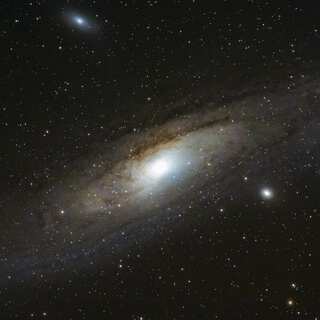
Babcock reported the rotation curve for the Andromeda Nebula,
Known now as the Andromeda Galaxy,
Which suggested the mass-to-luminosity ratio increases radially.
He attributed it to either light absorption within the galaxy,
Or modified dynamics in the outer portions of the spiral,
And not to the missing matter he had uncovered.
Following Babcock's 1939 report of unexpectedly rapid rotation in the outskirts of the Andromeda Galaxy,
And a mass-to-light ratio of 50,
In 1940,
Jan Oort discovered and wrote about the large,
Non-visible halo of NGC 3115.
1960s Early radio astronomy observations performed by Seth Shostak,
Later SETI Institute Senior Astronomer,
Showed a half-dozen galaxies spun too fast in their outer regions,
Pointing to the existence of dark matter as a means of creating the gravitational pull needed to keep the stars in their orbits.
1970s Vera Rubin,
Ken Ford,
And Ken Freeman's work in the 1960s and 1970s provided further strong evidence,
Also using galaxy rotation curves.
Rubin and Ford worked with a new spectrograph to measure the velocity curve of edge-on spiral galaxies with greater accuracy.
This result was confirmed in 1978.
An influential paper presented Rubin and Ford's results in 1980.
They showed most galaxies must contain about six times as much dark as visible mass.
Thus,
By around 1980,
The apparent need for dark matter was widely recognized as a major unsolved problem in astronomy.
At the same time,
Rubin and Ford were exploring optical rotation curves.
Radio astronomers were making use of new radio telescopes to map the 21-centimeter line of atomic hydrogen in nearby galaxies.
The radial distribution of interstellar atomic hydrogen often extends to the much greater galactic distances and can be observed as collective starlight,
Expanding the sampled distances for rotation curves and thus of the total mass distribution to a new dynamical regime.
Early mapping of Andromeda with the 300-foot telescope at Green Bank and the 250-foot dish at Jaw Drill Bank already showed the hydrogen rotation curve did not trace the expected Keplerian decline.
As more sensitive receivers became available,
Roberts and Whitehurst,
1975,
Were able to trace the rotational velocity of Andromeda to 30 kiloparsecs,
Much beyond the optical line.
They were able to do this by using optical measurements,
Illustrating the advantage of tracing the gas disk at large radii.
The paper's Figure 16 combines the optical data,
The clusters of points at radii of less than 15 kiloparsecs with a single point further out,
With the hydrogen data between 20 and 30 kiloparsecs,
Exhibiting the flatness of the outer galaxy rotation curve.
The curve peaking at the center is the optical surface density,
While the other curve shows the cumulative mass,
Still rising linearly at the outermost measurement.
In parallel,
The use of interferometric arrays for extragalactic hydrogen spectroscopy was being deployed.
Rogstad and Szostak,
1972,
Published hydrogen rotation curves of five spirals mapped with the Owens Valley Interferometer.
The rotation curves of all five were very flat,
Suggesting very large values of mass-to-light ratio in the outer parts of their extended hydrogen disks.
1980s A stream of observations in the 1980s supported the presence of dark matter,
Including gravitational lensing of background objects by galaxy clusters,
The temperature distribution of hot gas and galaxies in clusters,
And the pattern of anisotropies in the cosmic microwave background.
According to consensus among cosmologists,
Dark matter is composed primarily of a not-yet-characterized type of subatomic particle.
The search for this particle,
By a variety of means,
Is one of the major efforts in particle physics.
In standard cosmological calculations,
Matter means any constituent of the universe whose energy density scales with the inverse cube of the scale factor,
I.
E.
,
Rho is proportional to a to the negative three.
This is in contrast to radiation,
Which scales as the inverse fourth power of the scale factor rho is proportional to a to the negative four.
And a cosmological constant,
Which does not change the respect to a,
Rho is proportional to a to zero.
The different scaling factors for matter and radiation are a consequence of radiation redshift.
For example,
After gradually doubling the diameter of the observable universe via cosmic expansion of general relativity,
The scale a has doubled.
The energy of the cosmic microwave background radiation has been halved because the wavelength of each photon has doubled.
The energy of ultra-relativistic particles,
Such as early-era standard model neutrinos,
Is similarly halved.
The cosmological constant,
As an intrinsic property of space,
Has a constant energy density regardless of the volume under consideration.
In principle,
Dark matter means all components of the universe which are not visible,
But still obey rho is proportional to a to the negative three.
In practice,
The term dark matter is often used to mean only the non-baryonic component of dark matter,
I.
E.
Excluding missing baryons.
Context will usually indicate which meaning is intended.
The arms of spiral galaxies rotate around the galactic center.
The luminous mass density of a spiral galaxy decreases as one goes from the center to the outskirts.
If luminous mass were all the matter,
Then we can model the galaxy as a point mass in the center and test masses orbiting around it,
Similar to the solar system.
From Kepler's third law,
It is expected that the rotation velocities will decrease with distance from the center,
Similar to the solar system.
This is not observed.
Instead,
The galaxy rotation curve remains flat as distance from the center increases.
If Kepler's laws are correct,
Then the obvious way to resolve this discrepancy is to conclude the mass distribution in spiral galaxies is not similar to that of the solar system.
In particular,
There is a lot of non-luminous matter,
Dark matter,
In the outskirts of the galaxy.
Stars and bound systems must obey the virial theorem.
The theorem,
Together with the measured velocity distribution,
Can be used to measure the mass distribution in a bound system,
Such as elliptical galaxies or globular clusters.
With some exceptions,
Velocity dispersion estimates of elliptical galaxies do not match the predicted velocity dispersion from the observed mass distribution,
Even assuming complicated distributions of stellar orbits.
As with galaxy rotation curves,
The obvious way to resolve the discrepancy is to postulate the existence of non-luminous matter.
Galaxy clusters are particularly important for dark matter studies since their masses can be estimated in three independent ways.
From the scatter and radial velocities of the galaxies within clusters,
From X-rays emitted by hot gas in the clusters,
From the X-ray energy spectrum and flux,
The gas temperature and density can be estimated,
Hence giving the pressure,
Assuming pressure and gravity balance determines the cluster's mass profile.
Gravitational lensing,
Usually of more distant galaxies,
Can measure cluster masses without relying on observations of dynamics,
E.
G.
Velocity.
Generally,
These three methods are in reasonable agreement that dark matter outweighs visible matter by approximately 5 to 1.
One of the consequences of general relativity is the gravitational lens.
Gravitational lensing occurs when massive objects between a source of light and the observer act as a lens to bend light from the source.
One example is a cluster of galaxies lying between a more distant source,
Such as a quasar,
And an observer.
The more massive an object,
The more lensing is observed.
Strong lensing is the observed distortion of background galaxies into arcs when their light passes through such a gravitational lens.
It has been observed around many distant clusters,
Including Abel 1689.
By measuring the distortion geometry,
The mass of the intervening cluster can be obtained.
In the dozens of cases where this has been done,
The mass-to-light ratios obtained correspond to the mass-to-light distortion.
The mass-to-light ratios obtained correspond to the dynamical dark matter measurements of clusters.
Lensing can lead to multiple copies of an image.
By analyzing the distribution of multiple image copies,
Scientists have been able to deduce and map the distribution of dark matter around the MACS J0416.
1-2403 galaxy cluster.
Weak gravitational lensing investigates minute distortions of galaxies using statistical analyses from vast galaxy surveys.
By examining the apparent sheer deformation of the adjacent background galaxies,
The mean distribution of dark matter can be characterized.
The mass-to-light ratios correspond to dark matter densities predicted by other large-scale structure measurements.
Dark matter does not bend light itself.
Mass,
In this case the mass of the dark matter,
Bends spacetime.
Light follows the curvature of spacetime,
Resulting in the lensing effect.
In May 2021,
A new detailed dark matter map was revealed by the Dark Energy Survey collaboration.
In addition,
The map revealed previously undiscovered filamentary structures connecting galaxies.
By using a machine learning method.
In April 2023,
Study in Nature Astronomy examined the inferred distribution of the dark matter responsible for the lensing of the elliptical galaxy HS0810 plus 2554 and found tentative evidence of interference patterns within the dark matter.
The observation of the interference patterns is incompatible with the WIMPS,
But would be compatible with simulations involving 10 to the negative 22 electron volt axions.
While acknowledging the need to corroborate the findings by examining other astrophysical lenses,
The authors argued that the ability of axion-based dark matter to resolve lensing anomalies,
Even in demanding cases such as HS081 plus 2554,
Together with its success in reproducing other astrophysical observations,
Tilt the balance toward new physics-invoking axions.
Although both dark matter and ordinary matter are matter,
They do not behave in the same way.
In particular,
In the early universe,
Ordinary matter was ionized and interacted strongly with radiation via Thomson scattering.
Dark matter does not interact directly with radiation,
But it does affect the cosmic microwave background,
CMB,
By its gravitational potential,
Mainly on large scales,
And by its effects on the density and velocity of ordinary matter.
Ordinary and dark matter perturbations,
Therefore,
Evolve differently with time and leave different imprints on the CMB.
The cosmic microwave background is very close to a perfect black body,
But contains very small temperature anisotropies of a few parts in 100,
000.
A sky map of anisotropies can be decomposed into an angular power spectrum,
Which is observed to contain a series of acoustic peaks at near equal spacing,
But different heights.
A series of peaks can be predicted for any assumed set of cosmological patterns by modern computer codes,
Such as CMB-FAST and CAMB.
Hand-matching theory to data,
Therefore,
Constrains cosmological parameters.
The first peak mostly shows the density of baryonic matter,
While the third peak relates mostly to the density of dark matter,
Measuring the density of matter and the density of atoms.
The CMB anisotropy was first discovered by COBE in 1992,
Though this had too coarse resolution to detect the acoustic peaks.
After the discovery of the first acoustic peak by the balloon-borne boomerang experiment in 2000,
The power spectrum was precisely observed by WMAP in 2003 to 2012,
And even more precisely by the Planck spacecraft in 2013 to 2015.
The results support the Lambda-CDM model.
The observed CMB angular power spectrum provides powerful evidence in support of dark matter,
As its precise structure is well fitted by the Lambda-CDM model,
But difficult to reproduce with any competing model,
Such as Modified Newtonian Dynamics,
MOND.
Structure formation refers to the period after the Big Bang when density perturbations collapse to form stars,
Galaxies,
And clusters.
Prior to structure formation,
The Friedmann solutions to general relativity describe a homogenous universe.
Later,
Small anisotropies gradually grew and condensed the homogenous universe into stars,
Galaxies,
And larger structures.
Ordinary matter is affected by radiation,
Which is a dominant element of the universe at very early times.
As a result,
Its density perturbations are washed out and unable to condense into structure.
If there were only ordinary matter in the universe,
There would not have been enough time for density perturbations to grow into the galaxies and clusters currently seen.
Dark matter provides a solution to this problem because it is unaffected by radiation.
Therefore,
Its density perturbations can grow first.
The resulting gravitational potential acts as an attractive potential well for ordinary matter collapsing later,
Speeding up the structure formation process.
The bullet cluster,
The result of a recent collision of two galaxy clusters,
Provides model-independent observational evidence for dark matter.
Alternatives like modified gravity theories have a difficult time explaining this system because its apparent center of mass is far displaced from the baryonic center of mass.
Type Ia supernovae can be used as standard candles to measure extragalactic distances,
Which can in turn be used to measure how fast the universe has expanded in the past.
Data indicates the universe is expanding at an accelerating rate,
The cause of which is usually described as dark energy.
Since observations indicate the universe is almost flat,
It is expected the total energy density of everything in the universe should sum to one.
Baryon Acoustic Oscillations,
BAO,
Are fluctuations in the density of the visible baryonic matter,
Normal matter,
Of the universe on large scales.
These are predicted to arise in the Lambda-CDM model due to acoustic oscillations in the photon baryon fluid of the early universe,
And can be observed in the Cosmic Microwave Background angular power spectrum.
BAOs set up a preferred length scale for baryons.
As the dark matter and baryons clumped together after recombination,
The effect is much weaker in the galaxy distribution in the nearby universe.
But is detectable as a subtle preference for pairs of galaxies to be separated by 147 megaparsecs,
Compared to those separated by 130 to 160 megaparsecs.
This feature was predicted theoretically in the 1990s,
And then discovered in 2005 in two large galaxy redshift surveys,
The Sloan Digital Sky Survey and the 2DF Galaxy Redshift Survey.
Combining the CMB observations with BAO measurements from galaxy redshift surveys provides a precise estimate of the Hubble constant and the average matter density in the universe.
The results support the Lambda-CDM model.
Large galaxy redshift surveys may be used to make a three-dimensional map of the galaxy distribution.
These maps are slightly distorted because distances are estimated from a small distance.
The redshift contains a contribution from the galaxy's so-called peculiar velocity,
In addition to the dominant Hubble expansion term.
On average,
Superclusters are expanding more slowly than the cosmic mean due to their gravity,
While voids are expanding faster than average.
In a redshift map,
Galaxies in front of a supercluster have excess radial velocity towards it and have redshifts slightly higher than their distance would imply,
While galaxies behind the supercluster have redshifts slightly low for their distance.
This effect causes superclusters to appear squashed in the radial direction and likewise voids are stretched.
Their angular positions are unaffected.
This effect is not detectable for any one structure since the true shape is not known,
But can be measured by averaging over many structures.
It was predicted quantitatively by Nick Kaiser in 1987 and first decisively measured in 2001 by the 2DF Galaxy Redshift Survey.
Results are in agreement with the Lambda-CTM model.
In astronomical spectroscopy,
The Lyman-alpha forest is the sum of the absorption lines arising from the Lyman-alpha transition of neutral hydrogen and the spectra of distant galaxies and quasars.
Lyman-alpha forest observations can also constrain cosmological models.
These constraints agree with those obtained with WMAP data.
The exact identity of dark matter is unknown,
But there are many hypotheses about what dark matter could consist of.
Dark matter can refer to any substance which interacts predominantly via gravity with visible matter,
E.
G.
Stars and planets.
Hence,
In principle,
It need not be composed of a new type of fundamental particle,
But could,
At least in part,
Be made up of standard baryonic matter,
Such as protons or neutrons.
Most of the ordinary matter familiar to astronomers,
Including planets,
Brown dwarfs,
Red dwarfs,
Visible stars,
White dwarfs,
Neutron stars,
And black holes,
Fall into this category.
Solitary black holes,
Neutron stars,
Burned-out dwarfs,
And other massive objects that are hard to detect are collectively known as machos.
Some scientists initially hoped that baryonic machos could account for and explain all the dark matter.
However,
Multiple lines of evidence suggest the majority of dark matter is not baryonic.
Sufficient diffuse baryonic gas or dust would be visible when backlit by stars.
The theory of Big Bang nucleosynthesis predicts the observed abundance of the chemical elements.
If there are more baryons,
Then there should also be more helium,
Lithium,
And heavier elements synthesized during the Big Bang.
Agreement with observed abundances requires that baryonic matter makes up between 4 to 5% of the universe's critical density.
In contrast,
Large-scale structure and other observations indicate that the total matter density is about 30% of the critical density.
Astronomical searches for gravitational microlensing in the Milky Way found at most only a small fraction of the dark matter may be in dark,
Compact,
Conventional objects,
Machos,
Etc.
The excluded range of object masses is from half the Earth's mass up to 30 solar masses,
Which covers nearly all the plausible candidates.
Detailed analysis of the small irregularities and isotropies in cosmic microwave background.
Observations by WMAP and Planck indicate that around 5-6% of the total matter is in a form that interacts significantly with ordinary matter,
Or photons,
Only through gravitational effects.
There are two main candidates for non-baryonic dark matter.
Hypothetical particles such as axions,
Sterile neutrinos,
Weakly interacting massive particles,
WIMPs,
Supersymmetric particles,
Atomic dark matter,
Or geons,
And primordial black holes.
Once a black hole ingests either kind of matter,
Baryonic or not,
The distinction is lost.
Unlike baryonic matter,
Non-baryonic particles do not contribute to the formation of the elements in the early universe.
Big bang nucleosynthesis.
And so its presence is revealed only via its gravitational effects,
Or weak lensing.
In addition,
If the particles of which is composed are supersymmetric,
They can undergo annihilation interactions with themselves,
Possibly resulting in observable byproducts such as gamma rays and neutrinos in direct detection.
In 2015,
The idea that dense dark matter was composed of primordial black holes made a comeback following results of gravitational wave measurements,
Which detected the merger of intermediate mass black holes.
Black holes with about 30 solar masses are not predicted to form by either stellar collapse,
Typically less than 15 solar masses,
Or by the merger of black holes in galactic centers,
Millions or billions of solar masses.
It was proposed that the intermediate mass black holes caused the detected merger formed in the hot dense early phase of the universe due to denser regions collapsing.
A later survey of about a thousand supernovae detected no gravitational lensing events,
When about eight would be expected if intermediate mass primordial black holes above a certain mass range accounted for over 60% of dark matter.
However,
The study assumed a monochromatic distribution to represent the LIGO-VIRGO mass range,
Which is inapplicable to the broadly platycurtic mass distribution suggested by subsequent James Webb Space Telescope observations.