Welcome to the I Can't Sleep Podcast,
Where I read random articles from across the web to bore you to sleep with my soothing voice.
I'm your host,
Benjamin Boster.
Today's episode is from a Wikipedia article titled,
Aurora.
An aurora,
Plural aurorae or auroras,
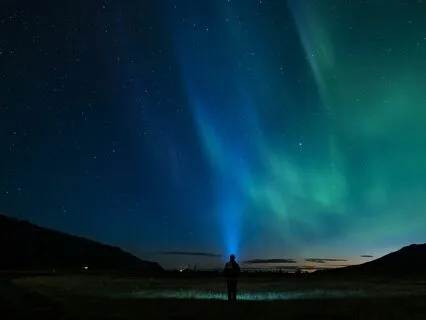
Also commonly known as the Northern Lights,
Aurora borealis,
Or Southern Lights,
Aurora australis,
Is a natural light display in Earth's sky predominantly seen in high-latitude regions.
Auroras display dynamic patterns of brilliant lights that appear as curtains,
Rays,
Spirals,
Or dynamic flickers covering the entire sky.
Auroras are the result of disturbances in the Earth's magnetosphere caused by the solar wind.
Major disturbances result from enhancements in the speed of the solar wind from coronal holes and coronal mass ejections.
These disturbances alter the trajectories of charged particles in a magnetospheric plasma.
These particles,
Mainly electrons and protons,
Precipitate into the upper atmosphere.
The resulting ionization and excitation of atmospheric constituents emit light of varying color and complexity.
The form of the aurora occurring within bands around both polar regions is also dependent on the amount of acceleration imparted to the precipitating particles.
Most of the planets in the solar system,
Some natural satellites,
Brown dwarfs,
And even comets also host auroras.
The term aurora borealis was coined by Galileo in 1619 from the Roman aurora,
Goddess of the dawn,
And the Greek boreas,
God of the cold north wind.
The word aurora is derived from the name of the Roman goddess of the dawn aurora who traveled from east to west,
Announcing the coming of the sun.
Ancient Greek poets used the corresponding name eos metamorphically to refer to dawn,
Often mentioning its play of color across the otherwise dark sky,
E.
G.
Rosy-fingered dawn.
E.
G.
Rosy-fingered dawn.
The word borealis and australis are derived from the names of the ancient gods of the north wind,
Boreas,
And the south wind,
Austere,
In Greco-Roman mythology.
Many auroras occur in a band known as the auroral zone,
Which is typically three degrees to six degrees wide in latitude,
And between ten degrees and twenty degrees from the geomagnetic poles at all local times,
Most clearly seen at night against a dark sky.
A region that currently displays an aurora is called the aurora oval,
A band displaced by the solar wind towards the night side of earth.
Auroras at the north pole itself are rare due to it being on the arctic ocean,
While auroras of the south pole itself are very common and guaranteed to be visible.
Early evidence for a geomagnetic connection comes from the statistics of auroral observations.
Elias Loomis,
And later Hermann Fritz and Sophus Trumhold,
In more detail,
Established that the aurora appeared mainly in the auroral zone.
In northern latitudes,
The effect is known as the aurora borealis,
Or the northern lights.
The southern counterpart,
The aurora australis,
Or the southern lights,
Has features almost identical to the aurora borealis,
And changes simultaneously with changes in the northern auroral zone.
The aurora australis is visible from high southern latitudes in Antarctica,
The aurora borealis is visible from high southern latitudes in Antarctica,
The southern cone,
South Africa,
Australasia,
And under exceptional circumstances as far north as Uruguay.
The aurora borealis is visible from areas around the arctic,
Such as Alaska,
Canada,
Iceland,
Greenland,
The Faroe Islands,
Scandinavia,
Scotland,
And Russia.
On rare occasions,
The aurora borealis can be seen as far south as the Mediterranean and the southern states of the U.
S.
During the Carrington event,
The greatest geomagnetic storm ever observed,
Auroras were seen even in the tropics.
A geomagnetic storm causes the auroral ovals north and south to expand,
Bringing the aurora to lower latitudes.
The instantaneous distribution of auroras is slightly different,
Being centered about 3 to 5 degrees nightward of the magnetic pole,
So that aurora arcs reach furthest toward the equator when the magnetic pole in question is in between the observer and the sun.
The aurora can be seen best at this time which is called magnetic midnight.
Auroras seen within the aurora oval may be directly overhead.
From farther away,
They illuminate the poleward horizon as a greenish glow,
Or sometimes a faint red,
As if the sun were rising from an unusual direction.
Auroras also occur poleward of the auroral zone as either the sun is in the middle of the horizon,
Or the sun is in the middle of the horizon.
Auroras also occur poleward of the auroral zone as either diffused patches or arcs,
Which can be subvisual.
Auroras are occasionally seen in latitudes below the auroral zone,
When a geomagnetic storm temporarily enlarges the auroral oval.
Large geomagnetic storms are most common during the peak of the 11-year sunspot cycle,
Or during the three years at the peak.
An electron spirals about a field line at an angle that is determined by its velocity vectors,
Parallel and perpendicular,
Respectively,
To the local geomagnetic field vector b.
This angle is known as the pitch angle of the particle.
The distance or radius of the electron from the field line at any time is known as its Larmor radius.
The pitch angle increases as the electron travels to a region of greater field strength nearer to the atmosphere.
Thus,
It is possible for some particles to return,
Or mirror,
If the angle becomes 90 degrees before entering the atmosphere,
To collide with the denser molecules there.
Other particles that do not mirror enter the atmosphere and contribute to the auroral display.
Over a range of altitudes.
Other types of auroras have been observed from space.
For example,
Poleward arcs stretching sunward across the polar cap,
The related theta aurora,
And dayside arcs near noon.
These are relatively infrequent and poorly understood.
Other interesting effects occur,
Such as pulsating aurora,
Black aurora,
And their rarer companion,
Anti-black aurora,
And subvisual red arcs.
In addition to all these,
A weak glow,
Often deep red,
Observed around the two polar cusps,
A field line separating the ones that close through Earth from those that are swept into the tail,
And close remotely.
Early work on the imaging of the auroras was done in 1949 by the University of Saskatchewan,
Using the SCR-270 radar.
The altitudes where auroral emissions occur were revealed by Carl Sturmer and his colleagues,
Who used cameras to triangulate more than 12,
000 auroras.
They discovered that most of the light is produced between 90 and 150 kilometers above the ground,
While extending at times to more than 1,
000 kilometers.
According to Clark,
There are five main forms that can be seen from the ground,
From least to most visible.
A mild glow near the horizon.
These can be close to the limit of visibility,
But can be distinguished from moonlit clouds because stars can be seen undiminished with the glow.
Patches or surfaces that look like clouds.
Arcs curve across the sky.
Rays are light and dark stripes across arcs,
Reaching upwards by various amounts.
Coronas cover much of the sky,
And diverge from one point on it.
Braque also describes some auroras as curtains.
The similarity to curtains is often enhanced by folds within the arcs.
Arcs can fragment or break up into separate,
At times rapidly changing,
Often rayed features that may fill the whole sky.
These are also known as discrete auroras,
Which are at times bright enough to read a newspaper by at night.
These forms are consistent with auroras being shaped by Earth's magnetic field.
The appearance of arcs,
Rays,
Curtains,
And coronas are determined by the shapes of the luminous parts of the atmosphere and the viewer's position.
Colors and wavelengths of auroral light.
Red.
At its highest altitudes,
Excited atomic oxygen emits at 630 nanometers.
Low concentration of atoms and lower sensitivity of eyes at this wavelength make this color visible only under more intense solar activity.
A low number of oxygen atoms and their gradually diminishing concentration is responsible for the faint appearance of the top parts of the curtains.
Scarlet,
Crimson,
And carmine are the most often seen hues of red for the auroras.
Green.
At lower altitudes,
The more frequent collisions suppress the 630 nanometer red mode.
Rather,
The 557.
7 nanometer emission green dominates.
A fairly high concentration of atomic oxygen and higher sensitivity in green make green auroras the most common.
The excited molecular nitrogen,
Atomic nitrogen being rare due to the highest stability of the N2 molecule,
Plays a role here.
The excited molecular nitrogen plays a role here as it can transfer energy by collision to an oxygen atom,
Which then radiates it away at the green wavelength.
The rapid decrease of concentration of atomic oxygen below about 100 kilometers is responsible for the abrupt looking end of the lower edges of the curtains.
Both the 557.
7 and the 630.
0 nanometer wavelengths correspond to forbidden transitions of atomic oxygen,
A slow mechanism responsible for the graduality of flaring and fading.
Blue.
At yet lower altitudes,
Atomic oxygen is uncommon and molecular nitrogen and ionized molecular nitrogen take over in producing visible light emission,
Radiating at a large number of wavelengths in both red and blue parts of the spectrum,
With 428 nanometers being dominant.
Blue and purple emissions typically at the lower edges of the curtains show up at the highest levels of solar activity.
The molecular nitrogen transitions are much faster than the atomic oxygen ones.
Ultraviolet.
Ultraviolet radiation from auroras has been observed with the requisite equipment.
Ultraviolet auroras have also been seen on Mars,
Jupiter,
And Saturn.
Infrared.
Infrared radiation in wavelengths that are within the optical window is also part of many auroras.
Yellow and pink are a mix of red and green or blue.
Other shades of red as well as orange and gold may be seen on rare occasions.
Yellow-green is moderately common.
As red,
Green,
And blue are linearly independent colors,
Additive synthesis could in theory produce most human perceived colors,
But the ones mentioned in this article comprise a virtually exhaustive list.
Auroras change with time.
Over the night,
They begin with glows and progress toward coronas,
Although they may not reach them.
They tend to fade in the opposite order.
Until about 1963,
It was thought that these changes are due to the rotation of the earth under a pattern fixed with respect to the sun.
Later,
It was found by comparing all sky films of auroras from different places that they often undergo global changes in a process called auroral substorm.
They change in a few minutes from quiet arcs all along the auroral oval to active displays along the dark side,
And after one to three hours they gradually change back.
Changes in auroras over time are commonly visualized using keograms.
At shorter time scales,
Auroras can change their appearances in intensity,
Sometimes so slowly as to be difficult to notice,
And at other times rapidly down to the sub-second scale.
The phenomenon of pulsating auroras is an example of intensity variations over short time scales,
Typically with periods of two to twenty seconds.
This type of aurora is generally accomplished by decreasing peak emission heights of about eight kilometers for blue and green emissions and above average solar wind speeds.
In addition,
The aurora and associated currents produce a strong radio emission around 150 kilohertz known as auroral kilometric radiation,
AKR,
Discovered in 1972.
Ionospheric absorption makes AKR only observable from space.
X-ray emissions originating from the particles associated with auroras have also been detected.
Aurora noise,
Similar to a crackling noise,
Begins about 70 meters above earth's surface and is caused by charged particles in an inversion layer of the atmosphere formed during a cold night.
The charged particles discharge when particles from the sun hit the inversion layer,
Creating the noise.
In 2016,
More than 50 citizen science observations described what was to them an unknown type of aurora,
Which they named Steve,
For strong thermal emission velocity enhancement.
Steve is not an aurora,
But is caused by a 25 kilometer wide ribbon of hot plasma at an altitude of 450 kilometers,
With a temperature of 3,
000 degrees celsius and flowing at a speed of six kilometers per second.
The processes that cause Steve are also associated with a picket fence aurora,
Although the latter can be seen without Steve.
It is an aurora because it is caused by a precipitation of electrons in the atmosphere,
But it appears outside the aurora oval,
Closer to the equator than typical auroras.
First reported in 2020 and confirmed in 2021,
The dune aurora phenomenon was discovered by Finnish citizen scientists.
It consists of regularly spaced parallel stripes of brighter emission and the green diffuse aurora,
Which give the impression of sand dunes.
The phenomenon is believed to be caused by the modulation of atomic oxygen density by a large-scale atmospheric wave traveling horizontally in a waveguide through an inversion layer in the mesosphere in presence of electron precipitation.
Horse-collar auroras,
HCA,
Are auroral features in which the auroral ellipse shifts poleward during the dawn and dusk portions,
And the polar cap becomes teardrop-shaped.
They form during periods when the interplanetary magnetic field,
IMF,
Is permanently northward.
When the IMF clock angle is small,
Their formation is associated with the closure of the magnetic flux at the top of the dayside magnetosphere by the double lobe reconnection,
DLR.
There are approximately eight HCA events per month with no seasonal dependence,
And that the IMF must be within 30 degrees of northwards.
Conjugate auroras are nearly exactly mirror-image auroras found on conjugate points in the northern and southern hemispheres on the same geomagnetic field lines.
These generally happen at the time of the equinoxes,
When there is little difference in the orientation of the north and south geomagnetic poles to the sun.
Attempts were made to image conjugate auroras by aircraft from Alaska and New Zealand in 1967,
68,
70,
And 71,
With some success.
A full understanding of the physical processes which lead to different types of auroras is still incomplete,
But the basic cause involves the interplay of the auroras.
A varying intensity of the solar wind produces effects of different magnitudes,
But includes one or more of the following physical scenarios.
1.
A quiescent solar wind flowing past Earth's magnetosphere steadily interacts with it,
And can both inject solar wind particles into the magnetic field,
And can also cause particles already trapped in the radiation belts to precipitate into the atmosphere.
2.
A quiescent solar wind flowing past Earth's magnetosphere steadily interacts with it,
And can both inject solar wind particles directly onto the geomagnetic field lines that are open as opposed to being closed in the opposite hemisphere,
3.
Once particles are lost to the atmosphere from the radiation belts under quiet conditions,
New ones replace them only slowly,
And the lost cone becomes depleted.
In the magnetotail,
However,
Particle trajectories seem constantly to reshuffle,
Probably when the particles cross the very weak magnetic field near the equator.
As a result,
The flow of electrons in that region is nearly the same in all directions,
Isotropic,
And assures a steady supply of leaking electrons.
The leaking of electrons does not leave the tail positively charged,
Because each leaked electron lost to the atmosphere is replaced by a low-energy electron drawn upward from the ionosphere.
Such replacement of hot electrons by cold ones is in complete accord with the second law of thermodynamics.
The complete process which also generates an electric ring current around Earth is uncertain.
2.
Geomagnetic disturbance from an enhanced solar wind Geomagnetic disturbance from an enhanced solar wind causes distortions of the magnetotail,
Magnetic substorms.
These substorms tend to occur after prolonged spells on the order of hours,
During which the interplanetary magnetic field has had an appreciable southward component.
This leads to a higher rate of interconnection between its field lines and those of Earth.
As a result,
The solar wind moves magnetic flux,
Tubes of magnetic field lines locked together with their resident plasma,
From the day side of Earth to the magnetotail,
Widening the obstacle it presents to the solar wind flow,
And constricting the tail on the night side.
Ultimately,
Some tail plasma can separate.
Some blobs are squeezed downstream and are carried away with the solar wind.
Others are squeezed toward Earth,
Where their motion feeds strong outbursts of auroras,
Mainly around midnight.
3.
A geomagnetic storm resulting from greater interaction adds more particles to the plasma trapped around Earth,
Also producing enhancement of the ring current.
Occasionally,
The resulting modification of Earth's magnetic field can be so strong that it produces auroras visible at middle latitudes,
On field lines much closer to the equator than those of the auroral zone.
3.
Acceleration of auroral-charged particles invariably accompanies a magnetospheric disturbance that causes an aurora.
This mechanism,
Which is believed to predominantly arise from strong electric fields along the magnetic field or wave-particle interactions,
Raises the velocity of a particle in the direction of the guiding magnetic field.
The pitch angle is thereby decreased and increases the chance of it being precipitated into the atmosphere.
Both electromagnetic and electrostatic waves produced at the time of greater geomagnetic disturbances make a significant contribution to the energizing processes that sustain an aurora.
4.
Particle acceleration provides a complex intermediate process for transferring energy from the solar wind indirectly into the atmosphere.
The details of these phenomena are not fully understood.
However,
It is clear that the prime source of auroral particles is the solar wind feeding the magnetosphere,
The reservoir containing the radiation zones,
And temporarily magnetically trapped particles confined by the magnetic field,
Coupled with particle acceleration processes.
The immediate cause of the ionization and excitation of atmospheric constituents leading to auroral emissions was discovered in 1960,
When a pioneering rocket flied from Fort Churchill in Canada revealed a flux of electrons entering the atmosphere from above.
Since then,
An extensive collection of measurements has been acquired painstakingly and with steadily improving resolution since the 1960s by many research teams using rockets and satellites to traverse the auroral zone.
5.
The main findings have been that auroral arcs and other bright forms are due to electrons that have been accelerated during the final few 10,
000 kilometers or so of their plunge into the atmosphere.
These electrons often,
But not always,
Exhibit a peak in their energy distribution and are preferentially aligned along the local direction of the magnetic field.
Electrons mainly responsible for diffuse and pulsating auroras have,
In contrast,
A smoothly falling energy distribution and an angular distribution favoring directions perpendicular to the local magnetic field.
Pulsations were discovered to originate at or close to the equatorial crossing point of auroral zone magnetic field lines.
Protons are also associated with auroras,
Both discreet and diffuse.
Auroras result from emissions of photons in Earth's upper atmosphere above 80 kilometers,
From ionized nitrogen atoms regaining an electron,
And oxygen atoms regaining an electron.
Ionized nitrogen atoms regaining an electron and oxygen atoms and nitrogen-based molecules returning from an excited state to ground state.
They are ionized or excited by the collision of particles precipitated into the atmosphere.
Both incoming electrons and protons may be involved.
Exhortation energy is lost within the atmosphere by the emission of a photon or by collision with another atom or molecule.
Oxygen emissions,
Green or orange-red,
Depending on the amount of energy absorbed.
Nitrogen emissions,
Blue,
Purple,
Or red.
Blue and purple if a molecule regains an electron after it has been ionized.
Red if returning to ground state from an excited state.
Oxygen is unusual in terms of its return to ground state.
It can take 0.
7 seconds to emit the 557.
7 nanometer green light and up to two minutes for the red 630 nanometer emission.
Collisions with other atoms or molecules absorb the excitation energy and prevent emission.
This process is called collision quenching.
Because the highest parts of the atmosphere contain a higher percentage of oxygen and lower particle densities,
Such collisions are rare enough to allow time for oxygen to emit red light.
Collisions become more frequent,
Progressing down into the atmosphere due to increasing density so that red emissions do not have time to happen and eventually even green light emissions are prevented.
This is why there is a color differential with altitude.
At high altitudes,
Oxygen red dominates,
Then oxygen green,
And nitrogen blue,
Purple,
Red,
Then finally nitrogen blue,
Purple,
Red when collisions prevent oxygen from emitting anything.
Green is the most common color.
Then comes pink,
A mixture of light green and red,
Followed by pure red,
Then yellow,
A mixture of red and green,
And finally pure blue.
Precipitating protons generally produce optical emissions as incident hydrogen atoms after gaining electrons from the atmosphere.
Proton auroras are usually observed at lower latitudes.
Bright auroras are generally associated with Birkeland currents,
Zmuda and Armstrong,
Which flow down into the ionosphere on one side of the pole and out on the other.
In between,
Some of the current connects directly through the ionosphere e-layer.
The rest detours,
Leaving again through field lines closer to the equator and closing through the partial ring current carried by magnetically trapped plasma.
The ionosphere is an ohmic conductor,
So some consider that such currents require a driving voltage,
Which an as yet unspecified dynamo mechanism can supply.
Electric field probes in orbit above the polar cab suggest voltages of the order of 40,
000 volts,
Rising up to more than 200,
000 volts during intense magnetic storms.
In another interpretation,
The currents are the direct result of electron acceleration into the atmosphere by wave-particle interactions.
Ionospheric resistance has a complex nature and leads to a secondary Hall current flow.
By a strange twist of physics,
The magnetic disturbance on the ground due to the main current almost cancels out,
So most of the observed effect of auroras is due to a secondary current,
The auroral electrojet.
An auroral electrojet index is regularly derived from ground data and serves as a general measure of auroral activity.
Christiane Birkeland deduced that the currents flowed in the east-west directions along the auroral arc,
And such currents flowing from the day side toward midnight were later named auroral electrojets.
Ionosphere can contribute to the formation of auroral arcs via the feedback instability under high ionospheric resistance conditions observed at night time and in dark winter atmosphere.