Thanks!
Hi there,
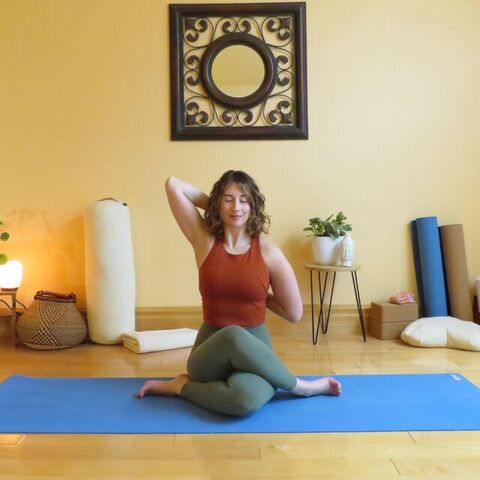
This is Jessica Gray from Belle Éclarege Hatha Yoga and I'm so glad you've chosen to listen in.
I'm truly grateful to be sharing with you information about the beautiful practice of Hatha Yoga that I hold close to my heart.
This talk serves as a starting point to introduce you to the practice and hopefully it sparks your curiosity to learn more.
But before we dive into defining what is Hatha Yoga,
I'd like to acknowledge all the teachers,
Sages,
And yogis that have come before us that have passed down their teachings for more than 5,
000 years and have recorded the ancient practices in sacred texts,
Making them accessible to us today.
To begin,
It's worth mentioning that sometimes in the Western world,
Yoga is reduced or equated to placing the body into different positions.
Often in modern fitness contexts,
When we think about yoga,
What comes to mind are the postures or in Sanskrit,
The asanas.
The asanas can inspire exercise and can be practiced independently of the spiritual and philosophical components of yoga.
But if the asanas are not performed with the same purpose and intention as the ancient scriptures,
Then when we say we are going to yoga class,
This isn't entirely accurate.
And even so,
Yoga is much more than asana practice.
Traditionally,
The practice of yoga was conceived to address questions related to self-realization.
Media scriptures describe the philosophy behind the practice as aimed at understanding the self,
Our identity,
And our existence,
Questioning who am I,
And finding peace and comfort with who we are and our place in the world.
When we consider these aspects,
A truer definition of yoga can be perceived as the process of self-inquiry or self-discovery.
And the scriptures indicate to achieve a state where self-realization is possible,
There are different paths that we can take to help us reach that goal.
And raja yoga is the path of control.
And to realize the self following this path is to bring the breath,
The body,
And the mind under control.
Hatha yoga is a component of this path.
So with that said,
And an introduction to yoga as a whole,
Let's look deeper into what is Hatha yoga.
So as I mentioned before,
Hatha yoga is a component of the raja yoga path that aims to bring the breath,
The body,
And the mind under control.
So it is an integrated and embodied form of spirituality.
And classically Hatha yoga uses asanas,
Known as postures,
Pranayama,
Known as breathing techniques,
Mudras or gestures,
Bandhas,
Internal locks,
And shatkriyas,
Purification techniques.
The practice integrates each of these with the aim to change or alter the physical,
Psychological,
And energetic state of the body and the mind.
And the focus is on the human body and the methods used to prepare the body to create conditions that allow for a shift in consciousness.
And it's really hard to define when this tradition began,
As various techniques belonging to Hatha yoga existed before the practice was defined in writing within the Sanskrit texts.
The first text to define and discuss all the practices was the Hatha yoga pradipika,
Written in the 15th century AD.
So now let's take a look more closely at the main physical practice of Hatha yoga,
Asana,
And pranayama.
Both practices were designed to promote holistic health by bringing the physical,
Mental,
And energetic body into balance.
And to better understand this concept and to make it relatable to what takes place while we practice on the mat,
Let's look at the etymology of Hatha yoga.
Hatha is a Sanskrit word that is often translated as force.
Hatha could be called or understood as the yoga of force based on this translation.
Sometimes the meaning of the word Hatha is broken down a bit further,
Where a subtler perception of the word Hatha could be ha meaning sun and the syllable ta meaning moon.
The Sanskrit term yoga is often understood as being derived from the verb to yoke together.
So based on this interpretation of these words,
Hatha and yoga,
The practice of Hatha yoga can be defined as the practice of uniting these two opposing forces,
The moon and the sun,
The solar force and the lunar force.
These forces that move along the energy channels of the body,
The ita and the pingala channels.
So the solar force and the lunar force,
Or energies,
Are embodied by the breath.
The solar force is the exhalation,
Is active,
Giving and embodies our inner strength.
And the lunar force is the inhalation,
It's passive,
Surrendering and embodies our receptivity.
Asana practice and pranayama practice helps us to become aware and to control these subtle aspects of our being.
When we control the breath,
We can influence our body,
Our mind and our emotions,
Bring our inner systems into alignment.
With the breath,
We balance the receptive and giving aspects of our being,
Altering our state of consciousness,
And with our inhalation,
We calm the mind,
With our exhalation,
We relax the body.
So the breath is at the forefront of our asana practice in Hatha yoga for this reason.
The breath comes first and serves as our guide.
And in asana practice,
As we control the breath,
We find symmetry between the in-breath and the out-breath,
And between the body movement of stretching the left and the right sides of our body.
So really focusing on these opposites and bringing them into harmony and to balance.
And practicing Hatha yoga essentially is to find balance in life by uniting the opposites into one.
It's about moderation and sustainability,
It's about avoiding the extremes,
Living within a comfortable centered position in life where we are not affected by the polarity within us or by the polarity that surrounds us as part of the dual nature of our world.
It's about becoming aware of the breath and Hatha yoga in this way is available to everyone no matter the condition of their body.
So it's really not about being flexible,
Being able to get into the most difficult poses.
Anyone can return to the breath at any moment in their life to feel a sense of balance,
To bring the body and the mind into harmony.
With awareness of the breath,
We can live at ease within the given reality.
We can live at ease within the present moment.
So I hope that although this talk was brief and although it certainly didn't cover all aspects of Hatha yoga,
That it has given you some insights into how we practice Hatha yoga on the mat and some insights into the history and philosophy of yoga and how it is a practice that involves much more than just our physical practice of Asana and Prayam.
I'd like to thank you so much for listening once again and I wish you all the best on the rest of your day.
Take good care.